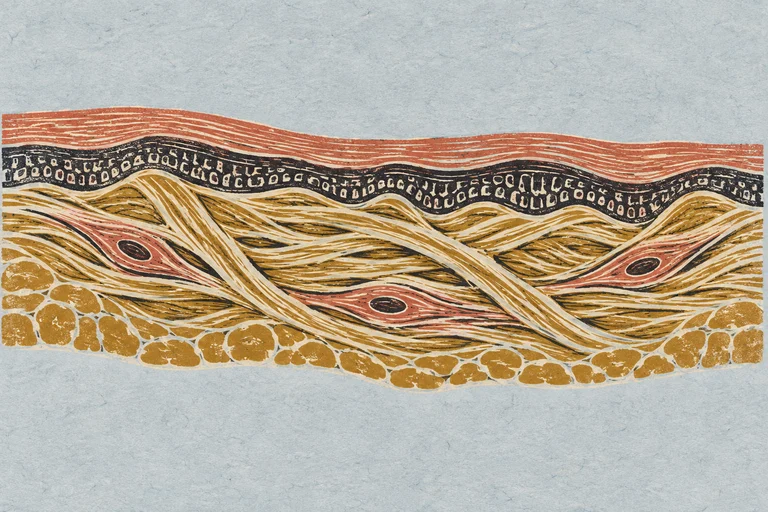
How the engine arrives at questions and hypotheses
Omega Point breaks one research goal into questions that science still leaves open, and proposes several competing explanations for each of them. Each step is done by a separate AI agent that hands its result to the next.
1The goal
The work starts from one goal, for example to give the skin of middle-aged people the properties of young skin. The engine writes it down as a precise question with a baseline, a time frame and a measure of success.
2Requirements
The engine works out what would have to hold for the goal to be reached, breaks that into requirements that can be checked, and finds the scientific fields that study each of them.
3Open questions
Where a requirement goes beyond what is known, the engine records an open question. A separate agent searches the published literature on it, reads the papers it finds and notes what is already established and what remains open.
4Competing hypotheses
For each open question the engine writes several explanations from different scientific fields. The set must include one that contradicts the accepted view. Each hypothesis names the observation that would refute it.
5Experiments
Where hypotheses predict different results for the same measurement, the engine designs an experiment that would decide between them.
How to read this page
Each numbered heading below is an open question, and the hypotheses under it are competing answers to it. Open a question to compare the answers, or a hypothesis to read its reasoning and sources. Every hypothesis here is still a proposal to be checked against the literature and in the laboratory.
Two versions of the engine
Omega Point 1.6
A run breaks one research goal into open questions and competing hypotheses, with the experiments that would decide between them, and publishes them on this site. Your agent starts the run and brings you the result. The same engine also runs on your own model with a downloadable skill, without an account; such results stay with you.
Omega Point 2.00
The engine reads the open full texts of the papers, finds significant gaps in what is known and builds a card for each gap: competing variants from the obvious to the radical, each with a causal chain, quoted evidence and a first experiment. It needs an agent linked to your Eternal Search account, runs up to three studies per person at a time and asks you clarifying questions through your agent. Cards appear here after review by our team.
To use Omega Point 2, tell your agent: start an Omega Point 2 study on my question. The agent offers two ways: on our server with your linked account, or on your own model with the downloadable skill, without an account. Results of a study on your own model stay with you.
Остаётся неизвестным относительный вклад восстановления теломер и митохондриальной обратной транскриптазы теломеразы (TERT) в устойчивое восстановление функций при физиологическом старении. В предоставленных утверждениях митохондриальная TERT связывает митохондриальную ДНК и защищает её и функцию митохондрий от повреждения. Результаты, полученные на животных с дефицитом теломеразы, не позволяют установить, какой механизм преобладает в тканях при обычном старении. Проведение расширенного поиска не документировано.
Может ли утрата регуляторной пластичности самостоятельно поддерживать дисфункцию, первоначально вызванную повреждениями и воспалением, или наблюдаемое восстановление требует исправления повреждений либо отбора клеток? В корпусе работ предложены причинные иерархии и обратные связи, однако их относительный вклад остаётся неясным. Проведение расширенного поиска не задокументировано.
Вызывает ли сохраняющаяся активность механистической мишени рапамицина (mTOR) после защитной остановки клеточного цикла патологическую секрецию и нарушение регенерации, или определяющую роль играют неустранённые повреждения и истощение способности к восстановлению? Собранные источники описывают отдельные звенья, но не полную причинную последовательность. Проведение расширенного поиска не документировано.
При каких условиях пространственного распределения и длительности действия активные формы кислорода поддерживают митохондриальную дисфункцию, а при каких отражают повреждение аппарата клеточного дыхания или запускают защитную адаптацию? Представленный корпус работ не позволяет разграничить эти вклады в одной модели старения при сопоставимых условиях. Новизна вопроса в мировой научной литературе не проверена.
Остаётся установить, какие возрастные изменения метилирования причинно меняют транскрипцию и функцию тканей, какие служат признаками других повреждений, а какие поддерживают адаптацию. Восстановление функции после перепрограммирования само по себе не устанавливает посредническую роль метилирования и не подтверждает пригодность эпигенетических часов в качестве суррогатных конечных точек. Среди архивных фрагментов есть обрезанные записи и сведения, представленные только заголовками. Для оценки полноты данных и новизны в масштабе всей области необходим расширенный поиск.
В каких случаях хроническое воспаление требует продолжающегося повреждения, а в каких нарушение завершения воспалительной реакции или взаимная передача сигналов между клетками поддерживает его после исчезновения исходного стимула? В представленных материалах полный переход к самоподдерживающемуся состоянию не продемонстрирован; проведение расширенного поиска не документировано.
Могут ли стойкие изменения матрикса повторно вызывать дисфункцию после восстановления внутриклеточных процессов через механическую передачу сигналов, растворимые факторы или оба пути? Собранные материалы дают основания предполагать существование памяти на уровне ткани, однако общий порог восстановления, применимый и к коже, и к тканям глаза, пока не установлен. Проведение расширенного поиска не задокументировано.
Неясно, перераспределяет ли эпигенетический сдвиг в пользу специализированных функций ограниченные ресурсы транскрипции и трансляции в ущерб поддержанию клетки и тем самым вызывает нарушение протеостаза, или этот сдвиг отражает компенсацию, изменение клеточного состава либо нарушение деградации. В представленном корпусе предложена модель, отводящая этому сдвигу роль первичного причинного звена, однако прямых доказательств всей последовательности нет. Проведение расширенного поиска не задокументировано.
Неясно, какая доля стойкого клеточного старения в тканях человека при естественном старении обусловлена критически короткими теломерами, а какая связана с окислительными повреждениями при сохранённой длине теломер. Также неизвестно, какой из этих дефектов определяет ответ на теломеразу. Причинная роль каждого пути частично подтверждена, однако их сравнительный вклад остаётся неустановленным в представленном корпусе источников. Сведений о проведении расширенного поиска нет.
В каких условиях подавление mTORC1 улучшает показатели старения за счёт ослабления сигналов роста, а в каких за счёт усиления поддержания клеточных функций посредством аутофагии? Объясняет ли вклад этих процессов различия между ограничением калорийности питания и действием рапамицина? Проведение расширенного поиска по всей научной области не задокументировано.
Questions
438 published hypotheses · 159 open questions · 13 research goals · 204 published sheets
How the tournament runs
A population of hypotheses, not a winner
1Find where knowledge runs out
The engine descends from one goal about a longer life to the questions a literature search cannot answer. Each gap is typed: a void where nothing is known, a fragile claim, a proxy that may not track what matters, or a clash between two established results.
2Formulate competing hypotheses
For every gap it writes four to seven rival mechanisms from different domain categories. The set must contain a heretic that contradicts the mainstream story and a transfer from an unrelated field. Nothing is dropped for being unpopular.
3Fight on observations, not on opinion
Every pair of rivals is bound to one observable that would come out differently under each. A hypothesis that predicts what its rivals predict has nothing to contest and earns no experiment.
4Rank the experiments, keep the hypotheses
The discriminating questions become bench-ready experiments with a system, an intervention, a meter and a threshold, scored for ambition and feasibility and ranked in a tournament of their own. The hypotheses stay in the ring until a bench result knocks one out.
The same logic runs the AI co-scientist described in Nature in 2026, Accelerating scientific discovery with Co-Scientist. There, rival hypotheses meet in pairwise debates that move an Elo rating, as in chess. A losing hypothesis is not thrown away: it may have a weak mechanism and a fine experiment, or a strong idea spoiled by one doubtful assumption, so its parts are bred into the next generation. Across 203 research goals, the rating of the best hypotheses kept rising the longer the system ran, because the extra compute went into new rounds of generation, critique, comparison and evolution rather than into defending a favourite.
One of its findings is worth keeping in mind on every card below. A critic asked to judge the novelty of already published ideas scored them 6.14 out of 10 from memory alone, and 2.38 once it could search the literature. Novelty claimed from memory is not novelty. Treat every hypothesis here the same way, as a claim, until the literature and the bench have had their say.
Two parts of that design are not on this page yet: Elo ratings from pairwise matches, and a next generation bred from losing hypotheses. Here every rival is still in its first generation, and the ranking happens one level down, among the experiments that would decide the contest.
In older-donor epithelial mosaics, fusion with resident cells may restore growth control in invasive descendants through retained resident alleles. Selective fusion or allele tests showing no effect, with adequate event detection, would limit this proposed protection in the tested setting.
9 / 10Clarity of mechanism
8 / 10Few extra conditions
6 / 10Completeness of the answer
5 / 10Novelty of the idea
10 / 10Few new entities
8 / 10Decisive experiment
2 / 10Silver-bullet potential
4 / 10Support from research
An observation that distinguishes this hypothesis
Proposed common-condition test: begin in sterile immune-free older-donor organotypic mosaics of one specified epithelial site, with traceable resident/invader nuclear genomes, measured local contacts, successful heterotypic replacement, baseline nutrient delivery, functional permeability and matrix. First live-track two viable parental cells becoming one viable hybrid, then establish nuclear organization, phased parental genomes, copy number/ploidy and subsequent fate; exclude doublets, engulfed nuclei, undegraded phagocytosed material, label or DNA transfer and transient colocalization. Quantify assay recovery and whether hybrid incidence and the descendants restrained could account for the field-level effect; an undetected rare event gives a sensitivity-dependent bound. Authentic fusion must precede durable arrest, but a necessary but not uniquely sufficient allele-dependence test is loss of a nominated functional resident allele within an established hybrid followed by release of arrest, and allele-specific restoration followed by restored restraint, with matched ploidy, fusion history and generic fusion-stress controls, measuring allele-dependent checkpoint changes without matching them away. Compare appropriate same-ploidy fusion controls to separate functional allele rescue from generic extra-DNA or fusion stress. If allele identity remains unknown, report fusion-associated arrest only. After that, a validated resident-specific fusion block should reduce new protective hybrid formation and increase viable invader-derived output relative to rescue, provided adhesion, polarity, secretome, local encounter geometry, replacement hazard, nutrient access and barrier function remain comparable. Test a new invader challenge separately from already formed hybrids. Division-arrested viable residents should retain only the fusion-attributable protection within the window where actual encounters, fusion and mature function persist. Track late chromosome loss, escape, mature contribution and basement-membrane crossing independently of arrest and cell number. A selective fusion/allele null with adequate event detection limits the proposed contribution in this setting; generic ploidy-dependent arrest favors a hybrid-stress alternative. Factorial matrix swaps can reveal an additional matrix contribution, including retained soluble factors, ligands and geometry; they do not eliminate complementation unless validated fusion/allele contrasts add no effect within those matrix strata. Additional required discriminators and bounded interpretations: Compare tracked fates, absolute growth and post-colonization balance in matched normal and tumor contexts with recorded genotypes and perturbation/rescue. Independently test interlineage competition and serial mature/barrier function; a fitness sign reversal alone neither validates any native candidate nor predicts older-human cancer prevention. In the same older-donor epithelial model compare retained versus removed residents with matched initial wounding and adequate functional replacement, and separately vary immune presence when feasible. Track resident–invader contacts, direct losses, basal extrusion, matrix and mature function. Resident protection is supported only as a measured contribution after removal-induced injury alternatives are tested; immune-free behavior alone does not establish in-vivo immunity irrelevance. Compare genotype-resolved survival and fate under recorded inflammatory exposure versus comparable noninflamed conditions, with functional perturbation/rescue and serial mature/barrier outcomes. Prospectively track cancer outcomes separately. Any colitis-context resistance prediction does not imply an age-only benefit or make a resident universally protective. Factorially vary defined matrix chemistry/architecture and selective signaling perturbation/rescue within a recorded genotype and matched repair context; measure actual crosslinks, focal signaling, basement-membrane crossing, mutation acquisition and wound strength separately. A matrix contribution can coexist with all four native mechanisms and does not establish absence of new mutations merely because none were intended. First calibrate recovery and live-track spontaneous two-parent-to-one viable hybrid events, phase parental nuclear genomes and copy number, and follow viability and arrest before attempting allele tests. If none are detected, give a tissue/window/recovery-dependent upper bound; missing or insufficiently detectable events leave wider-subset support unknown. Conditional on viable selective edits, physiological restoration of the nominated deficient function should reinstate allele-mediated restraint, whereas matched controls and independent edits test dosage or linked-state alternatives. Measure checkpoint changes as possible mediators, distinguishing them from generic fusion stress. If selectivity, viability or defect identity cannot be established, report allele-associated arrest or unresolved identification rather than rejection or proven complementation. Estimate incident hybrid events per time and their counterfactual viable descendant output avoided per event with uncertainty, including unfused invaders and hybrid persistence/loss. Integrate these contributions through repairs and compare with the observed field effect; sustained arrested-hybrid accumulation alone cannot account for a formation-mediated protective flux. Before the contrast, pilot and prespecify a window based on actual local contacts, fusion incidence, resident allele expression and mature/barrier function, then independently validate those conditions during the comparison. Retained fusion-attributable protection in that window does not predict months–years of adequate replenishment; follow repeated repair separately and call the isolated comparison inconclusive if its controls fail. Compare cumulative viable invasive descendants, hybrid persistence/escape and mature tissue contribution across successive repairs, with late chromosome and phenotype tracking. Report the observed horizon and remaining tail uncertainty explicitly; no early arrest or arbitrary finite horizon certifies long-term safety. Current finding-specific qualification: The avoided output of a fused invader is an unobserved counterfactual: an arbitrary unfused invader need not be exchangeable because fusion may select contact histories and cell states. A formation-mediated field contribution remains conditional on a justified comparable-ancestry/history contrast, not on hybrid prevalence. Constrain avoided descendant output using comparable ancestral lineages and pre-event contact/state histories together with selective formation loss/rescue; report residual selection uncertainty and sensitivity bounds if comparability fails. Integrate incident events, counterfactual output, hybrid persistence/loss, late escape and unfused descendants over the same horizon. No event frequency or quantitative protective effect is supplied.
Hypothesis 2 · Published 2026-10-10Omega Point 1.5
In older-donor epithelial mosaics, resident daughters may restrain invaders by replacing their renewing positions. Selectively changing and restoring replacement must predict invader growth in held-out repairs; failure would bound the mechanism or reject its proposed predictive reduction
10 / 10Clarity of mechanism
8 / 10Few extra conditions
6 / 10Completeness of the answer
4 / 10Novelty of the idea
8 / 10Few new entities
8 / 10Decisive experiment
2 / 10Silver-bullet potential
4 / 10Support from research
An observation that distinguishes this hypothesis
Proposed common-condition test: in a sterile immune-free older-donor epithelial mosaic of one site, track a complete resident–invader boundary fate ledger: division, daughter retention and differentiation, migration, extrusion direction, death, vacancies and actual replacement of viable invader renewing positions. Keep invader genotype, initial lineage composition, matrix, baseline nutrients and functional permeability comparable and measure local contact geometry, density, cell size, tension proxies and signaling. First test whether gross J_R predicts directly observed h_RI at all. Then reversibly alter resident output with a resident-autonomous perturbation and rescue during the measured window before mature function or coverage diverges, with direct invader-exposure controls. If the mechanism operates, a reduction in successful h_RI should reduce position-loss events and increase absolute renewing-invader growth by the event-accounted amount when other rates are unchanged; restoring h_RI with competent fusion-incompetent cells should restore that component of restraint. Equal J_R alone does not establish equivalent replacements, and no mutation-count-independent invasion claim is made without equivalent contacts, hazards and function. Estimate parameters from mutually exclusive observed fates, predict held-out episodes, and vary geometry explicitly rather than absorbing every result into kappa_R. Gross production changes with no h_RI change and no growth effect favor a contact/occupancy explanation over a transferable gross-flux law. Coupled mechanical and replacement effects support spatial turnover competition and limit an independent constant-coefficient model. Measure mature output and next-cycle reserve independently; a lower g_I cannot compensate for their deterioration. If toxin or feeding interruption removes an ablation-associated excess while h_RI stays low, this limits flux loss as a sufficient or dominant cause only when invader growth capacity is preserved. Nutrients can increase lambda_I or survival enough to overcome high h_RI without disproving displacement. Cross matrix strata that preserve both lineages and allow events; matrix effects may alter h_RI or other rates and can coexist, while a selective h_RI null bounds this contribution. Report SPV_9 with denominator growth and anatomical crossing separately. Additional required discriminators and bounded interpretations: Before observing held-out net growth, estimate time/geometry-conditioned rate relationships on other repairs, then integrate their predicted local trajectories and propagate event-recovery, parameter and ambiguous-fate uncertainty. Compare predicted absolute I and separate tissue clone fractions with observations. A failed stationary approximation limits that reduction, not the possibility of displacement; post hoc reconstruction from the same outcome episode is bookkeeping, not predictive transfer. Follow P_R(t), mature daughter production, D_R survival/lifespan, tissue-specific mature function, growth control and reserve available at the next repair jointly. Integrate mature inflow and loss over time; a lower renewing-invader growth rate or higher J_R does not establish beneficial aging renewal or adequate specialization. Track divisions, daughter states, nondivision loss and mature survival separately; audit migration/dedifferentiation and include their net flows or restrict the model to a justified closed interval. Estimate time/geometry-conditioned rates and prospectively integrate held-out repair trajectories with uncertainty, preserving specialized function as an independent outcome. Directly count gross progenitor daughters per measured area/time and separately follow which reach and causally replace viable invader positions. Record changing area and boundaries; compare J_R with the event-resolved hazard in held-out geometry/time strata, allowing no relation or changing kappa_R. Freeze training-derived time/geometry relationships and predictive uncertainty before held-out episodes, including reciprocal replacement and repair-stage changes; use observable starting state and prespecified inputs. Recounting all held-out fates afterward checks accounting only. If no useful stable relation survives, retain event-caused displacement conditionally and reject or bound that transportable reduction, not replace its mechanism. Prespecify invader-derived hybrid membership and count each viable descendant once in a lineage numerator, track renewing and differentiated compartments and denominator dynamics, and report SPV_9 per year separately from absolute growth and crossing. Check observed count consistency and uncertainty; changing fractions or mutation counts alone cannot establish malignancy or whole-human aging benefit. Compare tracked fates, absolute growth and post-colonization balance in matched normal and tumor contexts with recorded genotypes and perturbation/rescue. Independently test interlineage competition and serial mature/barrier function; a fitness sign reversal alone neither validates any native candidate nor predicts older-human cancer prevention. In the same older-donor epithelial model compare retained versus removed residents with matched initial wounding and adequate functional replacement, and separately vary immune presence when feasible. Track resident–invader contacts, direct losses, basal extrusion, matrix and mature function. Resident protection is supported only as a measured contribution after removal-induced injury alternatives are tested; immune-free behavior alone does not establish in-vivo immunity irrelevance. Compare genotype-resolved survival and fate under recorded inflammatory exposure versus comparable noninflamed conditions, with functional perturbation/rescue and serial mature/barrier outcomes. Prospectively track cancer outcomes separately. Any colitis-context resistance prediction does not imply an age-only benefit or make a resident universally protective. Factorially vary defined matrix chemistry/architecture and selective signaling perturbation/rescue within a recorded genotype and matched repair context; measure actual crosslinks, focal signaling, basement-membrane crossing, mutation acquisition and wound strength separately. A matrix contribution can coexist with all four native mechanisms and does not establish absence of new mutations merely because none were intended. Use time-resolved boundary imaging plus selective resident output/incorporation perturbation and rescue, comparing the ordering of viable position occupancy, incorporation and invader exit. Prespecify uncertain-order cases and bound their influence; preserved area or gross J_R alone cannot identify replacement causation. Calibrate fate observation and missed events; report growth bounds under plausible assignments of ambiguous events without allocating them to fit the equation. Track displaced descendants as viable differentiated, basally displaced, dead or unresolved separately: loss from the renewing compartment is not automatically loss of the clone or anatomical safety. Current finding-specific qualification: The exponential compartment trajectory applies to a deterministic or justified conditional-mean reduction with homogeneous prescribed rates and represented flows; it is not a realized rare-clone trajectory or an extinction law. For random history-dependent rates, dE[I_s]/dt=E[g_s I_s]+E[net flows], and E[g_s I_s] generally differs from E[g_s]E[I_s]. A product-of-means closure requires independent justification. Prespecify and validate the closure on training repairs or integrate an explicit history-dependent stochastic model; propagate event, rate and demographic variability into held-out expected counts and outcome distributions. Report realized counts and extinction separately, without replacing the already defined time-local hazard by the pooled interval estimator. Compare equally prespecified contact/occupancy models. Match baseline mechanics; measure mechanics caused by daughter incorporation as part of its total displacement effect instead of clamping that mediator. A failed closure or proportional hazard reduction limits that reduction, not event-caused displacement.
Hypothesis 3 · Published 2026-10-10Omega Point 1.5
In older-donor intestinal epithelial mosaics, barrier loss may expose surviving renewing cells to microbial toxins that create invasion-causing mutations. Failure to show increased exposure, surviving new mutations or their causal role in invasion would bound this mechanism in the tested setting
10 / 10Clarity of mechanism
10 / 10Few extra conditions
6 / 10Completeness of the answer
5 / 10Novelty of the idea
10 / 10Few new entities
9 / 10Decisive experiment
2 / 10Silver-bullet potential
4 / 10Support from research
An observation that distinguishes this hypothesis
Proposed common-condition test: use a defined older-donor intestinal epithelial mosaic supporting documented luminal microbial contact and repair, with banked, deeply characterized ancestral lineages split across conditions. Cross retention, viability-preserving suppression and controlled small-area removal with verified toxin-competent, toxin-deficient and complemented producer conditions plus sterile controls. The matched reagent pair is an experimental target: verify microbial growth, metabolism, adhesion, community composition and proximity; equal bacterial counts are not equal delivered dose. Match initial deletion, non-toxin injury, starting producer burden, baseline nutrients, initial corpse material and matrix; downstream toxin-induced corpse release is not matched away in the total-effect arm. Measure functional permeability and local toxin activity/contact over time and do not force downstream toxin-mediated injury equal, because it lies on the proposed causal path. First establish whether removal actually increases delivered exposure and DNA adducts/damage in surviving renewal cells. If it does, follow barcodes, repeated samples and descendant phylogenies to nominate sequence changes acquired after exposure and before phenotype, reporting deep-baseline detection limits rather than claiming every rare pre-existing subclone was absent. A new mutational signature or passenger plus expansion is insufficient. After toxin withdrawal, compare descendants in a shared uninjured niche and matrix; reconstruct a nominated acquired lesion in the appropriate ancestral background or correct it in the descendant, with matched genetic controls, to test causal invasive behavior and possible cooperation with pre-existing drivers. Under the hypothesis, specific toxin interruption reduces the acquired-lesion-mediated component, and restoration of verified delivered exposure is predicted to restore its population-level contribution under a viable exposure regime, not the identical lesion or descendant in every replicate. Toxin dependence alone can also reflect selective killing or growth of pre-existing invasive lineages; ancestry and lesion causality distinguish these routes. Sterile or toxin-negative arms should lack this toxin-mediated new-lesion component, while other release mechanisms can persist. A finite negative result bounds the tested dose/time and detectable lineage frequency, not all late events. Measure absolute descendant production, clone fractions with denominator, mature barrier recovery and basement-membrane crossing separately. Matrix-dependent invasion without required new causal lesions supports a matrix contribution and can coexist with genotoxicity. Additional required discriminators and bounded interpretations: Measure local delivered dose, activity/contact, adducts/damage, cell death/arrest and surviving descendant lesions in banked ancestral lines under matched toxin-deficient and complemented conditions. Bound pre-existing ancestry and require separate lesion-function evidence before predicting invasive descendants; current microbiome composition cannot establish past exposure. Compare tracked fates, absolute growth and post-colonization balance in matched normal and tumor contexts with recorded genotypes and perturbation/rescue. Independently test interlineage competition and serial mature/barrier function; a fitness sign reversal alone neither validates any native candidate nor predicts older-human cancer prevention. In the same older-donor epithelial model compare retained versus removed residents with matched initial wounding and adequate functional replacement, and separately vary immune presence when feasible. Track resident–invader contacts, direct losses, basal extrusion, matrix and mature function. Resident protection is supported only as a measured contribution after removal-induced injury alternatives are tested; immune-free behavior alone does not establish in-vivo immunity irrelevance. Compare genotype-resolved survival and fate under recorded inflammatory exposure versus comparable noninflamed conditions, with functional perturbation/rescue and serial mature/barrier outcomes. Prospectively track cancer outcomes separately. Any colitis-context resistance prediction does not imply an age-only benefit or make a resident universally protective. Factorially vary defined matrix chemistry/architecture and selective signaling perturbation/rescue within a recorded genotype and matched repair context; measure actual crosslinks, focal signaling, basement-membrane crossing, mutation acquisition and wound strength separately. A matrix contribution can coexist with all four native mechanisms and does not establish absence of new mutations merely because none were intended. Compare retention, suppression and the specified removal procedure using delivered toxin activity/contact, functional barrier measures and surviving-renewal-cell damage. Proceed to the lesion-mediated prediction only if that first link is supported in the proposed model; absence under rapid functional replacement bounds that procedure, not all epithelial removal. Preserve banked ancestral lines, baseline detection bounds, time-resolved ancestry and post-exposure lesion timing. Test nominated new changes in the relevant ancestral/descendant genetic background, with existing drivers characterized, and require a causal contribution to sustained anatomical invasion after washout in a justified common niche rather than signature enrichment or toxin dependence alone. Across independent ancestral replicates compare exposure-linked rates and distributions of surviving causal-lesion descendants, with uncertainty, delivered dose, cell loss/arrest and adequate follow-up recorded. Restoration means recovery of the conditional distributional contribution within a justified exposure regime; a finite unmatched stochastic realization is not falsification, and no universal monotonic dose response is asserted. Report both total-effect and pulse-clamped estimates with their distinct intervention conditions; track all initial lineages, death and surviving descendants, then report survivor-conditional quantities as such. Preserve the toxin-to-death-to-feeding chain in total-effect comparisons and use ancestral matching rather than treating survivor selection as randomization. Where indicated, test justified lesion sets and characterized cooperating state/background with matched genetic controls. Retain the exposure-to-ancestry chain and test sustained basement-membrane crossing in a shared niche justified for the original tissue. Invasion enabled only by an artificial permissive matrix does not establish consequential invasion caused by removal in aging tissue. Current finding-specific qualification: Toxin restoration remains a conditional distributional prediction, with distinct estimands per initial lineage, per exposure and conditional on survival. A pulse-clamped contrast is a separate controlled effect only if the clamp is feasible and does not independently alter delivered toxin, susceptibility or relevant repair functions; feasibility is not established. Prespecify follow-up and report the probability of at least one causal-lesion descendant per starting lineage, absolute causal-lesion descendant counts per initial lineage, and any exposure-normalized rate with its exposure denominator and uncertainty; separately label survivor-conditional quantities and follow all initial lineages including deaths/arrests. Validate any pulse clamp for exposure and susceptibility; if validation fails, omit its isolated causal interpretation while retaining the total-effect arm with toxin-induced injury, death and feeding intact. Validate producer deletion/complementation ecology and delivery; toxin dependence alone still does not distinguish new-lesion causality from selection.
Hypothesis 4 · Published 2026-10-10Omega Point 1.5
In older-donor epithelial mosaics, retained dead-cell material may fuel extra survival or growth of an existing invasive lineage. Verified selective interruption of its metabolic use without loss of that extra output would bound the feeding contribution, provided injury responses and alternative nutrition remain intact.
10 / 10Clarity of mechanism
10 / 10Few extra conditions
6 / 10Completeness of the answer
3 / 10Novelty of the idea
10 / 10Few new entities
8 / 10Decisive experiment
2 / 10Silver-bullet potential
4 / 10Support from research
An observation that distinguishes this hypothesis
Proposed common-condition test: in a defined older-donor epithelial mosaic with a barcoded pre-existing invasive lineage, initially exclude microbes and immune cells. Compare resident retention, viability-preserving suppression, killing with retained debris and physical extraction, recording local coverage, successful replacement hazard, mature function, death mode, nutrient delivery, matrix and non-target injury. Prelabel resident biomass, wash and chase, then measure the amount, chemical species and kinetics released, cleared and reaching invaders. Trace label through extracellular species into purified newly synthesized invader macromolecules and, for survival/maintenance, quantify catabolic products and energetic use; exclude residual medium/free label, adherent corpses, undegraded engulfed material and acellular carryover. Add macrophages only in separate arms to distinguish direct from indirect recycling. Quantify absolute births, deaths, net newly produced biomass and invasive events. Use carbon/nitrogen or substrate-relevant mass balance, with medium inputs, recovered corpse material and metabolic losses, to ask whether accessible assimilated material and its measured yield plausibly account for extra output; a limiting trace substrate need not supply most biomass, but its necessity and quantitative capacity must be shown. Test measured resident-equivalent concentration/time courses under baseline-supporting, physiologically defensible nutrient/perfusion and clearance conditions; dependence manufactured by starvation does not establish an ordinary-human route. After identifying a candidate limiting substrate, use orthogonal invader-specific uptake/conversion perturbations with target engagement and demonstrated loss of relevant flux, rescue the pathway, and compare equally injured invaders supplied with non-corpse nutrients. Baseline fitness alone cannot exclude a general repair-stress or signaling effect, and one redundant transporter block is not a complete salvage interruption. Under the hypothesis, selective loss of material flux reduces the extra production/survival component and its restoration rescues it. Fraction sufficiency at measured kinetics is supplementary: separately interrupt signaling versus metabolic conversion where feasible and test alternative nutrient rescue to distinguish instructions from feeding. If signaling drives extra growth despite adequately verified loss of material flux, the feeding contribution is bounded; if selective separation is impossible, label plus growth does not establish nutrition. High-flux or fusion-competent resident add-back can consume the pulse or suppress fed invaders, so restored restraint does not disprove feeding. Measure actual uptake and birth/loss terms in such factorial arms; matrix may separately determine crossing. Null invasion alone does not exclude nutrition, and null single-step perturbation alone does not exclude redundant salvage. Additional required discriminators and bounded interpretations: For the survival branch extend substrate-relevant mass balance to extracellular metabolites, intracellular flux, catabolic products and energetic/maintenance use, while separating contamination and indirect macrophage recycling. Couple measured flux to absolute survival/death and selective loss/rescue; absence of retained biomass label alone cannot exclude catabolic feeding, and catabolic label alone cannot establish its causal benefit. Bound accessible amount, uptake rate and plausible output supported using the measured requirement/yield and uncertainty; test graded physiologically defensible availability with alternative nutrient rescue and pathway-selective loss/rescue when feasible. Do not equate bulk isotope enrichment with causal contribution or claim a numerical capacity absent measurements. Compare tracked fates, absolute growth and post-colonization balance in matched normal and tumor contexts with recorded genotypes and perturbation/rescue. Independently test interlineage competition and serial mature/barrier function; a fitness sign reversal alone neither validates any native candidate nor predicts older-human cancer prevention. In the same older-donor epithelial model compare retained versus removed residents with matched initial wounding and adequate functional replacement, and separately vary immune presence when feasible. Track resident–invader contacts, direct losses, basal extrusion, matrix and mature function. Resident protection is supported only as a measured contribution after removal-induced injury alternatives are tested; immune-free behavior alone does not establish in-vivo immunity irrelevance. Compare genotype-resolved survival and fate under recorded inflammatory exposure versus comparable noninflamed conditions, with functional perturbation/rescue and serial mature/barrier outcomes. Prospectively track cancer outcomes separately. Any colitis-context resistance prediction does not imply an age-only benefit or make a resident universally protective. Factorially vary defined matrix chemistry/architecture and selective signaling perturbation/rescue within a recorded genotype and matched repair context; measure actual crosslinks, focal signaling, basement-membrane crossing, mutation acquisition and wound strength separately. A matrix contribution can coexist with all four native mechanisms and does not establish absence of new mutations merely because none were intended. Quantify release, delivery, uptake and use versus viable/suppressed-resident secretion, and test whether a limiting material input causes extra survival or production after controlling independent instructive signaling while allowing downstream nutrient-state signaling to vary. Equivalent dead mass from another lineage predicts equivalence only when species, composition, death mode, clearance and local availability are matched. Demonstrate loss of the relevant material flux, intact matched-injury responses and alternative-nutrition growth, and orthogonal pathway-specific rescue. If redundancy or inseparable signaling prevents these controls, report transfer plus association and bounds, not proven nutritional causation; a single null transporter perturbation does not reject the mechanism. Measure local release, availability, uptake and output over an explicitly justified delivery/clearance range anchored to the chosen tissue once such data exist. Report the range as unvalidated until measured. An immune-free arm isolates direct transfer; separately add phagocyte clearance/recycling and record net effects before making any in-vivo inference. Current finding-specific qualification: Material feeding can cause downstream nutrient-state signaling. Preserving independent instructive signaling in the nutrition contrast must not mean clamping signaling caused by restored limiting material or energy. The rival is instruction independent of that limiting material function, not every signaling response to nutrition. Where selective separation is feasible, compare material-use loss and orthogonal pathway or suitable nutrient restoration while preserving independent instructive exposure and matched-injury/alternative-nutrition competence, allowing downstream nutrient-state responses to vary. Attribute assimilative and catabolic/maintenance flux to viable invaders with the existing sterile, acellular and separate-phagocyte controls. If material and instructive roles cannot be separated, report transfer, association and substrate-specific quantitative bounds rather than proven nutritional causation.
In a three-dimensional dermal system using older-human donor macrophages, mutual obstruction may limit dead-cell destruction and sustain injury. Failure of selective interference relief to restore clearance at relevant densities would challenge this mechanism in that regime.
8 / 10Clarity of mechanism
5 / 10Few extra conditions
5 / 10Completeness of the answer
6 / 10Novelty of the idea
10 / 10Few new entities
8 / 10Decisive experiment
2 / 10Silver-bullet potential
Not ratedSupport from research
An observation that distinguishes this hypothesis
Use older-human donor macrophages in a defined three-dimensional dermal system with verified irreversibly dead targets of specified identity and size. Record donor age, sex, diseases, medications and macrophage state. First measure relevant human-tissue density ranges and spatial distributions. Independently vary N and M, separating fixed-N and fixed-N/M paths. Directly image contacts that interrupt encounter, capture, internalization or subsequent processing; quantify their duration, recurrence and attributable lost clearance time. Mere contact at high density is insufficient. Measure accessible volume, target depletion and accessibility, motility, encounter frequency, capture probability, oxygen, nutrients, viability, activation, metabolic flux, intracellular processing and readiness for another target. Cross calibrated attachment enhancement with selective relief of the observed interruption. At the same N and M, interference relief should recover consequential lost clearance time and increase completed destruction beyond changes explained by ordinary access, resources, capture or intrinsic handling. Relief of the obstruction itself may improve access; distinguish that causal change from unrelated changes in baseline accessibility rather than requiring access to remain invariant by definition. Use reversible or orthogonal perturbations where feasible and verify their specificity. Define a completed-removal event for the chosen target using observed uptake and processing of specified material; separately report any residual refractory fraction. Calibrate q and r independently and prospectively compare the two interventions below and above the crossover when c>0 and qr<1. Compare per-cell and total clearance within each density. Continued benefit from attachment enhancement, a positive fitted c or a throughput crossover alone does not prove direct interference. If qr≥1, the stated pure-parameter interventions have no crossover. If interventions also alter h, geometry, access or cell state, use measured changes to test the full response rather than applying the simple threshold. Validate predictions on held-out density combinations and during serial processing; allow rejection of constant parameters or the quasi-steady approximation. Observe contacts over hours and processing over days within demonstrated culture viability. Measure corpse production, extracellular residence, uptake, intracellular stock, export and destruction products separately. Faster uptake may increase storage, and faster destruction may leave an injury process unchanged. After a selective clearance rescue, test secondary injury, tissue function and post-transient damage slopes directly against attachment restoration, compartment-specific lysosomal repair, measured metabolic-demand reduction and appropriate controls. Failure of selective rescue at relevant densities challenges direct interference in that regime; failure of the crossover constrains the comparative prediction without excluding interference generally. Failure to reduce injury despite increased destruction limits the downstream aging claim.
Hypothesis 2 · Published 2026-10-10Omega Point 1.5
In older-human donor cells, initially proposed skin fibroblasts, altered protein chemistry may prevent breakdown despite restored processing. Comparable breakdown after ordinary processing is restored would weaken this claim; chemical correction must demonstrably enable destruction of the same protein backbone
9 / 10Clarity of mechanism
7 / 10Few extra conditions
5 / 10Completeness of the answer
5 / 10Novelty of the idea
8 / 10Few new entities
9 / 10Decisive experiment
3 / 10Silver-bullet potential
4 / 10Support from research
An observation that distinguishes this hypothesis
Begin with sequence-matched modified, unmodified and pre-corrected proteins with analytically resolved modification sites, linkage and stereoisomers. Use standards and sample-handling controls to distinguish biological modification from changes introduced during preparation. In defined proteolytic conditions, compare direct effects with conformation, aggregation and accessibility held comparable; separately measure total effects when modification is allowed to change folding or aggregation, since these can mediate chemical resistance. Measure modification formation and backbone turnover independently to distinguish modification-driven retention from residence-driven modification. Identify a matching endogenous pool at functionally consequential abundance in older-human donor cells, initially proposed dermal fibroblasts, recording age, sex, disease and treatment. Define consequential abundance through a measurable effect on specified tissue-relevant function at endogenous exposure rather than merely enrichment in old material. Specify whether the pool is cytosolic, lysosomal, extracellular-matrix-associated or corpse-associated. Cross verified lysosomal integrity, leakage, acidity, delivery and ordinary proteolytic capacity with active versus catalytically inactive repair enzyme at comparable delivery, localization, substrate access and cofactor exposure. Avoid artificial overload and independent toxicity; measure metabolic flux, synthesis and stress responses. The focal result is selective persistence of the modified pool despite restored ordinary processing, followed by verified chemical correction that causally increases destruction of the same labeled backbone. Establish the correction-mediated step using analytically characterized pre-corrected substrate: remove the repair enzyme and reaction components before a matched degradation challenge, with sham-treated modified controls, so a direct effect of the enzyme or carryover on proteases cannot alone explain rescue. Confirm the relevant result in endogenous material; cell-free rescue does not establish cellular delivery. Measure correction yield, remaining modified forms and the accessible repairable fraction. Track intact modified and corrected backbones, degradation products, export, cell loss, redistribution, new synthesis and label recycling across original cells, macrophages and medium. Loss of an isomer signal, catalytic dependence or temporal order alone is insufficient. For the uptake prediction, directly trace the same identified modified backbone from corpse cargo into macrophages, verify restored ordinary macrophage processing, and test persistent material and correction-enabled destruction within that compartment. Fibroblast retention and cell-free resistance do not establish macrophage resistance. If the pool never reaches macrophages, investigate access and trafficking. Observe chemical conversion over hours and turnover over days or longer within demonstrated viability. Comparable degradation after ordinary processing restoration weakens the proposed chemical limitation for that substrate. Correction that improves function without increasing backbone destruction supports a compatible direct-repair interpretation rather than the parent degradation chain. Only after establishing the causal sequence should repeated exposure compare post-transient accumulation, functional injury and harms with membrane repair, uptake restoration and measured metabolic-demand reduction.
Hypothesis 3 · Published 2026-10-10Omega Point 1.5
In paired older-human skin explants linked to human endothelial cells, a topical lipid may trigger a skin-made mediator that reduces remote damage. Selective mediator blockade must remove its protection and add-back restore it; failure would challenge this mechanism under adequately tested conditions.
8 / 10Clarity of mechanism
10 / 10Few extra conditions
5 / 10Completeness of the answer
5 / 10Novelty of the idea
7 / 10Few new entities
9 / 10Decisive experiment
3 / 10Silver-bullet potential
4 / 10Support from research
An observation that distinguishes this hypothesis
Use paired older-human skin explants with recorded age, sex, anatomical site, baseline barrier condition, disease and treatment, coupled initially to a specified human endothelial model. The proposed initial scope is viable older-donor skin with reproducible receptor engagement and measurable baseline secretory activity, connected to remote cells with a prospectively defined damage-formation endpoint. Identify L, R, responding skin-cell type, endogenous K and the remote damage class before confirmatory mechanism testing. Define eligibility independently of a favorable confirmatory outcome. Confirm the identified chain in separate material. Compare chemically defined active A and inactive B with matched vehicle, coverage and hydration. Repeatedly establish equivalence of relevant physical permeability, water loss, irritant flux, lipid organization, viability and local injury throughout exposure and receptor manipulation, using justified model-specific bounds and intervals. Define each permeability probe and compartment. Measure penetration and concentration-time profiles of each formulation constituent separately; equivalent physical permeability does not imply equal biologically active ligand exposure or receptor engagement in A and B. If the needed physical separation cannot be maintained, the independent receptor contribution remains unresolved rather than disproved. Cross skin-restricted receptor interruption with rescue. Deplete or block K and restore it at its measured physiological exposure. Include sham depletion, recovery measurements and an orthogonal mediator-blocking approach where feasible; quantify whether depletion also removes bound lipid, metabolites, carrier proteins or other active medium components. Receptor interruption can change uptake or metabolism of the formulation, so quantify those changes rather than interpreting receptor dependence alone as endogenous mediation. Trace applied L, other constituents, metabolites, tissue binding, reservoirs and delayed release; reproduce measured remote concentration-time profiles in direct-exposure controls. Establish endogenous K identity and origin separately from formulation-derived active metabolites. The focal mechanistic prediction is R-dependent endogenous K output reaching the remote compartment at sufficient exposure, with reduced formation of the specified damage and preserved function. Selective K interruption removes its attributable protection, and physiological add-back restores that component after physical and direct-exposure explanations are accounted for. Add-back demonstrates sufficiency only in the tested background, not universal sufficiency. Incomplete exposure accounting or nonselective depletion retains a mixed or unresolved mechanism. For the stronger ranking, directly compare A, barrier-matched B, a defined measured-demand-reduction arm M, and vehicle or appropriate usual-care controls, adding rival handles where feasible. Here M names the comparator arm, whereas M in IH_02 denotes macrophage density. Fix population, baseline impairment, remote vulnerability, exposures, maintenance, damage class and post-transient interval prospectively. For the selected deterioration slope, positive means worsening. Define Δ_A=b_A−b_M and Δ_B=b_B−b_M in the same damage-per-time units. The frozen strict hypothesis H_strict is Δ_A<0 AND Δ_B≥0. Evaluate both zero-threshold contrasts jointly with prespecified uncertainty control: an upper confidence bound below zero for Δ_A supports A's strict superiority; a lower bound at or above zero for Δ_B supports B's non-superiority under the stated inferential assumptions. An interval crossing zero leaves the corresponding ordering unresolved. Exact equality cannot generally be established by finite noisy observations, and nonsignificance does not establish Δ_B≥0. Separately define positive practical margins δ_A and δ_B before testing. A practical hypothesis H_practical may be Δ_A<−δ_A AND Δ_B>−δ_B: A exceeds the chosen meaningful-benefit margin, while a benefit of at least δ_B for B is excluded. This allows a small negative Δ_B and therefore does not establish H_strict. Conversely, H_strict allows an arbitrarily small negative Δ_A and therefore does not establish meaningful superiority for A. Assess practical bounds against their own thresholds and report strict ordering, meaningful A benefit and exclusion of meaningful B benefit separately. Symmetric equivalence, if tested, is another claim and does not prove Δ_B≥0. Call a margin clinically meaningful only if its clinical interpretation is justified; a culture-assay threshold alone supplies an experimental relevance margin. No margin value is established here. R interruption or K depletion should remove A's mediator-attributable protection or comparative component, and rescue should restore it; the direction of every residual A-versus-M contrast is not fixed if other pathways also act. Measure formation, removal, cell loss, composition and function separately. Observe signaling over hours and injury over days, repeating only within verified viability. Failure of strict or practical ranking limits that specific claim even if endogenous receptor-mediated protection exists. Human systemic delivery, maintenance and multisystem trajectories require subsequent evidence.
In older human muscle, removing damaged material before copying its spatial pattern could impair ordered replacement and later force. Normal organized recovery after verified selective pattern erasure, with alternative cues intact, would weaken the proposed need for that information
8 / 10Clarity of mechanism
5 / 10Few extra conditions
9 / 10Completeness of the answer
6 / 10Novelty of the idea
10 / 10Few new entities
8 / 10Decisive experiment
3 / 10Silver-bullet potential
Not ratedSupport from research
An observation that distinguishes this hypothesis
Under the common conditions, first identify a damaged old component, establish its active and passive mechanical properties, and show that a measurable position/orientation pattern precedes nascent assembly beyond surrounding geometry. Only after validating selective manipulation, cross registered versus scrambled versions of the same material with pre- versus post-clearance introduction and with independently characterized mechanical support. Compare registration at each matched introduction time, delivery, persistence, actual removal, synthesis, viability, coassembly chemistry and locally measured fusion competence. IH_01 conditionally predicts direct transfer of imposed registration to new positions/orientations. Only a functionally competent registered pattern additionally predicts improved unassisted repeated-load force with no old-carrier coassembly or relevant mechanical assistance; an arbitrary imposed or scrambled pattern need not improve force. Equivalent scrambled material at the same stage should not reproduce that pattern-specific benefit. Compare mechanically equivalent ordinary scaffolds and intact surviving cues. Follow passive stiffness, adhesion, local strain, load paths and maturation throughout exposure, not just after removing the template: late persistence alone cannot exclude earlier unloading or maturation assistance. Erasure must remove the specified information while preserving viable architecture and alternative prerequisites; equal rescue after selective scrambling, or normal organized recovery after verified erasure, weakens necessity in that preparation without identifying a rival. If geometry, chemistry and mechanics cannot be separated, report a composite scaffold effect rather than informational causality; multiple successful crossed rescues allow coexistence. For a prespecified identified carrier, predict the nascent pattern from surviving cues alone versus cues plus the old pattern, then require selective imposed-pattern redirection relative to independently fixed landmarks. Separately follow actual ordinary renewal to test whether this carrier is removed before copying and whether the missing information is reconstructed from other cues. Association alone, or artificial sufficiency without endogenous occurrence, does not establish irrecoverable information loss or aging prevalence. Before outcomes, enumerate measured surviving landmarks, attachment geometry, ligand/contact distribution, adhesion, stiffness, strain and signaling; specify the moved old-carrier position/orientation variable and the ordinary-cue model's predicted new pattern. Claim an incremental record only for residual transfer prospectively predicted by carrier registration under demonstrated equivalence of those cues. If moving registration necessarily moves an explanatory ordinary cue, report scaffold-guided assembly with unresolved stronger information claim; do not relabel it memory. First define an experimentally admissible range of imposed positions/orientations using independent viability, ordinary architecture and mechanical compatibility criteria; no numeric range is supplied. Direct transfer is a prespecified old-to-new spatial mapping relative to stable landmarks. Functional quality is a separate mature alignment and unassisted repeated-load-force criterion. A displaced or scrambled pattern may redirect assembly and reduce force: redirection alone supports transfer, not beneficial guidance. The frozen surprise requires a functionally competent registered pattern to preserve later force despite higher retained damage and without extra synthesis or mechanical support over the entire repair history. Helpful guidance alone does not prove irrecoverability; verified selective erasure with intact alternative cues tests that separately. The common mature older-donor muscle platform is an eligibility requirement, not an existing validated preparation. Before any pairwise contest, demonstrate that both mechanisms can operate in the SAME preparation and SAME mild lesion with the necessary aged architecture retained. Separate favorable cultures, reconstituted assemblies or injury-rich fusion models provide staged component pilots only, not a common-condition ranking. Not every mechanism must be active in every preparation. Match initial lesion and direct procedural injury, baseline reserve, measured exposure and external loading boundary regime; do not force equal the downstream new pattern, occupancy, actual fusion, local redistribution, strain-dependent injury or rebuilt routes when one is the hypothesized mediator. Record them in temporal order. For comparisons that need a mediator already adequate as a prerequisite, validate that adequacy independently before the focal contrast. Effective local load is measured, not matched away when route loss changes it. All definitions below specify proposed operational tests; no identified carrier, molecular species, phase-selective tool, endogenous removal event or physiological incidence is invented.
Hypothesis 2 · Published 2026-10-10Omega Point 1.5
In aging human muscle, renewal may sever critical force-transmitting routes before replacement, causing lasting loss. A selective null in a preidentified vulnerable layout would weaken this mechanism; temporary force loss or bypass rescue alone would not establish it
8 / 10Clarity of mechanism
8 / 10Few extra conditions
6 / 10Completeness of the answer
5 / 10Novelty of the idea
10 / 10Few new entities
7 / 10Decisive experiment
2 / 10Silver-bullet potential
4 / 10Support from research
An observation that distinguishes this hypothesis
Under the common conditions, validate functional links by local transmission/strain tests and predeclare the graph, candidate bridges, capacities and redundant/lateral routes before perturbation outcomes. Derive a heterogeneous continuum-mechanics comparator from the same measured geometry, material properties, active capacity and loading boundaries. Prospectively compare held-out predictions across architectures and force- versus displacement-controlled regimes. At matched removed material, initial lesion and direct procedural injury, target engagement, nutrient use, registration and integration timing, with downstream local loading and injury observed rather than equalized, IH_02 predicts that a specified renewal event disables a preidentified critical route before redistribution and later residual loss; route-specific reconnection or staggered removal prevents that loss more effectively than equal off-path material in the susceptible architecture. Do not require overload where boundaries predict unloading. Measure immediate transmission, local strain/injury and final unassisted recovery separately; remove any temporary bypass and map new links at removal, rebuilding and final testing. A bridge cut and attached bypass improving current force are also predicted by ordinary mechanics and do not establish the new aging account. Equal predictive success of the continuum account supports mechanics but no uniquely additional percolation explanation. A selective null in a preidentified vulnerable layout weakens the proposed dominant path bottleneck there; a null in a highly redundant layout does not generally refute it. Delayed template rescue with rebuilt connections is compatible with both mechanisms. Controlled ablation tests mechanical sufficiency only; physiological clearance at a relevant scale must independently be linked to the path loss. Identify an actual endogenous substrate-removal event and its spatial scale, measure functional transmission before/during it, and record its incidence in eligible older-donor tissue. Test whether compensating or new lateral routes preserve transmission; then test event→route loss→boundary-dependent redistribution→new injury→later residual loss across cycles. An imposed bridge ablation establishes mechanical sufficiency only. Failure to observe a link-loss event in an eligible, sensitive chosen setting limits that setting; no frequency or general age dependence is supplied. Parameterize both models from the same measured geometry, capacities, constitutive properties, active regulation, lateral routes and boundaries, with comparable complexity and measurement uncertainty. Before outcomes, specify a feasible condition where their predictions differ beyond uncertainty. If none exists, call them representations of the same mechanical pathway and report prediction/parsimony only; bridge-specific rescue cannot distinguish them. Differences caused by omitted continuum structure or unequal flexibility are non-diagnostic. Do not fabricate a separating perturbation merely to claim novelty. Under each separately prespecified force- or displacement-controlled regime, observe rather than equalize redistribution, effective local load, new strain-dependent injury and later residual force. Follow injury after removal as the predicted mediator. Boundary-dependent unloading remains possible and no automatic overload is claimed. All six comparisons inherit this rule. Validate on-route versus off-route attachment effects on chemistry, maturation and initial procedural injury, plus whether the same total biological material is removed. Prospectively predicted natural renewal vulnerability must precede an intervention-induced change in the route-loss sequence. Follow the complete repaired map, including newly built lateral routes, during removal, rebuilding and final unassisted testing. Remove temporary support before final force measurement while retaining its full earlier strain/protection history. A benefit through ordinary mechanical protection supports that pathway, not an extra percolation law.
Hypothesis 3 · Published 2026-10-10Omega Point 1.5
In aging human muscle, intact damaged old proteins could join newly forming contractile complexes and impair new material beyond ordinary mixture effects. A sensitive test showing no such impairment, with selective exclusion validated, would weaken the mechanism for the chosen protein.
9 / 10Clarity of mechanism
8 / 10Few extra conditions
5 / 10Completeness of the answer
5 / 10Novelty of the idea
10 / 10Few new entities
9 / 10Decisive experiment
2 / 10Silver-bullet potential
4 / 10Support from research
An observation that distinguishes this hypothesis
Under the common conditions, identify the damaging modification and intact old molecular lineage inside native nascent functional complexes with orthogonal structural/biochemical association measurements. Include isotope-recycling, juxtaposition, aggregation, contamination, extraction and post-lysis exchange controls; tracer incorporation alone is not intact coassembly. Test isolated or minimally reconstituted assemblies across measured occupancy, comparing undamaged and damaged incorporation-competent versus suitably matched nonincorporating material. IH_03 predicts occupancy-dependent dysfunction exceeding a prospectively specified ordinary native composition-and-assembly null incorporating stoichiometry, cooperativity, serial weak links, occupancy distributions and spatial heterogeneity, then replacement-first increases this occupancy before persistent force loss in tissue with adequate registration, connectivity and actual fusion. Only after a selective tool is validated, cross sequence with permission/exclusion of coassembly while validating comparable total amount, time-resolved local free/bioactive exposure and encounter history, and normal assembly composition and competence, accessibility to degradation, signaling and effective synthesis. Selective exclusion should restore complex function and later force and reduce the portion of sequence effect mediated by poisoning; no complete abolition is expected if other bottlenecks remain. Incorporation-competent add-back should reverse the rescue, while an otherwise validated equal-damage nonincorporating comparator should not. If exclusion sequesters toxin or alters ordinary assembly, rescue is ambiguous. Clearance benefit alone, oxidation correlations or ordinary old/new mixtures do not discriminate. A selective null weakens this species-specific mechanism; benefits from registration, routes or timing may coexist and do not confer a unique winner. Before sequence inference, identify intact damaged old molecules in native nascent complexes with orthogonal lineage/association and artifact controls, and measure abundance, encounter/incorporation kinetics, occupancy distribution and residence time during the same mild recovery. Establish whether enough intact material persists at physiological occupancy to impair intrinsic function across ordinary cycles. No invented protein identity, affinity, modification or effective dose is substituted for this gate. Specify the native assembly unit and expected intrinsic function prospectively using measured stoichiometry, occupancy distribution and spatial heterogeneity, cooperativity, serial weak links and ordinary mechanical coupling. Include independently measured undamaged and damaged component behavior and uncertainty; do not assume proportional dilution. Only a reproducible residual beyond this adequate null, together with intact incorporation and selective causal evidence, supports the stronger impairment-of-new-material claim. Raw nonlinearity or residuals against an inadequate linear model are non-diagnostic. Validate time-resolved local free/bioactive concentration, encounter/contact history over the assembly interval, normal composition and stoichiometry, degradation accessibility, signaling and synthesis in permission/exclusion arms. Show that exclusion/add-back itself does not change damage or ordinary assembly competence. Equal steady-state concentration alone fails this test. If that counterfactual cannot be realized, rescue remains ambiguous and a null is not a falsification; species-specific inference requires demonstrated selectivity and adequate sensitivity. After validating the complex lesion, test whether actual clearance reaches the species selectively and whether sequence changes occupancy before force loss. Account separately for acute force dip, subsequent injury, registration loss, route loss, rebuilding, precursor integration and retained toxicity across cycles. Predict later unassisted benefit only when avoided incorporation harm exceeds these costs. An isolated-assembly result does not determine net sequence benefit, dose, interval, prevalence or persistence. No nutrition withholding or living-human clearance protocol follows.
Hypothesis 4 · Published 2026-10-10Omega Point 1.5
In older human muscle after a mild lesion, mismatched readiness windows in precursors and recipient fibers could impair fusion and force recovery. Normal competence and fusion plus an ineffective selective timing correction would weaken this explanation in that setting.
8 / 10Clarity of mechanism
7 / 10Few extra conditions
6 / 10Completeness of the answer
6 / 10Novelty of the idea
10 / 10Few new entities
8 / 10Decisive experiment
2 / 10Silver-bullet potential
4 / 10Support from research
An observation that distinguishes this hypothesis
Under the common conditions, first demonstrate that actual fusion contributes to the chosen mild-load recovery. Define each partner's functional readiness separately by pairing it across time with a standardized competent reference partner, controlling handling/contact, then validate in situ that readiness is transient and closes rather than simply increasing with maturation. Do not use the same failed pairing to define and test competence. Only after selective reversible phase manipulation is validated, cross precursor phase, recipient phase and absolute time since the defined clearance/injury event at multiple recovery times. Monitor viable cell number, local contact duration, adhesion, differentiation, nutrient use, localization and active exposure of relevant proteins, coassembly chemistry, registration and mechanical paths; equal integrated marker totals do not isolate phase. IH_04 predicts that independently moving either functional window shifts the favorable phase of its partner, with a prospective relative-phase interaction and losses on either side of overlap. Selectively correcting an actual mismatch should restore observed fusion followed by mature integration and repeated-load force without a mechanical bypass or altered mixed-complex chemistry. A common maturation gate can also yield a peaked arrival-time curve, so a bell shape alone is insufficient: test whether optimum timing follows relative functional phase beyond absolute postinjury time, nutrient readiness and competent contact. Validated normal competence/fusion plus a selective ineffective timing correction can weaken dominance in that setting; rescue of a downstream bottleneck alone cannot eliminate an earlier timing contribution. Lack of separable phase manipulation leaves the mechanism unresolved. For the SAME specified mild lesion, use a validated fusion-specific perturbation/rescue with other precursor functions tracked to test whether actual fusion causally contributes to mature force recovery. If it is nonlimiting, state that scope limit; do not increase injury and call that ordinary renewal. Only eligible lesions proceed to separate precursor and recipient opening/closing trajectories and their prevalence. An injury-rich culture demonstrates at most its own regenerative setting. Calibrate each reference partner's competence repeatedly through the assay interval, including donor/batch drift. Compare matched handling, adhesion, contact and reference-derived signals; test whether reference contact induces or prolongs the queried window. Confirm the predicted opening and closing in situ with independently validated nonresetting readouts before predicting untouched test-pair outcomes. If reference-induced state changes cannot be excluded, the inferred windows remain assay-dependent and unresolved. Prespecify each calibrated functional window's onset, closure, amplitude and duration at the available temporal resolution. At matched absolute recovery time, translating only precursor phase should move the favorable recipient phase and vice versa; translate both together at several otherwise eligible absolute times to test whether relative alignment retains its predicted advantage. Preserve/measure window amplitude, duration, competent contact, differentiation and nutrient readiness. Predict lower fusion for precursor readiness either earlier OR later than recipient readiness, not for an aligned pair merely early or late in absolute time. If amplitude, duration or common maturation changes, assess those ordinary alternatives; without separable shifts, the phase mechanism remains unresolved. Identify a particular substrate-removal event and compare its timing or selective occurrence while matching initial/procedural injury and observing nutrient readiness and precursor state. Require the event to shift the independently calibrated recipient trajectory before changed overlap, actual fusion, mature integration and later force. A timing rescue without that link supports timed fusion only, not why accelerated clearance harms recovery. Broad mTOR manipulation is not a selective substitute; no substrate or effective perturbation is supplied. При достаточности остальных условий синхронизация местных окон готовности предшественника и принимающего волокна могла бы уменьшать остаточную потерю без универсального правила «сначала удалить» или «сначала восполнить». Потеря предсказывается при расхождении окон в любую сторону: готовность предшественника слишком рано или слишком поздно ОТНОСИТЕЛЬНО готовности волокна. Само совпадение окон не становится неудачным только из-за раннего или позднего абсолютного срока; абсолютное созревание проверяется отдельно.
The proposed benefit starts with blocking interleukin-11 signaling, followed by less inflammation, less accumulating damage, and better preservation of function.
5 competing hypotheses+
Hypothesis 1 · Published 2026-10-10Omega Point 1.5
In prospectively specified cycling epithelial progenitors from aging humans, blocking interleukin-11 may increase structural repair errors despite reduced inflammatory injury and preserved early function. Bounded equivalence in repair accuracy for comparable initial lesions would constrain this claim
8 / 10Clarity of mechanism
5 / 10Few extra conditions
10 / 10Completeness of the answer
6 / 10Novelty of the idea
8 / 10Few new entities
9 / 10Decisive experiment
2 / 10Silver-bullet potential
Not ratedSupport from research
An observation that distinguishes this hypothesis
Before observing repair outcomes, specify the donor population and baseline cellular eligibility, including epithelial lineage, cycling capacity and a reproducible endogenous IL-11 response measured in independent baseline aliquots. Do not define susceptibility by subsequently observing excess errors. Under randomized donor-paired control, ligand-neutralization and inducible IL11RA-loss conditions, compare characterized nonlethal lesion classes at matched genomic sites. Characterize initial break-end structure and chemistry, clustered or associated damage, complexity, local chromatin and replication context, lesion induction timing and burden. Equal break counts alone are insufficient. Combine a defined-break reporter with direct measurements at endogenous loci, including matched-site induced lesions and separately characterized ordinary endogenous damage where feasible. Follow lesion processing over time: treatment-induced end processing may itself mediate repair choice and must not automatically be matched away. Estimate the total treatment effect separately from repair accuracy under experimentally comparable initial substrates. Retain unchallenged cultures and the complete randomized starting population. The focal prediction is excess de novo structural repair errors for comparable initial lesion classes before differential expansion explains the result, with orthogonal IL-11 perturbations and a validated physiological, perturbation-compatible rescue reversing that excess. Orthogonal polymerase-theta perturbation should identify its contribution while accurate repair, other erroneous repair, persistent breaks, arrest, death and lineage loss remain accounted for per initial lesion and starting cell; descendant-level estimates are additional denominators. A reduced microhomology signature accompanied by worse unresolved damage or lineage survival does not demonstrate improved fidelity. The substrate/selection alternative predicts that differences follow lesion characteristics, lesion production, division history or lineage recovery, with equivalent accuracy for comparable substrates. If initial substrates cannot be adequately characterized or controlled, fidelity versus substrate mediation remains unresolved. Separately demonstrate reduced inflammatory injury, adequate early epithelial replacement and mature function, and preserved laboratory pathogen clearance at the same exposure. A fidelity defect alone supports only part of the frozen conjunction. Sensitive bounded equivalence constrains the prospectively defined population and tested lesion classes; it does not justify retrospectively excluding nonresponders. Receptor competition, communication defects and immune injury may coexist or lie upstream.
Hypothesis 2 · Published 2026-10-10Omega Point 1.5
In older-human lung epithelial–stromal pairs, interleukin-11 signals may guide repair by reflecting a partner's state. Equivalent recovery with a state-independent schedule after accounting for receiver readiness, shared injury history and support would challenge the need for this guidance.
8 / 10Clarity of mechanism
8 / 10Few extra conditions
8 / 10Completeness of the answer
5 / 10Novelty of the idea
10 / 10Few new entities
8 / 10Decisive experiment
2 / 10Silver-bullet potential
Not ratedSupport from research
An observation that distinguishes this hypothesis
First identify a native responsive older-human lung epithelial–stromal sender–receiver pair. Independently perturb sender repair state across independently varied receiver starting states while controlling initial injury, matrix, nutrients and nonspecific support. Measure whether endogenous IL-11 output changes with sender state and whether selective sender IL-11 loss and receiver IL11RA loss interrupt the attributable response, with appropriate perturbation-alone and restoration controls. Monitor other secretions, nutrient changes, matrix changes and material transport. Then randomize correct alignment versus mismatch between actual partner state and delivered IL-11-dependent signal. Compare contingent signals with yoked signals from independently assigned, appropriately matched partners, shuffled signals and state-independent schedules. Balance waveform amplitude, duration, integrated exposure, pulse statistics and relevant delay distributions where feasible, while retaining state–signal alignment as the changed variable. Measure realized receptor activation and adaptation without forcing complete mediator histories to equality. The focal prediction is that mismatch impairs complementary mature differentiation and barrier recovery and correct alignment reverses this penalty while isolated competence and lower mean inflammatory signaling remain separately verified. A favorable separation additionally requires maintained reduction in actual inflammatory injury during rescue, with cell-specific exposure, peaks and duration assessed; a lower average can conceal damaging local pulses. Equivalent recovery with an appropriately chosen state-independent schedule after receiver readiness, shared injury history and support are addressed favors the alternative that actual partner state adds no necessary guidance. Unmatched replay superiority, equal integrated ligand and pulse-versus-tonic superiority are insufficient. Demonstrated endogenous feedback supports the biological coupling claim but does not establish novelty beyond reciprocal paracrine support or validate the consensus equation. For the model, calibrate coordinates and parameters independently and predict held-out changes in sender state, communication edges, delays and mature functional recovery; compare these predictions with receiver-only exposure/support models.
Hypothesis 3 · Published 2026-10-10Omega Point 1.5
In ordinary human aging, blocking interleukin-11 could suppress its pathway without substantially slowing aging or causing consequential repair or infection costs. Meaningful benefit or harm beyond predefined equivalence bounds would reject neutrality within the tested tissue, exposure and duration.
7 / 10Clarity of mechanism
10 / 10Few extra conditions
9 / 10Completeness of the answer
5 / 10Novelty of the idea
7 / 10Few new entities
8 / 10Decisive experiment
2 / 10Silver-bullet potential
Not ratedSupport from research
An observation that distinguishes this hypothesis
Test limited benefit and limited harm separately after a prospectively justified transient interval. At demonstrated tissue exposure, validated damage and functional trajectories should lie within prespecified consequential equivalence bounds, while repair, pathogen control and adverse channels independently meet their own bounds. Aggregate nonsignificance supports neither neutrality nor cancellation. If a candidate cost appears, use randomized control C, blockade B, rescue alone R and blockade-plus-rescue BR arms. Verify comparable blockade exposure and target engagement in B and BR, demonstrate adverse-mediator removal, and measure the rescue's independent effects. For Y oriented so that higher is better, estimate Δ0=Y_B−Y_C, ΔR=Y_BR−Y_R and interaction I=ΔR−Δ0. A favorable BR−B contrast does not identify blockade benefit; a favorable ΔR or interaction does not alone identify cancellation. The prediction that no consequential blockade benefit emerges under rescue is conditional on rescue preserving the relevant biological context, beneficial pathways and effect modifiers apart from removing a demonstrated blockade-induced harmful component. Test that preservation using direct mediator, cell-state, exposure and beneficial-channel measurements; rescue specificity by itself does not establish it. If rescue creates a new permissive state or interaction, benefit under rescue remains compatible with neutrality in the original setting. To support cancellation, demonstrate beneficial and harmful effects of blockade before rescue at the same exposure and relevant duration, then show selective removal of the harmful component while the beneficial route remains operative. Even with a factorial interaction, alternative synergy requires consideration. Failure to uncover benefit remains inconclusive when rescue is incomplete, context changes, exposure differs, precision is inadequate or follow-up is too short. Marker behavior, disease-specific amplification and redundancy require additional causal tests and are not identified by equivalence alone.
Hypothesis 4 · Published 2026-10-10Omega Point 1.5
In older-human epithelial cells, blocking interleukin-11 may release the shared receptor component gp130 to competing receptors and sustain harm. Testing must establish exchange within a limiting surface pool and sustained functional harm; neutral, beneficial or transient allocation would not confirm this harmful mechanism.
9 / 10Clarity of mechanism
10 / 10Few extra conditions
6 / 10Completeness of the answer
5 / 10Novelty of the idea
8 / 10Few new entities
9 / 10Decisive experiment
2 / 10Silver-bullet potential
Not ratedSupport from research
An observation that distinguishes this hypothesis
In a characterized older-human epithelial population under fixed defined ligands, an occupancy-releasing blocker should produce a quantitatively compatible loss of gp130 from IL-11 complexes and gain in specified competing complexes within the same accessible pool. Resolve individual cells and relevant membrane compartments with sufficient temporal resolution to establish exchange compatibility before the competing signal and functional cost. Reciprocal population or whole-cell averages from different subpopulations or disconnected compartments are insufficient. Use convergent minimally perturbing complex and localization measurements and, where validated, tracking of component movement or a pool-selective perturbation to test access and exchange. Account for free, other-bound, incoming, internalized and recycled components rather than assume direct one-for-one transfer. Compare blocker modalities at comparable IL-11 inhibition; occupancy-retaining inhibition need not redistribute gp130. Independently demonstrate a limiting range where additional accessible surface gp130 increases competing-complex assembly and a nonlimiting range where further increases do not materially increase assembly, with adequate precision and unsaturated detection. Independently verify that downstream and functional readouts retain responsive range. Quantify receptor abundances, ratios, localization, baseline complexes and trafficking across the manipulation. Only the conjunction of same-pool allocation, validated limitation and its relief, responsive readouts and functional mediation supports competition. Controlled occupancy restoration should reverse allocation, subject to controls for its effects on signaling and trafficking. Competing-receptor interruption should remove the attributable cost while IL-11 suppression persists, with interruption-alone controls. Rescue or attenuation at high gp130 alone does not distinguish allocation from feedback, saturation or trafficking. Follow the acute step into sustained harmful differentiation or function and post-transient deterioration; neutral, beneficial or transient allocation does not confirm the harmful extension.
Hypothesis 5 · Published 2026-10-10Omega Point 1.5
In susceptible aging-human epithelia, blocking interleukin-11 may alter protein processing and displayed self-peptide identities, allowing pre-existing memory T cells to cause persistent injury. Injury independent of the specified peptide-recognition interaction would argue against this mechanism.
8 / 10Clarity of mechanism
7 / 10Few extra conditions
9 / 10Completeness of the answer
5 / 10Novelty of the idea
8 / 10Few new entities
9 / 10Decisive experiment
2 / 10Silver-bullet potential
4 / 10Support from research
An observation that distinguishes this hypothesis
First establish epithelial IL-11 responsiveness and a reproducible change in endogenous displayed self-peptide species under orthogonal epithelial IL-11 perturbations. Identify peptide sequence, relevant modifications and presenting HLA molecule. Compare baseline and treated samples with quantitative recovery controls, targeted baseline measurements and explicit detection limits. Baseline non-detection cannot establish absolute absence. Constrain baseline abundance and compare it with independently characterized recognition over physiological display ranges, testing whether increased abundance of an unchanged species can explain recognition. If that account remains plausible, report identity change as unresolved; do not count new detection as confirmation or reject broader antigen-specific harm. At comparable cell composition and total presentation, the full chain predicts altered proteasomal processing before the repertoire change, recognition by a baseline memory population with independently demonstrated cognate specificity, and then selective killing. Measure source proteins, direct cleavage products, transport/loading, HLA composition, turnover and cell state. Selective processing intervention should prevent the identity change and attributable injury while preserving epithelial fitness; physiological downstream reconstitution should restore the specified peptide–HLA complex and recognition. Broad proteasome inhibition is insufficient. Separately remove and restore the implicated peptide–HLA–T-cell-receptor interaction at endogenous-range display, preserving source-protein function and IL-11 blockade. Include epithelial-only, T-cell-only, coculture, perturbation-alone and pretreatment/washout controls with residual drug and pathway-state measurements. Demonstrate baseline memory phenotype, specificity, tissue access and response under prospectively defined physiological activation support; strong artificial stimulation cannot establish the in-tissue conjunction. Measure preserved intrinsic repair, adequate laboratory pathogen killing and reduced soluble inflammatory markers separately. Follow repeated killing, replacement, immune restraint and barrier function before claiming persistent injury. Identity change without processing mediation leaves the proteasomal link open; antigen-specific killing without an identified switch supports only a partial or alternative route. Injury independent of the specified recognition pair favors stress, bystander activation or generalized susceptibility.
In a prospectively characterized subgroup of older humans, maintained training could improve mobility while raising kidney filtration, sodium transport costs and lasting renal harm during ordinary warm activity. Precise absence of acquisition, excess oxygen cost, oxygen imbalance or sustained dysfunction would reject that link
8 / 10Clarity of mechanism
10 / 10Few extra conditions
10 / 10Completeness of the answer
5 / 10Novelty of the idea
10 / 10Few new entities
8 / 10Decisive experiment
3 / 10Silver-bullet potential
4 / 10Support from research
An observation that distinguishes this hypothesis
Apply the shared population, exposure and outcome conditions in notes. Before outcomes, define baseline strata using measured renal functional response, resting function, disease and medication exposure; these are candidate effect modifiers, not validated susceptibility criteria. Estimate the training effect across the prespecified population and strata rather than defining susceptibility retrospectively from injury. If subgroup discovery is necessary, freeze its baseline-only rule before independent confirmation. Obtain repeated pretraining baselines and serial acquisition-period measurements during maintained training and a concurrent appropriate control. The focal sequence is a training-associated increase in challenge filtration at matched absolute exposure, followed by increased regional transport-associated oxygen consumption, oxygen imbalance, incomplete recovery and sustained renal dysfunction in the same participants whose mobility improves. Account separately for baseline reserve, hydration, medications and cumulative daily activity. Cortical proximal tubular S1/S2 segments remain one conditional first localization; their involvement is unknown. Align filtration-marker kinetics, plasma sodium and urinary collections, accounting for transit and nonsteady intrarenal storage. Whole-kidney balance screens for the phenotype but cannot establish regional transport or oxygen consumption. In a complementary preparation, independently characterize segmental sodium transport, transport-associated oxygen consumption, oxygen delivery, extraction, tissue oxygenation and function. Cross baseline and human-phenotype-matched elevated filtered loads with baseline-adequate and augmented regional oxygen supply. Establish baseline adequacy before escalation; it is not a claim that the same supply remains sufficient after demand rises. Load-dependent injury, prevention when load is reduced and recurrence when restored support a downstream transport contribution only with verified separation of pressure, osmotic, oncotic, signaling, transport-distribution and direct intervention effects. Augmented oxygen preventing high-load injury would further support supply-demand mediation. Such results remain compatible with conventional transport energetics; independent human acquisition evidence is required for the distinctive training-origin claim. Demand reduction can also protect primary delivery-limited tissue. Persistent harm requires control-adjusted recovered-state filtration and functional-response trajectories, corroborating tubular dysfunction where measurable, and concurrent mobility benefit. A sustained filtration shift alone remains compatible with adaptive regulation. Adequately precise absence of acquisition, regional excess cost, oxygen imbalance or sustained dysfunction contradicts the corresponding link within the tested population, segment and exposure range.
Hypothesis 2 · Published 2026-10-10Omega Point 1.5
In a prospectively characterized subgroup of older humans, training could improve mobility while unequal adaptation of cardiovascular feedback causes recurrent kidney or intestinal blood-flow deficits. Precisely established absence of the acquired mismatch or tissue consequences would reject the corresponding link
9 / 10Clarity of mechanism
8 / 10Few extra conditions
10 / 10Completeness of the answer
6 / 10Novelty of the idea
8 / 10Few new entities
8 / 10Decisive experiment
6 / 10Silver-bullet potential
4 / 10Support from research
An observation that distinguishes this hypothesis
At fixed measured thermal state, perform repeated baseline and serial acquisition-period identification during maintained training and an appropriate control, using safe independently varied nonperiodic workload and posture inputs. Estimate trajectories and relative adaptation rates for the full parameter set, with uncertainty; a before-and-after difference cannot establish the proposed mismatch. The candidate b increase and delayed compensating changes must precede a verified reduction in damping, regional consequences and any persistent deficit. Record respiration, heart rate, pressure, cardiac output estimates and validated regional flow, with muscle sympathetic recordings in a specialist subset. Test structural and practical identifiability, parameter recovery and plausible omitted respiratory, cardiac, vascular and baroreflex states. Independently estimated parameters must predict held-out pressure settling and regional-flow responses across new sequences and acquisition stages. Predictive superiority must be evaluated against stable forced-response models and models allowing training-related changes in vascular reserve, thermal accumulation and ordinary recovery kinetics. A training-by-timing interaction is necessary for the proposed timing implementation but is not specific to it. Do not require an unestablished linear proportionality between benefit and a fitted parameter: prospectively predict the direction, sequence dependence and uncertainty from the identified model. Even superior prediction does not establish a coefficient's biological identity; that requires independent physiological validation or a selective perturbation with collateral effects assessed. Validate the regional arterial-to-venous pressure-gradient and resistance bridge, then determine whether regional excursions produce epithelial microperfusion or oxygen deficits. Protected tissue despite systemic oscillation contradicts that transmission link in the tested regime. Establish organ-specific magnitude-duration and recovery relationships separately in appropriate preparations or safe observations; a root shift cannot supply an injury threshold. Follow sustained renal and intestinal function alongside mobility. Failure of identification leaves attribution unresolved, failure of held-out regional prediction weakens the specified model, and adequately precise absence of the acquired trajectory or tissue consequences contradicts the corresponding biological link.
Hypothesis 3 · Published 2026-10-10Omega Point 1.5
In older-human kidney or intestinal lining cells, protection may fade before heat-shock gene activation recovers, making repeated ordinary warm activity damaging despite mobility gains. Adequately resolved absence of this protection gap would reject the tested tissue-and-exposure version.
9 / 10Clarity of mechanism
7 / 10Few extra conditions
10 / 10Completeness of the answer
6 / 10Novelty of the idea
10 / 10Few new entities
9 / 10Decisive experiment
5 / 10Silver-bullet potential
4 / 10Support from research
An observation that distinguishes this hypothesis
First establish separate tissue-region temperature-time profiles and repeat intervals from safe older-human observations or a validated exposure model with explicit uncertainty. Ambient and core temperatures alone do not establish epithelial exposure. Experiments outside a defensible ordinary-exposure envelope test cellular possibility only. In separately characterized older-donor renal and intestinal preparations, compare sham, single-pulse and prespecified early, intermediate and late repeat conditions at matched oxygenation, flow, nutrients, transport demand and thermal history. Preserve naturally cycling and noncycling distinctions. As a concrete unverified implementation, measure inducible HSP70-family activity, relevant co-chaperone activity, HSPA1A/HSPA1B and DNAJB1 nascent transcription, and HSF1-associated promoter activation. Pair these candidate-specific measures with broader functional refolding, aggregation-suppression, proteostasis and tissue-function assessments; one HSP70-associated assay cannot represent all protective capacity. Define inducibility as the incremental nascent transcription elicited by an identical second pulse relative to matched sham-first-pulse preparations, accounting for viable cell identity and baseline state. Use matched sister preparations when protection assays could precondition the cells. The focal prediction is independently insufficient existing protection and depressed inducibility before excess intermediate-pulse injury, with better early and late tolerance. Serially quantify residual aggregates, refolding, repair capacity, metabolism, viability and cell composition after the first pulse and report detection limits. Bound the largest residual impairment compatible with negative assays; if that uncertainty could explain the second-pulse excess, attribution remains unresolved. A nonmonotonic interval curve alone is insufficient. A proposed temporally gated restoration must leave pre-pulse protection comparable, restore functional protein activity before the injury it is claimed to prevent, and preserve relevant metabolism, survival, repair and composition. Compare immediate injury onset and burden separately from later recovery. Equal initial injury followed by faster recovery supports a repair effect, not the proposed preventive rescue. Inactive controls and an independent response perturbation are required where feasible; broad activation or protective preloading is ambiguous. Finally, repeated cellular deficits must predict control-adjusted sustained organ impairment beyond acute exposure and compensatory tissue responses, with mobility benefit in the same maintained-training comparison. Adequately resolved absence of the gap contradicts the specified tissue-exposure implementation, not every possible tissue or interval.
Hypothesis 4 · Published 2026-10-10Omega Point 1.5
In older humans, activity during maintained training could promote intestinal cell replacement; later gene reading during copying could cause inherited genome injury and impair renewal despite better mobility. No activity-induced replacement or consequential overlap would contradict the initiating mechanism
8 / 10Clarity of mechanism
10 / 10Few extra conditions
10 / 10Completeness of the answer
5 / 10Novelty of the idea
8 / 10Few new entities
9 / 10Decisive experiment
2 / 10Silver-bullet potential
4 / 10Support from research
An observation that distinguishes this hypothesis
Use unsynchronized older-donor crypt-villus preparations distinguishing stem/progenitor cells from mature absorptive epithelium. First compare a human-constrained activity exposure with sham or matched no-activity conditions at equivalent baseline turnover. Require an activity-attributable change in identified replacement-cell recruitment, division, fate or timing before the later demand; baseline cycling alone is insufficient. Distinguish proliferative replacement from closure by surviving nondividing cells. In a discovery phase, identify a plausible activity- or meal-associated signal, its responding crypt population, receptor or signaling route where ascertainable, induced transcriptional program, loci and exposure interval. Freeze that implementation before independent confirmation. A signal-induced program in the same S-phase cells is a conditional implementation, not an observed pathway; if the bridge cannot be identified under ordinary exposures, it remains unresolved. Compare activity-only, subsequent-demand-only, combined-sequence and appropriate sham conditions at matched thermal history, oxygenation, flow, nutrients and initial injury. Require excess locus-associated transcription-replication interference beyond physiological coexistence, with conflict-associated hybrids and fork slowing preceding new lesions. Hybrid abundance alone cannot determine causality. Combine cell-cycle and nascent-transcription measurements, orthogonal nuclease-controlled hybrid assays, locus-associated fork assessment and lesion mapping. Characterize baseline sister lineages, detection limits, absolute survival and representation; follow descendants through multiple measured turnovers to distinguish new retained alterations from transient lesions and expansion of rare pre-existing clones. Test descendant function in common environments and composition-controlled reconstituted tissue, while also measuring inherited epigenetic and organelle states. These comparisons remain insufficient to identify DNA causation by themselves. Conditional on identifying a candidate alteration or alteration set, independently correct it in affected descendants and recreate it in matched baseline descendants, with editing and clone-selection controls, then test renewal and barrier recovery at the observed burden. If such separation is infeasible, retain genomic causation as unresolved rather than replacing it with inherited state. Proposed locally targeted active RNase H1 must show locus-level target engagement, reduced conflict before fork and lesion rescue, and prevention of retained alterations and later dysfunction while preserving lineage-specific cycling, transcription, differentiation, survival and absorption. Include catalytically inactive, targeting-only and delivery controls, and an independent intervention such as altered timing relative to natural S phase, with nutrient-handling and repair effects assessed. Protection through reduced cycling, changed survival or lower initial injury is nondiagnostic. Absence of activity-attributable replacement or consequential natural overlap contradicts the corresponding initiating implementation. Inheritance without genomic attribution or functional effect leaves downstream links unresolved.
The proposed explanation starts with inactivity reducing physical capacity, which makes ordinary tasks consume a larger share of the capacity remaining.
3 competing hypotheses+
Hypothesis 1 · Published 2026-10-10Omega Point 1.5
In some aging humans with postinfectious exertional intolerance, a damaged connective-tissue path could spread failure despite early rehabilitation gains. Testing must demonstrate mechanical transmission; absent reproducible regions or a vulnerable path would weaken the proposal.
8 / 10Clarity of mechanism
8 / 10Few extra conditions
6 / 10Completeness of the answer
5 / 10Novelty of the idea
10 / 10Few new entities
7 / 10Decisive experiment
2 / 10Silver-bullet potential
4 / 10Support from research
An observation that distinguishes this hypothesis
Under shared_conditions and the time-indexed effect definition in competition_interpretation, map repeatable regional force contributions, capacities and a named vulnerable physical load-bearing path before a focal event. Define t0 immediately before that event, separately from any earlier coupling intervention. Record pre-event strain histories and rates, fatigue cycles, recovery intervals, stress concentrations, perfusion, recruitment and achieved work, and contemporaneous externally imposed common demand that is not generated by the event. Compare linked and unlinked regions with overlap in those pre-event states and common inputs. The focal prediction is a localized path event followed by demonstrable mechanically transmitted change and persistent injury/force loss in otherwise capable linked regions. Temporal/spatial resolution must separate path transmission from an independently traveling perfusion or recruitment disturbance. An ordered lesion map alone does not establish that separation. The ordinary alternative permits correlated loss through common overload, incomplete recovery, marginal weakness or shared perfusion/activation without a path-transmitted event. Equal total work and peak strain alone do not control that alternative.
The primary target is the total effect of the demonstrated path event or, separately, of a feasible coupling modification on later joint injury and task retention. Event-generated redistribution of strain, stress concentration, perfusion or recruitment, and resulting changes in marginal failure probabilities, are possible transmission mediators; they are measured after t0, not conditioned away. No excess beyond all post-event local histories or post-event marginals is required for this total effect. Identification still requires adequate control of pre-event common causes and independent evidence of the named transmitted process; unexplained correlation is insufficient. A future noninjurious modification must first be validated in an architecture-preserving preparation, with sham handling and comparable pre-intervention state and independently imposed demand where feasible. Measure its direct effects on capacity, force transmission and viability, its effect on the path event/transmission, subsequent local doses, achieved task force and displaced injury. Protection caused by lower imposed demand, or redistribution with no demonstrated path-event sequence, is a meaningful total intervention result but does not alone identify this damaged-path mechanism. Changes in local dose generated by a demonstrated path effect remain part of that effect even without post-event exposure overlap. A controlled direct architecture effect at fixed local histories is a distinct, optional contrast requiring feasible independent control and overlap; absence of either leaves that narrower contrast unidentified rather than disproving total path-mediated injury. Useful force retention, independence and absence of displaced harm are separately required for an activity-preserving benefit. Distinguish persistent structural/functional injury from transient inhibition. Lack of reproducible regions or the required vulnerable path weakens this particular import; a good aggregate fit, unexplained cofailure or a rival rescue alone cannot identify or exclude it. Biochemical and infectious processes may lie upstream or downstream.
For the conservative benefit scenario in process_hypothesis, assess later regional loading, task force, independence, viability and injury elsewhere as outcomes at the declared ordinary tasks across repeated episodes. A loading increase alone does not negate a demonstrated total path effect; any broader activity-preserving benefit requires a prospectively specified clinically meaningful net comparison of retained function and injury, with the individual outcomes reported separately. No acceptable numerical tradeoff or safe manipulation is supplied.
Hypothesis 2 · Published 2026-10-10Omega Point 1.5
In some aging humans with postinfectious exertional intolerance, contraction-released heme iron could sustain new lipid damage despite early reconditioning. Sensitive tests finding no preceding catalytic rise or no less injury after selective interruption would constrain this mechanism in the tested compartment and window.
8 / 10Clarity of mechanism
8 / 10Few extra conditions
9 / 10Completeness of the answer
5 / 10Novelty of the idea
8 / 10Few new entities
7 / 10Decisive experiment
3 / 10Silver-bullet potential
4 / 10Support from research
An observation that distinguishes this hypothesis
Under shared_conditions and the time-indexed effect definition in competition_interpretation, identify an endogenous physiological species and compartment: distinguish heme retained in protein, released heme-associated catalyst and any subsequent conversion to dissociated nonheme iron. No one readout substitutes for another; source, accessibility, concentration, conversion kinetics and contraction threshold remain unknown. Conditional on their identification and artifact-controlled preservation, the implicated catalytic rise must precede newly forming lipid oxidation and injury. Quantify formation separately from clearance and follow new oxidative flux after contraction and before delayed force loss. Measure or bound fresh initiation from inflammation, mitochondrial dysfunction, ischemia/reperfusion, mechanical disruption and peroxide breakdown, together with propagation and termination in the relevant compartment. Operationally, the stronger autonomous version predicts continuing consequential new damage over a specified post-initiation window after the initiating contraction ends and continuing external initiation is absent or bounded too small to explain the flux under an explicit kinetic model. Internal catalyst/substrate/peroxide cycling must be specified within that model rather than silently counted as zero initiation. No duration or quantitative bound is supplied. If ongoing initiation cannot be bounded or independently varied, autonomy is unidentified; an input-dependent chemical amplifier remains possible. The ordinary alternative predicts continued insults or slowly cleared products without the proposed preceding catalytic transition.
For a future delayed interruption define t0 after the documented initiating history and before intervention. Compare pre-t0 actual work and imposed demand, viable mass, force, injury, catalyst state and productive pathogen burden, then estimate the total subsequent protection from target-engaged interruption against its control under a comparable independently imposed demand schedule where feasible. Measure compartment-level target engagement and new oxidation before subsequent injury and force change. Direct tool actions on metabolism, contraction, host defense or pathogen growth that bypass the intended catalytic change are alternative intervention pathways requiring specific controls if feasible; if unresolved, rescue alone cannot attribute protection to the proposed catalyst. Changes after t0 in viability, injury, force, achieved work, inflammation or pathogen burden caused by chemical protection or feedback belong to the total effect and must not be matched away. Do not require subsequent viability or injury equality to test preservation. A changed imposed load or direct contractile impairment is reported separately as an exposure tradeoff. A contrast holding specified later infection or injury trajectories fixed concerns a narrower controlled direct effect and is attempted only when independently feasible with overlap; it is not a prerequisite for the total amplifier effect. Convergent sequestration and independently acting chain termination support attribution only after target engagement and direct off-target routes are examined, not simply because both rescue. Conditional restoration must reproduce the identified physiological species, localization, concentration and timing; bulk toxic iron addition is not a validating reversal. Relate the amount and duration of new oxidation to subsequent force loss and the fraction of recovery delay/residual loss, with useful adaptation and defense assessed. Lower products without less injury or functional loss are insufficient. Iron dependence can identify a downstream amplifier without autonomy or exclusion of mechanical/infectious causes. Adequate sensitive negative tests constrain the specified compartment/window only and do not establish a rival.
Hypothesis 3 · Published 2026-10-10Omega Point 1.5
In some aging humans with postinfectious exertional intolerance, rebuilding may enable new pathogen production before injury and delayed loss despite early gains. Verified suppression without less new injury in an adequately sensitive window would constrain ongoing infection dependence, but not test rebuilding’s role
8 / 10Clarity of mechanism
10 / 10Few extra conditions
9 / 10Completeness of the answer
5 / 10Novelty of the idea
10 / 10Few new entities
7 / 10Decisive experiment
2 / 10Silver-bullet potential
4 / 10Support from research
An observation that distinguishes this hypothesis
Under shared_conditions and the time-indexed effect definition in competition_interpretation, first identify an organism and an anatomically constrained viable reservoir, with an organism/assay-specific upper bound on low or nonproductive baseline output and a predeclared site/window. No organism, site or threshold is supplied. Demonstrate linkage of genuinely new productive output to that same reservoir rather than another site or new exposure. A specified rebuilding-associated host change must precede the rise, followed by local injury and delayed loss despite genuine early adaptation. Repeat this ordering across natural tolerated episodes and quantify output burden, recurrence, injury and functional magnitude. Organism-appropriate orthogonal assays must distinguish productive output from persistent nucleic acid, static antigen, abortive expression, noninfectious particles, redistribution and fragments released after damage. The ordinary alternative at the same initial states, tolerated demands and times permits sterile immune injury and fragments, already active or independently fluctuating infection, reinfection, or stress/immune-containment changes without rebuilding as a gate.
Separate two causal questions. For the total effect of suppressing demonstrated new productive output, define t0 before suppression; compare pre-t0 reservoir/output history, host rebuilding, synthesis/fidelity, inflammation, metabolism, mechanics, catalytic state, viable mass, force and work history, with comparable independently imposed demand where feasible. Only after an observed transition, a state-preserving contained preparation and a sufficiently selective pathogen-specific perturbation exist does reduced output followed by reduced new injury support infection-dependent protection. Direct drug effects on inflammation, metabolism, rebuilding, fidelity, mechanics, chemistry, viability or contraction that bypass output reduction must be assessed and separated where possible; otherwise a rescue is only a total intervention effect. In contrast, downstream changes caused by lower infection in those same host variables, including subsequent achieved work, viable mass and force, are intended mediators or outcomes and are included in the total infection effect. Reduced downstream inflammation or catalysis is compatible with infection causality, not a specificity failure. Do not require post-suppression host fidelity, mechanics, chemistry or force to remain equal. Controlled direct-effect contrasts fixing specified host mediators are additional questions only if independently feasible with overlap. Record any changed imposed activity exposure separately.
For the distinctive rebuilding gate, output suppression alone is insufficient. A preparation must retain the same viable reservoir-host transition. Identify the proposed rebuilding change and, only if possible, selectively vary it before productive output while comparing pre-gate stress, injury, immune containment, nutrient availability and baseline host/organism capacity. Determine whether gate-associated changes act through an explicitly specified permissiveness pathway or are independently caused alternatives; measure their trajectories without automatically matching away any proposed gate mediator. A manipulation merely reducing general replication capacity or host survival does not identify a rebuilding gate. If rebuilding cannot be separated from its covarying alternatives, keep the gate unverified even if infection-dependent injury is supported. Conditional restoration must reproduce the same host-state transition and organism; fragments or an unrelated imposed infection cannot validate it. Existing damage need not reverse immediately. A verified reduction in output without less new injury over an adequately sensitive causal window constrains ongoing dependence locally, not all historical infection effects. Negative samples constrain the named organism, site, sensitivity and window, not every reservoir and not a rival. Susceptibility, safe duration, relapse after withdrawal, host defense and activity-preserving net benefit remain unknown.
In a proposed older-adult human colonic epithelial mosaic with the donor's own immune cells, regeneration could delete protective T cells and leave a lasting surveillance deficit. Restored coverage despite deletion would refute that persistent-deficit link
9 / 10Clarity of mechanism
8 / 10Few extra conditions
8 / 10Completeness of the answer
5 / 10Novelty of the idea
10 / 10Few new entities
9 / 10Decisive experiment
2 / 10Silver-bullet potential
4 / 10Support from research
An observation that distinguishes this hypothesis
First validate the endogenous antigen–lineage pair, baseline cognate restriction and presenting-cell population. Cross regenerative exposure with intact, selectively interrupted and restored presentation by that population, preserving epithelial target presentation and measuring support, injury, presenting-cell viability and delivered exposure. Restoration uses matched parallel induction cultures or a new matched induction cycle; it does not resurrect deleted cells. Follow identified starting cognate cells and their descendants through activation, division, directly observed death and movement between sampled compartments. Reconcile absolute counts with births, deaths, arrivals and departures. Include unstimulated presentation controls, unrelated specificities and stimulus-exposed T cells lacking the nominated presentation route. The focal prediction is a regeneration-associated, presentation-dependent death contribution that reduces subsequent functional coverage after accounting for expansion and replenishment, rather than merely fewer activated or expanded cells. Activation caused by presentation may mediate deletion and must not automatically be matched away; direct toxicity and presentation-independent attrition require separate controls. After verified signal clearance, place arms in a common permissive surveillance environment and independently exchange T cells, presenting cells and epithelium. Exchanges localize persistence but do not establish its induction mechanism. Test recovery of original survivors, alternative cognate clonotypes and defined autologous replenishment over an independently justified immune-recovery interval. Where baseline immune pressure, target access and killing susceptibility remain demonstrable, persistent inadequate coverage predicts a survival component reversible by physiological cognate add-back and reproducible by cognate depletion. Match avidity distribution, activation, differentiation, banking history and effector-to-target ratio; use irrelevant add-back controls. Recovery by original cells supports reversible dysfunction. Deletion with restored coverage defeats the persistent-deficit link in that setting. A count difference explained solely by failed proliferation does not establish deletion. Death unaffected by a validated presentation intervention challenges the nominated induction route. Residual immune-free growth permits an intrinsic contribution. Rescue requires immediate mature output and barrier integrity plus preserved renewal during a subsequent calibrated repair challenge.
Hypothesis 2 · Published 2026-10-10Omega Point 1.5
In older-adult human colonic epithelium, regenerative input could favor harmful lineages through overlapping failures of independently sufficient growth restraints. The mechanism is challenged if selectively changing joint escape leaves harmful divisions and retained output unchanged
9 / 10Clarity of mechanism
5 / 10Few extra conditions
6 / 10Completeness of the answer
6 / 10Novelty of the idea
9 / 10Few new entities
8 / 10Decisive experiment
2 / 10Silver-bullet potential
4 / 10Support from research
An observation that distinguishes this hypothesis
Prospectively define the cell-cycle decision, observation horizon and functional criterion independently of restraint reporters. Closure of a repair deficit and restored occupancy identify a candidate context only. Validate inappropriate entry by an intervention showing that allowing the nominated entry, compared with selectively vetoing it in comparable starting conditions, causes persistent excess retained occupancy or impaired mature function while ordinary replacement demand is accounted for. In the same lineage and comparable decision-state strata, factorial interventions must show that either functioning restraint blocks that same event when the other is permissive and that joint permissiveness permits it. Serial components or correlated reporters do not satisfy the architecture. Failure limits this implementation, not every possible restraint pair. Next attempt a programmable relative-timing intervention preserving prespecified marginal distributions of failure probability, episode duration and within-restraint temporal dependence, with comparable relevant phase strata, delivered exposure and pre-intervention histories. It must change cross-restraint overlap; identical realized joint histories cannot be preserved. Check attainable probability bounds and measure opportunity frequency, checkpoint recovery and direct effects on death, differentiation and extrusion. A selective change in functional joint escape should change completed harmful divisions and retained output consistently with observed fates. Reporter covariance alone is insufficient. Use complete pedigree and tissue outcomes as primary endpoints even if the instantaneous rate approximation fails. After withdrawal, compare with matched unstimulated trajectories and measure total net rates rather than infer zero selection from independence. Assess every tracked competitor, spatial occupancy, mature output, barrier function and renewal through a subsequent calibrated repair challenge.
Hypothesis 3 · Published 2026-10-10Omega Point 1.5
In aging human epithelial tissue already carrying replicating cancer-driving DNA outside chromosomes, repeated regeneration could favor higher-copy descendants and sustain excess growth after withdrawal; no preferential retained output would challenge selection, and validated output reduction tests growth dependence
8 / 10Clarity of mechanism
8 / 10Few extra conditions
6 / 10Completeness of the answer
4 / 10Novelty of the idea
10 / 10Few new entities
8 / 10Decisive experiment
2 / 10Silver-bullet potential
4 / 10Support from research
An observation that distinguishes this hypothesis
Before stimulation, establish the naturally occurring extrachromosomal oncogene species using complementary localization, structural and junction evidence, distinguishing chromosomal amplification and integration. Separately demonstrate new-copy production and transmission through divisions. Before claiming selection of pre-existing high-copy descendants, validate a way to link each starting copy state to its subsequent pedigree. A proposed route is minimally perturbing live copy-state measurement calibrated against terminal structural and copy assays in tracked cells and matched sacrificial subsets; its accuracy, temporal resolution and neutrality remain prerequisites. Do not equate an expression reporter with DNA copies or infer one sister's copy state from the other without validated segregation information. Compare unstimulated, repeated-regeneration and withdrawn arms, tracking copy-conditioned division, survival, retention, per-division copy transitions, new amplification, bottlenecks and linked genetic or regulatory states. The focal prediction is preferential retained output from identifiable pre-existing higher-copy descendants relative to the unstimulated trajectory. Additional divisions with unchanged per-opportunity fitness support increased opportunities for basal selection; new-copy production alone does not establish selection of pre-existing high-copy descendants. If only destructive cross-sectional measurements are available, population redistribution may be estimated, but direct individual inheritance and selection remain unresolved unless an independently validated model identifies them. After verified withdrawal, separately measure retained copies, expression, signaling and continuing excess absolute and relative growth. Structurally specific copy reduction, if achievable without consequential damage or integrated-copy effects, should reduce its growth contribution. Orthogonal oncogene-output suppression and matched expression rescue test oncogene mediation. The conclusion is limited to the specificity achieved: expression rescue alone does not prove a special role for extrachromosomal inheritance. Persistent growth after sufficient validated output reduction supports other drivers or coexistence. Functional rescue requires restored restraint in surviving cells, mature differentiation, barrier integrity and later repair, with neighboring replacement capacity assessed separately from lineage elimination.
Hypothesis 4 · Published 2026-10-10Omega Point 1.5
In older-adult human colonic epithelium, repeated alignment of regenerative pulses with responsive cell-cycle phases could favor harmful descendants. A recovery-only model that predicts schedule effects without repeated alignment would challenge this explanation within the experiment's resolution
8 / 10Clarity of mechanism
8 / 10Few extra conditions
6 / 10Completeness of the answer
6 / 10Novelty of the idea
10 / 10Few new entities
8 / 10Decisive experiment
2 / 10Silver-bullet potential
4 / 10Support from research
An observation that distinguishes this hypothesis
Use an independently perfused culture chamber containing a defined organoid or epithelial mosaic as the exposure-assignment unit; a shared pulse is not independently randomized to every cell. For initial response mapping, prospectively randomize replicate chambers to phase-triggered delivery rules, with a prespecified focal lineage or cell-selection rule and fixed follow-up measured from delivery. Record all cells' pre-pulse phases and complete fates. Assignment identifies the effect of the delivery policy; interpreting it as a phase-specific effect additionally requires separating waiting time, prior exposure and other state differences. Complement these maps with chamber-level randomized pulse times that encounter naturally varying phases, recognizing that phase-conditioned associations alone can remain confounded. Where feasible, obtain overlapping combinations of pre-pulse phase and elapsed time since prior exposure across comparable chambers. If meaningful overlap or a valid independent intervention is absent, phase and recovery contributions remain nonidentifiable even if schedules causally change output. Preserve phase-caused receptor, downstream and checkpoint changes in the total alignment effect. Use independently estimated phase and recovery responses to predict held-out repeated schedules, then test them in shared competing mosaics while measuring density, composition, repair demand, daughter-cycle distributions, death, differentiation, extrusion and retained output. A causal alignment change producing predicted retained output supports the mechanism, including effects through signaling mediators. A short synchronized burst, jitter effect or rank reversal alone does not. Rank reversal is predicted only within supported tissue states and intervals where response curves cross. Recovery-only accounts are favored where schedule effects persist without repeated alignment and a phase-independent recovery model predicts the causal output changes within the experiment's resolution. After verified withdrawal, independently track signal clearance, phase-distribution and pedigree evidence of memory, committed divisions, absolute and relative growth, mature barrier function and a subsequent calibrated repair challenge. Persistent fraction alone establishes neither memory nor continuing selection.
In a subset of aging humans, liver energy demand from recycling muscle lactate into glucose could sustain muscle activity after stress. Adequate tests showing no demand-driven return signal or only stable delayed recovery would reject the proposed self-maintaining loop in the tested setting.
8 / 10Clarity of mechanism
10 / 10Few extra conditions
9 / 10Completeness of the answer
6 / 10Novelty of the idea
8 / 10Few new entities
8 / 10Decisive experiment
5 / 10Silver-bullet potential
Not ratedSupport from research
An observation that distinguishes this hypothesis
First establish whether a quantitatively important excess-recycling phenotype exists after matched mild activity. Combine complementary glucose and lactate tracers, regional muscle balance and an identifiable non-steady-state carbon model. Account for circulating glucose, glycogen, alternative lactate fates, other glucose sources and compartment exchange. For a defined muscle compartment, lactate-pool change equals local formation plus uptake minus oxidation, other disposal and export; net vascular release equals export minus uptake. Arteriovenous balance alone cannot identify production. Report uncertainty bounds where formation, uptake or disposal cannot be separated. Bound hepatic energetic expenditure using regional or independently validated mechanistic measurements; whole-body calorimetry, hepatic oxygen consumption alone and an ATP concentration alone cannot identify recycling-specific ATP demand. Define Q_H as hepatic ATP-equivalent turnover attributable to the relevant processing over a specified interval, R as a candidate demand-transmitting cardiovascular or endocrine relay, and Z as specified competing substrate, redox or secretory changes with a possible demand-independent action. These are experimental variables requiring identification, not observed pathways. Identify R's origin, muscle target, exposure-response relation, gain and delay. Validate a liver-restricted recycling perturbation and exclude direct muscle exposure to it or its active products. Match glucose concentration and delivery, insulin, oxygen, electrolytes, arterial lactate and independently imposed upstream inputs; independently replay altered substrate trajectories. Then add a demand-versus-collateral-output discrimination. In one experimental series, independently vary Q_H within the relevant hepatic compartment while matching the specified Z trajectories and allowing R to respond. The frozen mechanism predicts a change in R followed by a corresponding change in independently resolved muscle glycolytic production. In a complementary series, vary candidate Z trajectories while Q_H and upstream inputs are matched. A muscle response fully attributable to Z without an independently demonstrated Q_H-to-R effect supports collateral hepatic signaling rather than establishing the frozen mechanism. If Z is itself proposed to be R, first test whether changing Q_H causes its production; subsequent Z add-back at fixed Q_H tests downstream sufficiency only. Never clamp the actual mediator in a test intended to establish intact transmission. A validated restoration of the relevant hepatic demand during continued recycling reduction, at matched competing outputs, should restore R and muscle production if demand is the operative cause. Generic ATP consumption in another compartment, hypoxia, injury or altered ATP concentration does not qualify as equivalent demand restoration. Independent perturbations or a quantitatively identified dissociation must separate the effects; correlated measurements and statistical adjustment alone are insufficient. No qualifying manipulation is supplied. If separation is infeasible, even successful relay blockade and physiological add-back justify only liver-to-muscle signaling, leaving demand dependence unresolved. In separate mediation experiments, relay blockade should remove the transmitted muscle response and physiological R replacement should restore it despite reduced recycling. Independent glucose replacement should fail to restore the loop only if a non-glucose demand-dependent relay closes it; include the replacement's physiological production, delivery, endocrine and other-organ costs in whole-person accounting. A fall in net lactate release with unchanged formation does not confirm the mechanism. Compare complete coupled and uncoupled systems with matched substrates, hormones, oxygen, waste removal, tissue support and local history. Before testing persistence, specify individualized recovery ranges, required duration within those ranges, an observation horizon based on independently measured recovery distributions, and measurements of residual tissue injury and retained states. Estimate directed responses independently and predict held-out challenges. The strong claim additionally predicts a post-input state incompatible with measured stable-decay and local-memory alternatives, and termination of that state after specific return-path interruption. Longer recovery or a positive root of a local fitted model alone is insufficient; finite observation cannot prove indefinite persistence. Under common forcing, hepatic processing may fall while muscle production follows residual injury or upstream activation. Null results constrain only the tested subgroup and window when target engagement, specificity, sensitivity and pathway representation are adequate.
Hypothesis 2 · Published 2026-10-10Omega Point 1.5
In older humans with limited kidney reserve, potassium may reduce kidney acid disposal, allowing retained acid to weaken muscle potassium uptake and reinforce the disturbance. Acid exposure reaching muscle only after its relevant response would reject the acute timing claim.
9 / 10Clarity of mechanism
6 / 10Few extra conditions
6 / 10Completeness of the answer
6 / 10Novelty of the idea
8 / 10Few new entities
7 / 10Decisive experiment
4 / 10Silver-bullet potential
4 / 10Support from research
An observation that distinguishes this hypothesis
Measure dietary potassium entry separately from activity-related redistribution, regional muscle potassium uptake and release, urinary potassium, urinary ammonium, titratable acid, bicarbonate excretion, acid production, nonrenal acid-base gains and losses, relevant extracellular volumes and buffering. Urinary net acid excretion is ammonium plus titratable acid minus bicarbonate, expressed as equivalent amounts over the same interval. Titratable acid is operationally the acid equivalents in urinary non-ammonium buffers determined by titration to a specified reference pH, with assay conventions reported. Whole-body acid retention requires an independent balance; buffering redistributes or binds retained acid equivalents rather than automatically eliminating them. Serial blood chemistry does not by itself establish the acid exposure at muscle. Identify the relevant acid-base species, pH and concentration-time trajectory reaching muscle using direct measurements where feasible or an independently validated transport-and-buffering model with uncertainty bounds. If the interval permits negligible or insufficient muscle exposure, the acute mechanism remains unsupported even with reduced ammonium excretion. Replay the participant-range muscle exposure at matched potassium, glucose, insulin, aldosterone and other relevant inputs, and measure regional uptake, release, dose-response and delay. Separately replay the resulting secondary potassium trajectory in renal preparations at matched acid exposure and other inputs; quantify total net acid disposal. Both independently estimated response functions and potassium and acid balances must predict the secondary coupled response on held-out ordinary challenges. A candidate muscle-specific intervention qualifies only if it selectively removes the acid-associated uptake defect while its independent effects on baseline transport, hormones and renal exposure are quantified. Test it in a crossed set of participant-relevant acid, potassium, hormonal and tissue states, including baseline-acid and open-path controls. Validate that direct-effect estimates transfer to the corresponding coupled states; do not subtract a single baseline effect from a nonlinear coupled response without demonstrating that transfer. Under the loop, interruption removes the predicted acid-mediated secondary potassium rise and renewed renal suppression beyond state-matched direct effects. Under primary renal or shared hormonal dysfunction, acid transmission is absent, too weak or too late, although nonspecific uptake enhancement or systemic alkali can still improve concentrations. If no selective interruption or defensible state-specific direct-effect bound is available, report the identified local responses and leave complete-loop rescue unresolved. Separately demonstrate that each protective function alone accommodates the same load over the same horizon and limits, with shared determinants and the other compartment's support specified, before interpreting joint indicator failure as failed redundancy. Follow later potassium release and eventual elimination. Acid exposure developing only after the relevant muscle response rejects the acute timing claim in the tested setting; a slower interaction remains a separate unestablished possibility. Null results require verified target engagement, adequate sensitivity, relevant exposures and represented pathways.
Hypothesis 3 · Published 2026-10-10Omega Point 1.5
In a subset of aging humans, impaired liver cortisol disposal could sustain a gut inflammatory signal that further impairs disposal. The proposed return pathway would be rejected in the tested setting if adequately represented, specifically perturbed pathways show no effect at physiological exposures.
8 / 10Clarity of mechanism
7 / 10Few extra conditions
9 / 10Completeness of the answer
6 / 10Novelty of the idea
8 / 10Few new entities
8 / 10Decisive experiment
6 / 10Silver-bullet potential
4 / 10Support from research
An observation that distinguishes this hypothesis
First separate adrenal secretion, reversible tissue regeneration, binding, distribution, extrahepatic metabolism and irreversible disposal using specialist isotope kinetics, serial free and total cortisol, binding measurements and steroid metabolomics over repeated circadian cycles. Establish identifiability; report bounds when these determinants cannot be separated. Specify whether clearance is referenced to free or total concentration. Establish a hepatic contribution independently through regional or enzyme-pathway measurements. E_H denotes an unidentified candidate hepatic disposal pathway, not an identified enzyme. Before claiming an enzyme-specific defect, identify the enzyme or defined reaction sequence, labeled products, irreversible fate, hepatic contribution and response to participant-range inflammatory exposure. Measure substrate-to-product conversion and candidate enzyme abundance or activity under matched substrate conditions; a changed expression marker alone is insufficient. A validated pathway-specific loss-and-restoration experiment would need to change irreversible disposal as predicted while alternative pathways and tissue viability are characterized. Until these steps identify E_H, the parent remains a conditional pathway-class hypothesis. Next replay participant-measured free-cortisol concentrations, durations and recovery periods in human enteric preparations containing glia and necessary immune cells, distinguishing glial responses from direct immune glucocorticoid suppression. M_G denotes an unidentified liver-active gut output. Determine its cellular source, production rate, molecular identity or explicitly characterized active fraction, transport, binding, degradation and removal, and the resulting hepatic concentration-time profile. Local gut abundance or culture-supernatant concentration cannot substitute for hepatic exposure. If direct hepatic exposure measurements are unavailable, use a prospectively specified transport model with independently constrained parameters and uncertainty bounds. Test whether the supported exposure range overlaps the measured hepatic inhibitory range. Suppression only at higher concentrations demonstrates pharmacological sufficiency, not operation of the human return arm. At fixed free cortisol and non-gut inflammatory inputs, selective gut interruption should increase pathway-resolved hepatic inactivation after direct hepatocyte exposure to the intervention and active products is excluded. Add-back using the supported hepatic exposure profile should restore suppression. This establishes a return arm only if specificity and physiological delivery are adequate. In a separate unclamped condition, the initial clearance improvement should lower free cortisol, reduce gut output and yield additional clearance recovery. Cortisol replacement should remove the exposure-mediated secondary component; the initial direct consequence of gut interruption can remain. Hepatic restoration followed by replacement alone fits a one-way downstream model. Estimate both tissue response functions, mediator transport, cortisol production and disposal, and adrenal feedback with delays. Test whether their independently measured ranges predict a persistent post-stress state and its interruption, versus stable delayed recovery, on new observations. Include compensatory secretion after increased clearance rather than treating it as zero. A persistent state may coexist with negative feedback without requiring that one local positive gain exceed every opposing process; the complete physiological dynamics must determine the outcome. If compensation restores exposure, predict reduced or absent exposure-mediated functional benefit rather than inferring benefit from clearance alone. Fixed apparatus cortisol tests exposure-response behavior only. Null results constrain adequately represented, specifically perturbed pathways within the tested physiological range. Sleep, activity, host defense and the response to a subsequent safe stress require separate assessment.
In older-human bronchial and immune-cell cultures from the same donor, synchronized removal could impair later recognition of damaged cells sharing the same antigens. Preserved surveillance after recovery would reject this link; faster endogenous accumulation requires separate demonstration
9 / 10Clarity of mechanism
6 / 10Few extra conditions
5 / 10Completeness of the answer
5 / 10Novelty of the idea
10 / 10Few new entities
8 / 10Decisive experiment
4 / 10Silver-bullet potential
4 / 10Support from research
An observation that distinguishes this hypothesis
Begin with autologous older-human bronchial epithelial, antigen-presenting-cell and lymphocyte cultures. This is a conditional anatomical setting, not evidence that the prerequisites exist. Identify an endogenous damaged-cell population using a reproducible damage phenotype independent of its recognition antigen, then establish antigen identity, baseline recognition, immune contribution to elimination and antigen retention on later damaged cells. Generic senescence-marker positivity is insufficient; engineered recognition tests only an explicitly artificial model. Compare synchronized and staggered apoptosis using the same calibrated method and matched cumulative killed-cell number, antigen amount and initial tissue deficit. Record antigen delivery, presentation, costimulation, corpse uptake, inflammatory exposure and immune access over time. Initially interpret this as the total effect of synchrony. To separate antigen peaks from clearance demand, conditionally use split cultures receiving antigen-bearing and antigen-negative matched apoptotic material with independently varied delivery schedules while holding total corpse arrival constant, and complementary comparisons varying corpse demand while preserving measured antigen-presentation trajectories. Such preparations and manipulations require validation for damage phenotype, uptake, presentation and inflammatory effects; absent independent variation, the mediators remain unresolved. Add repair-order comparisons only when a defined repair action and removal can be manipulated independently. After verified washout and a prospectively bounded acute-recovery interval, challenge with matched and unrelated targets standardized for viability, antigen density, access and killing susceptibility. Use reciprocal tissue, antigen-presenting-cell and lymphocyte transfers to distinguish tissue access, presentation competence and effector defects. Test retained clonotypes separately and in reconstructed mixtures matched for clonotype abundance and measured antigen responsiveness; equal total effector numbers alone are insufficient. Test candidate suppressors by removal and restoration, with matched-antigen triggering crossed against matched and unrelated responder targets in both mixed and separated settings. Suppression triggered by one antigen but affecting nearby unrelated responses must be reported as bystander suppression rather than evidence of selectively impaired recognition alone. For first-episode presentation causation, a concrete conditional contrast is to split equally antigen-loaded autologous antigen-presenting cells and transiently alter their costimulatory state only during first contact with effectors, then remove that manipulation and use common untreated presentation cells and targets for later tests. No selective reagent is supplied or claimed validated. This contrast supports presentation-mediated induction only if antigen-presentation duration, recruitment, viability, initial removal and repair are comparable and carryover and direct effects are excluded; otherwise it identifies only the total effect of the presentation intervention. Finally track endogenous entries into the damaged state, proliferation, elimination, repair-related exits and movement independently. Persistent functional tolerance must precede a sustained clearance-attributable accumulation increase. Artificial target challenges or a transferred immune defect alone cannot establish this rate extension. Preserved surveillance, recovery after acute suppression, sufficient explanation by repertoire selection, exhaustion or presentation defects, or compensation by other clearance pathways rejects or limits the corresponding link in the tested domain.
Hypothesis 2 · Published 2026-10-10Omega Point 1.5
In older-human alveolar repair cultures, cells may select the strongest effective pathway signal, delaying maturation while repair-initiation signaling dominates. Persistent response differences after a fixed pathway reset and equilibration would refute the proposed no-history rule
8 / 10Clarity of mechanism
5 / 10Few extra conditions
5 / 10Completeness of the answer
6 / 10Novelty of the idea
8 / 10Few new entities
8 / 10Decisive experiment
2 / 10Silver-bullet potential
Not ratedSupport from research
An observation that distinguishes this hypothesis
Use older-human alveolar repair cultures with one defined injury and matched depletion, density, matrix, closure and repair stage. First identify two accessible inputs and a reversible same-cell precommitment response, then demonstrate that this response predicts later functional maturation rather than only reporter opposition. IL-1β-associated signaling is a candidate initiation input from an unverified contextual summary; a differentiation-promoting input remains unidentified. Use the explicit measurement model in operational_definitions. Independently determine background, reporter response functions and reference activities on separate calibration material, fixing the reference convention before estimating sensitivities. A sensitivity may receive biological meaning only if a separately measurable comparator-proximal coupling quantity supports it; otherwise retain only identifiable effective products as phenomenological parameters and report the molecular comparator as unverified. Normalize the common score scale by a declared convention; do not mistake this convention for an empirical sensitivity measurement. Freeze calibration, threshold, uncertainty, response lag, eligibility and donor domain before held-out tests. Test new input magnitudes, durations and histories, including common scaling in measured score space above threshold and crossings of score ordering. Proportional ligand changes need not produce proportional score changes. The focal rule predicts preserved selection when ordering is preserved and a changed response within the declared lag after crossing. Report predictive coverage over all eligible cells and separately across donors and exposure strata; predeclare an independently justified minimum informative coverage. If most observations are indeterminate or score combinations cannot be manipulated with adequate overlap, the test is inconclusive rather than successful. After a molecular comparator is identified, a targeted perturbation must shift the boundary in an independently predicted direction and magnitude without arbitrary refitting. Compare with prespecified absolute-dose, saturation, cumulative-exposure and history-dependent models. Ordinary biochemical antagonism implementing exactly the same rule is compatible. Track cells through immediate response, commitment and mature function. Compare different histories after the fixed proximal reset and equilibration interval; residual response differences falsify this bounded no-history rule, even if later associated with receptor abundance or chromatin. Such a result does not uniquely identify another memory mechanism. Finally test sustained injury and clearance under independently justified ordinary-exposure patterns; improved maturation alone does not establish an aging-rate effect.
Hypothesis 3 · Published 2026-10-10Omega Point 1.5
In a specified older-human population, the combination could improve deficits while later damage accumulation remains equivalent to contemporaneous care. A reproducible exposure-linked rate difference beyond an independently justified margin would reject equivalence for that damage channel and interval.
5 / 10Clarity of mechanism
10 / 10Few extra conditions
5 / 10Completeness of the answer
3 / 10Novelty of the idea
10 / 10Few new entities
6 / 10Decisive experiment
2 / 10Silver-bullet potential
Not ratedSupport from research
An observation that distinguishes this hypothesis
Keep the full three-component hypothesis explicitly conditional until its population, independently justified components and safe depletion method are identified. A separate reduced-combination comparison can concern older adults with documented epidermal barrier impairment and reduced mobility reserve, receiving independently justified topical barrier care plus individualized walking, strength and balance support versus contemporaneous usual care. This supplies no evidence for selective depletion or the full combination. Before confirmatory interpretation, freeze population and deficit definitions, component formulations and actual intensities, sequencing, maintenance, ordinary exposures, each damage channel, transition rule, intervals, equivalence margins and required precision. Where these specifications cannot be justified from independent information, the corresponding equivalence claim remains untested. Select damage channels for their plausible connection to component action, not solely because they are accessible or yield null results. Conditional candidates include accumulation of persistent structural injury or scar/remodeling burden following naturally occurring barrier lesions and persistent muscle structural injury associated with ordinary loading and recovery; each requires a validated definition, longitudinal sensitivity and evidence connecting it to the component's action. They are proposed candidates, not established aging surrogates. Retain epidermal fixed-substitution accumulation as an auxiliary channel whose relevance to topical care and mobility may be weak. Distinguish new mutations from selection, migration, clone expansion and sampling changes through lineage reconstruction with quantified uncertainty; destructive biopsies do not repeatedly observe the same cells and can themselves injure tissue. If lineage accounting fails, report population-average burden without relabeling it as mutation formation. Analyze the complete trajectory from intervention initiation: burden at specified times, total accumulation, time-integrated burden where biologically interpretable, episode incidence and residual losses, alongside transition and post-transition rates. A prospectively fixed transition boundary must not discard early benefit or harm; if adaptation overlaps continuing deterioration, use the predefined time-varying comparison and report that a distinct chronic phase was not established. For channel j and the declared interval, sufficiently precise uncertainty bounds for Δb_j entirely inside [-ε_j,+ε_j], accompanied by demonstrated level benefits, support bounded equivalence. A reproducible exposure-linked divergence beyond the independently justified margin rejects equivalence for that channel and interval; neither conclusion settles other organs. Measure formation and removal separately where possible, and verify proposed repair or conditioning mechanisms independently. Safe maintenance changes require confirmed exposure change, carryover and a predefined response lag. Continuing relevant behavior or active engineered cells precludes complete-cessation claims. Hazardous withdrawal remains unperformed without invalidating the maintenance comparison.
Hypothesis 4 · Published 2026-10-10Omega Point 1.5
In older-human vascular smooth-muscle-cell cultures, remains from selective apoptotic removal could seed calcium-phosphate deposits under permissive chemistry. Unchanged total deposition after selective surface inactivation would challenge their proposed contribution
8 / 10Clarity of mechanism
7 / 10Few extra conditions
5 / 10Completeness of the answer
3 / 10Novelty of the idea
9 / 10Few new entities
8 / 10Decisive experiment
2 / 10Silver-bullet potential
4 / 10Support from research
An observation that distinguishes this hypothesis
First apply the intended removal method in older-human vascular smooth-muscle-cell cultures under measured tissue-relevant conditions. Establish whether it produces accessible nucleation-active bodies at plausible abundance and residence time. Use source tracing, matched other vesicles, body-depleted preparations, permissive and nonpermissive chemistry, and controls for initial mineral seeds. Confirm new mineral phase and time-resolved origin with complementary methods; staining and colocalization alone are insufficient. Quantify total mineral as well as body-associated mineral. Separate the causal investigation into stages. In a cell-free assay, compare matched body preparations with untreated versus candidate surface-passivated preparations and sham processing under the same local ion activities, pH and temperature. A passivation method is a conditional tool to be developed, not a supplied validated intervention; verify that any difference reflects altered surface nucleation rather than changed free-ion activity, aggregation or pre-existing seeds. This test addresses physicochemical activity only. In living cultures, test a validated body-specific intervention and a mechanistically different mineral-directed intervention, with reconstitution, to distinguish body contribution to total deposition from mineral contribution to dysfunction. Both require selectivity checks for uptake, corpse residence, inflammatory ligands, nutrients, viability and repair; two interventions with shared off-target effects do not identify mediation. A conditional functional contrast is to suppress deposition while maintaining comparable non-mineral debris exposure, then restore characterized mineral of matched phase, location, amount and formation history where feasible. Added mineral may not reproduce in situ deposits, so failed matching leaves mediation unresolved. For timing, independently cross body-availability schedules with permissive-chemistry schedules at matched cumulative body exposure and chemical exposure where feasible. Record complete local ion-activity histories, body accessibility and seeds formed before the comparison; equal endpoints or equal exposure integrals do not ensure equal nucleation history. A specific overlap effect should follow the joint presence of accessible active bodies and permissive chemistry and diminish after validated body-surface inactivation, beyond effects attributable to surviving cells or inflammation. Before any epithelial-order claim, separately establish in an anatomically appropriate older-human model, such as the conditional skin-over-stroma example, that removal-derived bodies or their mineral seeds actually reach the relevant compartment and remain after closure. Follow transport, retention and clearance directly. After removal stops, measure deposition, dissolution, live-cell mineralization and function separately. Unchanged total deposition despite reduced body-associated mineral limits body specificity; persistent dysfunction despite effective mineral prevention limits mineral-mediated injury. A sustained aging-rate extension requires continuing attributable deterioration, not merely a stable deposit.
Hypothesis 5 · Published 2026-10-10Omega Point 1.5
In repaired older-human bronchial cultures, ordinary breathing-related deformation could injure genomes through nuclear-envelope rupture despite restored barrier function. Failure to establish rupture-mediated injury under validated ordinary loads would reject or leave this mechanism unresolved
8 / 10Clarity of mechanism
5 / 10Few extra conditions
6 / 10Completeness of the answer
5 / 10Novelty of the idea
10 / 10Few new entities
7 / 10Decisive experiment
2 / 10Silver-bullet potential
4 / 10Support from research
An observation that distinguishes this hypothesis
Use repaired older-human bronchial organotypic cultures only after mapping ordinary breathing-related load histories to epithelial and nuclear deformation. Exercise-related respiratory loading is relevant only after its local transmission is validated. Include multiple independent older donors, younger references, paired early and later repair states and unloaded controls; a single older-donor culture cannot establish age specificity. Independently calibrate physiological amplitude, frequency, cycle count, deformation rate, geometry, confinement and prior force history. First compare the same external physiological waveform early and late without conditioning away maturation-dependent transmission. This estimates the total loading-associated difference and includes changes in local nuclear exposure. Separately, where experimentally feasible, impose or compare matched nuclear deformation trajectories, including rate, direction, geometry and loading history, to assess susceptibility at comparable exposure. This second contrast cannot estimate the total maturation effect; matching only scalar strain can leave important exposure differences. Preserve the competence difference under test while accounting for barrier function, depletion, matrix, composition, cell cycle, proliferation, inflammation and oxidation. Track the same cells, distinguishing leakage from death, and measure rupture frequency, duration and cumulative exposure followed by lesions, newly fixed substitutions, structural variants and lineage survival. Rupture preceding injury is necessary but insufficient for mediation. A concrete conditional protection contrast is a temporally restricted envelope-protection manipulation active only around the loading episode versus sham, crossed with loaded and unloaded cultures; a complementary delayed manipulation after the rupture interval tests some direct effects on repair. No selective molecular tool is supplied. Independently validate effects on force transmission, nuclear deformation, chromatin, migration, proliferation, survival, selection and DNA repair. To attribute injury reduction to rupture, require selective variation in rupture exposure or a justified causal model with explicit assumptions about direct effects, unmeasured common causes and treatment-induced confounding. Measurements and two interventions alone do not satisfy those assumptions. A change in unloaded injury or benefit from a delayed manipulation identifies possible direct effects; negative controls cannot prove their complete absence. If separable variation is unavailable, report the total protective-intervention effect and leave rupture mediation unresolved. After competence is independently demonstrated, withdraw protection only in a justified safe model. Establish loss of active exposure and residual target action using separately calibrated kinetics and activity assays, then repeat the same ordinary load and the deformation-matched challenge over a prespecified interval in the same surviving lineages. Analyze all tracked lineages, including losses, rather than conditioning only on survivors. Continued competence with retained earlier substitutions supports the treatment-free consequence within the interval; recurrence supports treatment dependence, and replacement or selective loss supports a population explanation. If residual action cannot be excluded, classify persistence as indeterminate. Restrict findings to nonphysiological conditions if rupture occurs only there. Annual mutation-rate claims require representative recurrence, temporal sequencing evidence and explicit lineage selection analysis.
The proposed benefit requires several steps: treatment changes cell regulation, cells retain or recover their specialized jobs, and those cells continue maintaining and replacing tissue after treatment stops.
4 competing hypotheses+
Hypothesis 1 · Published 2026-10-10Omega Point 1.5
In aging human dermal fibroblast lineages, lysosomal waste export could restore lasting repair without sustained nuclear rejuvenation. Recovery with retained waste, safe export without recovery, or loss of recovery when younger nuclear changes are selectively reversed would challenge these claims.
8 / 10Clarity of mechanism
8 / 10Few extra conditions
6 / 10Completeness of the answer
6 / 10Novelty of the idea
7 / 10Few new entities
9 / 10Decisive experiment
2 / 10Silver-bullet potential
4 / 10Support from research
An observation that distinguishes this hypothesis
Before confirmatory testing, use independent calibration samples to fix cargo chemistry, baseline dysfunction, eligibility, the load-bearing matrix endpoint, required improvement, equivalence margins, measurement uncertainty, repair challenges, disposal criteria and observation interval. Eligibility must not depend on treatment response. Establish chemically and ultrastructurally that pre-existing cargo exits surviving original cells, accounting for intracellular, extracellular and recipient compartments, chemical transformation, degradation, division, death and selection within labeled lineages. Then compare sham, matched delivery, repeated reprogramming, selective export blockade, specific export rescue and export alone. Two independent interventions support cargo mediation only if their shared and distinct effects on membrane repair, secretion, lysosomal metabolism, signaling, survival and replacement are characterized. Where technically possible, independently vary cargo removal while matching non-cargo effects, and reproduce those non-cargo effects while cargo remains retained. Failure to achieve this separation leaves full mediation unresolved. Selective blockade should abolish the specified durable benefit, rescue should restore it, and export alone should reproduce it within the locked equivalence margin. Full recovery with retained cargo challenges necessity; verified safe export without recovery challenges sufficiency within the locked population, including when a newly discovered parallel defect explains failure. Do not retrospectively exclude such failures. Separately nominate a nuclear-state vector N, comprising specified broad features and narrow programs, with independently measured older and younger reference distributions under matched identity, cell-cycle, culture and loading conditions. Fix the age-associated direction, required magnitude, persistence rule and post-withdrawal interval before outcomes. After export is complete, selectively prevent or reverse the nominated persistent younger-directed nuclear changes while maintaining low cargo burden, downstream disposal, ordinary nuclear regulation, viability and replacement. Compare with cargo-cleared cells retaining those changes and matched perturbation controls; restore the nuclear changes in a rescue arm if feasible. An additional arm preventing their establishment tests whether they are needed to establish, rather than maintain, recovery. Preserved function within a prespecified equivalence margin supports dispensability only for the tested nuclear changes and interval. Loss of function under a validated selective perturbation, reversed by nuclear-state rescue at unchanged cargo burden, challenges that dispensability claim. A nonsignificant difference, an incomplete panel, or a perturbation that damages ordinary regulation is inconclusive. Follow recipient injury, inflammation, local reserve, absolute competent replacement, matrix architecture and growth control. Measure fibrotic area longitudinally and separately from stiffness, collagen production and load-bearing performance.
Hypothesis 2 · Published 2026-10-10Omega Point 1.5
In aging human dermal fibroblast lineages, partial reprogramming could restore durable specialization by repairing transcription-blocking lesions using an intact complementary strand. Preserved additional benefit under verified selective repair blockade would challenge this mechanism
8 / 10Clarity of mechanism
8 / 10Few extra conditions
5 / 10Completeness of the answer
5 / 10Novelty of the idea
10 / 10Few new entities
8 / 10Decisive experiment
2 / 10Silver-bullet potential
4 / 10Support from research
An observation that distinguishes this hypothesis
Prospectively nominate one chemically characterized endogenous lesion L, complementary-strand-dependent reaction R, affected loci and matrix-function endpoint. L and R are specifications to establish, not findings. First show that L obstructs relevant transcription and that treatment increases sequence-accurate endogenous correction before substantial composition change, measuring lesion production as well as removal. Cross reprogramming versus sham with intact R, selective blockade and specific rescue, and usable versus demonstrably unavailable required-template information. Under viable conditions with bypass access assessed, information loss should remove accurate R-mediated correction and its additional functional contribution; restoring information should restore those components if other requirements are adequate. This conditional reaction requirement alone does not establish mediation of aging or treatment benefit. Require a treatment-by-repair effect linked to endogenous sequence accuracy, transcription and durable repeated-repair output in original contributors. Evaluate lesion configuration, toxicity, loci, chromatin, replication, cell-cycle state, exposure, survival and replacement. Equal lesion counts do not establish equal injury. Disproportionate blockade toxicity can produce an apparent interaction. Reporter-only dependence, increased synthesis or reduced average lesions is insufficient. Preserved incremental benefit under verified selective blockade challenges mediation by R. Apparent accurate R-mediated repair despite truly unavailable required information and excluded bypasses challenges the reaction specification or information assay. Recovery through another route does not refute R's template requirement. Independently test lesion mutagenicity and measure new substitutions per diploid genome per year with division histories, absolute contributor accounting and error-controlled sequencing; report per-division information separately rather than substituting it for the annual metric. Fewer divisions or changed composition must not be interpreted as increased repair fidelity.
Hypothesis 3 · Published 2026-10-10Omega Point 1.5
Repeated partial reprogramming could leave inherited extra centrosomes in cycling aging human dermal fibroblasts, impairing repair after withdrawal despite initial recovery. Verified selective correction that leaves excess failure unchanged would challenge this mechanism
8 / 10Clarity of mechanism
8 / 10Few extra conditions
6 / 10Completeness of the answer
5 / 10Novelty of the idea
8 / 10Few new entities
8 / 10Decisive experiment
2 / 10Silver-bullet potential
4 / 10Support from research
An observation that distinguishes this hypothesis
Continuously observe original contributors from baseline through exposure, withdrawal and subsequent repairs. Count centrioles separately from centrosomal organizing material and verify functional centrosomes relative to phase and ploidy, distinguishing pericentriolar changes from new organelle excess. Record cytokinesis, reduplication, baseline abnormalities and every cell fate. Establish new acquisition, persistence and initial specialized matrix contribution before linking individual later divisions to segregation errors, daughter copy-number changes and repeated-repair output. An alternative acquisition history fails the specific reduplication subprediction without necessarily eliminating the broader inherited-organelle mechanism. At comparable actual exposure and adequate mitotic opportunity, independently validated prevention or correction should reduce errors per mitosis and preserve absolute competent replacement and matrix function. Analyze the full pretreatment population as well as the per-mitosis endpoint: retain deaths, arrests, detached cells and unresolved tracking losses, rather than conditioning conclusions on surviving dividing cells. Report cumulative divisions, errors and functional output together; do not force equality of division counts by discarding affected contributors. Apparent benefit obtained solely through arrest or elimination is not correction in original cells. Measure DNA injury, replication stress and checkpoint state; upstream genomic injury may coexist with downstream centrosome mediation. Independent induction of comparable excess without reprogramming tests the specified cellular hazard, not inevitable cancer. Measure daughter placement directly under characterized matrix, adhesion and cytoskeletal conditions. Verified selective correction that leaves excess failure unchanged challenges mediation in affected lineages. Failures in normal-centrosome lineages identify parallel hazards. Follow descendant replacement, reserve and growth behavior before inferring tissue injury.
Hypothesis 4 · Published 2026-10-10Omega Point 1.5
Partial reprogramming could alter the sugar-rich coat of aging human dermal fibroblasts, weakening attachment under repair load despite recovered nuclear identity. Correcting contact geometry without restoring attachment would challenge this mechanism
8 / 10Clarity of mechanism
10 / 10Few extra conditions
6 / 10Completeness of the answer
5 / 10Novelty of the idea
10 / 10Few new entities
8 / 10Decisive experiment
2 / 10Silver-bullet potential
4 / 10Support from research
An observation that distinguishes this hypothesis
In donor-matched constructs with pretreatment competence recorded, compare loaded and unloaded conditions after confirmed cessation of factor activity. Prospectively specify the contact-local geometric variable, independently calibrated functional reference, matrix, loading, contact endpoint and later tissue endpoint. Measure geometry at receptor-ligand contact regions, receptor access, adhesion force and subsequent failure in the same original contributors; bulk glycan abundance or whole-cell thickness alone is insufficient. Independently follow nuclear identity and programs regulating adhesion, secretion and cytoskeletal force. Measure integrin abundance, activation, clustering and trafficking, ligand chemistry, membrane mechanics, force coupling and secreted matrix throughout loading. A predivision event or earlier geometric change establishes timing, not causation. Use independently validated geometric correction and reciprocal alteration in untreated aged cells with matched matrix and loading, characterizing direct biochemical and mechanical side effects and shared effects across interventions. Geometry-induced downstream signaling remains an allowed mediator. Reciprocal changes in contact-local access and force, followed by retention and durable functional effects, support geometric initiation only where these alternatives are distinguishable. Verified geometric correction without contact rescue challenges the specified initiating mechanism under the defined conditions; receptor or cytoskeletal rescue with persistent geometry supports alternatives or co-mediation. Track all detached cells, reattachment, death, absolute competent replacement, local reserve and matrix output for months. Contact rescue without durable tissue benefit supports at most the cellular link. Preserved output and reserve through effective compensation challenge the injury extension. Normal averages alone neither establish nor exclude local deficits. Full restoration of the same endpoint despite a verified limiting contact defect under the same load challenges its necessity; partial rescue through DNA repair or export does not.
In old mice with moderately reduced liver urea production, synchronized tissue renewal may drive kidney ammonia release despite preserved filtration. Tracing labelled glutamine and partly suppressing kidney glutaminase would test causality; no extra kidney ammonia production would reject the mechanism.
9 / 10Clarity of mechanism
8 / 10Few extra conditions
10 / 10Completeness of the answer
5 / 10Novelty of the idea
10 / 10Few new entities
8 / 10Decisive experiment
4 / 10Silver-bullet potential
5 / 10Support from research
An observation that distinguishes this hypothesis
При одинаковом обновлении тканей за цикл синхронный режим увеличит положительный почечный артериовенозный баланс аммиака. Введение глутамина с меткой 15N покажет почечное происхождение дополнительного потока. Частичное индуцируемое подавление почечной глутаминазы уменьшит системный пик аммиака и восстановит функцию, хотя выведение аммония с мочой снизится. Эффект должен сохраняться при сопоставимых кислотно-основном состоянии и фильтрации. Отсутствие дополнительного почечного образования аммиака при наличии конкурентной задержки органических анионов поддержит IH_Q_L3_M_G3_2_02.
Hypothesis 2 · Published 2026-10-06Omega Point 1.4
Coincident tissue renewal may let less toxic metabolites monopolize organic anion transporter 1, delaying toxic waste removal. Separating the flows should end retention; absent retention plus protection from blocking mineral particles would favor a rival explanation.
8 / 10Clarity of mechanism
8 / 10Few extra conditions
9 / 10Completeness of the answer
5 / 10Novelty of the idea
10 / 10Few new entities
7 / 10Decisive experiment
6 / 10Silver-bullet potential
4 / 10Support from research
An observation that distinguishes this hypothesis
При одинаковом молярном поступлении продуктов замена одного сопутствующего метаболита на менее токсичный, но более сильный конкурент OAT1 увеличит время пребывания другого, токсичного субстрата. Разведение этих двух потоков во времени устранит задержку. Эффект должен количественно следовать независимо измеренным концентрациям свободных веществ и их сродству к переносчику. Если задержка отсутствует, а повреждение предотвращается подавлением образования минеральных частиц при неизменной секреции анионов, преимущество получает IH_Q_L3_M_G3_2_03.
Hypothesis 3 · Published 2026-10-06Omega Point 1.4
Synchronized tissue renewal may release phosphate that forms calcium-phosphate protein particles, damaging kidney cells after dissolved phosphate normalizes. Persistent injury after particle removal, relieved only by suppressing lipid oxidation, would favor the rival mechanism.
8 / 10Clarity of mechanism
8 / 10Few extra conditions
9 / 10Completeness of the answer
5 / 10Novelty of the idea
9 / 10Few new entities
8 / 10Decisive experiment
2 / 10Silver-bullet potential
5 / 10Support from research
An observation that distinguishes this hypothesis
Синхронный режим увеличит количество минеральных частиц до появления признаков повреждения канальцев. В перфузионной модели удаление частиц с восстановлением исходного состава растворённых веществ уменьшит повреждение; возврат выделенной фракции восстановит его. Краткое торможение образования частиц пирофосфатом должно защищать при сохранённых потоках органических анионов и азота. Если повреждение сохраняется после удаления частиц и исчезает только при подавлении липидного окисления, преимущество получает IH_Q_L3_M_G3_2_04.
Hypothesis 4 · Published 2026-10-06Omega Point 1.4
A mimic that synchronizes membrane renewal may trigger persistent lipid oxidation and cell death in kidney tubules. Protection after the lipid pulse ends would support this; recovery only when competition delays waste removal less would favor the rival transport explanation.
8 / 10Clarity of mechanism
8 / 10Few extra conditions
8 / 10Completeness of the answer
5 / 10Novelty of the idea
10 / 10Few new entities
8 / 10Decisive experiment
2 / 10Silver-bullet potential
4 / 10Support from research
An observation that distinguishes this hypothesis
После синхронного цикла окисление мембран канальцев продолжит нарастать уже после снижения поступления продуктов из обновляемых тканей. Липрокстатин-1 либо независимое генетическое уменьшение чувствительности канальцев к ферроптозу предотвратит потерю функции при неизменных почечном образовании аммиака, конкурентной секреции органических анионов и количестве минеральных частиц. Защита должна возникать и при начале вмешательства после окончания входного липидного импульса. Если функция восстанавливается исключительно вслед за снижением конкурентной задержки анионов, преимущество получает IH_Q_L3_M_G3_2_02.
Muscle-produced glutamine can supply fuel to cells lining internal surfaces and to immune cells, providing a reported starting point for the proposed connection between tissues [S1].
5 competing hypotheses+
Hypothesis 1 · Published 2026-10-06Omega Point 1.4
In old mice with delayed feeding, a fasting mimetic may sustain heart energy using muscle-derived glutamine, potentially depleting muscle over repeated cycles. Failure of alternative fuel to restore protection despite verified recovery of energy flow in an isolated heart would reject this explanation.
8 / 10Clarity of mechanism
8 / 10Few extra conditions
10 / 10Completeness of the answer
5 / 10Novelty of the idea
9 / 10Few new entities
8 / 10Decisive experiment
5 / 10Silver-bullet potential
4 / 10Support from research
An observation that distinguishes this hypothesis
У старых мышей при задержке питания миметик увеличивает чистый выход глутамина из задней конечности и его углеродный вклад в окислительный обмен сердца. Избирательное подавление сердечной GLS1 снижает образование АТФ раньше появления повреждений и устраняет защиту. В изолированном сердце альтернативное окисляемое топливо восстанавливает защиту при сохранённой блокаде GLS1, если экспериментально подтверждено восстановление энергетического потока. При повторных циклах величина мышечной потери связана с интегральным экспортом и недостаточным восстановительным синтезом.
Hypothesis 2 · Published 2026-10-06Omega Point 1.4
In heart muscle cells, a glutamine–glutamate cycle may spend adenosine triphosphate to sustain respiration and limit damage during repeated signals that mimic early fasting. Testing must first establish sufficient joint activity of glutamine synthetase and glutaminase; its absence rejects this implementation.
8 / 10Clarity of mechanism
5 / 10Few extra conditions
9 / 10Completeness of the answer
6 / 10Novelty of the idea
10 / 10Few new entities
8 / 10Decisive experiment
3 / 10Silver-bullet potential
4 / 10Support from research
An observation that distinguishes this hypothesis
При неизменном поступлении глутамина и сохранённой GLS1 частичное подавление GLUL в кардиомиоцитах уменьшает встречные потоки синтеза и гидролиза глутамина, повышает отношение АТФ к аденозиндифосфату, но увеличивает восстановленность дыхательной цепи и устраняет защиту миметика. В клеточной модели регулируемая дополнительная АТФазная нагрузка восстанавливает защиту при сопоставимых аммиаке, глутатионе и гликозилировании. Простое энергетическое восполнение при отсутствии такого оборота защиты не возвращает.
Hypothesis 3 · Published 2026-10-06Omega Point 1.4
An early-fasting mimic may protect ageing heart muscle cells by keeping their mitochondria connected, reducing reliance on muscle glutamine. The hypothesis would be rejected if independent changes in connectivity fail to shift the threshold for loss of heart function when glutaminase activity is reduced.
8 / 10Clarity of mechanism
8 / 10Few extra conditions
10 / 10Completeness of the answer
6 / 10Novelty of the idea
10 / 10Few new entities
8 / 10Decisive experiment
5 / 10Silver-bullet potential
4 / 10Support from research
An observation that distinguishes this hypothesis
При сопоставимых массе митохондрий, максимальной дыхательной мощности и доступности топлива зависимость функции сердца от ослабления GLS1 имеет порог, положение которого меняется при изменении связности сети. Увеличение связности сохраняет защиту после ослабления GLS1 при низком поступлении мышечного глутамина. Фрагментация отменяет этот эффект даже при восстановленных глутатионе и гексозаминовом обмене. Порог должен воспроизводиться при двух независимых способах изменения связности.
Hypothesis 4 · Published 2026-10-06Omega Point 1.4
An early-fasting mimetic may protect the heart by using muscle glutamine to make glutathione. The claim would be challenged if restoring energy supply alone restored protection, or if blocking lipid damage failed to restore function while glutamine oxidation remained low.
8 / 10Clarity of mechanism
7 / 10Few extra conditions
10 / 10Completeness of the answer
5 / 10Novelty of the idea
10 / 10Few new entities
8 / 10Decisive experiment
6 / 10Silver-bullet potential
4 / 10Support from research
An observation that distinguishes this hypothesis
После подавления сердечной GLS1 липидные перекиси растут раньше падения АТФ. В клеточной модели липроксстатин-1 либо подтверждённое восстановление внутриклеточного глутатиона возвращает защиту миметика при сохраняющемся снижении окисления глутамина. Альтернативное топливо, восстановившее энергетический поток, сохраняет недостаточную защиту. После обхода окислительного повреждения частичное подавление GLUL не должно воспроизводить обязательную потерю защиты, предсказанную IH_02.
Hypothesis 5 · Published 2026-10-06Omega Point 1.4
During delayed feeding, muscle glutamine may preserve heart protein quality through nitrogen-dependent sugar production. The proposal predicts that blocking this pathway removes protection despite preserved energy and glutathione; protection persisting under that blockade would reject its claimed necessity.
8 / 10Clarity of mechanism
7 / 10Few extra conditions
9 / 10Completeness of the answer
5 / 10Novelty of the idea
9 / 10Few new entities
8 / 10Decisive experiment
5 / 10Silver-bullet potential
4 / 10Support from research
An observation that distinguishes this hypothesis
Миметик увеличивает включение амидного 15N глутамина в гексозамины целевой ткани. Частичное подавление GFAT1 устраняет защиту при сохранённых АТФ и глутатионе. N-ацетилглюкозамин восстанавливает защиту и уменьшает потребность в поступающем глутамине только при работоспособном пути его повторного использования. Частичное подавление GLS1 сохраняет или усиливает защиту при доступном альтернативном топливе. Блокада использования N-ацетилглюкозамина отменяет специфическое восстановление.
In old mice, briefly inducing genome doubling and enlargement in mature absorptive gut cells could extend remaining life while baseline gut renewal continues. The claim fails if benefit requires extra production of new cells or persists when genome doubling is selectively blocked
8 / 10Clarity of mechanism
6 / 10Few extra conditions
10 / 10Completeness of the answer
5 / 10Novelty of the idea
10 / 10Few new entities
8 / 10Decisive experiment
3 / 10Silver-bullet potential
4 / 10Support from research
An observation that distinguishes this hypothesis
При сохранённом базовом обновлении эпителия миметик увеличивает оставшуюся продолжительность жизни даже тогда, когда дополнительное деление стволовых клеток удерживается на исходном уровне. Увеличенные зрелые клетки сохраняют свою идентичность и закрывают дефекты; образования новых стволовых клеток из них не происходит. Избирательное выключение эндоредупликации в зрелой популяции устраняет пользу, а её восстановление возвращает эффект. Если для выигрыша обязательно усиленное образование новых клеток, преимущество получают наборы 02 или 04.
Hypothesis 2 · Published 2026-10-05Omega Point 1.4
Brief local R-spondin-1 and Wnt3a pulses may support Lgr5-positive stem cells and recruit initially Lgr5-negative, Dll1-positive secretory precursors to restore crypts and extend life. A survival benefit with reserve repair disabled, at matched average epithelial cell production, would reject this claim.
7 / 10Clarity of mechanism
5 / 10Few extra conditions
10 / 10Completeness of the answer
5 / 10Novelty of the idea
9 / 10Few new entities
7 / 10Decisive experiment
2 / 10Silver-bullet potential
4 / 10Support from research
An observation that distinguishes this hypothesis
При одинаковом среднем числе новых эпителиальных клеток продление жизни возникает только при сохранённой способности Dll1-положительных предшественников восстанавливать крипты. Отключение этой способности увеличивает частоту редких необратимых потерь крипт и устраняет выигрыш выживаемости, хотя средний пролиферативный ответ остаётся прежним. Вероятность восстановления меняется с числом доступных резервных клеток по предсказанию модели. Сохранение пользы при выключенном резерве поддержит иной минимальный набор.
Hypothesis 3 · Published 2026-10-05Omega Point 1.4
A brief local glial cell line-derived neurotrophic factor pulse with its required co-receptor may extend life through gut lymphoid cells and an interleukin-22-responsive lining. Benefit persisting after either required receptor response is disabled would reject the proposed minimal pair
8 / 10Clarity of mechanism
5 / 10Few extra conditions
10 / 10Completeness of the answer
5 / 10Novelty of the idea
10 / 10Few new entities
8 / 10Decisive experiment
3 / 10Silver-bullet potential
5 / 10Support from research
An observation that distinguishes this hypothesis
Миметик продлевает жизнь при сохранённой паре «RET-положительная лимфоидная клетка, эпителий с ответом на интерлейкин-22», даже если дополнительное привлечение секреторных предшественников и перестройка матрикса удерживаются на исходном уровне. Выключение RET исключительно в этих лимфоидных клетках или рецепторного ответа на интерлейкин-22 в эпителии устраняет пользу. Прямое введение интерлейкина-22 должно обходить первое выключение, но не второе. Если прямой эпителиальный миметик даёт тот же долговременный эффект, двухпопуляционный набор оказывается больше необходимого для этого альтернативного препарата.
Hypothesis 4 · Published 2026-10-05Omega Point 1.4
In the old intestine, a brief, targeted small interfering RNA pulse against lysyl oxidase in fibroblasts around crypts could restore support flexibility and enable epithelial repair. A lifespan benefit that persists when the matrix is held stiff would reject the proposed mechanical requirement.
8 / 10Clarity of mechanism
5 / 10Few extra conditions
9 / 10Completeness of the answer
5 / 10Novelty of the idea
10 / 10Few new entities
8 / 10Decisive experiment
3 / 10Silver-bullet potential
4 / 10Support from research
An observation that distinguishes this hypothesis
Выигрыш оставшейся продолжительности жизни сопровождается восстановлением механических свойств перикриптальной опоры и исчезает, если матрикс экспериментально удерживается в исходном жёстком состоянии при сохранённом химическом воздействии. Обходное восстановление податливости опоры возвращает пользу. Избирательное выключение дополнительного механического ответа эпителиальных предшественников также устраняет эффект. При этой гипотезе усиление лимфоидной секреции или доступности резервных предшественников само по себе оставляет хронические дефекты при прежней механике матрикса.
The proposed chain begins with temporary suppression of a growth-regulating target, followed by an interval in which muscle protein building can recover.
5 competing hypotheses+
Hypothesis 1 · Published 2026-10-06Omega Point 1.4
In old mice, muscle protein production between fasting-mimetic cycles may outpace ribosome assembly, causing toxic protein buildup and limiting lifespan gains. Shorter life after blocking this recovery, despite normal ribosome assembly, would count against the hypothesis.
8 / 10Clarity of mechanism
7 / 10Few extra conditions
10 / 10Completeness of the answer
5 / 10Novelty of the idea
10 / 10Few new entities
8 / 10Decisive experiment
4 / 10Silver-bullet potential
4 / 10Support from research
An observation that distinguishes this hypothesis
При подтверждённом подавлении межциклового синтеза белка мышечно-специфическое вмешательство увеличит дополнительный выигрыш жизни от миметика и уменьшит долю рибосомных белков вне собранных рибосом. Принудительное восстановление анаболического всплеска вернёт протеотоксичность и сократит этот выигрыш. Решающий результат: согласование сборки рибосом устранит вред всплеска при сохранении его амплитуды. Если блокирование восстановления сокращает жизнь при нормальной сборке рибосом, гипотеза уступает механизмам обязательного структурного или органелльного восстановления.
Hypothesis 2 · Published 2026-10-06Omega Point 1.4
The hypothesis proposes that fasting mimetics lose their lifespan benefit when blocked muscle recovery lets repair-supporting cells persist and drive scarring. Normal cell numbers and fates, together with no benefit from selectively limiting these cells, would argue against this mechanism.
8 / 10Clarity of mechanism
8 / 10Few extra conditions
10 / 10Completeness of the answer
6 / 10Novelty of the idea
10 / 10Few new entities
8 / 10Decisive experiment
3 / 10Silver-bullet potential
4 / 10Support from research
An observation that distinguishes this hypothesis
После блокирования межциклового анаболизма численность фиброзно-жировых предшественников начнёт увеличиваться от цикла к циклу раньше выраженного фиброза. Избирательное возвращение их численности к физиологическому диапазону восстановит выигрыш жизни при сохранённом подавлении мышечного синтеза белка. Краткое восстановление анаболизма поможет только до закрепления патологической структуры сообщества. Если численность и судьба этих клеток остаются нормальными, а их избирательное ограничение не помогает, гипотеза уступает внутриклеточным механизмам.
Hypothesis 3 · Published 2026-10-06Omega Point 1.4
A substance that mimics fasting may extend animal lifespan by suppressing fatal disease outside muscle despite blocked muscle recovery. The hypothesis fails if restoring muscle recovery restores a lost survival benefit while disease in other tissues remains comparable
8 / 10Clarity of mechanism
8 / 10Few extra conditions
10 / 10Completeness of the answer
5 / 10Novelty of the idea
10 / 10Few new entities
8 / 10Decisive experiment
3 / 10Silver-bullet potential
4 / 10Support from research
An observation that distinguishes this hypothesis
В факторном сравнении миметика и мышечного блокирования последнее ухудшит силу и анаболический ответ, но дополнительный выигрыш жизни от миметика сохранится в заранее установленной полосе эквивалентности. Снижение частоты или отсрочка смертельных опухолей также сохранится. Восстановление мышечной функции улучшит функциональные показатели, почти не изменив дополнительного выигрыша жизни. Гипотеза опровергается, если избирательное возвращение мышечного восстановления возвращает утраченный эффект миметика на выживаемость при сопоставимой патологии остальных тканей.
Hypothesis 4 · Published 2026-10-06Omega Point 1.4
Blocking muscle rebuilding between cycles could erase a fasting mimetic's lifespan benefit by preventing filamin C replacement in Z-discs. Losing that benefit with intact Z-discs and no dependence on mechanical load would refute the mechanism.
8 / 10Clarity of mechanism
8 / 10Few extra conditions
10 / 10Completeness of the answer
6 / 10Novelty of the idea
10 / 10Few new entities
8 / 10Decisive experiment
3 / 10Silver-bullet potential
4 / 10Support from research
An observation that distinguishes this hypothesis
При одинаковом подавлении общего синтеза белка потеря эффекта миметика будет зависеть от механической нагрузки и сопровождаться незавершённой заменой филамина C в Z-дисках. Избирательное восстановление его встраивания улучшит удельную силу и сохранит выигрыш жизни при низком общем анаболизме. Нормализация только численности стромальных клеток или только лизосомного цикла окажется недостаточной. Сохранность Z-дисков и отсутствие зависимости от нагрузки при утрате выигрыша жизни опровергнут этот механизм.
Hypothesis 5 · Published 2026-10-06Omega Point 1.4
Prolonged suppression of mechanistic target of rapamycin complex 1 in muscle may erase a fasting mimic's lifespan benefit by blocking lysosome renewal. Equal lifespan loss under a separate protein-synthesis block, with normal lysosome function in both cases, would argue against this mechanism.
8 / 10Clarity of mechanism
7 / 10Few extra conditions
10 / 10Completeness of the answer
5 / 10Novelty of the idea
10 / 10Few new entities
8 / 10Decisive experiment
3 / 10Silver-bullet potential
5 / 10Support from research
An observation that distinguishes this hypothesis
Продолжительное подавление мышечного mTORC1 уменьшит повторное образование лизосом, ухудшит деградацию аутофагического груза в поздних циклах и устранит выигрыш жизни. При сопоставимом подавлении синтеза белка через отдельную трансляционную ветвь, сохраняющую лизосомный цикл, выигрыш останется. Восстановление именно преобразования мембран аутолизосом вернёт эффект миметика при низком анаболизме. Если оба способа подавления трансляции одинаково сокращают жизнь при нормальной лизосомной функции, гипотеза уступает структурному механизму.
In old mice with labeled normal and Apc-altered intestinal cells, coincident spermidine, feeding and peak immune killing may favor altered clones by killing normal competitors. No preferential immune killing of normal cells would refute the mechanism, even if changing the schedule helps.
9 / 10Clarity of mechanism
8 / 10Few extra conditions
10 / 10Completeness of the answer
6 / 10Novelty of the idea
10 / 10Few new entities
8 / 10Decisive experiment
3 / 10Silver-bullet potential
4 / 10Support from research
An observation that distinguishes this hypothesis
В старых мышах с мечеными нормальными и Apc-изменёнными кишечными клетками совпадение спермидинового импульса, питания и иммунного пика сначала увеличит иммунные контакты и гибель нормальных клеток, затем увеличит абсолютную численность изменённого клона. Краткая блокада NKG2D только в этом окне либо удаление соответствующих лигандов только у нормальных клеток уменьшит поздний абсолютный рост клона при сохранении аутофагического потока. Перенос блокады на другое окно такого эффекта не даст. Отсутствие преимущественной иммунной гибели нормальных клеток опровергнет центральное звено, даже если изменение расписания окажется полезным.
Hypothesis 2 · Published 2026-10-06Omega Point 1.4
Altered cells may secrete NOTUM, an enzyme that suppresses normal neighbours’ WNT-dependent repair, creating a local abundance threshold for spermidine scheduling. An advantage unchanged across starting fractions and retained after switching off Notum would reject this mechanism
8 / 10Clarity of mechanism
8 / 10Few extra conditions
10 / 10Completeness of the answer
5 / 10Novelty of the idea
7 / 10Few new entities
8 / 10Decisive experiment
3 / 10Silver-bullet potential
5 / 10Support from research
An observation that distinguishes this hypothesis
При одинаковом расписании спермидина и одинаковой общей плотности клеток знак изменения доли изменённого клона будет зависеть от его исходной локальной доли. Перестановка фаз питания и удаления даст разные результаты по разные стороны измеренного порога. Генетическое выключение Notum в изменённых клетках устранит этот порог и соответствующее взаимодействие между исходной долей и расписанием, сохранив аутофагический ответ нормальных клеток. Если преимущество одинаково при разных долях и сохраняется после выключения Notum, предложенный механизм отвергается.
Hypothesis 3 · Published 2026-10-06Omega Point 1.4
In intestinal organoids, a spermidine pulse may leave cell recycling active after extra MYC growth activity fades, allowing feeding with less altered-cell growth. Responses fading together, or changing MYC lifetime without changing this separation, would reject the hypothesis.
8 / 10Clarity of mechanism
6 / 10Few extra conditions
10 / 10Completeness of the answer
6 / 10Novelty of the idea
10 / 10Few new entities
8 / 10Decisive experiment
3 / 10Silver-bullet potential
4 / 10Support from research
An observation that distinguishes this hypothesis
После спермидинового импульса обнаружится интервал, в котором аутофагический поток остаётся повышенным, а дополнительная активность MYC уже исчезла. Возобновление питания в этом интервале сохранит функциональную пользу при меньшем абсолютном росте изменённых клеток даже в культуре без иммунных клеток и при выключенном Notum. Экспериментальное продление времени жизни MYC закроет интервал, а обратимое удаление TFEB перед формированием лизосомной программы устранит сохраняющуюся аутофагическую пользу. Если белковые ответы затухают совместно либо изменение времени жизни MYC не меняет разделимость, гипотеза отвергается.
Hypothesis 4 · Published 2026-10-06Omega Point 1.4
Coinciding spermidine exposure and feeding may push normal cells leaving rest into DNA copying before preparation is complete, favouring altered clones. The explanation is rejected if the scheduling benefit persists after replication preparation is equalised.
8 / 10Clarity of mechanism
8 / 10Few extra conditions
10 / 10Completeness of the answer
5 / 10Novelty of the idea
10 / 10Few new entities
8 / 10Decisive experiment
3 / 10Silver-bullet potential
4 / 10Support from research
An observation that distinguishes this hypothesis
Вредное совпадение фаз даст уменьшение количества связанного с хроматином MCM2-7 перед первой S-фазой, затем повреждения ДНК преимущественно в нормальных клетках, вышедших из покоя. Эффект сохранится при выключенном Notum и отсутствии иммунных клеток. Краткое продление подготовительной фазы G1 обратимым воздействием на циклинзависимые киназы должно восстановить загрузку MCM2-7 и уменьшить последующее преимущество изменённого клона при сохранении аутофагии. Для подтверждения требуется сопоставить завершённое число делений за весь цикл: простое подавление пролиферации недостаточно. Если преимущество расписания сохраняется после выравнивания подготовки репликации, это объяснение отвергается.
The proposed sequence is that intermittent treatment produces useful effects, muscle protein is replenished during the breaks, and the repeated cycles produce longer survival.
3 competing hypotheses+
Hypothesis 1 · Published 2026-10-06Omega Point 1.4
In old muscle, protein rebuilding between fasting-mimetic pulses may introduce faulty proteins that limit rapamycin's lifespan benefit. Restoring accurate protein synthesis should remove the benefit of blocking rebuilding; if blocking remains necessary, the mechanism is refuted.
8 / 10Clarity of mechanism
8 / 10Few extra conditions
10 / 10Completeness of the answer
6 / 10Novelty of the idea
10 / 10Few new entities
8 / 10Decisive experiment
4 / 10Silver-bullet potential
4 / 10Support from research
An observation that distinguishes this hypothesis
При одинаковом подавлении mTORC1 и сопоставимом противоопухолевом действии блокада восстановительного синтеза увеличит выигрыш оставшейся жизни относительно одного рапамицина, одновременно снизив абсолютное образование ошибочных пептидов и их включение в белковые комплексы. Решающий результат: повышение точности трансляции при восстановленном объёме синтеза устранит преимущество блокады и позволит безопасно восстановить мышечную массу. Если точность восстановлена, но блокада синтеза по-прежнему необходима, предложенный механизм опровергнут.
Hypothesis 2 · Published 2026-10-05Omega Point 1.4
Increasing protein L-isoaspartyl methyltransferase (PCMT1) activity in muscle could preserve intermittent rapamycin’s lifespan benefit despite suppressed protein synthesis and no recovery of protein mass. Removing damage without restoring muscle function and survival would reject this mechanism.
8 / 10Clarity of mechanism
8 / 10Few extra conditions
10 / 10Completeness of the answer
5 / 10Novelty of the idea
10 / 10Few new entities
8 / 10Decisive experiment
4 / 10Silver-bullet potential
4 / 10Support from research
An observation that distinguishes this hypothesis
Предварительное повышение активности PCMT1 сохранит функцию мышц и выигрыш жизни от миметика при продолжающемся подавлении нового синтеза и отсутствии восстановления белковой массы. Каталитически неактивный PCMT1 такого эффекта не даст. Восстановление функции будет сопровождаться уменьшением изоаспартильных повреждений именно в ранее меченных белках. Если такие повреждения устранены, но функция и выживание остаются нарушенными, гипотеза уступит механической или митохондриальной альтернативе.
Hypothesis 3 · Published 2026-10-05Omega Point 1.4
In muscle, moderately reducing mitochondrial protein synthesis when cytoplasmic recovery is suppressed could preserve respiratory complex assembly and fasting-mimetic lifespan gains. If confirmed correction of subunit balance and assembly fails to restore tolerance and benefit, the hypothesis is refuted.
8 / 10Clarity of mechanism
8 / 10Few extra conditions
10 / 10Completeness of the answer
6 / 10Novelty of the idea
10 / 10Few new entities
7 / 10Decisive experiment
3 / 10Silver-bullet potential
4 / 10Support from research
An observation that distinguishes this hypothesis
При подавленном восстановительном синтезе частичное согласованное снижение митохондриальной трансляции сохранит большую долю собранных дыхательных комплексов, дыхательный резерв и выигрыш жизни от миметика. Общий объём синтеза при этом дополнительно уменьшится. Зависимость будет иметь оптимум: чрезмерное подавление обоих аппаратов ухудшит функцию. Если подтверждённое исправление соотношения субъединиц и их сборки не восстановит переносимость и пользу миметика, гипотеза опровергнута.
The proposed benefit depends on a sequence: changing the material around cells would protect tissue, that protection would preserve function through injury, and the resulting effects would increase remaining lifespan.
4 competing hypotheses+
Hypothesis 1 · Published 2026-10-05Omega Point 1.4
In old mice, a treatment that mimics a matrix of long hyaluronan chains may extend remaining life by blocking fusion between abnormal epithelial cells and macrophages. Full protection after introducing preformed, genetically confirmed hybrids would refute fusion prevention as the leading mechanism.
8 / 10Clarity of mechanism
6 / 10Few extra conditions
10 / 10Completeness of the answer
Not ratedNovelty of the idea
10 / 10Few new entities
8 / 10Decisive experiment
4 / 10Silver-bullet potential
Not ratedSupport from research
An observation that distinguishes this hypothesis
У старых мышей с заранее меченными патологическими клонами миметик уменьшит число клеток, содержащих подтверждённые ядерные генетические метки обеих родительских линий, и частоту инвазивных опухолей при сопоставимой численности исходных мутантных клеток. Введение заранее полученных и генетически подтверждённых гибридов обойдёт защиту миметика. Если слияние независимо подавлено при сохранённых фагоцитозе и иммунной цитотоксичности, дополнительный противоопухолевый эффект гиалуронана почти исчезнет. Сохранение полной защиты после введения гибридов опровергнет предполагаемое ведущее звено.
Hypothesis 2 · Published 2026-10-05Omega Point 1.4
A late-life hyaluronan mimic could promote pathological clone invasion if its matrix loses resistance during sustained cell pulling. In epithelial cultures with fibroblasts, no dependence of invasion on relaxation behavior despite confirmed mechanical changes would refute the proposed mechanism
9 / 10Clarity of mechanism
8 / 10Few extra conditions
6 / 10Completeness of the answer
4 / 10Novelty of the idea
9 / 10Few new entities
7 / 10Decisive experiment
2 / 10Silver-bullet potential
6 / 10Support from research
An observation that distinguishes this hypothesis
При одинаковых концентрации и распределении длины гиалуронана, начальной жёсткости и доступности рецепторных участков быстро релаксирующий матрикс позволит клонам распространяться дальше, чем матрикс с устойчивой упругой составляющей. Различие сохранится в культуре эпителия с фибробластами при исключённых слиянии с макрофагами и внеклеточных гистонах. Переход от коротких к длительным эпизодам клеточной тяги усилит различие в соответствии с измеренным временем релаксации. Отсутствие зависимости инвазии от релаксационного спектра при подтверждённом изменении механики опровергнет эту гипотезу.
Hypothesis 3 · Published 2026-10-05Omega Point 1.4
With a late start, repeated injury may make protein-modified hyaluronan shift macrophages toward repair and away from clearing abnormal cells. Loss of the clone-survival difference after matching matrix mechanics would favor mechanical dissipation instead.
8 / 10Clarity of mechanism
7 / 10Few extra conditions
9 / 10Completeness of the answer
6 / 10Novelty of the idea
10 / 10Few new entities
8 / 10Decisive experiment
3 / 10Silver-bullet potential
4 / 10Support from research
An observation that distinguishes this hypothesis
При одинаковых длине цепей и измеренной механике матрикса клоны будут сохраняться лучше в присутствии гиалуронана с ковалентно присоединёнными тяжёлыми цепями. Избирательное подавление трансферазной функции TSG-6 восстановит удаление патологических клеток, а добавление заранее сформированного комплекса вернёт их защиту. Эффект должен сопровождаться изменением активности макрофагов при сопоставимых числе контактов с мишенями и частоте клеточного слияния. Если различие исчезает после выравнивания механики, преимущество получает гипотеза диссипации.
Hypothesis 4 · Published 2026-10-05Omega Point 1.4
High-molecular-weight hyaluronan started in old age may bind histones released outside cells after repeated injury, protecting normal neighbours and limiting pathological clone expansion. Continued suppression of clone growth after nearly eliminating free toxic histones would reject this as the main explanation.
8 / 10Clarity of mechanism
5 / 10Few extra conditions
9 / 10Completeness of the answer
5 / 10Novelty of the idea
10 / 10Few new entities
8 / 10Decisive experiment
4 / 10Silver-bullet potential
Not ratedSupport from research
An observation that distinguishes this hypothesis
Избирательная нейтрализация внеклеточных гистонов воспроизведёт защиту нормальных соседей и существенно уменьшит дополнительный эффект гиалуронана. Защита сохранится в культуре с исключённым слиянием клеток и подавленным переносом тяжёлых цепей. При одинаковой механике матрикса выраженность эффекта будет следовать за снижением свободной цитотоксичной фракции гистонов. Если гиалуронан по-прежнему ограничивает клональный рост после практически полного устранения этой фракции, гипотеза теряет статус основного объяснения.
The hypothesis proposes that one recovery pattern of extracellular signal-regulated kinase (ERK) activity in mature epithelium and skeletal muscle fibres could replace all four interventions. Any independent lifespan benefit surviving selective disruption of that pattern would reject the claim
8 / 10Clarity of mechanism
6 / 10Few extra conditions
10 / 10Completeness of the answer
6 / 10Novelty of the idea
10 / 10Few new entities
8 / 10Decisive experiment
4 / 10Silver-bullet potential
4 / 10Support from research
An observation that distinguishes this hypothesis
Избирательное нарушение восстановительной динамики ERK в названных клетках устраняет выигрыш жизни от каждого из четырёх воздействий при сохранении их ближайших эффектов, включая образование метаболитов и мышечные сокращения. Прямое воспроизведение траектории ERK восстанавливает тканевую функцию и выигрыш жизни после исключения любого из четырёх воздействий. Сохранение хотя бы одного самостоятельного выигрыша жизни при таком нарушении отвергает ответ «один» в пользу многокомпонентных ответов.
Hypothesis 2 · Published 2026-10-05Omega Point 1.4
The proposal combines microbial gut defence with interchangeable muscle and epithelial recovery programmes. Failed reciprocal replacement of those programmes, or an independent lifespan benefit from either microbial component alone, would reject the proposed two-function minimum
6 / 10Clarity of mechanism
8 / 10Few extra conditions
10 / 10Completeness of the answer
6 / 10Novelty of the idea
5 / 10Few new entities
7 / 10Decisive experiment
4 / 10Silver-bullet potential
Not ratedSupport from research
An observation that distinguishes this hypothesis
После подтверждённого выпадения ответа на C воздействие E полностью восстанавливает заранее заданный профиль тканевого восстановления и соответствующий вклад в оставшуюся жизнь; обратная замена также успешна. Одновременное выпадение C и E устраняет этот вклад. Воздействия C или E не заменяют B+L. Исключение B либо L устраняет собственный выигрыш жизни микробного кандидата. Таким образом, две реализации C и E повышают надёжность одного миметика, сохраняя число самостоятельных кандидатов равным двум.
Hypothesis 3 · Published 2026-10-05Omega Point 1.4
The proposal combines microbial protection with separately timed muscle calcium adaptation and electrically guided epithelial repair. It would be rejected if either tissue programme replaced the other’s longevity contribution or either microbial component alone extended life
7 / 10Clarity of mechanism
10 / 10Few extra conditions
10 / 10Completeness of the answer
6 / 10Novelty of the idea
6 / 10Few new entities
8 / 10Decisive experiment
4 / 10Silver-bullet potential
4 / 10Support from research
An observation that distinguishes this hypothesis
При сохранении суммарного воздействия изменение временного рисунка C избирательно устраняет мышечную адаптацию и её вклад в продолжительность жизни; E этот вклад не восстанавливает. Перестановка фаз E избирательно нарушает восстановление эпителия при сохранном ответе C. Возврат соответствующей последовательности восстанавливает только утраченную функцию. Одновременно B и L по отдельности сохраняют ближайшие эффекты, но выигрыш жизни даёт лишь их сочетание. Получается ровно три самостоятельных кандидата в ограниченном наборе.
Hypothesis 4 · Published 2026-10-05Omega Point 1.4
Butyrate support of colon cells, bacterial suppression by isoallolithocholic acid, muscle adaptation and epithelial repair may each contribute to longer life. The proposed separation of the microbial effects would fail if selectively disabling either function also removed the other's life benefit
6 / 10Clarity of mechanism
10 / 10Few extra conditions
10 / 10Completeness of the answer
5 / 10Novelty of the idea
6 / 10Few new entities
7 / 10Decisive experiment
4 / 10Silver-bullet potential
4 / 10Support from research
An observation that distinguishes this hypothesis
B и L по отдельности увеличивают среднюю оставшуюся жизнь относительно контроля и сохраняют разные причинные зависимости. При замене чувствительных кишечных бактерий на функционально сопоставимые устойчивые варианты исчезает вклад L, тогда как вклад B сохраняется. При избирательном нарушении использования бутирата зрелыми колоноцитами исчезает вклад B, тогда как антимикробное действие и выигрыш от L сохраняются. Ни C, ни E не восстанавливают эти утраченные функции. Такая двойная диссоциация отвергает ответы с единым микробным кандидатом.
Brief activation of caspase-activated DNase (CAD), an enzyme that cuts DNA, may complete intestinal cell maturation after barrier repair and limit pathological descendants. Predominant death of cells with recorded breaks, or retained benefit with CAD switched off, would reject the mechanism.
8 / 10Clarity of mechanism
7 / 10Few extra conditions
10 / 10Completeness of the answer
5 / 10Novelty of the idea
10 / 10Few new entities
8 / 10Decisive experiment
3 / 10Silver-bullet potential
4 / 10Support from research
An observation that distinguishes this hypothesis
При одинаковом раннем восстановлении и одинаковом позднем снижении пролиферации выключение каталитической активности CAD устранит устойчивую дифференцировку и последующее ограничение патологических линий. Возвращение кратковременной активности нормального CAD восстановит оба эффекта; каталитически неактивный вариант окажется бесполезен. Решающее наблюдение: клетки с зарегистрированными кратковременными разрывами останутся живыми, завершат дифференцировку и дадут меньше патологических потомков. Если они преимущественно погибают либо польза сохраняется при выключенном CAD, предложенный механизм опровергнут.
Hypothesis 2 · Published 2026-10-05Omega Point 1.4
Late suppression of long interspersed nuclear element-1 (LINE-1) may preserve early epithelial repair while reducing new insertions and harmful clone expansion at equal total cell divisions. If a completion mimic remains beneficial when retrotransposition is nearly eliminated, its proposed determining role is refuted
8 / 10Clarity of mechanism
7 / 10Few extra conditions
9 / 10Completeness of the answer
6 / 10Novelty of the idea
8 / 10Few new entities
7 / 10Decisive experiment
3 / 10Silver-bullet potential
4 / 10Support from research
An observation that distinguishes this hypothesis
При равном суммарном числе делений позднее подавление LINE-1 уменьшит число новых подтверждённых вставок и патологическое расширение линий, сохранив раннее восстановление. Оно также устранит дополнительное преимущество миметика завершения, если оба действуют через один механизм. Напротив, сохранение преимущества завершения при практически устранённой ретротранспозиции опровергнет её определяющую роль. Перестановка последовательности циклов при одинаковом наборе нагрузок отдельно проверит предсказание модели накопления.
Hypothesis 3 · Published 2026-10-05Omega Point 1.4
The hypothesis proposes that restoring intestinal alkaline phosphatase as the gut lining matures could limit pathological growth by removing phosphate groups from bacterial inflammatory components. A benefit that persists without measurable phosphate removal would refute it.
8 / 10Clarity of mechanism
8 / 10Few extra conditions
9 / 10Completeness of the answer
5 / 10Novelty of the idea
10 / 10Few new entities
8 / 10Decisive experiment
4 / 10Silver-bullet potential
5 / 10Support from research
An observation that distinguishes this hypothesis
При одинаковой проницаемости эпителия, одинаковом содержании кислорода и одинаковом количестве бактерий активный фермент уменьшит воспалительную активность кишечного содержимого и позднее расширение патологических линий; каталитически неактивный фермент этого не сделает. Подавление эндогенной кишечной щелочной фосфатазы устранит преимущество завершения, а добавление активного фермента восстановит его. Сохранение преимущества при отсутствии измеримого дефосфорилирования опровергнет гипотезу.
Hypothesis 4 · Published 2026-10-05Omega Point 1.4
Late, local mesalazine may restore oxygen consumption by mature colon cells, limiting bacterial respiratory growth, repeated injury and tumour-related deaths. Protection persisting when oxygen availability and bacterial respiration are experimentally held fixed would refute the hypothesis.
8 / 10Clarity of mechanism
7 / 10Few extra conditions
9 / 10Completeness of the answer
5 / 10Novelty of the idea
9 / 10Few new entities
9 / 10Decisive experiment
3 / 10Silver-bullet potential
5 / 10Support from research
An observation that distinguishes this hypothesis
При одинаковом раннем восстановлении и сохранённой активности кишечной щелочной фосфатазы преимущество позднего миметика исчезнет при избирательном подавлении окислительного обмена колоноцитов. Независимое восстановление низкой доступности кислорода вернёт защиту. В определённом микробном сообществе замена бактерий на сопоставимые варианты, лишённые соответствующего преимущества дыхания, должна резко уменьшить различие между усилением и завершением регенерации. Если защита сохраняется при экспериментально фиксированных кислороде и бактериальном дыхании, гипотеза опровергнута.
Hypothesis 5 · Published 2026-10-05Omega Point 1.4
A late pulse of an aryl hydrocarbon receptor ligand may temporarily restrain pathological clones without reducing lifelong cancer risk or extending life. A lasting reduction in tumour-forming potential after withdrawal together with longer remaining life would refute this hypothesis
7 / 10Clarity of mechanism
5 / 10Few extra conditions
9 / 10Completeness of the answer
3 / 10Novelty of the idea
10 / 10Few new entities
7 / 10Decisive experiment
2 / 10Silver-bullet potential
4 / 10Support from research
An observation that distinguishes this hypothesis
После полного прекращения воздействия патологические линии из обеих групп покажут сопоставимую способность к повторному росту в общей среде и сопоставимую опухолеобразующую способность. При продолжительном наблюдении до конца жизни различие в размерах клонов не перейдёт в преимущество общей выживаемости. Устойчивое уменьшение опухолевого потенциала после отмены вместе с увеличением оставшейся жизни опровергнет эту гипотезу в пользу одного из механизмов полноценного завершения.
In old mice, prolonged histamine action after electrical muscle stimulation could shorten remaining life through low blood pressure and reduced organ blood flow despite strength gains. No histamine-dependent pressure drop, or no protection when it is prevented, would reject this chain.
9 / 10Clarity of mechanism
7 / 10Few extra conditions
9 / 10Completeness of the answer
6 / 10Novelty of the idea
10 / 10Few new entities
8 / 10Decisive experiment
4 / 10Silver-bullet potential
4 / 10Support from research
An observation that distinguishes this hypothesis
После короткой стимуляции обнаруживается отсроченное повышение образования гистамина, за которым следуют падение давления и признаки повреждения органов. Ограничение позднего действия рецепторов H1/H2 улучшает оставшуюся продолжительность жизни при сохранённом приросте силы, даже если часть сосудистой и метаболической адаптации мышцы ослабевает. Независимое предотвращение падения давления воспроизводит защиту. Исправление сенсорного кода, нормализация калиевых колебаний и подавление вирусной репликации не устраняют этот поздний ответ. Отсутствие гистаминзависимой гипотензии либо отсутствие защиты при её устранении опровергает предложенную причинную цепочку.
Hypothesis 2 · Published 2026-10-05Omega Point 1.4
Electrical muscle stimulation may increase strength yet shorten life through shared sensory errors that trigger excessive blood pressure rises. Restoring informative feedback while preserving muscle work should reduce this response; its persistence would refute the proposed link.
7 / 10Clarity of mechanism
10 / 10Few extra conditions
9 / 10Completeness of the answer
6 / 10Novelty of the idea
7 / 10Few new entities
7 / 10Decisive experiment
3 / 10Silver-bullet potential
4 / 10Support from research
An observation that distinguishes this hypothesis
При одинаковых внутримышечных pH, механической работе и калиевой траектории обычная электростимуляция создаёт большую компоненту согласованных сенсорных ошибок и более сильное повышение давления, чем стимуляция с восстановленной сенсорной информативностью. Избирательное изменение сенсорного рисунка при сохранении моторного ответа уменьшает прессорные эпизоды, последующее повреждение сердца и потерю продолжительности жизни. Устранение поздней гистаминовой гипотензии либо подавление вирусной репликации этого эффекта не воспроизводит. Если информативность восстановлена, а избыточный прессорный ответ сохраняется, предложенная связь опровергнута.
Hypothesis 3 · Published 2026-10-05Omega Point 1.4
Electrical muscle stimulation may increase strength yet shorten life by causing rapid potassium swings that disrupt an ageing heart's rhythm. The hypothesis would lose support if systemic swings are absent or replaying the measured potassium pattern in an isolated old heart causes no electrical disturbance.
9 / 10Clarity of mechanism
8 / 10Few extra conditions
9 / 10Completeness of the answer
5 / 10Novelty of the idea
10 / 10Few new entities
8 / 10Decisive experiment
3 / 10Silver-bullet potential
4 / 10Support from research
An observation that distinguishes this hypothesis
Избыточные аритмии привязаны к измеренным калиевым пикам или последующим минимумам и возникают до накопления хронического повреждения. Воспроизведение реально зарегистрированной калиевой траектории в изолированном старом сердце вызывает сходные нарушения при постоянных гистамине и вегетативных влияниях. Нормализация калиевой траектории во время миметика устраняет аритмии при сохранении сокращений и сенсорного возбуждения. Если соответствующих системных колебаний нет либо измеренная траектория не нарушает сердечную электрическую активность, эта гипотеза уступает остальным.
Hypothesis 4 · Published 2026-10-05Omega Point 1.4
In old animals with latent herpes simplex virus, electrical muscle stimulation may cause prolonged neuronal overactivity that restarts viral replication and shortens remaining life despite strength gains. Absent overactivity, reactivation or replication-dependent damage would reject this chain.
8 / 10Clarity of mechanism
8 / 10Few extra conditions
6 / 10Completeness of the answer
5 / 10Novelty of the idea
10 / 10Few new entities
8 / 10Decisive experiment
3 / 10Silver-bullet potential
5 / 10Support from research
An observation that distinguishes this hypothesis
Избыточное повреждение после повторной стимуляции возникает преимущественно при подтверждённой латентной инфекции и сопровождается вирусной литической транскрипцией и репликацией в соответствующей нейронной территории. Подавление репликации устраняет это повреждение и дефицит выживания, сохраняя мышечную силу, калиевую траекторию и гемодинамические ответы. У животных без соответствующей латентной инфекции такого механизма быть не должно. Отсутствие длительной гипервозбудимости, реактивации или зависимости повреждения от репликации опровергает цепочку.
The proposed causal chain starts with a hot flash, proceeds to disrupted sleep and changes in automatic body control, and ends with those disturbances reinforcing one another after the original flash ends.
4 competing hypotheses+
Poster
Hypothesis 1 · Published 2026-10-03Omega Point 1.4
In a menopause-associated subgroup, excessive blood-pressure reflex slowing of the heart may sustain instability after awakening despite verified flash suppression. Absent oscillatory overcorrection, or improved recovery when reflex strength increases, would reject the mechanism.
8 / 10Clarity of mechanism
10 / 10Few extra conditions
10 / 10Completeness of the answer
6 / 10Novelty of the idea
10 / 10Few new entities
8 / 10Decisive experiment
3 / 10Silver-bullet potential
4 / 10Support from research
An observation that distinguishes this hypothesis
During verified flash suppression, isolated randomized awakenings produce alternating pressure and heart-period excursions whose persistence increases with experimentally estimated cardiovagal gain. In a mechanistic animal arm, partial, reversible attenuation of the cardiovagal reflex shortens cardiovascular settling time and sleep re-entry latency despite reducing vagal HRV; enhancing that reflex prolongs both. Compare at matched initial awakening intensity, mean pressure and ventilation. Absence of oscillatory overcorrection, or improvement with increased reflex gain, rejects this mechanism.
Poster
Hypothesis 2 · Published 2026-10-03Omega Point 1.4
During neurokinin 3 receptor blockade, paired awakenings test whether autonomic recovery must restart after each interruption. Preserved recovery progress, or persistent dysfunction after a sufficiently long uninterrupted interval, would reject this mechanism
8 / 10Clarity of mechanism
8 / 10Few extra conditions
10 / 10Completeness of the answer
6 / 10Novelty of the idea
10 / 10Few new entities
7 / 10Decisive experiment
3 / 10Silver-bullet potential
Not ratedSupport from research
An observation that distinguishes this hypothesis
First estimate each participant's uninterrupted recovery duration, tau, from isolated awakenings during NK3 blockade. Then deliver matched second awakenings at different fractions of tau. Recovery completion should occur approximately tau after the last awakening, independent of progress before that awakening. A late interruption should erase more completed recovery than an early interruption. Once an uninterrupted interval exceeds tau, recovery should complete without a residual penalty from the earlier episode count. Preserved progress after interruption or persistent dysfunction after a sufficiently long quiet interval rejects the strict restart mechanism.
Poster
Hypothesis 3 · Published 2026-10-05Omega Point 1.4
In an ovarian-withdrawal model with verified thermal suppression by neurokinin 3 receptor blockade, altered chloride regulation may sustain stress-neuron output after awakening. Normal inhibitory polarity, or failure of verified polarity restoration to rescue recovery, would reject this mechanism
8 / 10Clarity of mechanism
10 / 10Few extra conditions
10 / 10Completeness of the answer
5 / 10Novelty of the idea
10 / 10Few new entities
7 / 10Decisive experiment
4 / 10Silver-bullet potential
4 / 10Support from research
An observation that distinguishes this hypothesis
In an ovarian-withdrawal model with independently verified NK3-sensitive thermal suppression, stress-output neurons should exhibit a depolarized GABA reversal potential after repeated awakenings. Cell-targeted restoration of KCC2 function should normalize post-awakening cardiovascular recovery and sleep re-entry without restoring flashes. The rescue should persist for isolated awakenings after a long uninterrupted recovery interval. Normal inhibitory polarity, or failure of verified polarity restoration to rescue recovery, rejects this hypothesis.
Poster
Hypothesis 4 · Published 2026-10-03Omega Point 1.4
With flashes verifiably suppressed, awakenings may trigger a respiratory blood-gas feedback cycle that delays cardiovascular recovery and return to sleep. Persistent instability despite successfully preventing carbon dioxide excursions would reject this mechanism.
8 / 10Clarity of mechanism
10 / 10Few extra conditions
10 / 10Completeness of the answer
3 / 10Novelty of the idea
10 / 10Few new entities
8 / 10Decisive experiment
4 / 10Silver-bullet potential
4 / 10Support from research
An observation that distinguishes this hypothesis
During verified flash suppression, randomized awakenings should produce carbon-dioxide undershoot followed by hypoventilation and renewed autonomic activation. In a laboratory crossover, an individualized isocapnic gas clamp that prevents the undershoot should shorten cardiovascular recovery and sleep re-entry relative to sham gas delivery, with oxygen, apparatus effects and initial awakening intensity controlled. Recovery should remain abnormal under sham even when obstructive events are absent. Persistent instability despite successful prevention of carbon-dioxide excursions rejects the proposed sustaining loop.
Repeatedly checking true cues in fictional routines may reverse the stated rule and exception when checks seem deliberate. The claim fails if ordinary pragmatic inference predicts the verification contrast or no residual effect remains within the equivalence margin
8 / 10Clarity of mechanism
10 / 10Few extra conditions
10 / 10Completeness of the answer
Not ratedNovelty of the idea
10 / 10Few new entities
8 / 10Decisive experiment
0 / 10Silver-bullet potential
Not ratedSupport from research
An observation that distinguishes this hypothesis
In a prevalidated source with an explicit ordinary rule and a marked exception, give identical true check sentences in two histories: recipients actively verify source-cue agreement, or receive a time/response-matched presentation with no semantic verification. Cross both with deliberate-author versus automatic-rule generation of the same cues; independently randomize a pragmatic-cancellation notice that the repetition conveys no additional typicality information. Keep all subsequent tests and source access fixed. Let Y be a wrong default/exception reversal, V verification, R relational redundancy, I perceived deliberate selection, and C cancellation. The strong prediction is [P(Y|V=1,R=1,I=1)-P(Y|V=0,R=1,I=1)] minus the same difference for automatic checks > delta, with the excess reduced within epsilon by C, even among materials with no detectable one-step literal or cue-validity deficit. Estimate these as randomized contrasts, not by selecting post-treatment correct participants. Source-grounded checking must still show the effect on the prespecified pragmatic proposition; an effect only without source access is weaker evidence. A calibrated ordinary pragmatic model fitted to separate nonchecking utterances and matched certification/attention controls must underpredict the held-out certification contrast. Stable identity tags, changing random switching rate, and forcing additional causal tests should not specifically remove this default/exception error when intention framing is retained. If the pragmatic model already predicts the contrast, or verification has no residual effect within epsilon, remove this as a distinct family and retain ordinary pragmatic reconstruction.
Poster
Hypothesis 2 · Published 2026-10-05Omega Point 1.4
Random format changes may most rapidly produce a committed source error at an intermediate switching rate. Reject the added mechanism if separated barriers yield monotonic curves or established models predict held-out error timing and its timescale shift within the stated margin.
9 / 10Clarity of mechanism
7 / 10Few extra conditions
9 / 10Completeness of the answer
5 / 10Novelty of the idea
10 / 10Few new entities
7 / 10Decisive experiment
0 / 10Silver-bullet potential
Not ratedSupport from research
An observation that distinguishes this hypothesis
Calibrate two truth-condition-equivalent check formats that produce distinct interpretation-switching barriers while matching full cue information, reading duration and source access. Use the same number and occupancy of formats but randomize their telegraph switching rate nu; equalize trial duration with content-neutral padding and include blocked and very rapid alternation. With parameters fitted on separate fixed-format and transition-probe trials, predict the full first-passage distributions on held-out nu values. The preregistered signature is an interior minimum of mean time T(nu) to the first source-inconsistent committed proposition: T(nu_mid) < min[T(nu_slow),T(nu_fast)]-delta_T, plus a predicted movement of nu_mid when the independently calibrated interpretation-progress timescale changes. There must be acceptable single-format performance and an independently observed first stage on switching, not merely an inverted-U accuracy plot. Private independent reconstruction should retain the switching-rate effect; pragmatic cancellation and identity tagging should not remove it. Fit standard sequential priming, adaptation, serially correlated errors and resource-matched state-dependent transition-kernel composition. If one of these predicts the held-out first-passage curves and timescale shift within epsilon, the stochastic model is a useful representation of established dynamics, not a distinct cultural family. If no barrier separation is achieved, redesign; if achieved separation yields monotonic or correctly baseline-predicted curves, reject the added resonant-activation mechanism.
Poster
Hypothesis 3 · Published 2026-10-05Omega Point 1.4
In narratives and recipe analogues, checking may preserve a wrong entity pairing and transmit exact role swaps despite full source access. Stable identity tags should selectively help; reject a distinct mechanism if calibrated ordinary binding errors explain the pattern or correspondence continuity adds no effect.
9 / 10Clarity of mechanism
10 / 10Few extra conditions
9 / 10Completeness of the answer
6 / 10Novelty of the idea
10 / 10Few new entities
8 / 10Decisive experiment
0 / 10Silver-bullet potential
4 / 10Support from research
An observation that distinguishes this hypothesis
Use narratives with two equally memorable agents and reversible roles, and recipe analogues with two visually distinguishable containers. All source identities and facts remain accessible. Show equivalent rewrite histories with preserved versus disrupted token correspondence, then present identical current drafts for the actual check. Cross this with stable nonsemantic identity tags versus equally salient tags reassigned between rewrites; both arms retain the same explicit identity table, so tags add no new source proposition. Include matched nonchecking rewrite histories to estimate ordinary binding/attention errors. The candidate predicts an excess checking-by-correspondence interaction on complete bijective role-swap errors >delta, little corresponding effect on unary predicate omission or default/exception errors, and selective rescue by stable tags. In the rescue, generic reminders, greater font salience, extra reading time and a second view of the identity table must be separately yoked. The committed swapped mapping must predict the exact next-generation role error beyond source/draft wording and measured initial binding error. A source-grounded audit of identity correspondence should help more than an equally informative extra predicate check. If the fully calibrated one-step binding model composed across rewrites predicts all these errors, or continuity has no effect once current mapping and initial error are fixed, remove the distinct checking-capture family and report ordinary binding errors. Initial failure without a tag manipulation first stage does not falsify the hypothesis.
Poster
Hypothesis 4 · Published 2026-10-05Omega Point 1.4
Successors may inherit rules that avoid decisive recipe tests, losing source-specific causal knowledge despite better scores on familiar checks. Reject the distinct claim if established learning models predict the contrasts or policy swapping/resetting has no independent effect.
8 / 10Clarity of mechanism
10 / 10Few extra conditions
9 / 10Completeness of the answer
5 / 10Novelty of the idea
10 / 10Few new entities
9 / 10Decisive experiment
0 / 10Silver-bullet potential
Not ratedSupport from research
An observation that distinguishes this hypothesis
In a finite toy-recipe simulator, choose source variants with equal familiar-case outcomes but different outcomes under one prespecified counterfactual intervention a*. Before any loss occurs, train recipients to understand that distinction and validate all possible test readouts. Each generation gets the same number of optional tests, the same simulator and the same current recipe; randomize whether it inherits a predecessor's explicit test-exclusion policy, an exposure-matched unordered record of exactly the same previous tests/results, or a policy replaced by a uniform/diagnostic-coverage rule. All available source facts and past outcomes are identical; only the inherited decision rule differs. First measure the probability of selecting a*, then source-contingency error and performance on withheld interventions. The candidate predicts inherited exclusion lowers pi_g(a*) by >delta_pi and increases later error by >delta_Y beyond a frozen Bayesian active-learning/pedagogical-inference-plus-reinforcement model calibrated in isolated learners with the same records. A randomized policy reset must restore selection and future source-specific performance without altering the text; hold subsequent outcome exposure constant in a yoked arm to show that the policy acts through which evidence is sampled, not a general motivational benefit. Once diagnostic test coverage is externally fixed for all groups, the distinctive inheritance effect should fall within epsilon. Stronger evidence requires persistence of the learned exclusion rule into successors rather than only compliance while a checklist is displayed. If standard social imitation, pedagogical inference and active learning composed with the observed records fully predict these contrasts, or swapping/resetting the policy has no independent effect, remove this as a distinct family and retain the established components.
Returning retellers may become less source-faithful as accurate model repairs override a lineage-specific revision right, despite intact private comprehension. Reject the distinct mechanism if calibrated reactance, ownership and learning models predict the authority-by-history contrast on new lineages.
9 / 10Clarity of mechanism
10 / 10Few extra conditions
9 / 10Completeness of the answer
5 / 10Novelty of the idea
10 / 10Few new entities
8 / 10Decisive experiment
0 / 10Silver-bullet potential
4 / 10Support from research
An observation that distinguishes this hypothesis
Cross correction accuracy with revision authority. In development sessions, establish either participant final approval or neutral editorial approval using matched stories and identical accepted text. Subsequently provide identical verified source-correct model repairs while experimentally retaining or overriding the previously exercised approval right. Include a yoked observer with the same texts, actions, timing and accuracy evidence but no ownership of that lineage; model-versus-human source labels are independently counterbalanced. At an identical current-artifact checkpoint, the rights hypothesis predicts more intentional correct-to-incorrect or correct-to-incompatible transitions after accurate override than after accurate authorized repair, despite equivalent private source-question accuracy. This negative correction-dose slope should transfer with assignment of the lineage's revision right and disappear when the right is prospectively relinquished; an unrelated right on another lineage should not suffice. Binding fatigue predicts dependence on conflicting revision cycles, not legitimate versus illegitimate authority; embodied reinstatement predicts action matching; contract ambiguity predicts audit payoffs. Compare with independently calibrated reactance, algorithm-aversion, endowment, ordinary learning and belief-conditioned H kernels, not only an unconditioned H. If those established components predict the authority-by-history contrast within the meaningful margin on held-out lineages, retire the proposed distinct family. No residual interaction alone identifies a new norm mechanism.
Poster
Hypothesis 2 · Published 2026-10-05Omega Point 1.4
Repeated incompatible corrections may weaken neighboring causal links in a returning human’s memory despite restored text. Reject this distinct mechanism if ordinary interference explains the trajectory, damage does not spread through connected links, or the proposed hidden state merely renames scored errors.
8 / 10Clarity of mechanism
5 / 10Few extra conditions
9 / 10Completeness of the answer
6 / 10Novelty of the idea
7 / 10Few new entities
8 / 10Decisive experiment
2 / 10Silver-bullet potential
Not ratedSupport from research
An observation that distinguishes this hypothesis
Use graph-matched fictional narratives with experimentally known causal links. Randomize whether an equal number of incompatible intermediate corrections repeatedly touches one connected neighborhood or dispersed unrelated links; restore the identical correct full text at a checkpoint and equate final exposure, total conflicting propositions, task time and output tokens. With the same human returning, the localized condition should show accelerating, spatially adjacent causal-role failures predicted by independently estimated a_t and revision-load amplitude, despite matched checkpoint text. Fresh humans should reset that excess; reinstating a gesture without repairing the affected bindings should not. Estimate load and binding accessibility in separate calibration participants to avoid the diagnostic test becoming retrieval practice. Compare the law against arbitrary flexible item-level learning/interference models, graph-conditioned one-step H and A, repeated-individual reconstruction, and exposure-position controls. A stable power-law relation fitted on one load/graph range must predict another without refitting its exponent. If endpoint text, ordinary interference and causal connectivity explain the trajectories; if growth is unrelated to connected damage; or if a_t merely redescribes the same scored errors, reject fatigue as a distinct mechanism. A good curve fit alone is insufficient.
Poster
Hypothesis 3 · Published 2026-10-05Omega Point 1.4
Human–model retelling patterns may follow from composed ordinary transformations, even when semantic loss is real and order matters. Reject this account if a reproducible intervention discrepancy exceeds uncertainty and the meaningful margin after adequate state enrichment and model checks.
8 / 10Clarity of mechanism
8 / 10Few extra conditions
10 / 10Completeness of the answer
4 / 10Novelty of the idea
10 / 10Few new entities
8 / 10Decisive experiment
0 / 10Silver-bullet potential
4 / 10Support from research
An observation that distinguishes this hypothesis
Freeze nulls and their uncertainty before seeing evaluation chains. In human-only, model-only, HA and AH chains, held-out proposition transitions, causal-role reversals, exception loss and private-source retention fall inside the propagated predictive envelope, and any candidate extension improves proper predictive scores or prespecified discrepancies by less than the smallest meaningful margin. Order effects are allowed. At an identical-current-artifact checkpoint, matched context, resources and independently measured ordinary learning explain later differences; no additional lineage-right, local-fatigue, motor-history or joint-contract state earns predictive value. Intervene on ancestry access and source regeneration with explicit resource matching: context-conditioned kernels predict the changes without chain-specific refitting. Under predictive equivalence on independent seeds and genuinely held-out contexts, remove the distinct recursive family's novelty and priority, while retaining the observed attractor phenomenon. This IH loses if a reproducible intervention-specific discrepancy exceeds uncertainty and the meaningful margin after competent state enrichment and absolute model checks; that loss does not automatically identify which extension is right.
Poster
Hypothesis 4 · Published 2026-10-05Omega Point 1.4
In human–model retelling, matching earlier role gestures may preserve who did what despite identical current text. Reject the new recursive family if ordinary multimodal memory predicts the full interaction, or reject the mechanism if verified action-memory changes produce no meaningful role-specific effect.
8 / 10Clarity of mechanism
10 / 10Few extra conditions
6 / 10Completeness of the answer
4 / 10Novelty of the idea
10 / 10Few new entities
8 / 10Decisive experiment
2 / 10Silver-bullet potential
4 / 10Support from research
An observation that distinguishes this hypothesis
At an identical-artifact checkpoint, cross semantically congruent role enactment at encoding with matched or swapped spatial enactment at later human production. Include no-enactment and equal-amplitude meaningless-movement controls, the same verbal generation and source-question practice, matched delays and workload, and fresh-human handoffs. Gesture instructions must not reveal any missing proposition; assign counterbalanced arbitrary locations to already supplied characters. This IH predicts an encoding-by-reinstatement interaction: congruent motor reinstatement selectively preserves the earlier causal roles, whereas swapping the learned locations increases role reversals even with the same current text. The interaction should persist after balancing ordinary verbal generation/retrieval practice and be absent for an unlearned movement mapping. Fatigue predicts localized cycle-dose deficits and fresh-person reset, but not this sign-changing mapping interaction; the rights and contract accounts predict their social manipulations instead. Calibrate an ordinary multimodal encoding-specificity model on nonrecursive tasks and replay controls. If it predicts the entire chain interaction, the motor explanation may be useful but the proposed new recursive family is eliminated. If matched motor perturbations have no meaningful role-specific effect despite a successful action-memory manipulation, reject this scout in favor of other models.
Poster
Hypothesis 5 · Published 2026-10-05Omega Point 1.4
In human–model editing, future evaluation with coarse checks may favor omitting details that limit later reinterpretation. Reject the extra mechanism if ordinary editing predicts the continuation-by-audit effect, or informed participants show no contract-specific selectivity.
8 / 10Clarity of mechanism
10 / 10Few extra conditions
6 / 10Completeness of the answer
5 / 10Novelty of the idea
10 / 10Few new entities
8 / 10Decisive experiment
0 / 10Silver-bullet potential
4 / 10Support from research
An observation that distinguishes this hypothesis
Cross continuation of the same evaluation relationship versus a one-shot handoff with coarse whole-story evaluation versus prespecified proposition-specific audit. Hold expected reward, current source, evidence access, output length/time, task wording and candidate policy fixed as far as feasible; report residual incentive differences. Explicitly distinguish descriptive accuracy from public approval. The contract account predicts more omission of auditable exceptions/attributions under continuing relationships with coarse verification, and a selective reversal under item-level audit. The expected gain from possible later reinterpretation should predict WHICH details disappear, even when those details are causally central, easy to recall and accurately answered in private. Remove future evaluation or assign liability to an independent editor while preserving authorship rights: strategic omissions should shrink; merely transferring revision ownership should not suffice. Compare with independently calibrated one-shot incentive, audience-design, risk-aversion, self-presentation and accountability kernels composed across rounds. Only a held-out continuation-by-verifiability effect beyond those components supports the proposed extra state. If the effects are fully predicted by ordinary task-conditioned editing, remove the recursive/new-family claim. No contract-specific selectivity, despite verified incentive comprehension, falsifies this mechanism in the task.
People and computer systems can affect which cultural material is encountered, how it is changed, whether it is taken up and whether its use continues.
3 competing hypotheses+
Poster
Hypothesis 1 · Published 2026-10-05Omega Point 1.4
People may understand a correction yet withhold it from public retelling until enough peers seem to have processed it. Reject this extra mechanism if ordinary recency, reliability and shared-knowledge models predict the test cases within declared bounds, or verified version labels add no effect.
8 / 10Clarity of mechanism
10 / 10Few extra conditions
5 / 10Completeness of the answer
Not ratedNovelty of the idea
10 / 10Few new entities
8 / 10Decisive experiment
0 / 10Silver-bullet potential
Not ratedSupport from research
An observation that distinguishes this hypothesis
Use unfamiliar narratives with one experimentally corrected causal proposition. In separate small blocks, randomize whether acknowledgments visibly descend from the correction or from the preceding version, while matching actual display times, report count, total reading time, majority frequency and marginal accuracy. Independently compare verified causal-version labels with equally salient noncausal recency labels; hold the graph's degree and available correction evidence fixed. Primary contrast D_E is the causal-label-by-valid-acknowledgment interaction in corrected proposition reproduction, estimated separately from private endorsement and mere sharing. The conjecture predicts D_E>delta_E plus fewer simultaneous incompatible public descendants when valid correction ancestry is visible; merely moving all wall clocks or adding arbitrary newer-looking labels should not produce the same effect. Measure private source comprehension before an independently randomized public-production opportunity in a subsample, with another subsample spared the comprehension probe to assess rehearsal. Against a fitted recency-weighted Bayesian reliability/common-knowledge coordination model, the proposed commitment gate must predict held-out stale-quorum cases that the rival mispredicts. Remove the extra family if the rival predicts these cases within the declared predictive/equivalence bounds, if verified epoch labels have no residual effect, or if only recency or actual source exposure explains the result. This rejects a proposed new cultural dependency while retaining ordinary consensus effects. The reset-sensitive proofreading rival instead predicts effects of interruptions in a continuously maintained candidate, even without multiple contributors or version ambiguity.
Poster
Hypothesis 2 · Published 2026-10-05Omega Point 1.4
In narrative retelling, losing source-bound checking progress may raise the wrong/right commitment ratio despite matched evidence and time. Reject the extra mechanism if established accumulation or editing models predict both fragmentation and checkpoint rescue on held-out examples.
8 / 10Clarity of mechanism
8 / 10Few extra conditions
4 / 10Completeness of the answer
6 / 10Novelty of the idea
9 / 10Few new entities
8 / 10Decisive experiment
0 / 10Silver-bullet potential
Not ratedSupport from research
An observation that distinguishes this hypothesis
In Module B compare contiguous checks, interleaved checks that clear the candidate/source binding, and interleaved checks with an external progress record that preserves the same binding. Match the exact evidence set and its reliability, total reading/decision time, sequence of check types, reading difficulty and number of generative passes. A neutral-interruption control matches general attention loss without clearing check state. Calibrate checking and reset rates in separate tasks; predict final source-supported transition rates without refitting n to each condition. The mechanism predicts a larger wrong/right commitment ratio after reset-prone fragmentation than after contiguous checking, and selective rescue by a binding-preserving checkpoint. In the idealized per-attempt model, p_wrong/p_right=[(k+r_right)/(k+r_wrong)]^n; this is a conditional quantitative prediction with estimated rates, not a universal numerical cultural law. Compare against a drift-diffusion/sequential-probability-ratio model with measured leakage, ordinary working-memory interference, and the composition of independently fitted human and model editing kernels. Fragmentation effects explained by those rivals do not establish a new family. The decisive extra test asks whether manipulating binding reset changes the commitment slope after evidence and fitted leakage are fixed. Remove this family if a standard accumulator/channel composition predicts both fragmentation and checkpoint rescue in held-out seeds, if no reset-dependent contrast remains within equivalence bounds, or if only added information improves correction. Under IH_02, when provenance is unambiguous and no peer quorum exists, a mere check-binding reset has no specific causal-epoch effect. Under IH_01, destruction of role relations matters even when checks are uninterrupted.
Poster
Hypothesis 3 · Published 2026-10-05Omega Point 1.4
After feed withdrawal, links between conventions may preserve past reversals in later replacement choices. Reject the extra mechanism if calibrated independent switching or learning models predict the full loop, overshoot and link-reassignment response.
8 / 10Clarity of mechanism
8 / 10Few extra conditions
4 / 10Completeness of the answer
5 / 10Novelty of the idea
9 / 10Few new entities
8 / 10Decisive experiment
0 / 10Silver-bullet potential
Not ratedSupport from research
An observation that distinguishes this hypothesis
In the miniature feed/convention alternative, first estimate individual switching thresholds under independent choice. Then randomize convention compatibility links and conduct small nested pressure cycles: rise to h_A, fall to h_B, rise to h_C<h_A, fall to h_B, then revisit h_A. Construct comparison histories with the same final h, total exposures, availability counts, recency distribution and endpoint variant shares but different reversal extrema; record actual differences that cannot be matched rather than adjusting them away after treatment. Reset recommender state and use a frozen prospective exposure replay at the endpoint. Compare intact compatibility links with randomized link reassignment that preserves individual threshold estimates, degree and immediate payoffs; include zero-interaction choice and archive-access controls. Primary outcomes are the multivariate repertoire recurrence distance, the order of individual switches, replacement probabilities at each standardized opportunity, and their response to an overshoot beyond h_A. The family predicts recurrence within a pilot-defined tolerance on closing an admissible loop, selective loss of the inner-loop trace on overshoot, and a link-reassignment effect on switching sequences that an independently fitted Preisach mixture cannot predict. Return-point memory alone is explicitly nondiscriminating because the independent mixture also predicts it. Ordinary reinforcement learning with matched finite memory, source availability, repeated reward and individual heterogeneity is the stronger compositional rival. Remove the family if those calibrated rivals predict the full nested-loop/overshoot/reassignment response, if only unreinitialized allocator memory explains it, or if the claimed interaction contrast is bounded near zero. IH_02 instead depends on causal correction ancestry and should not generate this repertoire-specific nested-loop law once version ambiguity is absent; IH_03 predicts source-bound reset effects without requiring an earlier extremum.
A joint meaning may survive complete learner replacement through a spontaneously regenerated relation, despite negligible information in any isolated contribution. Reject the extra mechanism if established learning models predict swap and turnover effects, or a single carrier contains the meaning.
8 / 10Clarity of mechanism
10 / 10Few extra conditions
10 / 10Completeness of the answer
6 / 10Novelty of the idea
8 / 10Few new entities
7 / 10Decisive experiment
0 / 10Silver-bullet potential
4 / 10Support from research
An observation that distinguishes this hypothesis
In E1 compare original role-pairing with reassignment of partner contributions between independently seeded groups, preserving each contribution's marginal distribution, source dose, task payoff, exposure schedule and expertise-directory accuracy. Reassignment must preserve low-order correlations up to the order the baseline explicitly models; otherwise ordinary cultural linkage explains it. S_H predicts an excess loss of ancestral joint-semantic recoverability and subsequent lineage survival when the relevant higher-order coupling is broken, with restoration after the original coupling is reinstated; the standalone contribution decoders remain within the preregistered negligible-information band. Fresh cohorts must regenerate the same joint relation without an explicit codebook or any surviving informed participant. Added families F_DUAL_PATH, F_REVOCATION and F_MATERIAL fail their incremental retention criteria. If distributed cue-combination, learned partner conventions, cultural linkage, or fixed secret-sharing codes predict the swap and turnover data within delta_H, F_CORRELATION loses its distinct-family status. If one person's contribution or an external shared record carries the alleged missing relation, the strongest heretical version is falsified, rather than rescued by redefining that carrier as a correlation.
Poster
Hypothesis 2 · Published 2026-10-05Omega Point 1.4
A cultural descendant may reproduce only when reconstruction and source-validation routes support each other. Reject the extra family if established joint network models predict graph-realignment effects, or matching source attention and route dependencies removes them.
8 / 10Clarity of mechanism
8 / 10Few extra conditions
7 / 10Completeness of the answer
5 / 10Novelty of the idea
7 / 10Few new entities
8 / 10Decisive experiment
0 / 10Silver-bullet potential
Not ratedSupport from research
An observation that distinguishes this hypothesis
Cross content graph and provenance graph routing while matching the marginal graphs' degree sequences, total opportunities, source-independence counts and contact timing. Use sparse graph realizations above and below a calibrated candidate joint-process threshold; vary only overlap/alignment where possible, and separately test misaligned content and provenance bottlenecks. S_N predicts that interventions preserving each marginal graph's viability can substantially change the survival of source-qualified descendants by changing the coupled Jacobian's leading eigenvalue. The prediction is a finite-network change in the survival curve and lineage size distribution, not a guaranteed universal sharp transition. Raw copying/reach may remain similar while qualified semantic-lineage survival diverges. A ordinary multiplex model with fixed jointly estimated edge weights, or a complex-contagion plus source-monitoring model, must fail held-out graph realignments by delta_N before this becomes a new family. No incremental pairing-code, inherited-revocation or material-memory family passes. If those established compositions predict the effect, or the effect disappears after matching effective source attention and measured route dependencies, retire F_DUAL_PATH as a distinct family even when topology clearly matters.
Poster
Hypothesis 3 · Published 2026-10-05Omega Point 1.4
People may pass on which source occurrence was withdrawn, suppressing its stale copies while allowing independent support. Reject a distinct inheritance mechanism if matched source statements or established source-monitoring models predict the contrasts within the declared margin.
8 / 10Clarity of mechanism
10 / 10Few extra conditions
8 / 10Completeness of the answer
Not ratedNovelty of the idea
7 / 10Few new entities
8 / 10Decisive experiment
0 / 10Silver-bullet potential
Not ratedSupport from research
An observation that distinguishes this hypothesis
E1 gives matched groups the same final narrative propositions, source confidence, correction comprehension, number/order of ordinary reading opportunities and immediate endorsement, but manipulates which source occurrence a retained withdrawal relation points to. Use equal-size semantically relevant source statements as the strongest control, not a blank screen. Later deliver either a stale copy of the withdrawn occurrence or a truly independent new assertion of the same proposition, matched for wording, frequency and source reliability. S_D predicts selective suppression of the stale descendant but reinstatement by independent support, with an additional effect of inherited operation ancestry after fitting source-monitoring/continued-influence/Bayesian evidence models. In fresh cohorts receiving equal final content, removing the causal withdrawal record should raise source-specific resurrection; retaining a record that points to a different occurrence should shift which branch is suppressed. This effect must survive held-out graph schedules and changed paraphrases; ordinary recency or an overall correction-strength difference is insufficient. Only Delta_D passes the common admission rule. If the explicit semantic source-statement control or an established causal source-monitoring model predicts these contrasts within delta_D, the entire claimed distinct family is removed, even if revocations help accurate reconstruction.
Poster
Hypothesis 4 · Published 2026-10-05Omega Point 1.4
In inherited workpieces, weak mechanical disturbances may preserve ancestral practices through reciprocal changes in material state and novice actions. Reject the new-family claim if calibrated material memory plus ordinary reconstruction predicts the full disturbance region, reset effect and transfer to new learners.
8 / 10Clarity of mechanism
5 / 10Few extra conditions
8 / 10Completeness of the answer
5 / 10Novelty of the idea
10 / 10Few new entities
8 / 10Decisive experiment
0 / 10Silver-bullet potential
Not ratedSupport from research
An observation that distinguishes this hypothesis
In E2 transmit an unfamiliar safe manipulation practice using trained compliant/granular workpieces or a pilot-validated physical medium with measurable cyclic memory. Cross inherited versus freshly reset workpieces with preserved versus absent process demonstrations, whole-cohort turnover, and weak mechanical perturbation versus an equal-duration sham. First measure independent material response curves and novice one-generation learning; use them to predict multigeneration behavior without the proposed extra coupling. Equalize opportunities, force/work budgets where possible, visible cues, immediate task success/payoff, and instruction exposure; assay residual physical differences rather than assuming macroscopically similar objects are identical. S_M predicts a reproducible intermediate-perturbation region where survival of multiple functionally distinct ancestral practices exceeds both zero perturbation and memory-erasing perturbation, while resetting the inherited microstate removes that region. Critically, the gain must exceed the prediction from the separately calibrated physical-memory plus ordinary reconstruction composition, and transfer with the workpiece to fresh learners rather than following experienced participants. Simple noise-induced exploration, stochastic resonance, payoff changes, additional practice and informative wear traces are explicit rival fits. Only Delta_M exceeds its preregistered practical margin delta_M and passes admission; online pairing, routing and revocation residuals are explained by B. If the composed baseline predicts the entire region, reset effect and turnover transfer, retain the physical effect as known ecological/material inheritance and delete F_MATERIAL as a novel family.
In online narrative or instruction tasks, a response law calibrated on reconstruction may predict choice and retelling from fixed meaning errors and production costs. Reject the one-family claim if matched tests retain an independent causal response; a flexible model fitted after failure cannot rescue it.
8 / 10Clarity of mechanism
6 / 10Few extra conditions
10 / 10Completeness of the answer
6 / 10Novelty of the idea
10 / 10Few new entities
8 / 10Decisive experiment
0 / 10Silver-bullet potential
4 / 10Support from research
An observation that distinguishes this hypothesis
Calibrate beta only on isolated reconstruction trials, then predict the log-odds difference for choosing variants a versus b: log[P(a)/P(b)]=-beta[L(a)-L(b)]. In the same people, a randomized reversal of the independently specified functional loss must reverse both choice preference and semantic transformation in the quantitatively predicted amount, within epsilon_2 and epsilon_4, without fitting a choice-specific beta. Source prestige/frequency, third-party modifier and concurrent-update contrasts have residuals within their equivalence margins after the specified loss, knowledge and opportunities are matched. S1 is the minimal set only if this cross-operation restriction predicts every held-out block and removal of the single source-loss dependency causes out-of-margin failure. A reproducible choice-versus-reconstruction double dissociation at matched loss, or a genuine moderator/concurrency/kinetic residual, falsifies K=1 in favor of a split answer. If an unrestricted single kernel succeeds but this tied law fails, that does not support S1: it is relabeling a composition.
Hypothesis 2 · Published 2026-10-05Omega Point 1.4
Cultural transmission may require reconstruction, selection and a distinct contextual modifier. Reject the modifier as a separate family if calibrated component models predict its held-out effect or if the effect survives only under one meaning measure.
9 / 10Clarity of mechanism
7 / 10Few extra conditions
10 / 10Completeness of the answer
5 / 10Novelty of the idea
7 / 10Few new entities
8 / 10Decisive experiment
0 / 10Silver-bullet potential
4 / 10Support from research
An observation that distinguishes this hypothesis
Measure lower-order source/competitor conditions first and freeze both the actual nonlinear R+S composition and its mixture-selection, causal-source-inference and complementary-information extensions. In held-out communities present the focal source i, competitor j and a third modifier k, keeping the focal producer's dose, selected parent, semantic facts and payoff constant. Change k's contextual relation to the i-versus-j contrast while preserving its surface salience and factual information; include independent-production and fixed-artifact-choice controls. Let D_M be the observed third-party change in the i-to-descendant semantic transition minus the prediction of the strongest calibrated established composition. S3 predicts |D_M|>epsilon_4, a prespecified direction for a given trained modifier relation, and loss of this residual when that relation is experimentally severed; restoring the relation rescues it in new source families. Fixed-artifact choice can show ordinary context effects without establishing M. The R and S removals separately impair source-specific feature transmission and fixed-variant selection, respectively, establishing the other two required dependencies. If the nonlinear established composition predicts D_M within margins, or if M survives only under one semantic meter, remove M as a distinct family and consolidate to the appropriate known R/S explanation. A significant three-way coefficient alone is expressly insufficient.
Poster
Hypothesis 3 · Published 2026-10-05Omega Point 1.4
Scoring differences may falsely split cultural transmission into more than reconstruction and selection. Reject this account if an extra effect persists in behavior, survives independent human scoring, and disappears when its own causal dependency is removed.
8 / 10Clarity of mechanism
7 / 10Few extra conditions
10 / 10Completeness of the answer
5 / 10Novelty of the idea
9 / 10Few new entities
8 / 10Decisive experiment
0 / 10Silver-bullet potential
4 / 10Support from research
An observation that distinguishes this hypothesis
Randomize the semantic coding pipeline on the same fully logged outputs, including meaning-reversed high-overlap pairs and meaning-preserved low-overlap pairs. Before calibration, the fitted family partition changes with coder and unit boundaries. After independent calibration of C_a and behavioral comprehension/enactment validation, the proposed modifier, concurrency and stage-split residuals all lie within epsilon_o and their added held-out predictive gain within eta_o; the source-removal versus fixed-variant-choice double dissociation persists, requiring exactly R and S. The one-law tie is rejected by a replicated difference between the reconstruction-calibrated and choice-calibrated response slopes. This is evidence for K=2 only with adequately powered equivalence and successful manipulation checks, not because a larger model has nonsignificant coefficients. A modifier or group-protocol residual that remains in behavioral outcomes, survives independent human rubrics and is selectively abolished by its own dependency removal falsifies the observation-channel account in favor of a larger candidate set. If the scoring effect is real but a biological/cultural residual remains too, S2 is not sufficient.
Poster
Hypothesis 4 · Published 2026-10-05Omega Point 1.4
In an online reference game, incompatible updates may create inherited rule conflicts beyond partner learning, motivating four distinct dependencies. Reject the extra update mechanism if established learning, visible history and recency predict all effects; serializing updates should remove any excess conflict.
8 / 10Clarity of mechanism
10 / 10Few extra conditions
10 / 10Completeness of the answer
5 / 10Novelty of the idea
7 / 10Few new entities
8 / 10Decisive experiment
0 / 10Silver-bullet potential
Not ratedSupport from research
An observation that distinguishes this hypothesis
Run small communities learning an artificial reference system with two initially compatible rules. In an asynchronous arm two producers read the same earlier public version and issue individually valid but jointly incompatible updates; in a serialized arm the second update is produced after reading the first. Match numbers of messages, total time, word content available at final test, partner mix, payoff and aggregate feedback. A replay arm gives the identical final corpus to new individuals without joint updating; a yoked-delay arm controls staleness and recency. Fit ordinary CHAI-like partner learning, sequential priming, rule learning and allocator memory on matched histories before the test. Define D_C as the excess rate of jointly inconsistent but individually accurately recalled rule pairs over that full established composition. S4 predicts D_C>epsilon_4 specifically when overlapping writes target a shared rule, disappearance when the shared-update dependency is serialized or made nonconflicting, and rescue when conflict is reintroduced; the effect must persist beyond a mere last-item recall error. Independently resetting partner history while retaining a coherent shared record removes H's familiar-to-new-partner transfer, demonstrating H is also needed. Removing source access or choice feedback establishes R and S. If all C effects are predicted by established partner learning plus visible history and recency, delete C and reduce the proposed four-family answer; if H also merges with R under the panel, reduce again. The group label does not earn a family by itself.
Poster
Hypothesis 5 · Published 2026-10-05Omega Point 1.4
In text or rule learning, six pathways may each be necessary because they respond differently to targeted removal and rescue. The exact count is rejected if a merged model predicts those responses, including combinations and timing changes.
8 / 10Clarity of mechanism
10 / 10Few extra conditions
10 / 10Completeness of the answer
5 / 10Novelty of the idea
5 / 10Few new entities
8 / 10Decisive experiment
0 / 10Silver-bullet potential
Not ratedSupport from research
An observation that distinguishes this hypothesis
Use an intervention-and-rescue panel with timed, information-matched controls: E, move the same organizing context from before to after source presentation; U, add a retrieval-context cue after equal encoding; I, scramble the cross-source relation while preserving the same component facts and recall; A, swap experimentally known recipient knowledge while keeping the source and private recognition fixed; S, perturb choice information on fixed unchanged artifacts with exposure matched; F, reset versus preserve a logged allocator state and compare with exact exposure-history replay. Each full nonlinear model predicts the result of all removals before observing their held-out combination. Let Delta_f,o be the difference between the observed held-out effect of removal f and the best model in which f is merged into its nearest component. S6 predicts an out-of-margin Delta_f,o for every f on its prespecified primary outcome, successful mediator validation, and selective rescue; no five-family merge predicts all six. In contrast, no extra residual for the ecology modifier or concurrent-update dependency remains after these six established pathways and their calibrated compositions are included. If a single source-state model predicts both E and U removals and rescue, merge them; if I is explained by complementary facts or ordinary hierarchical reconstruction, merge I; if a logged exposure process fully explains F without an independent adaptive-state effect, merge F with S. Any such successful equivalence refutes exactly K=6 and narrows the admissible count downward. This must be tested with the actual nonlinear models, not a rank-six response matrix.
Public repetition determines what cultural material becomes visible to others, but private adoption concerns what someone accepts or continues to practice.
4 competing hypotheses+
Poster
Hypothesis 1 · Published 2026-10-05Omega Point 1.4
In a browser task, approval tied to public expression may restore competing remembered actions and reduce private use despite matched exposure. Reject the distinct mechanism if ordinary learning and retrieval explain private choice, or restored access to competitors leaves adoption unchanged after verified changes.
8 / 10Clarity of mechanism
8 / 10Few extra conditions
10 / 10Completeness of the answer
6 / 10Novelty of the idea
10 / 10Few new entities
8 / 10Decisive experiment
0 / 10Silver-bullet potential
4 / 10Support from research
An observation that distinguishes this hypothesis
Under replayed full acquisition deliveries and fixed action opportunities, independently vary whether B alternatives compete during A production, and later reinstate B through a brief neutral retrieval opportunity or a matched unrelated-action retrieval control. Estimate C=[P(A private|contingent)-P(A private|yoked)] with versus without a competing repertoire. The strong version predicts C_competitors<-delta_A while the corresponding public-expression contrast is positive; C_no_competitors is within epsilon_A of zero or positive. Competitor reinstatement abolishes the private contingent-versus-yoked difference by restoring B in the suppressed arm, without reversing the public A reward-value difference or changing independently tested A rule competence. A symmetric A-only refresher does not reproduce the B-specific rescue. Ranker reset has no extra effect under future replay; it changes exposure in the free-running arm. IH_02 instead requires contact-geometry intervention; IH_03 requires tool-cost intervention; IH_04 requires changes in payoff risk. FAMILY-FALSIFYING RESULT: after verified reward contingency, competitor competition and retrieval first stages, private choice is explained within the informative margin by target value, ordinary retrieval-practice/priming and measured B accessibility with no reward-specific release term, or B-specific reinstatement has no adoption effect despite clear restoration of B accessibility. Retain ordinary reward learning/query theory and remove the distinct reward-release cultural family. A private-choice null without successful competitor manipulation is inconclusive.
Poster
Hypothesis 2 · Published 2026-10-05Omega Point 1.4
Compatible partner patches may preserve private use after feedback ends despite matched feeds and contact budgets. Reject a distinct mechanism if ordinary homophily and coordination models predict all held-out trajectories, or successful contact remixing yields a precise absence of geometry-dependent private use.
9 / 10Clarity of mechanism
10 / 10Few extra conditions
10 / 10Completeness of the answer
5 / 10Novelty of the idea
8 / 10Few new entities
8 / 10Decisive experiment
0 / 10Silver-bullet potential
4 / 10Support from research
An observation that distinguishes this hypothesis
Hold participant composition, assigned feed sequence, expected number of interactions and every person's degree fixed; randomize a small set of allowed degree-preserving partner swaps. Compare compact compatible patches with fragmented patches matched on global prevalence and, where feasible, each recipient's immediate A-neighbor count, but differing in boundary length and partner-of-partner structure. In the free-contact arm, the fitted adhesion model must predict the subsequent direction and speed of boundary rearrangement and the resulting confidential A-use trajectory in held-out communities; do not infer adoption from movement of people. After reset/withdrawal, disabling additional sorting versus restoring a saved contact map yields different A abandonment despite identical feed replay. A compatibility adapter that makes A/B collaboration equally effective should remove the topology-dependent adoption contrast while leaving contact identity, content and potential action opportunities present. Neither competitor reinstatement, personal tool replacement nor outcome-variance insurance alone should remove it when deterministic compatibility costs are held fixed. FAMILY-FALSIFYING RESULT: ordinary homophily plus a standard coordination-game model, independently fitted to the same pairwise choices and costs, predicts all held-out reset, remix and adapter trajectories within the prespecified tolerance and the morphogenetic geometric constraint adds no testable separation. Then classify the result as established network coordination/niche construction, not a distinct morphogenetic memetics family. Equivalently precise absence of geometry-dependent private use after a successful topology first stage rejects this candidate in the declared scope.
Poster
Hypothesis 3 · Published 2026-10-05Omega Point 1.4
Reward-built aids may jointly reduce the cost of a cultural practice and sustain private use after rewards end. Reject the distinct family if calibrated additive-cost models predict the whole trajectory; reject capital as dominant if removing verified savings leaves adoption unchanged.
9 / 10Clarity of mechanism
10 / 10Few extra conditions
10 / 10Completeness of the answer
5 / 10Novelty of the idea
8 / 10Few new entities
9 / 10Decisive experiment
0 / 10Silver-bullet potential
4 / 10Support from research
An observation that distinguishes this hypothesis
In acquisition, independently permit construction of reusable A aids versus equally costly non-reusable preparation, without changing assigned source content, expressive reward totals, total work time or tool visibility. At withdrawal randomize retaining the aid, replacing it with a visually matched inert version, or giving a functionally equivalent neutral aid that makes A and B equally cheap; preregister the private use outcome. IH_03 predicts an adoption-retention contrast following measured execution-cost savings, and a restore-the-original-aid rescue without further social exposure or reward. Transfer a working configuration to a separately trained recipient under neutral ownership labels: savings and adoption should travel with the usable complement rather than with its author's public-feedback history. To test the proposed extension rather than generic switching costs, cross retention of k_1 and k_2 and predict private adoption from externally timed joint versus additive execution costs using held-out task instances. Competitor retrieval, graph remix with compatibility guaranteed, and variance insurance have no independent effect on this pure model once their impacts on tool usefulness and costs are blocked. FAMILY-FALSIFYING RESULT: a standard cost-sensitive choice model plus additive setup savings, independently calibrated before the cultural test, predicts the entire contingent-feedback/asset-reset trajectory within the prespecified tolerance; joint configuration supplies no extra functional dependence. Remove the distinct cultural-complementarity family and report ordinary switching-cost/niche effects. If verified removal of actual savings leaves adoption unchanged within epsilon_A, reject capital as the dominant persistence mechanism even if people continue to like or recognize the aid.
Poster
Hypothesis 4 · Published 2026-10-05Omega Point 1.4
People may keep a convention because its outcomes hedge failures of other routines, even after recommendation memory resets. Reject a distinct mechanism if ordinary risk-sensitive choice predicts the full trajectory, or verified changes in covariance and insurance produce precisely no joint response.
7 / 10Clarity of mechanism
10 / 10Few extra conditions
10 / 10Completeness of the answer
4 / 10Novelty of the idea
10 / 10Few new entities
7 / 10Decisive experiment
0 / 10Silver-bullet potential
4 / 10Support from research
An observation that distinguishes this hypothesis
Keep A content, displayed feedback, target outcome sequence, expected payoff, marginal target variance, task effort and contact graph fixed. Randomize the coupling of a participant's already familiar B outcomes with those A outcomes, creating low versus high A/B covariance while preserving each marginal history. Do this as an assigned risk environment, not a post hoc subgroup defined by successful outcomes. With verified risk comprehension and r>0, IH_04 predicts greater private allocation to A when A diversifies B, even if A receives the same or lower expressive approval. Rerandomize a transparent loss-insurance arrangement versus an actuarially matched fixed transfer; the covariance-by-private-adoption contrast should shrink toward zero under insurance while public reproduction can remain reward-sensitive. Ranker reset with replay cannot remove the diversification effect. IH_02 predicts topology/compatibility sensitivity with deterministic returns; IH_03 predicts executable-aid sensitivity after risks are insured; IH_01 predicts B-retrieval specificity after actual outcome risk is held constant. FAMILY-FALSIFYING RESULT: ordinary expected-utility/portfolio choice with independently measured risk sensitivity and costs predicts the entire acquisition/reset/insurance trajectory within informative error bands; there is no residual dependence on the proposed culture-to-risk feedback edge after those actual risks are accounted for. Then retain risk-sensitive adoption as an established economic composition, not a distinct memetic family. Alternatively, a precise absence of a covariance-by-insurance response after confirmed risk first stages rejects this mechanism as the dominant explanation. A positive insurance main effect alone is not evidence for covariance-mediated cultural persistence.
A rewriting step changes the material that the next participant receives, so small changes can accumulate as a story or other cultural item passes through a sequence.
4 competing hypotheses+
Poster
Hypothesis 1 · Published 2026-10-05Omega Point 1.4
Returning retellers may choose edits that evade a familiar model’s next reconstruction, even with equally original immediate meanings. Reject the extra mechanism if calibrated reactance and novelty-seeking predict the partner-specific crossover, or a precise test finds no crossover.
8 / 10Clarity of mechanism
8 / 10Few extra conditions
10 / 10Completeness of the answer
6 / 10Novelty of the idea
10 / 10Few new entities
8 / 10Decisive experiment
0 / 10Silver-bullet potential
Not ratedSupport from research
An observation that distinguishes this hypothesis
During history acquisition, randomize feedback showing that the partner anticipated a participant's previous semantic move versus equally accurate feedback about someone else's move; match words, accuracy, valence, exposure and immediate test framing using counterbalanced histories. Separately estimate ordinary algorithm reactance, general novelty-seeking and single-step source-conditioned rewriting under these histories. At the common-parent probe, use two frozen partners A and B preselected to undo different semantic edits, matched on accuracy and perceived reliability. The strong prediction is a crossover: humans with A-history choose edit y_A rather than y_B, despite equal immediate semantic distance and rated originality, and this ranking reverses with B-history; the choice specifically maximizes divergence after the NEXT model step. Switching the real next-step partner while keeping the historical partner cue fixed destroys the two-step advantage. Matched low-threat, non-evaluative conditions retain the crossover after measured reactance is calibrated. Merely writing more novel text or avoiding an AI label does not count. A null composed of individually measured reactance/novelty policies and partner-specific K_M that predicts the crossover within delta removes the extra mechanism; so does absence of the two-step crossover with a narrow interval. A strong history effect abolished only by factual choice receipts instead favors IH_04.
Poster
Hypothesis 2 · Published 2026-10-05Omega Point 1.4
Interaction history may set when humans and models commit to a meaning, so identical source texts develop differently. Reject this timing mechanism if separately measured boundary and memory effects explain the response, or if a repeatable phase or mutual timing reset is absent.
8 / 10Clarity of mechanism
10 / 10Few extra conditions
10 / 10Completeness of the answer
6 / 10Novelty of the idea
8 / 10Few new entities
8 / 10Decisive experiment
0 / 10Silver-bullet potential
Not ratedSupport from research
An observation that distinguishes this hypothesis
First estimate individual boundary-response and temporal-memory effects with scripted, open-loop sequences, and model segmentation kernels with timestamp-blind prompts. Then form coupled alternating chains and deliver identical, semantically neutral boundary cues in regular versus phase-jittered schedules, matching the cue count, total time, distribution of intervals, reading dose and source content; randomize schedule order independently of text. Estimate phase from separate boundary reports or preregistered behavioral cycles, never from the semantic effect one intends to explain. In common-parent replay, the coupled model predicts a phase-response curve with reset-sensitive and insensitive windows and a selective loss of semantic-state locking when reciprocal cue contingency is broken. Timing shifts of the model boundary must shift the HUMAN phase and later semantic transition peaks, while shifts of human boundary timing must shift the model's subsequent segmentation; one-way timing sensitivity is insufficient. The crucial observable is held-out phase-specific SPV_4 transition probability beyond composition of independently measured event-boundary/spacing kernels. If such augmented component kernels account for the entire response, or no reproducible phase variable or reciprocal reset exists, discard the proposed family. A mere oscillation in average story sentiment is not evidence. If a control/data wrapper eliminates the effect while phase perturbation does not, IH_03 wins.
Poster
Hypothesis 3 · Published 2026-10-05Omega Point 1.4
In human–model editing chains, lost quotation scope may turn story text into instructions whose execution encourages further scope loss. The distinct feedback claim fails if independently measured human conversion and model instruction-following processes predict the held-out effect.
8 / 10Clarity of mechanism
10 / 10Few extra conditions
9 / 10Completeness of the answer
6 / 10Novelty of the idea
10 / 10Few new entities
8 / 10Decisive experiment
0 / 10Silver-bullet potential
4 / 10Support from research
An observation that distinguishes this hypothesis
Use harmless fictional quoted requests and editing-as-dialogue examples, never live tools or harmful instructions. At a common-parent probe, cross human continuity with retained model history. Compare the same historical words carried in explicit quoted-data records versus an ordinary conversational history wrapper; match wrapper length and position with neutral padding, and separately estimate wrapper effects on uncomplicated texts. IH_03 predicts that the residual history effect concentrates at the MODEL step, transfers with the historical scope-bearing text to a replacement human, and is sharply reduced by a verified instruction/data boundary without deleting the old semantic information. Human choice receipts alone have little effect after text exposure is matched. Reconstruct the scope-loss sequence from logs, then independently estimate H scope-conversion and M instruction-following kernels on the same input support. A closed-loop held-out excess in conversion probability must depend on both links: severing either historical quote-to-guidance conversion or model execution removes it. If these component kernels accurately compose, report ordinary prompt-injection susceptibility rather than a new recursion family. If no naturally arising scope conversion occurs, the endogenous hypothesis is falsified even if deliberately planted injections work. Phase jitter with intact scope should not selectively abolish this effect, unlike IH_02.
Poster
Hypothesis 4 · Published 2026-10-05Omega Point 1.4
In human–model retelling, justifying a misreported choice may rebuild a preference that the model then reinforces. Accurate choice receipts should weaken the effect; prediction by separately measured choice and model processes would reject an additional feedback mechanism.
8 / 10Clarity of mechanism
10 / 10Few extra conditions
10 / 10Completeness of the answer
5 / 10Novelty of the idea
10 / 10Few new entities
8 / 10Decisive experiment
0 / 10Silver-bullet potential
Not ratedSupport from research
An observation that distinguishes this hypothesis
Randomize, during history acquisition, whether a model's summary accurately or incorrectly records which of two equally plausible neutral interpretations the human chose. Cross this with producing a reason for the recorded decision versus a matched factual-description task; match words, task time and number of choices, and include passive readers given the same account and rationale. At the identical-parent probe, randomize a verbatim receipt of the person's original click/choice versus an equally long non-diagnostic history receipt, then make a private, unrewarded interpretation choice and a subsequent retelling. The specific prediction is a substitution-by-self-justification effect on the private interpretation criterion and SPV_4 that is reduced by an accurate decision receipt; generic false information exposure without self-justification is weaker after calibration. Continue through a frozen model with factual narrative sources unchanged. A new-family claim additionally requires reciprocal adaptation of the model's inferred criterion to account for an effect beyond separately measured choice blindness, self-perception, source-monitoring and sycophancy kernels, including active versus yoked exposure controls. Accurate prospective composition eliminates the extra family even if ordinary choice blindness remains. If preserving quoted-data scope in model history alone removes the effect while authentic decision receipts do not, IH_03 wins. A receipt-sensitive effect without any own-choice/rationale interaction supports ordinary source monitoring and does not satisfy this candidate.
After accurate correction, speakers may know a relation yet omit it for an uninformed recipient; opening an answer-free agenda beforehand may prevent this. Reject a distinct mechanism if ordinary audience-design and retrieval models predict the whole interaction.
9 / 10Clarity of mechanism
8 / 10Few extra conditions
10 / 10Completeness of the answer
6 / 10Novelty of the idea
10 / 10Few new entities
8 / 10Decisive experiment
2 / 10Silver-bullet potential
Not ratedSupport from research
An observation that distinguishes this hypothesis
Randomize source-equivalent correction versus restudy, C-R versus R-C, and a content-free outgoing-question agenda opened before versus after C. The agenda lists only which already-present relation must be conveyed; it does not supply its answer. Give an explicit new-recipient ignorance cue in every cell, match overt retrieval and elapsed time, and assess source knowledge on an independent unit set to avoid rehearsal contamination. Define D_A as the C-R minus R-C omission difference. The candidate predicts D_A>delta with no pre-opened agenda, but |D_A|<epsilon when the same agenda is opened before C; opening it only after C fails to rescue within the prespecified interval. Crucially, the correction arm has equal or higher private source accuracy but lower source-specific receiver accuracy. The correction-by-agenda interaction remains after matching trial-level attention, source-memory discrimination, total message length and ordinary given/new status. Uniform correction-time allocation, unchanged source-selection rules and a no-sleep immediate session do not remove it. Subsequent human-only descendants retain the between-lineage semantic advantage over a pilot-defined horizon; exact-artifact yoking abolishes predecessor-history differences. An absence of agenda timing specificity with a selective bundle-allocation effect favors IH_02; a sleep-stage/cue reversal favors IH_03; an explicit sampling-rule reversal favors IH_04. If ordinary audience-design/retrieval models already predict the whole interaction, remove the new-family claim even if the best schedule remains R-C.
Poster
Hypothesis 2 · Published 2026-10-05Omega Point 1.4
In human cultural transmission, reconstruction may reveal jointly useful repairs, so allocating correction time to packages could remove an order advantage. Reject this explanation if bids fail to predict allocation or matched allocation leaves a repeatable agenda-, sleep- or selection-rule effect.
8 / 10Clarity of mechanism
8 / 10Few extra conditions
10 / 10Completeness of the answer
5 / 10Novelty of the idea
10 / 10Few new entities
8 / 10Decisive experiment
0 / 10Silver-bullet potential
4 / 10Support from research
An observation that distinguishes this hypothesis
Cross C-R versus R-C with package-versus-separate-target allocation of an equal integration-time budget; everyone sees the same source cards for the same total time and completes the same number of model calls. Include targets whose experimentally defined functional value is additive and targets whose joint correction is complementary, while keeping the proposition rubric fixed. Estimate each participant's complementarity from incentive-compatible choices on independent calibration units. Let D_B be the R-C minus C-R source-specific functional accuracy gap. Predict D_B>delta under separate-target allocation for complementary relations, with a smaller |D_B| under package allocation; the package interaction is near zero for additive units. Manipulating retained relational identity changes measured bundle complementarity and predicts this interaction before seeing the final outcomes. The decisive replay control randomly yokes the exact per-target attention schedule and correction content from package winners to recipients who never bid: the auction-label effect and any unexplained order advantage should fall within epsilon once this allocation path is fixed. Agenda timing, sleep stage and evidence-sampling labels do not produce independent effects in the allocation-only model. Continued advantage after withdrawal must be predicted from what was actually corrected, not from the presence of old prices. If bids fail to forecast repair allocation, or fixed allocation leaves a reproducible agenda-, sleep-, or selection-rule-specific residual, reject this mechanism as the sufficient explanation in favor of the appropriate rival.
Poster
Hypothesis 3 · Published 2026-10-05Omega Point 1.4
Reconstruction followed by correction may preserve source relations if sleep stabilizes the corrected episode; cueing a conflicting episode may reverse the advantage. Reject a distinct mechanism if only a general sleep benefit appears or standard replay models predict the full contrast.
8 / 10Clarity of mechanism
10 / 10Few extra conditions
10 / 10Completeness of the answer
5 / 10Novelty of the idea
10 / 10Few new entities
8 / 10Decisive experiment
2 / 10Silver-bullet potential
4 / 10Support from research
An observation that distinguishes this hypothesis
Independently tag source-relation encoding and the human reconstruction episode with counterbalanced nonsemantic cues. Cross C-R versus R-C with a matched nap/quiet-rest interval, then, in the physiological validation, deliver source-episode versus reconstruction-episode cues during verified slow-wave sleep, with sham and waking-cue controls. Hold clock time, interference, cue count, arousal and source information constant or explicitly counterbalance them. Define D_S as the post-interval R-C minus C-R probability of preserving the arbitrary source relation, subtracting each schedule's immediate baseline on independent items. Predict a stage-by-cue-by-order interaction exceeding delta: stabilizing a correctable source-bound episode benefits R-C, whereas selectively stabilizing a conflicting reconstruction reduces or reverses that advantage. The corresponding effect is weaker than delta in waking/sham controls under this candidate's stated scope. Entity-only retention weakens the interaction despite matched recognition. One-step kernels estimated separately for sleep and wake plus standard retrieval, spacing and targeted-memory-reactivation effects are the nearest strong rival; an extra order-by-binding state must improve held-out prediction beyond them. If only a nonspecific sleep main effect occurs, or a standard replay model already predicts the full contrast, remove the proposed distinct family. If awake agenda timing or package allocation predicts the advantage and verified stage-specific cueing adds no informative effect, prefer IH_01 or IH_02. After withdrawal, test both original individuals and naive human chains; exact-message replay must eliminate inaccessible predecessor-sleep effects.
Poster
Hypothesis 4 · Published 2026-10-05Omega Point 1.4
In invented narrative worlds, correction order may carry inferred example-selection policies into new rule judgments despite equal fact recall. Reject an extra-history mechanism if ordinary sampling-based inference fully predicts the errors; a verified policy reset should make the excess effect negligible.
9 / 10Clarity of mechanism
8 / 10Few extra conditions
10 / 10Completeness of the answer
5 / 10Novelty of the idea
10 / 10Few new entities
8 / 10Decisive experiment
0 / 10Silver-bullet potential
4 / 10Support from research
An observation that distinguishes this hypothesis
Use invented narrative worlds with a general rule and explicitly indexed exceptions; correction supplies a true, partially diagnostic source example rather than simply spelling out the entire answer. Pilot that the example is understood and supports the prespecified source interpretation. Cross C-R/R-C with a transparent random-example selection rule versus error-triggered selection. Construct worlds where the exact observed corrective example has the same surface form and source truth under both sampling rules but different evidential relevance to the unsupplied generalization. Everyone receives the same number of source examples and equal time. Establish the ordinary sampling-conditioned response on independent one-step items. Then use new, exchangeable source units to test whether previously experienced correction order changes the inferred selection policy despite an explicitly reset current policy. Define D_Q as the order difference in a held-out scope-transfer error, with exact fact recall held equivalent. The candidate predicts D_Q changes sign between general-rule and genuine-exception worlds, and an experimentally verified policy reset reduces the excess order effect below epsilon. The extra-history term is required only if order-linked policy carryover predicts new-source errors beyond the known sampling-conditioned Bayesian baseline; a mere random-versus-selected example effect is established inference, not a new memetic result. Opening a communicative agenda cannot rescue the private scope error while leaving the selection interpretation unchanged; neither a bundle-allocation change nor a sleep cue has a necessary effect when its proposed state is clamped. Falsify in favor of IH_01 if only output omission changes with intact private scope, or in favor of IH_03 if only the physiological cue interaction remains after sampling comprehension is verified.
In the mechanism being considered, exposure leads to further circulation, which can generate additional exposure and keep related cultural items active.
4 competing hypotheses+
Poster
Hypothesis 1 · Published 2026-10-05Omega Point 1.4
For harmless conventions, disconnecting copying from real recommendation training may increase new human descendants despite lost amplification. The claim fails if suppression does not follow the transferred training link or ordinary reactance predicts the held-out results
8 / 10Clarity of mechanism
10 / 10Few extra conditions
10 / 10Completeness of the answer
6 / 10Novelty of the idea
10 / 10Few new entities
8 / 10Decisive experiment
0 / 10Silver-bullet potential
4 / 10Support from research
An observation that distinguishes this hypothesis
In independent groups first estimate the same prespecified small-pulse response band, and then randomize a genuine act-to-training gate independently of recommender-state reset. Maintain the same current candidate pool, actor-specific predecision exposure history, copy opportunity, immediate recipient panel and public attribution using a preregistered yoked-allocation arm. The gate controls a real subsequent update for a separately logged later audience, not a fictitious shadow rule. Estimate the proximal copying response before that future audience response can return; otherwise a compensating controller that cancels every future consequence would also remove the very causal influence g being manipulated. The ensuing total lineage-survival contrast includes downstream exposure changes and must be reported separately from the controlled proximal effect. Teach the gate by harmless contingent demonstrations before withdrawal, with attention-matched demonstrations in controls. Give no rescue responsibility, censorship message or scarcity warning. Let D(t)=P(documented new human descendant by t | gate detached)-P(descendant by t | gate coupled) at matched exposure. The candidate requires D(t)>0 beyond a pilot-chosen meaningful bound and a dose-ordered negative response to g, including when delivery remains available and no outage occurs. Reversal of which lineage trains the allocator must reverse the selective withholding. The crucial total survival prediction is more new human generations after detachment despite loss of the positive allocation path, not merely more clicks or one rebound post. For a second-stage common-regime test, randomize both groups into the same openly announced follow-up policy after their initial copy decisions, and test whether those decisions seeded different descendant trajectories; do not claim a controlled survival effect while covertly changing future exposure. IH_02 instead needs a perceived continuity failure and available substitute; IH_03 needs a learned prospective cue; IH_04 needs inherited procedural defaults. Falsify the distinctive claim if a calibrated ordinary reactance/control-preference model predicts the held-out gate-transfer results, or if D is bounded near zero after directly matching those variables. A generic label or annoyance effect is insufficient.
Poster
Hypothesis 2 · Published 2026-10-05Omega Point 1.4
After recommendation failure, a human standby relay may take over and pass its handover rule onward. Reject the distinct mechanism if it fails to predict either break or ordinary retention plus an additive warning response explains the effect.
9 / 10Clarity of mechanism
7 / 10Few extra conditions
10 / 10Completeness of the answer
5 / 10Novelty of the idea
7 / 10Few new entities
8 / 10Decisive experiment
0 / 10Silver-bullet potential
4 / 10Support from research
An observation that distinguishes this hypothesis
Randomize recommender-state reset versus retention, partial human-relay availability, and a content-free verified outage signal versus a matched irrelevant signal. Hold the available cultural content and pre-break recall distribution fixed. With the automatic route actually interrupted, the outage signal should selectively increase first new human handovers and their descendant survival when a trained standby route is permitted. It should have little effect when that route is unavailable; a policy gate detached while delivery continues should not by itself produce the increase predicted by IH_01. Estimate coverage C from separate failure drills, then predict S(t) without refitting it after withdrawal. Under the restricted equation in cross_field_source, the survival gain from C0 to C1 is (C1-C0) times the specified nonnegative convolution, giving both a sign and a held-out magnitude prediction. At a forced break at time u, conditional human-route survival is C W_H(u) R_H(v) over post-break horizon v, under the stated assumptions. An equal-current-exposure demonstration that routes are still working should remove the takeover response. To test the extension, pass identical content with versus without the inherited handover rule to fresh successors; survival after a second unanticipated break should depend on the inherited rule despite equal first-handover rates. Failure to predict either break, or an effect fully explained by ordinary independent retention and an additive warning response, removes the distinctive standby explanation.
Poster
Hypothesis 3 · Published 2026-10-05Omega Point 1.4
Inherited cultural outputs may recreate cues that trigger fresh acts after a relay obligation ends. Reject the loop if no new commission effect appears, cue suppression leaves the excess unchanged, or an open-loop cue-response model explains the tail and descendants without inherited rearming.
8 / 10Clarity of mechanism
8 / 10Few extra conditions
9 / 10Completeness of the answer
6 / 10Novelty of the idea
10 / 10Few new entities
8 / 10Decisive experiment
0 / 10Silver-bullet potential
4 / 10Support from research
An observation that distinguishes this hypothesis
After identical initial cultural exposure, randomly bind the relay intention to cue x or equally familiar cue y. Complete the intention once and clearly terminate the obligation. Independently reset the recommender, allow or suppress return notifications, and remap the notification's cue identity while holding cultural payload, event count, timing, visual salience and opportunity to act constant. The distinctive contrast is Delta_PM=[P(new copy|return x)-P(new copy|return y)]_x-trained minus the same difference in y-trained participants; it must be positive in the predicted direction after completion and predict descendants through the measured cue-response lag. A newly composed post must require an explicit fresh action, so replaying a precommitted send cannot satisfy the endpoint. A deactivation procedure rehearsing the now-correct response to the old cue should reduce the continuation tail without reducing independent content recall. This effect should occur without outage knowledge, an inherited default or a change in one's causal influence on training. IH_02 predicts status-triggered takeover, not arbitrary cue-identity transfer; IH_01 predicts training-gate transfer; IH_04 predicts procedural-setting transfer. Falsify the loop if no new action-specific commission effect occurs, if return-cue suppression leaves the predicted excess unchanged within a prespecified precision bound, or if an already fitted open-loop cue-response model predicts the entire tail and cross-generation results without any inherited rearming dependence.
Poster
Hypothesis 4 · Published 2026-10-05Omega Point 1.4
In shared naming or document tasks, inheriting a default may encourage people to set it again for successors, even with their own output fixed. Reject a distinct mechanism if default bias and carried-over settings explain all outcomes, or its benefit vanishes with effort and authority cues matched.
9 / 10Clarity of mechanism
8 / 10Few extra conditions
10 / 10Completeness of the answer
6 / 10Novelty of the idea
10 / 10Few new entities
8 / 10Decisive experiment
0 / 10Silver-bullet potential
Not ratedSupport from research
An observation that distinguishes this hypothesis
Use fresh recipients at every successor step, reset learned ranking and restore candidate pools to baseline, cancel pending sends and suppress the specified person-to-person message route. Randomize whether the artifact's default field is inherited, erased, or assigned independently with the same marginal convention frequency. Both accept and replace require one active, equally costly confirmation; the choice panel presents all alternatives equally and gives no machine endorsement. Separately randomize the current output, so the reinstallation contrast is not obtained by conditioning on a self-selected choice. Let d be the inherited default indicator, y the assigned current convention, and D_next the successor default. The proposed extra dependence is P(D_next=focal|do(d=focal),do(y=focal))-P(D_next=focal|do(d=neutral),do(y=focal))>0 beyond a preregistered meaningful bound. Forward prediction composes the independently estimated choice and reinstallation kernels; the inherited-default arm should retain a larger probability of genuinely authored focal descendants through fresh cohorts than the equal-frequency independently assigned-default arm. IH_01, IH_02 and IH_03 lose their carried person state under fresh-recipient replacement and do not predict an ancestry effect of the procedural field after their own inputs are controlled. Erasing the field should remove this excess while equalizing visible content, and restoring an ancestrally linked field should restore it. Reject a new family if ordinary one-step default bias and mechanical field persistence predict all outcomes, or if the apparent benefit disappears when active confirmation, authority cues and choice cost are matched.
In online narrative chains, confirmed understanding by an unreachable recipient may reduce the sender's memory while later tellings survive. Reject a distinct mechanism if receipt and archive conditions behave alike or ordinary offloading and goal completion predict the joint pattern.
8 / 10Clarity of mechanism
10 / 10Few extra conditions
10 / 10Completeness of the answer
6 / 10Novelty of the idea
10 / 10Few new entities
8 / 10Decisive experiment
0 / 10Silver-bullet potential
Not ratedSupport from research
An observation that distinguishes this hypothesis
Within reset/open-loop arms, require identical sender retellings and randomize subsequent receipt: independently verified comprehension by an unreachable recipient; equally successful private archival deposit with no later retrieval; or matched nonmnemonic task completion. Receipt salience, praise, elapsed time and output effort are matched. Actual receiver competence and sender belief are measured separately; pilot any credible receipt implementation before the main study. IH_01 predicts a negative receiver-receipt effect on later sender source-detail availability exceeding margin delta_m, despite the usual positive retrieval benefit, coupled with reduced repeated forwarding by that sender and preserved or increased survival through new recipients. Crucially, the contrast survives elimination of reciprocal access and survives controls for expected future usefulness, perceived task completion, effort and social approval. It need not preserve the sender's adoption. An ordinary allocator account predicts no receipt-specific sender-memory difference during common open loop; ordinary retrieval predicts benefit from the matched production; ordinary offloading predicts an effect tied to recoverable storage, and general goal completion predicts the matched closure control suffices. Primary decisive result is the joint sender-memory/descendant-survival sign pattern, not the number of shares alone. If both receipt and archive conditions behave alike, or a fitted offloading-plus-goal-closure model predicts the joint trajectories within the negligible-extra-effect margin on held-out content, delete this distinct family. If memory merely remains unobserved in one test, use source-cued recovery and recognition probes before claiming loss; no behavioral result licenses molecular erasure.
Poster
Hypothesis 2 · Published 2026-10-05Omega Point 1.4
People may retain exposure order as private time reservations, rejecting long cultural acts despite equal real opportunity after recommendation reset. Reject this distinct mechanism if calibrated ordinary time and choice models reproduce all predicted contrasts, or if private reservations are absent.
8 / 10Clarity of mechanism
8 / 10Few extra conditions
10 / 10Completeness of the answer
Not ratedNovelty of the idea
10 / 10Few new entities
8 / 10Decisive experiment
0 / 10Silver-bullet potential
Not ratedSupport from research
An observation that distinguishes this hypothesis
During the common open-loop probe give everyone the same objectively uninterrupted interval and the same menu of optional short and long enactments; all can physically finish either. Independently randomize a neutral reorganization of their pre-existing tentative plans that preserves planned duration, obligations, rewards and content, versus equally effortful plan inspection. Model planned and performed activities separately. Given externally equal opportunities, IH_02 predicts the history contrast interacts with indivisible enactment duration and is attenuated selectively by repacking, with effect magnitude predicted out of sample by available-start measure A(d). Example, purely mathematical rather than empirical: subjective free gaps of 4+4 versus 1+7 minutes both total eight, but a five-minute indivisible act has A(5)=0 versus 2 minutes of acceptable start positions. Splitting the same act into independently meaningful shorter parts should relieve rejection without extra source exposure, but does not by itself establish ancestry or adoption. A scalar resource-depletion model predicts equal rejection at equal total free time after controlling task cost; a boundary-task/time-contraction model predicts effects from current salient boundary distance, so fit it explicitly. The claimed new family is removed if independently calibrated boundary perception, planning-cost and ordinary opportunity-choice models reproduce all history-by-duration and repacking contrasts, or if measured private reservations are absent. If real external time or feasible action opportunities differ, this does not answer the L3 and the trial must be redesigned.
Poster
Hypothesis 3 · Published 2026-10-05Omega Point 1.4
After recommendation reset, exposure history may determine how source-linked sleep cues preserve details and cultural descendants; reject the distinct mechanism if ordinary memory and cueing models explain later transmission, or awakenings or unequal waking rehearsal explain the cue effects.
8 / 10Clarity of mechanism
10 / 10Few extra conditions
10 / 10Completeness of the answer
5 / 10Novelty of the idea
8 / 10Few new entities
8 / 10Decisive experiment
0 / 10Silver-bullet potential
4 / 10Support from research
An observation that distinguishes this hypothesis
After the matched history/reset procedure, randomly assign counterbalanced benign source-associated cues to verified non-REM sleep, the same cues during quiet wake, or uncued control, while keeping total waking content exposure, elapsed interval and later opportunity schedule equal. Within sleep, target the historically prioritized source or its competitor with the same cue count and intensity, randomizing cue identity independently of exposure order. IH_03 predicts a prespecified history-by-targeted-source-by-sleep interaction on arbitrary-source-detail retention and subsequent qualified survival, with onset after sleep and persistence through the common open-loop interval. The specific candidate predicts that cueing the lower-priority source attenuates or reverses the history contrast beyond a consequence margin even when a preregistered ordinary memory-strength/TMR model calibrated in single-source controls predicts only an additive cue gain. Estimate that rival's nonlinearities and ceiling effects rather than assume additivity. A pure allocator model predicts no such open-loop, sleep-specific history interaction. The accounting, disposal and prospective-packing hypotheses do not predict source-cue specificity during verified sleep when their own states are held constant. Family-removing result: ordinary source memory plus the already established TMR/preference model predicts later choices and descendants within the negligible-extra-effect margin, or apparent cue effects are explained by awakenings or unequal waking rehearsal. A cue-induced preference shift alone is explicitly insufficient for novelty.
Poster
Hypothesis 4 · Published 2026-10-05Omega Point 1.4
In equally learned narrative-sharing practices after recommendation reset, crediting the same completed work to another lineage may move voluntary persistence without changing skill or memory fidelity; the distinct claim fails if ordinary accounting and effort justification predict the transfer
8 / 10Clarity of mechanism
10 / 10Few extra conditions
10 / 10Completeness of the answer
5 / 10Novelty of the idea
10 / 10Few new entities
8 / 10Decisive experiment
0 / 10Silver-bullet potential
4 / 10Support from research
An observation that distinguishes this hypothesis
In a preregistered benign practice experiment, require equal amounts of neutral preparatory work that cannot improve skill, give identical monetary pay and practice opportunities, and randomize which lineage that work is recorded as supporting. Assignment of credit is made separately from actual variant exposure and order. After verified reset and common open-loop delivery, cross unchanged versus transparently reassigned effort credit with a matched relabeling-only control and an equal-value general acknowledgement control; no extra payment, audience or material advantage is introduced. IH_04 predicts that the sign of private post-support persistence follows the credited lineage, including a transfer to a different fully learned lineage, while blinded source competence and source-detail fidelity remain stable within their margins. The critical contrast is change in D after lineage-specific reassignment minus change after equally salient general acknowledgement or label change. It should survive explicit confirmation that prior work cannot be recovered and future costs are equal. Pure allocator memory cannot move common-open-loop private persistence this way; offline memory predicts a trace-related effect; time packing predicts duration-specific feasibility rather than credited ancestry; disposal predicts a recipient-comprehension contingency. Remove the distinct family if ordinary accounting plus effort justification predicts the transfer and later hazards out of sample, if mere labels suffice, or if the manipulation changes expected future reward or competence. A standard sunk-cost main effect is only a successful control, not discovery.
After prolonged estrogen deprivation, re-exposure may eliminate dangerous breast clones by forcing cells with abnormal centrosomes through multipolar divisions. Death before mitosis or continued elimination after verified spindle correction would reject this mechanism.
8 / 10Clarity of mechanism
8 / 10Few extra conditions
9 / 10Completeness of the answer
6 / 10Novelty of the idea
10 / 10Few new entities
9 / 10Decisive experiment
2 / 10Silver-bullet potential
4 / 10Support from research
An observation that distinguishes this hypothesis
In sister cultures randomized to different deprivation durations, irreversible lineage loss occurs predominantly after directly observed multipolar mitoses. Correcting centrosome number or restoring bipolar spindle assembly preserves long-term clonogenic survival despite unchanged intracellular estradiol and receptor activation. Conversely, introducing the corresponding centrosomal abnormality into short-deprived cells reproduces susceptibility. Death before mitosis, or continued elimination after verified spindle correction, rejects this explanation in favor of the ribosomal or lysosomal rivals.
Hypothesis 2 · Published 2026-10-03Omega Point 1.4
Estrogen may expand or eliminate dangerous breast cell lineages depending on local cooperative-cell density after deprivation. At matched intracellular estradiol exposure and total epithelial density, failure of reciprocal population reconstruction to transfer the response would reject this mechanism.
8 / 10Clarity of mechanism
8 / 10Few extra conditions
10 / 10Completeness of the answer
6 / 10Novelty of the idea
10 / 10Few new entities
8 / 10Decisive experiment
2 / 10Silver-bullet potential
4 / 10Support from research
An observation that distinguishes this hypothesis
At identical intracellular estradiol exposure and total epithelial density, changing the local abundance of cooperating dangerous cells produces a reproducible sign change in their absolute net growth. Reconstituting cooperating cells, or their experimentally verified survival signal, rescues long-deprived lineages without altering their centrosomes, ribosomal collision response or lysosomal integrity. Diluting the same cooperating population below its fitted threshold makes short-deprived lineages decline. Failure of reciprocal population reconstruction to transfer the response rejects this IH in favor of a cell-intrinsic mechanism.
Hypothesis 3 · Published 2026-10-03Omega Point 1.4
In dangerous breast cells after prolonged estrogen deprivation, re-exposure may trigger ribosome collisions and lethal ZAKα-dependent stress. The hypothesis is rejected if collisions do not precede the predicted stress response or selective ZAKα disruption fails to preserve lasting colony-forming survival.
8 / 10Clarity of mechanism
8 / 10Few extra conditions
9 / 10Completeness of the answer
5 / 10Novelty of the idea
10 / 10Few new entities
8 / 10Decisive experiment
2 / 10Silver-bullet potential
4 / 10Support from research
An observation that distinguishes this hypothesis
Deprived lineages show a re-exposure-specific increase in collided-ribosome footprints followed by ZAKα–p38/JNK activation before their first mitosis or lysosomal leakage. ZAKα disruption preserves clonogenic survival despite persistent collision footprints and matched estrogen signaling; wild-type ZAKα restores killing, whereas a collision-sensing-defective construct does not. Equalizing cooperative-cell density does not rescue. Absence of the predicted collision sequence, or failure of selective ZAKα disruption to rescue, favors the other IHs.
Hypothesis 4 · Published 2026-10-03Omega Point 1.4
After prolonged estrogen deprivation, re-exposure may rupture lysosomes and release cathepsins that kill susceptible breast cell lineages. Leakage beginning only after another death pathway activates, or failure of lysosome-specific rescue, would reject this initiating mechanism.
8 / 10Clarity of mechanism
10 / 10Few extra conditions
7 / 10Completeness of the answer
6 / 10Novelty of the idea
10 / 10Few new entities
8 / 10Decisive experiment
2 / 10Silver-bullet potential
4 / 10Support from research
An observation that distinguishes this hypothesis
During matched re-exposure, lysosomal leakage and cytosolic cathepsin activity precede mitochondrial permeabilization, caspase activation and the first mitosis. Independently validated suppression of the responsible cathepsins or prevention of lysosomal rupture restores post-washout clonogenic survival, whereas ZAKα disruption, spindle correction and cooperative-population reconstruction do not. Executioner-caspase inhibition alone fails to preserve the lineage. Leakage only after another death pathway activates, or failure of lysosome-specific rescue, rejects this initiating mechanism.
The proposed chain begins with sweating and increased skin blood flow during a hot flash, followed by a fall in internal body temperature; S1 reports that shivering occurs if temperature crosses a lower threshold.
4 competing hypotheses+
Poster
Hypothesis 1 · Published 2026-10-03Omega Point 1.4
After matched flashes, retained sweat may keep removing body heat after secretion subsides. Randomizing a brief humid interval followed by drying versus immediate drying tests this claim; absence of a moisture-dependent delayed cooling response would argue against it
8 / 10Clarity of mechanism
10 / 10Few extra conditions
10 / 10Completeness of the answer
6 / 10Novelty of the idea
10 / 10Few new entities
8 / 10Decisive experiment
2 / 10Silver-bullet potential
4 / 10Support from research
An observation that distinguishes this hypothesis
Following matched initial flashes, randomize a brief humid interval followed by drying versus immediate drying, holding air temperature and airflow fixed. This hypothesis predicts that humidity postpones evaporation and that subsequent drying produces a delayed heat-flux peak, cold rebound and increased awakening hazard proportional to the measured residual moisture. Removing retained moisture without evaporating it against the body should abolish that delayed peak despite unchanged secretion and vascular recovery. Absence of a moisture-dependent delayed response argues against this mechanism.
Poster
Hypothesis 2 · Published 2026-10-03Omega Point 1.4
After menopausal hot flashes, blood flow may transfer heat from the core to previously cooled peripheral tissues, causing cold rebound and awakening. The proposed signature would fail if preventing external heat loss stopped core cooling rather than allowing it to continue as peripheral tissues warm.
8 / 10Clarity of mechanism
8 / 10Few extra conditions
9 / 10Completeness of the answer
4 / 10Novelty of the idea
10 / 10Few new entities
7 / 10Decisive experiment
2 / 10Silver-bullet potential
4 / 10Support from research
An observation that distinguishes this hypothesis
After a flash, suppress evaporation and servo-control external heat exchange near zero while measuring regional tissue temperature and perfusion. Core temperature should continue falling as peripheral tissues warm, without a commensurate decrease in whole-body heat content. In participants with a sufficiently cooled peripheral compartment, a bounded peripheral warming pulse that increases its perfusion could transiently deepen the core undershoot despite adding heat to the body. The moisture-queue and conductive-loss rivals predict that eliminating outward heat flux removes their causal cooling tail.
Poster
Hypothesis 3 · Published 2026-10-03Omega Point 1.4
Local histamine action may sustain skin heat loss after a flash ends, even without retained moisture. Local histamine receptor blockade tests this: no effect despite confirmed receptor engagement, together with no mediator elevation, would argue against the mechanism.
8 / 10Clarity of mechanism
10 / 10Few extra conditions
6 / 10Completeness of the answer
5 / 10Novelty of the idea
10 / 10Few new entities
8 / 10Decisive experiment
2 / 10Silver-bullet potential
4 / 10Support from research
An observation that distinguishes this hypothesis
In an initial paired-site experiment, locally administered H1/H2 blockade should shorten post-event cutaneous hyperemia and reduce local dry heat loss relative to vehicle after secretion subsides, while measured neural activity and early flash recruitment remain comparable. This site-specific effect should persist when surface moisture is removed and humidity is held constant. Failure of blockade despite demonstrated local target engagement, together with absent mediator elevation, favors the physical heat-transfer rivals. A local result alone does not establish an effect on whole-body rebound or awakening.
Poster
Hypothesis 4 · Published 2026-10-03Omega Point 1.4
Wet contact between skin, clothing and bedding may keep removing heat after sweating stops. If separating wet fabric from skin without drying fails to reduce outward heat flow and rebound under matched conditions with evaporation near zero, the proposed mechanism would be challenged.
8 / 10Clarity of mechanism
10 / 10Few extra conditions
9 / 10Completeness of the answer
5 / 10Novelty of the idea
10 / 10Few new entities
8 / 10Decisive experiment
2 / 10Silver-bullet potential
4 / 10Support from research
An observation that distinguishes this hypothesis
At matched retained water mass, secretion, vascular state and near-zero measured evaporation, mechanically separating wet fabric from skin with a low-contact spacer should immediately reduce outward conductive heat flux and subsequent rebound relative to a pressure-matched sham arrangement. The effect should occur without drying. Changing humidity without changing contact geometry should have little immediate effect under this evaporatively suppressed condition. A moisture-queue mechanism instead requires evaporation to account for its cooling tail.
In a subset of perimenopausal participants, low-exposure intervals may let estrogen receptors renew and preserve tissue function. Test constant versus interrupted estradiol exposure at matched total exposure; equivalent or better function under constant exposure would reject the claim.
8 / 10Clarity of mechanism
10 / 10Few extra conditions
9 / 10Completeness of the answer
5 / 10Novelty of the idea
10 / 10Few new entities
8 / 10Decisive experiment
4 / 10Silver-bullet potential
4 / 10Support from research
An observation that distinguishes this hypothesis
First randomize constant and interrupted estradiol waveforms in participant-derived cultures, matching integrated exposure and holding other steroids constant. Interrupted exposure should restore receptor responsiveness and tissue function specifically when low-exposure intervals exceed the measured receptor-recovery time. The advantage should survive circadian-phase scrambling but disappear when receptor renewal is selectively disrupted. If translated safely to a parallel human comparison, the interrupted profile should improve a prespecified objective functional endpoint despite greater endocrine variance; equivalent or superior function under constant exposure would reject the central claim.
Poster
Hypothesis 2 · Published 2026-10-03Omega Point 1.4
Under identical estradiol exposure patterns, reducing estrogen-receptor recruitment of p300 may restore its allocation to repair genes and improve cellular stress recovery. Failure to detect reciprocal changes in p300 occupancy would favor another mechanism.
8 / 10Clarity of mechanism
8 / 10Few extra conditions
9 / 10Completeness of the answer
3 / 10Novelty of the idea
8 / 10Few new entities
8 / 10Decisive experiment
4 / 10Silver-bullet potential
4 / 10Support from research
An observation that distinguishes this hypothesis
Under identical estradiol waveforms, selectively reducing estrogen-receptor recruitment of p300 should restore p300 occupancy at repair loci and rescue a prespecified cellular stress-recovery endpoint without restoring receptor abundance or changing circadian phase. Conversely, increasing competing receptor demand should worsen recovery even with unchanged hormone exposure. Rescue must track measured redistribution, rather than total p300 expression alone. Failure to detect reciprocal occupancy changes would favor another mechanism.
Hypothesis 3 · Published 2026-10-03Omega Point 1.4
In synchronized participant-derived cultures, identical hormone patterns may produce different functional responses depending on tissue clock phase. The claim would fail if shifting phase leaves responses unchanged or disrupting the cellular clock preserves phase dependence
8 / 10Clarity of mechanism
10 / 10Few extra conditions
9 / 10Completeness of the answer
4 / 10Novelty of the idea
10 / 10Few new entities
8 / 10Decisive experiment
4 / 10Silver-bullet potential
4 / 10Support from research
An observation that distinguishes this hypothesis
Randomize otherwise identical endocrine waveforms to different measured circadian phases, initially in synchronized participant-derived cultures. A phase shift should reverse or substantially alter functional response despite matching average exposure, amplitude, pulse spacing and receptor recovery. Disrupting the cellular clock should remove this phase dependence. A subsequent permissible human timing contrast should reproduce an interaction with measured biological phase, rather than merely clock time.
Poster
Hypothesis 4 · Published 2026-10-03Omega Point 1.4
The hypothesis links menopause-associated dysfunction to lost chemical protection against lipid oxidation. In participant-derived cells, a different radical-trapping compound should protect despite estrogen-receptor blockade; failure at physiological concentrations would reject the clinical mechanism.
8 / 10Clarity of mechanism
10 / 10Few extra conditions
9 / 10Completeness of the answer
4 / 10Novelty of the idea
10 / 10Few new entities
8 / 10Decisive experiment
4 / 10Silver-bullet potential
4 / 10Support from research
An observation that distinguishes this hypothesis
In participant-derived cells exposed to measured physiological steroid and metabolite concentrations, a chemically distinct radical-trapping compound should reproduce protection against lipid-peroxidation injury despite estrogen-receptor blockade. Removing hydroxylated-estrogen radical-trapping activity while maintaining receptor activation should abolish protection. At matched tissue radical-trapping activity, changing endocrine variance or circadian phase should add no meaningful benefit. Failure at physiological concentrations would reject the proposed clinical mechanism.
Poster
Hypothesis 5 · Published 2026-10-03Omega Point 1.4
In perimenopausal participants, sampling and diagnostic pooling may falsely link hormone variability to lasting functional decline. A reproducible, meaningful functional benefit from verified randomized changes in hormone mean or variability would challenge this explanation
8 / 10Clarity of mechanism
10 / 10Few extra conditions
10 / 10Completeness of the answer
5 / 10Novelty of the idea
7 / 10Few new entities
7 / 10Decisive experiment
2 / 10Silver-bullet potential
4 / 10Support from research
An observation that distinguishes this hypothesis
After verified randomized separation of endocrine mean and variability, confidence intervals exclude the prespecified meaningful effect on the selected objective functional endpoint, while an independently randomized indicated downstream action improves it equally across endocrine assignments. The original variability association attenuates under dense phase-aware sampling and disorder-specific analysis, and its proposed syndrome fails external replication. Null endocrine results are interpretable only with adequate target separation, precision and follow-up.
The proposed chain begins with the delivery route changing the liver's initial exposure to the hormone, which could change its contribution to clotting.
4 competing hypotheses+
Poster
Hypothesis 1 · Published 2026-10-03Omega Point 1.4
At free estradiol concentrations measured during menopausal treatment, direct binding may boost activated factor XIII outside cells, leaving clotting risk despite bypassing the liver's first pass. No increased activity in purified enzyme across the observed exposure range would reject this mechanism.
8 / 10Clarity of mechanism
5 / 10Few extra conditions
10 / 10Completeness of the answer
6 / 10Novelty of the idea
10 / 10Few new entities
9 / 10Decisive experiment
2 / 10Silver-bullet potential
Not ratedSupport from research
An observation that distinguishes this hypothesis
At independently verified free estradiol concentrations measured in participants, purified preactivated factor XIII shows increased turnover of a soluble transglutaminase substrate while calcium, enzyme concentration and substrate concentration remain fixed. The effect requires neither fibrin polymerization nor cells, immunoglobulin, estrogen receptors or upstream thrombin generation. Orthogonal binding measurements identify an estradiol interaction, and a binding-site alteration abolishes estradiol potentiation while preserving basal catalysis. Absence of this effect across the observed exposure range rejects this hypothesis even if intact blood remains hypercoagulable, directing attention to IH_02 or IH_03; dependence on patient-derived modified fibrinogen instead favors IH_04.
Poster
Hypothesis 2 · Published 2026-10-03Omega Point 1.4
In reconstituted blood depleted of antibodies and containing unmodified fibrinogen, estradiol may sustain excess thrombin generation through catalytic amplification. Failure to predict responses to selective inhibition, or excess confined to isolated factor XIII activity, would reject this explanation.
8 / 10Clarity of mechanism
7 / 10Few extra conditions
10 / 10Completeness of the answer
5 / 10Novelty of the idea
9 / 10Few new entities
8 / 10Decisive experiment
2 / 10Silver-bullet potential
4 / 10Support from research
An observation that distinguishes this hypothesis
In immunoglobulin-depleted reconstituted blood containing unmodified fibrinogen, independently measured reaction rates predict which samples show expanding versus extinguishing thrombin-generation bursts. Selective interruption of a predicted high-contribution catalytic reaction eliminates the estradiol-associated excess while preserving coagulation initiated downstream by a matched thrombin input. Neither patient immunoglobulin nor patient fibrinogen is required. A model that cannot predict held-out responses to reaction-specific inhibition, or an excess confined to isolated factor XIII catalysis, rejects this explanation.
Poster
Hypothesis 3 · Published 2026-10-03Omega Point 1.4
In a rare susceptible menopausal subgroup, pre-existing antibodies against platelet factor 4 may sustain platelet activation after estradiol resumes, despite bypassing the liver’s first pass. Failure to transfer excess activation with patient antibodies and restore it after antibody removal would reject this mechanism
8 / 10Clarity of mechanism
10 / 10Few extra conditions
10 / 10Completeness of the answer
5 / 10Novelty of the idea
10 / 10Few new entities
8 / 10Decisive experiment
2 / 10Silver-bullet potential
4 / 10Support from research
An observation that distinguishes this hypothesis
Post-resumption plasma transfers excess activation to standardized donor platelets at fixed estradiol and PF4 concentrations. Selective immunoglobulin depletion removes the excess; add-back of purified patient immunoglobulin restores it, whereas control immunoglobulin does not. PF4-specific adsorption and FcγRIIa blockade reproduce the loss of activity. Antibody binding without functional activation is insufficient. Failure of immunoglobulin transfer and rescue rejects this IH in favor of the antibody-independent rivals.
Hypothesis 4 · Published 2026-10-03Omega Point 1.4
In a susceptible menopausal subgroup, persistent fibrinogen modification could delay clot removal during estradiol interruption and resumption at matched exposure. Normal activity of modified, soluble fibrin-derived helpers of clot breakdown would reject the proposed chemical mechanism.
8 / 10Clarity of mechanism
6 / 10Few extra conditions
10 / 10Completeness of the answer
5 / 10Novelty of the idea
10 / 10Few new entities
9 / 10Decisive experiment
2 / 10Silver-bullet potential
4 / 10Support from research
An observation that distinguishes this hypothesis
Purified fibrinogen from residual responders transfers impaired plasmin generation into a standardized system after hormones, immunoglobulin and other patient proteins have been removed. Targeted mass spectrometry identifies N-homocysteinylated lysines, and reconstitution at the observed modification occupancy reproduces the deficit. Replacing patient fibrinogen with unmodified fibrinogen restores fibrinolysis under an identical initiating thrombin pulse. Crucially, corresponding modified soluble fibrin-derived cofactors also impair tPA-mediated plasminogen activation without a polymerized clot. Normal soluble-cofactor activity rejects this specified chemical-catalytic explanation, even if clot architecture differs.
Brief estrogen exposure may leave a lasting gene-activity memory that changes which later menopause treatment works better after recovery. No meaningful exposure-by-treatment interaction, or unchanged recall after erasing the proposed memory mark, would challenge this claim.
8 / 10Clarity of mechanism
10 / 10Few extra conditions
6 / 10Completeness of the answer
6 / 10Novelty of the idea
10 / 10Few new entities
8 / 10Decisive experiment
2 / 10Silver-bullet potential
4 / 10Support from research
An observation that distinguishes this hypothesis
Randomize an initial endocrine exposure or matched control, allow verified exposure clearance and recovery of prespecified clinical baselines, then independently randomize endocrine versus nonendocrine treatment. The initial exposure changes the later treatment contrast for objective physiological outcomes, with a persistent transcriptional recall signature preceding that change. A reproducible initial-exposure-by-later-treatment interaction supports this hypothesis; its absence within a prespecified clinically meaningful equivalence margin favors the other rivals. In matched cell models, erasing the candidate priming mark must abolish altered recall without changing genotype or current receptor exposure.
Poster
Hypothesis 2 · Published 2026-10-03Omega Point 1.4
Menopause response types may reflect random threshold crossings rather than distinct classes. A fixed model must predict event timing and treatment effects; stable personal classes, lasting priming or biological-phase-linked reversals unexplained by the model would reject it as the dominant explanation
8 / 10Clarity of mechanism
7 / 10Few extra conditions
9 / 10Completeness of the answer
6 / 10Novelty of the idea
10 / 10Few new entities
7 / 10Decisive experiment
2 / 10Silver-bullet potential
Not ratedSupport from research
An observation that distinguishes this hypothesis
A frozen first-passage model predicts held-out event waiting times, return times and treatment effects using estimated fluctuation variance and relaxation rate, while fixed syndrome labels add no clinically meaningful treatment-selection value. Under a bounded randomized mild thermal input with equal mean but different temporal variance, event rates change as predicted by the model without persistent reassignment after the input ends. Stable person-specific classes, enduring priming effects, or phase-locked reversals unexplained by the stochastic model would reject it as the dominant explanation.
Poster
Hypothesis 3 · Published 2026-10-03Omega Point 1.4
Menopause syndrome labels may reflect reporting and selection rather than shared treatment responses. In an externally recruited cohort randomized to endocrine or nonendocrine treatment, reproducible shared response patterns or useful added treatment-selection value from labels would reject this explanation
8 / 10Clarity of mechanism
10 / 10Few extra conditions
10 / 10Completeness of the answer
5 / 10Novelty of the idea
7 / 10Few new entities
6 / 10Decisive experiment
0 / 10Silver-bullet potential
4 / 10Support from research
An observation that distinguishes this hypothesis
In an externally recruited cohort with objective endpoints and randomized endocrine and nonendocrine assignments, each component's baseline severity and established clinical modifiers predict its response, but a frozen syndrome label supplies no additional treatment interaction within a prespecified equivalence margin. Residual objective responses across components show no reproducible shared response factor. Changing questionnaire framing alters category assignment without changing objective treatment effects. Reproducible shared stochastic dynamics, genotype-defined response classes, molecular priming or phase-dependent cross-domain treatment rankings would defeat this explanation.
Poster
Hypothesis 4 · Published 2026-10-03Omega Point 1.4
Inherited combinations controlling hormone-responsive gene activity may define stable menopause treatment-response types. The proposal fails if genetic effects are only smooth, weak modifiers without reproducible groups that differ in which treatment works better.
8 / 10Clarity of mechanism
10 / 10Few extra conditions
10 / 10Completeness of the answer
6 / 10Novelty of the idea
10 / 10Few new entities
8 / 10Decisive experiment
2 / 10Silver-bullet potential
4 / 10Support from research
An observation that distinguishes this hypothesis
A prespecified regulatory-genotype classifier predicts a reproducible endocrine-versus-nonendocrine treatment interaction across stage transitions and independent cohorts, beyond flexible continuous baseline models. In matched isogenic cells, editing the implicated variant combination reverses the relevant endocrine transcriptional response at equal exposure; sham editing does not. If genotype effects are only smooth, weak modifiers without reproducible treatment-ranking partitions, this discrete-type hypothesis fails.
Poster
Hypothesis 5 · Published 2026-10-03Omega Point 1.4
Menopause response types may reflect internal biological phase: randomized timing of sufficiently fast-acting treatments would repeatedly reverse the relative benefit of hormone-based and other treatments. No meaningful phase interaction, or one confined to reports rather than objective physiology, would reject this
8 / 10Clarity of mechanism
7 / 10Few extra conditions
10 / 10Completeness of the answer
6 / 10Novelty of the idea
8 / 10Few new entities
8 / 10Decisive experiment
2 / 10Silver-bullet potential
4 / 10Support from research
An observation that distinguishes this hypothesis
For interventions with sufficiently rapid pharmacodynamics, randomized administration at different measured biological phases produces a repeatable crossover in endocrine-versus-nonendocrine benefit. A controlled phase shift moves the response curve with internal phase rather than civil clock time. A frozen circular phase-response model then predicts held-out treatment response better than syndrome labels. No meaningful phase interaction, or an interaction confined to reporting rather than objective physiology, rejects this hypothesis.
In aged female animals with reproductive senescence, suppressing bone remodeling may improve bone strength but accelerate hidden tumors by lowering circulating tumstatin. Restoring tumstatin should prevent that acceleration; no demonstrable osteoclast contribution to circulating tumstatin would reject the mechanism.
9 / 10Clarity of mechanism
8 / 10Few extra conditions
6 / 10Completeness of the answer
6 / 10Novelty of the idea
10 / 10Few new entities
9 / 10Decisive experiment
4 / 10Silver-bullet potential
Not ratedSupport from research
An observation that distinguishes this hypothesis
In aged female animals with reproductive senescence and standardized occult tumor burden, selective suppression of osteoclast remodeling lowers circulating tumstatin and increases distant tumor microvascular density despite improved bone strength. Restoring tumstatin to its pretreatment concentration abolishes the cancer acceleration while retaining skeletal benefit, with lead exposure and IgG glycosylation held comparable. Failure to demonstrate an osteoclast-dependent contribution to circulating tumstatin rejects this mechanism before survival testing.
Hypothesis 2 · Published 2026-10-03Omega Point 1.4
Menopause-associated injuries may trigger later illnesses without changing a common molecular aging process. Randomized fracture prevention should reduce later pneumonia and cardiovascular events; unchanged downstream event burden with sufficiently narrow uncertainty would reject the mechanism
9 / 10Clarity of mechanism
8 / 10Few extra conditions
6 / 10Completeness of the answer
4 / 10Novelty of the idea
10 / 10Few new entities
8 / 10Decisive experiment
6 / 10Silver-bullet potential
4 / 10Support from research
An observation that distinguishes this hypothesis
Randomized fracture prevention reduces subsequent pneumonia and cardiovascular events in the time windows predicted from independently estimated event-triggering kernels, despite unchanged lead, tumstatin and IgG-glycan profiles. In a factorial comparison, adding a post-injury cascade-interruption program makes some of the survival benefit of fracture prevention redundant because both prevent the same downstream events. The mechanism fails if preventing initiating injuries leaves the prespecified downstream event burden unchanged with sufficiently narrow uncertainty.
Hypothesis 3 · Published 2026-10-03Omega Point 1.4
In people with substantial historical lead exposure, correcting menopausal bone remodeling could reduce injury beyond fractures by limiting lead release. Equal benefits beyond bone in negligible-lead models or after restoring circulating lead to untreated levels would reject this explanation.
8 / 10Clarity of mechanism
10 / 10Few extra conditions
6 / 10Completeness of the answer
4 / 10Novelty of the idea
10 / 10Few new entities
8 / 10Decisive experiment
6 / 10Silver-bullet potential
4 / 10Support from research
An observation that distinguishes this hypothesis
With comparable skeletal improvement, reductions in circulating lead and subsequent renal or vascular deterioration are substantially larger in participants with high pretreatment bone lead. In preclinical models, restoring circulating lead to the untreated concentration abolishes these extra-skeletal benefits without abolishing bone preservation. Persistence of equal extra-skeletal benefit in negligible-lead models, or after matched lead replacement, rejects this explanation.
Poster
Hypothesis 4 · Published 2026-10-03Omega Point 1.4
The hypothesis proposes that estrogen withdrawal changes sugars on existing antibodies, increasing injury across organs without changing what they recognize. Editing those sugars should reduce injury in tissue assays and aged animals; unchanged antibody effector activity would reject the mechanism.
8 / 10Clarity of mechanism
8 / 10Few extra conditions
6 / 10Completeness of the answer
5 / 10Novelty of the idea
10 / 10Few new entities
8 / 10Decisive experiment
4 / 10Silver-bullet potential
4 / 10Support from research
An observation that distinguishes this hypothesis
In paired experiments using the same purified IgG preparation, enzymatic correction of Fc glycans reduces complement deposition and injury in multiple tissue assays while preserving antibody concentration and antigen specificity. Sham-edited IgG retains the injury phenotype. In an appropriate aged-animal model, glycan correction reduces multisystem injury without changing skeletal turnover, lead exposure or tumstatin. Failure of glycan editing to alter effector activity rejects this mechanism even if hormone treatment changes a glycan-age score.
The proposed chain runs from treatment order, through improvement in sleep or hot flashes, to recovery of automatic body regulation and continued benefit after treatment ends.
4 competing hypotheses+
Poster
Hypothesis 1 · Published 2026-10-03Omega Point 1.4
In a heat-sensitive menopausal subgroup, suppressing nighttime flashes before sleep rehabilitation may retain heat and impair cardiovascular recovery. No increase in retained heat, or no recovery rescue with adequately delivered cooling, would reject this proposed mechanism.
8 / 10Clarity of mechanism
10 / 10Few extra conditions
10 / 10Completeness of the answer
7 / 10Novelty of the idea
10 / 10Few new entities
8 / 10Decisive experiment
3 / 10Silver-bullet potential
4 / 10Support from research
An observation that distinguishes this hypothesis
Under mild nighttime heat, suppression-first reduces objectively recorded flashes but lengthens next-day cardiovascular recovery when it also increases retained heat. Randomized external cooling reverses that deterioration within the same night despite continued flash suppression and without requiring microbial, resolution-lipid or DNA-repair changes. Failure to observe increased retained heat, or failure of adequately delivered cooling to rescue recovery, rejects this mechanism.
Poster
Hypothesis 2 · Published 2026-10-03Omega Point 1.4
In menopause, treating sleep first may establish a gut community that sustains autonomic recovery after treatment ends. Failed transfer to animals despite verified engraftment, or loss of the establishment-order effect with community function unchanged, would weaken this mechanism.
8 / 10Clarity of mechanism
8 / 10Few extra conditions
10 / 10Completeness of the answer
5 / 10Novelty of the idea
10 / 10Few new entities
8 / 10Decisive experiment
4 / 10Silver-bullet potential
4 / 10Support from research
An observation that distinguishes this hypothesis
After matched treatment exposure and documented washout, durable responders retain a strain-resolved community signature. Washed microbial communities collected after sleep-first treatment transfer improved sleep continuity and cardiovascular recovery to standardized recipient animals, whereas baseline and suppression-first communities do not. Reconstructing the communities with identical strains but reversed establishment order reproduces the difference. Failure of transfer despite verified engraftment, or elimination of the order effect without changing community function, weakens this mechanism in favor of host-intrinsic rivals.
Poster
Hypothesis 3 · Published 2026-10-03Omega Point 1.4
In menopause, sleep rehabilitation may restore inflammation-resolving capacity before hot-flash suppression can improve autonomic recovery. The mechanism would be rejected if verified disruption of the relevant resolution pathway preserved the benefit of sleep-first treatment
8 / 10Clarity of mechanism
8 / 10Few extra conditions
10 / 10Completeness of the answer
6 / 10Novelty of the idea
9 / 10Few new entities
8 / 10Decisive experiment
4 / 10Silver-bullet potential
4 / 10Support from research
An observation that distinguishes this hypothesis
Among participants with comparable objective sleep improvement and flash suppression, autonomic benefit begins only after recovery of both validated resolution-lipid production and an ex vivo resolution-function assay. In a parallel animal experiment, selectively disrupting the relevant resolution pathway abolishes benefit from sleep-first treatment despite preserved sleep improvement; pathway rescue bypasses the need for the sleep-first lead-in. Cooling alone and transfer of washed microbial communities do not reproduce this rescue.
Poster
Hypothesis 4 · Published 2026-10-03Omega Point 1.4
Starting sleep rehabilitation and hot-flash suppression together may permit repair of deoxyribonucleic acid (DNA) in autonomic tissues, enabling lasting recovery. In a menopausal animal model, normal recovery despite verified persistent lesions would reject this repair prerequisite.
8 / 10Clarity of mechanism
6 / 10Few extra conditions
10 / 10Completeness of the answer
6 / 10Novelty of the idea
8 / 10Few new entities
8 / 10Decisive experiment
3 / 10Silver-bullet potential
4 / 10Support from research
An observation that distinguishes this hypothesis
Simultaneous initiation produces earlier durable autonomic recovery than either sequential order, even after accounting for total component exposure. In a menopausal animal model, transient tissue-specific impairment of DNA repair during otherwise successful joint treatment prevents later autonomic recovery without preventing initial sleep improvement. Restoring repair restores benefit. The effect remains after controlling temperature, microbial community and resolution-lipid status; normal recovery despite verified persistent lesions rejects the proposed repair prerequisite.
In a subset of ovarian-loss fractures, early senescent stromal cells may stabilize repair through sustained traction. The mechanism is rejected if inhibiting their contraction has no immediate mechanical effect and repair is rescued by patterned signals, fibrin removal or cell-to-cell communication
9 / 10Clarity of mechanism
10 / 10Few extra conditions
10 / 10Completeness of the answer
6 / 10Novelty of the idea
10 / 10Few new entities
9 / 10Decisive experiment
2 / 10Silver-bullet potential
4 / 10Support from research
An observation that distinguishes this hypothesis
In an instrumented early-callus culture, reversible, lineage-restricted inhibition of myosin in verified senescent cells causes an immediate fall in callus stiffness despite preserved viability, extracellular matrix content and secretory output. After clearance, externally restoring the measured prestress rescues subsequent bridging and mechanical strength without restoring these cells or their secretome. Conditioned medium alone fails. Absence of an immediate mechanical effect, together with rescue by patterned morphogens, fibrinolysis or junctional communication, rejects this explanation.
Poster
Hypothesis 2 · Published 2026-10-03Omega Point 1.4
Early senescent repair cells may position signals that guide cartilage-to-bone repair. In matched repair systems, patterned bone morphogenetic protein and antagonist delivery should restore bridging after clearance; no effect of placement or rescue solely through rival mechanisms would reject the hypothesis.
8 / 10Clarity of mechanism
8 / 10Few extra conditions
9 / 10Completeness of the answer
6 / 10Novelty of the idea
10 / 10Few new entities
8 / 10Decisive experiment
2 / 10Silver-bullet potential
Not ratedSupport from research
An observation that distinguishes this hypothesis
At matched cell numbers, total BMP exposure, matrix mechanics and fibrin clearance, spatially patterned BMP and antagonist delivery restores bridging after early clearance, whereas uniform delivery of the same quantities produces misplaced mineralization and inferior torsional strength. Moving the source pattern predictably moves the differentiation boundary. Failure of spatial placement to matter, or rescue solely by restored prestress, fibrinolysis or gap-junction coupling, rejects this explanation.
Poster
Hypothesis 3 · Published 2026-10-03Omega Point 1.4
An early senescent stromal subset may enable fracture repair by activating plasmin to remove fibrin outside blood vessels, even as clearance improves bone-turnover markers. Normal fibrin clearance during repair failure, or failure of verified fibrin removal to rescue repair, would reject this mechanism.
9 / 10Clarity of mechanism
8 / 10Few extra conditions
10 / 10Completeness of the answer
6 / 10Novelty of the idea
10 / 10Few new entities
8 / 10Decisive experiment
2 / 10Silver-bullet potential
4 / 10Support from research
An observation that distinguishes this hypothesis
Early clearance reduces local net plasmin activity before persistent extravascular fibrin and failed bridging emerge. In repair cultures, replacing fibrin with a matched non-fibrin matrix abolishes the clearance penalty. In fracture models, locally restoring fibrin removal rescues union despite continued depletion, without restoring the morphogen source map or junctional coupling. Normal fibrin clearance during repair failure, or failure of verified fibrin removal to rescue repair, rejects the hypothesis.
Poster
Hypothesis 4 · Published 2026-10-03Omega Point 1.4
Early senescent bone-forming cells may preserve repair through connexin43 channels that relay signals triggered by loading. Protection by cells lacking functional channels, or normal communication during clearance-induced repair failure, would reject this mechanism.
8 / 10Clarity of mechanism
10 / 10Few extra conditions
10 / 10Completeness of the answer
5 / 10Novelty of the idea
10 / 10Few new entities
8 / 10Decisive experiment
2 / 10Silver-bullet potential
4 / 10Support from research
An observation that distinguishes this hypothesis
At fixed cell density, geometry and contractility, channel-deficient but viable early senescent cells fail to protect repair, whereas otherwise matched channel-competent cells preserve load-evoked calcium propagation and subsequent mechanical strength. Restoring junctional coupling in surviving nonsenescent cells rescues repair after clearance without restoring total senescent burden. Protection by channel-deficient cells, or normal communication during clearance-induced failure, rejects this mechanism.
An ovarian graft introduces living tissue, and the question distinguishes a proposed longevity signal from effects of the operation, hormone exposure, graft health and differences between recipient mice.
4 competing hypotheses+
Poster
Hypothesis 1 · Published 2026-10-03Omega Point 1.4
Young ovarian grafts depleted of germ cells may improve survival through recipient macrophages clearing dying donor cells, without continued donor hormone secretion. Benefit persisting when donor death or recipient clearance is blocked would reject the proposed requirement.
8 / 10Clarity of mechanism
8 / 10Few extra conditions
10 / 10Completeness of the answer
5 / 10Novelty of the idea
10 / 10Few new entities
8 / 10Decisive experiment
4 / 10Silver-bullet potential
4 / 10Support from research
An observation that distinguishes this hypothesis
Compare ordinary grafts, apoptosis-resistant grafts, and a matched preparation of apoptotic ovarian somatic cells under equivalent surgery and steroid exposure. Apoptotic cells reproduce the survival and functional benefit, whereas apoptosis-resistant viable grafts lose it. A recipient-phagocyte-specific efferocytosis perturbation abolishes benefit, with the corresponding sham-by-perturbation controls distinguishing general toxicity. Antigen-specific T-cell transfer does not reproduce protection.
Poster
Hypothesis 2 · Published 2026-10-03Omega Point 1.4
Young ovarian somatic networks may protect by integrating tissue-distress signals while rejecting isolated extremes. Connected tissue cultures would test this rule; failure to find reciprocal communication and outlier rejection would reject the hypothesis before animal survival testing.
8 / 10Clarity of mechanism
6 / 10Few extra conditions
10 / 10Completeness of the answer
7 / 10Novelty of the idea
10 / 10Few new entities
7 / 10Decisive experiment
4 / 10Silver-bullet potential
4 / 10Support from research
An observation that distinguishes this hypothesis
In a perfused multi-tissue system, perturb one communication node versus several independently connected nodes while matching total cytokine exposure. A functioning young ovarian network rejects a single extreme input but responds to concordant distributed inputs. Selectively disabling input sensing while preserving basal secretion abolishes this pattern. Only after demonstrating that signature should grafted animals test whether sensing-competent grafts outperform sensing-disabled grafts and a matched open-loop secretome replay in survival and function.
Poster
Hypothesis 3 · Published 2026-10-03Omega Point 1.4
Germ-cell-depleted young ovarian grafts could extend recipient survival by provoking immunity against shared tumor antigens, without generalized rejuvenation. The mechanism would be rejected if selective interruption of shared-antigen cross-presentation preserved the survival advantage
8 / 10Clarity of mechanism
5 / 10Few extra conditions
10 / 10Completeness of the answer
5 / 10Novelty of the idea
10 / 10Few new entities
8 / 10Decisive experiment
3 / 10Silver-bullet potential
4 / 10Support from research
An observation that distinguishes this hypothesis
Protection transfers with purified recipient tumor-reactive T cells, but not with cell-free serum after removal of donor-derived material. Removing an experimentally identified shared antigen from otherwise matched donor tissue, or selectively interrupting its cross-presentation, eliminates the survival advantage. Benefit is concentrated in reduced antigen-positive lethal tumors; broad nonmalignant functional recovery is not required. Equal apoptosis and clearance of antigen-negative donor cells fail to reproduce protection.
Poster
Hypothesis 4 · Published 2026-10-03Omega Point 1.4
Young ovarian somatic cells may export small ribonucleic acids (RNAs) that suppress recipient retroelements, reducing immune activation and injury. The proposal would be challenged if selectively removing the transferred RNA leaves retroelement suppression and the survival benefit intact
8 / 10Clarity of mechanism
10 / 10Few extra conditions
10 / 10Completeness of the answer
6 / 10Novelty of the idea
10 / 10Few new entities
9 / 10Decisive experiment
4 / 10Silver-bullet potential
4 / 10Support from research
An observation that distinguishes this hypothesis
Identify a donor-derived small RNA that reaches recipient Argonaute complexes at an effective concentration. Selectively remove that RNA from donor cells while preserving viability, steroids, apoptosis and major protein secretion. Loss of recipient retroelement suppression and survival benefit, followed by rescue with sequence-matched RNA but not a binding-defective version, supports this IH. Recipient retroelement reporters with resistant target sequences should escape suppression despite otherwise intact graft signaling.
In the mechanism proposed by the question, an earlier inflammatory episode changes blood-forming stem cells, which can then change the supply or behavior of cells involved in later defenses.
4 competing hypotheses+
Poster
Hypothesis 1 · Published 2026-09-30Omega Point 1.4
Aging blood-forming stem cells may sustain damage by secreting interleukin-6 while their descendants retain antimicrobial memory. Insufficient secretion, or damage declining only after descendant replacement following selective shutdown in stem cells, would reject the mechanism.
8 / 10Clarity of mechanism
10 / 10Few extra conditions
10 / 10Completeness of the answer
6 / 10Novelty of the idea
8 / 10Few new entities
8 / 10Decisive experiment
8 / 10Silver-bullet potential
4 / 10Support from research
An observation that distinguishes this hypothesis
После формирования памяти ограниченное стволовыми клетками выключение синтеза интерлейкина-6 снижает его межэпизодный уровень и последующее повреждение лёгких и почек раньше обновления зрелых миелоидных клеток. Численность, состояние хроматина и ранняя противомикробная активность этих клеток остаются сопоставимыми с контролем. Восстановление измеренного физиологического потока интерлейкина-6 возвращает повреждение. Отсутствие достаточного потока из стволовых клеток или появление эффекта только после смены потомков опровергает центральное утверждение.
Poster
Hypothesis 2 · Published 2026-09-30Omega Point 1.4
In blood-forming stem-cell descendants, molecular crowding may shift glucose-6-phosphate dehydrogenase forms and preserve rapid antimicrobial defense. Loss of the effect after controlling osmolarity, acidity and viscosity, or an effect confined to transcription changes, would argue against this mechanism.
8 / 10Clarity of mechanism
7 / 10Few extra conditions
6 / 10Completeness of the answer
6 / 10Novelty of the idea
10 / 10Few new entities
7 / 10Decisive experiment
4 / 10Silver-bullet potential
4 / 10Support from research
An observation that distinguishes this hypothesis
При одинаковых количестве фермента, составе клеток и состоянии хроматина обратимое изменение доли объёма, занятого макромолекулами, меняет образование восстановительного эквивалента и раннее уничтожение микроорганизмов. Эффект возникает до изменения транскрипции. В бесклеточной реконструкции воспроизводятся направление и величина сдвига равновесия ферментных форм. Если влияние исчезает после контроля осмолярности, кислотности и вязкости либо сопровождается только изменением транскрипции, гипотеза исключённого объёма теряет поддержку.
Poster
Hypothesis 3 · Published 2026-09-30Omega Point 1.4
In myeloid descendants, queuosine modification of transfer RNA may preserve rapid antimicrobial protein synthesis while inflammatory memory is weakened. Persistence after synonymous codon replacement, or no difference between protective and damaging protein sets, would reject the proposed separation.
7 / 10Clarity of mechanism
6 / 10Few extra conditions
9 / 10Completeness of the answer
5 / 10Novelty of the idea
9 / 10Few new entities
8 / 10Decisive experiment
4 / 10Silver-bullet potential
4 / 10Support from research
An observation that distinguishes this hypothesis
При одинаковом количестве матричной РНК изменение квеозиновой модификации меняет отношение синтеза выбранных защитных и повреждающих белков. Зависимость защитного белка от модификации исчезает после синонимической замены чувствительных кодонов при сохранении его аминокислотной последовательности и сопоставимых количества и стабильности матричной РНК. Такая замена восстанавливает раннюю защитную функцию после ослабления воспалительной памяти. Сохранение эффекта после замены кодонов либо отсутствие различий между защитным и повреждающим наборами белков опровергает предложенное разделение.
Poster
Hypothesis 4 · Published 2026-09-30Omega Point 1.4
Human LL-37, a cathelicidin peptide, may retain bacterial killing while a defined modification at its amino end increases host-cell damage. Too little modified peptide in the living organism, or no effect of selectively replacing it, would reject the mechanism.
8 / 10Clarity of mechanism
8 / 10Few extra conditions
9 / 10Completeness of the answer
4 / 10Novelty of the idea
10 / 10Few new entities
8 / 10Decisive experiment
4 / 10Silver-bullet potential
5 / 10Support from research
An observation that distinguishes this hypothesis
При одинаковой секреции кателицидина и одинаковой ранней инфекционной нагрузке повреждение ткани определяется долей конкретных карбамилированных форм. Химически определённая N-концевая модификация человеческого LL-37 повышает повреждение клеток хозяина при сохранении бактерицидного эффекта в подходящей модели. Ограничение образования этой формы уменьшает повреждение, а её добавление в измеренной физиологической концентрации возвращает его. Отсутствие достаточного количества модифицированного пептида in vivo или эффекта его избирательной замены опровергает механизм.
The proposed chain starts with a targeted change, passes through a mediator, and reaches the functions of several body systems before affecting lifespan.
4 competing hypotheses+
Poster
Hypothesis 1 · Published 2026-09-30Omega Point 1.4
In naturally aging mice, correcting liver cells supplying half of apolipoprotein B (APOB) may improve vessel, muscle and glucose function. The mediator is rejected if benefit reflects lipid changes or persists after faulty APOB is restored; lifespan is tested separately.
8 / 10Clarity of mechanism
8 / 10Few extra conditions
9 / 10Completeness of the answer
6 / 10Novelty of the idea
9 / 10Few new entities
8 / 10Decisive experiment
8 / 10Silver-bullet potential
4 / 10Support from research
An observation that distinguishes this hypothesis
В естественно стареющих мышах коррекция указанной половины секреторной продукции улучшает сосудистую реактивность, восстановление мышечной силы и толерантность к глюкозе при сохранении исходных аммиачного профиля, гормональной пульсации и тимусной презентации антигенов. Коррекция четверти продукции не достигает заранее заданных функциональных границ, а увеличение охвата до 75% даёт эквивалентный результат. Возврат выделенной из исходной плазмы фракции липопротеинов с подтверждёнными ошибками в APOB устраняет пользу; контрольная фракция с сопоставимыми липидами и числом частиц её сохраняет. Если эффект объясняется изменением липидного состава либо сохраняется после восстановления исходной нагрузки ошибочного APOB, предложенный посредник отвергается. Продление жизни проверяется отдельно.
Poster
Hypothesis 2 · Published 2026-09-30Omega Point 1.4
In old mice, correcting feedback sensitivity in 50% of anterior pituitary corticotrophs and response timing in 50% of steroidogenic cells in both adrenal glands' zona fasciculata may restore corticosterone pulses and improve several functions; benefit from either population alone would reject the proposed minimum.
8 / 10Clarity of mechanism
7 / 10Few extra conditions
9 / 10Completeness of the answer
5 / 10Novelty of the idea
8 / 10Few new entities
8 / 10Decisive experiment
4 / 10Silver-bullet potential
5 / 10Support from research
An observation that distinguishes this hypothesis
Только совместная коррекция двух популяций восстанавливает форму гормональных импульсов и улучшает три функциональные траектории. Коррекция одной популяции либо по 25% клеток каждой не достигает заранее заданной границы; увеличение охвата до 75% эквивалентно 50%. В отдельном опыте замена восстановленного импульсного профиля кортикостерона на исходный возрастной профиль при одинаковой суточной экспозиции устраняет удалённую пользу. Воспроизведение восстановленного профиля у контрольных старых мышей даёт функциональный эффект без коррекции печени или тимуса. Если достаточно одной популяции, гипотеза двухкомпонентного минимума отвергается.
Poster
Hypothesis 3 · Published 2026-09-30Omega Point 1.4
Restoring glutamine synthetase activity in 80% of mapped liver cells near veins could reduce ammonia peaks and preserve muscle and brain function. Normalized ammonia with unchanged functional decline and survival would reject the proposed route to longer life.
8 / 10Clarity of mechanism
8 / 10Few extra conditions
10 / 10Completeness of the answer
5 / 10Novelty of the idea
8 / 10Few new entities
8 / 10Decisive experiment
8 / 10Silver-bullet potential
5 / 10Support from research
An observation that distinguishes this hypothesis
После коррекции 80% перивенозных клеток уменьшаются постпрандиальные аммиачные пики, затем улучшаются восстановление мышечной силы и когнитивные показатели. Эти изменения возникают при сохранении исходных точности синтеза APOB, гормональной пульсации и тимусной презентации антигенов. Охват 40% проваливает функциональный критерий при сочетании пищевой и двигательной нагрузок; охват 100% эквивалентен 80%. Повторное выключение глутаминсинтетазы в скорректированных клетках либо восстановление исходного аммиачного профиля отменяет удалённую пользу. Если коррекция нормализует аммиак, но функции и выживаемость продолжают исходную траекторию, набор отвергается как «серебряная пуля».
Poster
Hypothesis 4 · Published 2026-09-30Omega Point 1.4
Restoring presentation of muscle and endocrine self-antigens in 80% of each thymic epithelial group may reduce new self-reactive T cells and improve muscle recovery and glucose regulation over weeks or months. Improvement within hours, or benefit persisting after self-reactive cell output returns, would refute it.
8 / 10Clarity of mechanism
5 / 10Few extra conditions
9 / 10Completeness of the answer
6 / 10Novelty of the idea
8 / 10Few new entities
8 / 10Decisive experiment
6 / 10Silver-bullet potential
4 / 10Support from research
An observation that distinguishes this hypothesis
Совместная коррекция двух групп при охвате 80% снижает выход новых Т-лимфоцитов с подтверждённой реактивностью к выбранным собственным антигенам; спустя недели или месяцы улучшаются мышечное восстановление и регуляция глюкозы. Коррекция только мышечной группы даёт преимущественно мышечный эффект, только эндокринной группы даёт преимущественно метаболический эффект, а полный тимусный охват эквивалентен целевому набору. Повторное выключение презентации выбранных антигенов возобновляет появление соответствующих аутореактивных клеток и постепенно устраняет пользу. Немедленное улучшение за часы либо сохранение эффекта при восстановлении исходного выхода аутореактивных клеток противоречит этой гипотезе. Положительный функциональный результат должен сопровождаться отдельным подтверждением выигрыша выживаемости.
Hybrids formed by fusion of myeloid descendants of blood-forming precursors with damaged-tissue cells may restart inflammation. Persistent relapse in cultures where fusion is reliably excluded, abolished by correcting contact geometry, RNA editing or matrix peptides, would reject this as the main explanation.
8 / 10Clarity of mechanism
8 / 10Few extra conditions
10 / 10Completeness of the answer
6 / 10Novelty of the idea
10 / 10Few new entities
8 / 10Decisive experiment
4 / 10Silver-bullet potential
Not ratedSupport from research
An observation that distinguishes this hypothesis
После раздельного и совместного обратимого подавления тканевой и кроветворной программ воспаление возвращается преимущественно из клеток, в которых подтверждены геномы обеих линий. Удаление только этих клеток устраняет рецидив после повторной малой нагрузки; удаление такого же числа соседних негибридных клеток этого эффекта не даёт. Обнаружение устойчивого рецидива в культурах с надёжно исключённым слиянием и его устранение коррекцией геометрии контакта, редактирования РНК или матриксных пептидов опровергает гипотезу как основное объяснение.
Poster
Hypothesis 2 · Published 2026-09-30Omega Point 1.4
Persistent surface geometry may let the phosphate-removing enzyme CD45 remain in macrophage contacts, impairing clearance and renewing inflammation. No dependence on connector length despite a verified change in membrane spacing would reject this explanation.
8 / 10Clarity of mechanism
7 / 10Few extra conditions
9 / 10Completeness of the answer
5 / 10Novelty of the idea
9 / 10Few new entities
8 / 10Decisive experiment
4 / 10Silver-bullet potential
4 / 10Support from research
An observation that distinguishes this hypothesis
При одинаковых плотности лиганда, сродстве рецептора, составе клеток и текущей среде изменение только длины инертного молекулярного соединителя меняет присутствие CD45 в контакте, фосфорилирование рецептора и вероятность завершённого поглощения. Короткий контакт восстанавливает очистку и предотвращает последующее воспаление при сохранении прежних ядерных программ. Укорочение внеклеточной части CD45 должно отменять этот эффект, поскольку укороченная фосфатаза снова помещается в контакт. Отсутствие такой зависимости при подтверждённом изменении расстояния отвергает геометрическое объяснение.
Poster
Hypothesis 3 · Published 2026-09-30Omega Point 1.4
In purified tissue cultures without immune cells, inadequately edited ribonucleic acid may sustain a self-reinforcing interferon response. Recurrence despite normalized editing, stopped only by correcting cell contact or the surrounding matrix, would reject the hypothesis.
8 / 10Clarity of mechanism
10 / 10Few extra conditions
10 / 10Completeness of the answer
5 / 10Novelty of the idea
10 / 10Few new entities
8 / 10Decisive experiment
4 / 10Silver-bullet potential
5 / 10Support from research
An observation that distinguishes this hypothesis
В очищенных тканевых культурах после удаления иммунных клеток возвращению воспаления предшествуют рост конкретных недостаточно отредактированных двуцепочечных РНК и активация MDA5. Адресное разрушение этих транскриптов или восстановление каталитически активного ADAR1 предотвращает рецидив; каталитически неактивный вариант не предотвращает. Для доказательства хранения состояния краткое вмешательство должно давать эффект после своей отмены, а интерфероновая стимуляция должна воспроизводимо восстанавливать образование причинных транскриптов. Если редактирование нормализовано, но воспаление возвращается и устраняется только коррекцией контакта или матрикса, гипотеза отвергается.
In linked gut and vascular tissue, repair-driven division may cause DNA replication stress and repeated cell death. Damage that persists during confirmed division arrest but stops when lipid oxidation or mineral particle formation is suppressed would reject this mechanism.
8 / 10Clarity of mechanism
6 / 10Few extra conditions
10 / 10Completeness of the answer
6 / 10Novelty of the idea
10 / 10Few new entities
8 / 10Decisive experiment
8 / 10Silver-bullet potential
4 / 10Support from research
An observation that distinguishes this hypothesis
В связанной модели кишечника и сосудистой ткани после удаления исходного повреждающего стимула новые очаги повреждения преимущественно возникают в потомках клеток, вступивших в деление после первичного эпизода. Обратимая остановка клеточного цикла только в строме принимающего звена на один цикл восстановления прекращает последующие волны в обеих тканях. Эффект сохраняется после возобновления деления и межтканевого обмена при прежней суточной нагрузке. Численность первоначальных сенесцентных клеток при этом может оставаться прежней. Если повреждение продолжает распространяться при подтверждённой остановке деления, а прекращается при подавлении окисления липидов или образования минеральных частиц, гипотеза отвергается в пользу соответствующего соперника.
Poster
Hypothesis 2 · Published 2026-09-30Omega Point 1.4
In stromal cell populations, repair contributors may gain an advantage only above a critical share, allowing a brief shift in survival to restore both tissues. A transition that persists when cell composition is held constant would reject this proposed explanation.
8 / 10Clarity of mechanism
7 / 10Few extra conditions
10 / 10Completeness of the answer
5 / 10Novelty of the idea
10 / 10Few new entities
8 / 10Decisive experiment
4 / 10Silver-bullet potential
4 / 10Support from research
An observation that distinguishes this hypothesis
При одинаковых общей численности клеток, начальном повреждении и суточной нагрузке исходная доля восстановительных клеток определяет противоположные долгосрочные траектории. Ниже независимо оценённого порога эта доля уменьшается, выше него возрастает; вслед за этим соответственно усиливаются или затухают повторные повреждения. Краткое вмешательство даёт устойчивый результат только при пересечении порога состава. Одинаковое временное торможение деления обеих популяций, сохраняющее их соотношение, устойчивого переключения не вызывает. При экспериментально постоянном составе клеток предполагаемый переход исчезает, даже если межтканевой обмен продолжается.
Poster
Hypothesis 3 · Published 2026-09-30Omega Point 1.4
Oxidized lipids may carry a self-renewing damage signal between gut and vascular tissue; briefly stopping their formation could end it. The hypothesis is rejected if the effect requires cell selection or a purified mineral fraction carries it after oxidized lipids are removed.
8 / 10Clarity of mechanism
6 / 10Few extra conditions
10 / 10Completeness of the answer
6 / 10Novelty of the idea
10 / 10Few new entities
8 / 10Decisive experiment
6 / 10Silver-bullet potential
4 / 10Support from research
An observation that distinguishes this hypothesis
Изотопная маркировка липидов каждого тканевого звена показывает последовательное образование новых окисленных липидов сначала в принимающей ткани, затем в исходной после возврата среды. Повреждающая активность регенерируется при последовательном переносе, превышая остаточную активность первоначального материала с учётом его разведения. Она сохраняется при остановке деления и отсутствии минеральных частиц, но прекращается после избирательного восстановления липидных гидроперекисей в возвращаемой фракции. Размыкание петли на время исчезновения этой активности обеспечивает устойчивое восстановление после повторного соединения. Если эффект требует клеточного отбора или переносится очищенной минеральной фракцией при удалённых окисленных липидах, гипотеза отвергается.
Poster
Hypothesis 4 · Published 2026-09-30Omega Point 1.4
The hypothesis proposes that calcium phosphate particles sustain a gut–blood vessel damage loop by generating surfaces for further particle growth. Continued damage transfer after selective mineral dissolution and restoration of initial ion concentrations would reject this mechanism.
8 / 10Clarity of mechanism
8 / 10Few extra conditions
10 / 10Completeness of the answer
6 / 10Novelty of the idea
10 / 10Few new entities
9 / 10Decisive experiment
6 / 10Silver-bullet potential
5 / 10Support from research
An observation that distinguishes this hypothesis
При одинаковых ионизированном кальции, фосфате, белковом составе и внешних нагрузках малая добавка охарактеризованных центров минерализации запускает длительное образование новых частиц и повторные пики повреждения. Частицы с подавленной способностью к росту при сопоставимых размере и белковой оболочке такого эффекта не дают. Избирательное растворение минеральной фазы возвращаемой фракции прекращает передачу повреждения после восстановления исходных концентраций ионов. Добавление новых центров вновь запускает цикл после отмены вмешательства. Зависимость от минеральной фазы сохраняется при подавлении деления клеток; при сохранённой минеральной активности одно устранение липидных гидроперекисей устойчивого выключения не обеспечивает.
Blocking sugar and sodium reabsorption changes the work performed within the kidney, and a supplied model predicts that oxygen use falls in one region while rising in another [S1, S3].
4 competing hypotheses+
Poster
Hypothesis 1 · Published 2026-09-30Omega Point 1.4
Blocking sodium-glucose cotransporter 2 (SGLT2) may shift work into the aging kidney’s inner region, where heat buildup could increase oxygen use and reduce recovery capacity. Absence of a temperature gradient large enough to explain the extra oxygen use would reject the hypothesis.
8 / 10Clarity of mechanism
7 / 10Few extra conditions
10 / 10Completeness of the answer
6 / 10Novelty of the idea
10 / 10Few new entities
9 / 10Decisive experiment
6 / 10Silver-bullet potential
Not ratedSupport from research
An observation that distinguishes this hypothesis
Повышение температуры мозгового вещества относительно артериальной крови предшествует падению тканевого парциального давления кислорода. Удержание местной температуры на уровне контрольной почки устраняет дополнительное потребление кислорода, гипоксию и потерю резерва при сохранённых дистальной доставке натрия, реабсорбции, давлении в канальцах и доставке кислорода. После приведения изолированных клеток обеих групп к одинаковой температуре эффективность митохондрий совпадает. Отсутствие температурного градиента достаточной величины отвергает эту гипотезу в пользу соперников.
Poster
Hypothesis 2 · Published 2026-09-30Omega Point 1.4
Reducing upstream transport work may shift demand onto kidney tubules sharing limited oxygen, reducing their reserve even if total kidney oxygen use falls. No neighboring loss of oxygen despite a confirmed consumption change would reject local competition.
8 / 10Clarity of mechanism
8 / 10Few extra conditions
9 / 10Completeness of the answer
5 / 10Novelty of the idea
10 / 10Few new entities
8 / 10Decisive experiment
3 / 10Silver-bullet potential
4 / 10Support from research
An observation that distinguishes this hypothesis
При одинаковых температуре, митохондриальной эффективности и микрососудистой геометрии увеличение реабсорбции в одном участке ухудшает оксигенацию соседнего участка, использующего тот же источник кислорода. Селективное уменьшение работы первого участка восстанавливает кислород и функцию второго. Эффект зависит от пространственного соседства и сохраняется при одинаковой общей доставке кислорода почке. Отсутствие такого соседского эффекта при подтверждённом изменении потребления отвергает модель локальной конкуренции.
Poster
Hypothesis 3 · Published 2026-09-30Omega Point 1.4
In an old kidney, blocking sodium–glucose cotransporter 2 (SGLT2) may increase downstream fluid delivery, expanding tubules and compressing nearby vessels despite lower upstream energy costs. Persistent oxygen shortage after confirmed relief of compression would reject this mechanism.
9 / 10Clarity of mechanism
8 / 10Few extra conditions
10 / 10Completeness of the answer
5 / 10Novelty of the idea
10 / 10Few new entities
8 / 10Decisive experiment
3 / 10Silver-bullet potential
4 / 10Support from research
An observation that distinguishes this hypothesis
Расширение канальцев и уменьшение диаметра соседних сосудов предшествуют гипоксии. При одинаковых фильтрации, реабсорбции, температуре и артериальном давлении контролируемое снижение местного гидростатического давления восстанавливает капиллярный кровоток, кислород и повторный резерв. В изолированных клетках потребление кислорода на единицу транспорта и митохондриальная эффективность остаются нормальными. Сохранение гипоксии после подтверждённого устранения компрессии отвергает эту гипотезу.
Poster
Hypothesis 4 · Published 2026-09-30Omega Point 1.4
After sodium–glucose cotransporter 2 (SGLT2) blockade, proton leakage may raise the oxygen cost of transport in downstream kidney cells. Normal proton conductance and adenosine triphosphate (ATP) output despite persistent oxygen shortage would reject this hypothesis.
8 / 10Clarity of mechanism
8 / 10Few extra conditions
9 / 10Completeness of the answer
5 / 10Novelty of the idea
10 / 10Few new entities
8 / 10Decisive experiment
4 / 10Silver-bullet potential
4 / 10Support from research
An observation that distinguishes this hypothesis
В выделенных нижележащих сегментах при одинаковых температуре, кислороде и субстратах сохраняются повышенное дыхание после блокирования синтеза АТФ, увеличенная протонная утечка и сниженное отношение синтеза АТФ к потреблению кислорода. Коррекция установленного источника утечки восстанавливает тканевую оксигенацию и резерв при сохранённой дистальной реабсорбции. Нормальная кривая протонной проводимости и нормальный выход АТФ при устойчивой гипоксии отвергают гипотезу.
The proposed chain runs from reduced receptor signaling to improved removal of worn-out immune cells, then to less inflammation and better function across several body systems.
5 competing hypotheses+
Poster
Hypothesis 1 · Published 2026-09-30Omega Point 1.4
After suppression of prostaglandin E2 receptor type 2 (EP2), delaying neutrophil uptake may improve muscle, heart and lung recovery by preserving protective vesicles. Failure of neutrophil-specific CD55 loss to abolish the added benefit would reject the proposed dependence on this protein.
8 / 10Clarity of mechanism
5 / 10Few extra conditions
10 / 10Completeness of the answer
6 / 10Novelty of the idea
8 / 10Few new entities
8 / 10Decisive experiment
8 / 10Silver-bullet potential
4 / 10Support from research
An observation that distinguishes this hypothesis
При подтверждённом подавлении EP2 и одинаковом исходном повреждении блокада поглощения нейтрофилов дополнительно улучшает восстановление мышцы, сердца и лёгких. Этот дополнительный выигрыш исчезает при нейтрофил-специфическом выключении CD55 и возвращается после введения очищенных CD55-положительных везикул. Напротив, независимое ускорение удаления нейтрофилов при сохранённой блокаде EP2 ухудшает восстановление, если происходит до образования защитных везикул. Простое сохранение пользы при блокаде поглощения для подтверждения этой гипотезы недостаточно.
Poster
Hypothesis 2 · Published 2026-09-30Omega Point 1.4
Suppressing prostaglandin E2 receptor 2 may restore macrophage removal of elastase-bearing vesicles despite blocked neutrophil uptake. Benefit without fewer active-elastase vesicles, or persistent inhibitor-size dependence after elastase detachment, would reject the proposed mechanism.
8 / 10Clarity of mechanism
8 / 10Few extra conditions
10 / 10Completeness of the answer
5 / 10Novelty of the idea
9 / 10Few new entities
8 / 10Decisive experiment
4 / 10Silver-bullet potential
4 / 10Support from research
An observation that distinguishes this hypothesis
При блокаде поглощения целых нейтрофилов эффект подавления EP2 сохраняется только при снижении количества везикул с активной эластазой. Возврат очищенной фракции таких везикул устраняет пользу; равное количество везикул с инактивированной эластазой этого не делает. При одинаковой активности против свободной эластазы малый ингибитор подавляет везикулярную протеазу и восстанавливает функции эффективнее крупного ингибитора. После отделения эластазы от поверхности размерная зависимость исчезает.
Poster
Hypothesis 3 · Published 2026-09-30Omega Point 1.4
Suppressing prostaglandin E2 receptor EP2 may make resident macrophages release itaconate, protecting muscle, heart and lung cells from ferroptosis despite blocked neutrophil uptake. No increase in natural itaconate flux would refute this link.
8 / 10Clarity of mechanism
8 / 10Few extra conditions
10 / 10Completeness of the answer
5 / 10Novelty of the idea
10 / 10Few new entities
8 / 10Decisive experiment
6 / 10Silver-bullet potential
4 / 10Support from research
An observation that distinguishes this hypothesis
При подавлении EP2 и блокаде поглощения нейтрофилов функции улучшаются на фоне сопоставимых количества нейтрофилов, активности комплемента и внеклеточной эластазы. Одновременно снижаются окисленные фосфолипиды и гибель паренхиматозных клеток. Макрофаг-специфическое выключение фермента синтеза итаконата ACOD1 устраняет этот выигрыш; прямое подавление ферроптоза в клетках-мишенях восстанавливает его при продолжающейся блокаде поглощения. Отсутствие увеличения потока природного итаконата после подавления EP2 опровергает предложенную связь.
Poster
Hypothesis 4 · Published 2026-09-30Omega Point 1.4
Suppressing the prostaglandin E2 receptor EP2 may preserve recovery through lipoxin synthesis by neutrophils and platelets despite blocked neutrophil engulfment. No dependence on platelet 12-lipoxygenase after its confirmed inactivation would reject this mechanism.
8 / 10Clarity of mechanism
7 / 10Few extra conditions
10 / 10Completeness of the answer
5 / 10Novelty of the idea
10 / 10Few new entities
8 / 10Decisive experiment
4 / 10Silver-bullet potential
4 / 10Support from research
An observation that distinguishes this hypothesis
Польза подавления EP2 сохраняется при блокаде поглощения нейтрофилов и сопровождается усилением образования липоксинов из изотопно меченного нейтрофильного предшественника. Тромбоцит-специфическое выключение 12-липоксигеназы устраняет этот эффект при сохранённых количестве нейтрофилов, активности CD55 на везикулах и потоке итаконата. Введение соответствующего продукта синтеза восстанавливает функции. Отсутствие зависимости от тромбоцитарного фермента при подтверждённом его выключении опровергает гипотезу.
Poster
Hypothesis 5 · Published 2026-09-30Omega Point 1.4
Suppressing prostaglandin E2 receptor subtype 2 (EP2) while blocking neutrophil engulfment may shift damage between organs, making early muscle improvement look like lasting recovery. Improvement across muscle, heart and lungs for months without transfer of the cell burden would refute this hypothesis.
8 / 10Clarity of mechanism
10 / 10Few extra conditions
10 / 10Completeness of the answer
4 / 10Novelty of the idea
10 / 10Few new entities
6 / 10Decisive experiment
2 / 10Silver-bullet potential
4 / 10Support from research
An observation that distinguishes this hypothesis
После подавления EP2 на фоне блокады поглощения меченые нейтрофилы исчезают из исходной ткани, но сохраняются в крови и обнаруживаются в удалённых органах. Раннее улучшение мышцы сопровождается отсроченным ухудшением лёгочной или сердечной функции после повторной обычной нагрузки. За заранее заданный период наблюдения согласованного функционального выигрыша трёх систем нет. Подтверждённое улучшение всех трёх систем на протяжении месяцев при отсутствии переноса клеточной нагрузки опровергает эту гипотезу.
The proposed explanation links suppression of the growth-control protein to removal of damaged cellular structures, then to lasting benefits across several body systems, and finally to longer life.
5 competing hypotheses+
Poster
Hypothesis 1 · Published 2026-09-30Omega Point 1.4
In old mice, rapamycin may extend remaining life through calcium control of diaphragm contraction, independently of mechanistic target of rapamycin (mTOR) suppression or mitophagy. Benefit from genetic mTOR suppression after removal of the calcium effect would refute this explanation.
8 / 10Clarity of mechanism
6 / 10Few extra conditions
10 / 10Completeness of the answer
6 / 10Novelty of the idea
10 / 10Few new entities
8 / 10Decisive experiment
2 / 10Silver-bullet potential
4 / 10Support from research
An observation that distinguishes this hypothesis
При подтверждённой блокаде митофагии рапамицин сохраняет выигрыш оставшейся жизни и повышает устойчивость диафрагмы к повторным сокращениям. Сопоставимое подавление mTOR генетическим способом этого результата не воспроизводит. Лиганд FKBP12, сохраняющий необходимое кальциевое действие и не подавляющий mTOR, воспроизводит оба эффекта. Избирательное устранение кальциевого действия рапамицина отменяет выигрыш при сохранённом подавлении mTOR. Сохранение пользы генетического подавления mTOR после такого устранения опровергает гипотезу.
Poster
Hypothesis 2 · Published 2026-09-30Omega Point 1.4
In cells and tissues, inhibiting mechanistic target of rapamycin complex 1 may restore a brief protein kinase B response that prevents cell death without mitophagy. Protection persisting after selective removal of this response, or a response that increases damage, would reject the hypothesis.
8 / 10Clarity of mechanism
5 / 10Few extra conditions
9 / 10Completeness of the answer
5 / 10Novelty of the idea
10 / 10Few new entities
7 / 10Decisive experiment
4 / 10Silver-bullet potential
4 / 10Support from research
An observation that distinguishes this hypothesis
После блокады митофагии сохраняются краткий ответ AKT, уменьшение апоптоза после повторной нагрузки и замедление функционального ухудшения нескольких систем. Избирательное устранение вызванного лечением ответа AKT отменяет эти эффекты при сопоставимом подавлении mTOR. Модель, построенная по ответам на одиночные слабые нагрузки, заранее предсказывает меньший пик повреждения при их сочетании. Если защита сохраняется при устранённом ответе AKT либо измеренный ответ усиливает повреждение, гипотеза отвергается.
Hypothesis 3 · Published 2026-09-30Omega Point 1.4
After suppression of mechanistic target of rapamycin (mTOR), lysosomal acidity may mimic faster mitochondrial removal, while slower fatal-tumor growth extends life. Independent confirmation of faster removal of whole mitochondria would reject the optical explanation.
8 / 10Clarity of mechanism
8 / 10Few extra conditions
10 / 10Completeness of the answer
5 / 10Novelty of the idea
7 / 10Few new entities
7 / 10Decisive experiment
2 / 10Silver-bullet potential
4 / 10Support from research
An observation that distinguishes this hypothesis
Изменение сигнала mt-Keima объясняется независимо измеренной кислотностью и количеством ранее накопленного репортёра. После соответствующей калибровки увеличение потока исчезает; независимое отслеживание доставки и разрушения меченых митохондрий также не выявляет ускорения. При этом подавление mTOR замедляет рост опухоли даже после устранения дополнительных механизмов остальных гипотез. Длительные траектории заранее выбранных неопухолевых функций остаются прежними. Подтверждение ускоренного удаления целых митохондрий независимыми методами опровергает оптическую часть гипотезы.
Poster
Hypothesis 4 · Published 2026-09-30Omega Point 1.4
With mitochondrial clearance suppressed, reducing ribosomal gene transcription could protect aging tissues by limiting genome-damaging hybrids of ribonucleic acid and deoxyribonucleic acid. Continued functional and survival benefits after genome damage is restored would reject this mechanism.
8 / 10Clarity of mechanism
7 / 10Few extra conditions
10 / 10Completeness of the answer
5 / 10Novelty of the idea
10 / 10Few new entities
8 / 10Decisive experiment
4 / 10Silver-bullet potential
4 / 10Support from research
An observation that distinguishes this hypothesis
При подавленной митофагии лечение уменьшает гибриды РНК и ДНК и новые разрывы в рибосомных генах до появления функциональной пользы. Направленное удаление патологических гибридов рибонуклеазой H1 воспроизводит защиту и уменьшает дополнительный эффект рапамицина в диапазоне, свободном от потолочного эффекта. Избирательное восстановление исходного уровня гибридов при сохранённом подавлении mTOR отменяет защиту. Если лечение сохраняет функциональную и жизненную пользу при экспериментально восстановленном геномном повреждении, эта версия отвергается.
Poster
Hypothesis 5 · Published 2026-09-30Omega Point 1.4
Inhibiting mechanistic target of rapamycin (mTOR) may protect several tissues by accelerating disposal of damaged proteins outside mitochondria despite blocked mitophagy. Benefit without extra destruction of the relevant proteins would refute this mechanism.
8 / 10Clarity of mechanism
7 / 10Few extra conditions
9 / 10Completeness of the answer
5 / 10Novelty of the idea
9 / 10Few new entities
8 / 10Decisive experiment
4 / 10Silver-bullet potential
4 / 10Support from research
An observation that distinguishes this hypothesis
После выключения митофагии сохраняются ускоренное разрушение заранее меченых повреждённых цитозольных белков и функциональная польза. Устранение именно вызванного лечением прироста убиквитин-зависимого разрушения отменяет пользу, хотя подавление mTOR и изменения транскрипции рибосомных генов сохраняются. Независимое восстановление протеасомного потока возвращает защиту. Сохранение пользы при отсутствии дополнительного разрушения соответствующих белков опровергает гипотезу.
If damage in one organ worsens another organ, and that organ sends damaging effects back, an initial problem can become self-reinforcing; the lung–kidney review describes such a loop [S2].
3 competing hypotheses+
Poster
Hypothesis 1 · Published 2026-09-30Omega Point 1.4
In old organisms, brief polymerase theta activity may seal persistent DNA (deoxyribonucleic acid) breaks, reducing inflammatory secretion and extending remaining life despite added mutations. Lasting benefit without new DNA junctions would refute the mechanism.
8 / 10Clarity of mechanism
5 / 10Few extra conditions
9 / 10Completeness of the answer
6 / 10Novelty of the idea
9 / 10Few new entities
8 / 10Decisive experiment
8 / 10Silver-bullet potential
4 / 10Support from research
An observation that distinguishes this hypothesis
Через 1, 3 и 6 месяцев после подтверждённого прекращения активности вмешательства сохраняются новые участки соединения ДНК, уменьшается число физических разрывов и ослабевает передача повреждения между системами. При этом число вставок и делеций увеличивается. Каталитически неактивная полимераза эффекта не даёт. Краткое подавление воспалительной секреции с сопоставимым ранним улучшением функций уступает по длительности пользы. Решающий результат: улучшение сосудистой реактивности, мышечной функции и функции печени вместе с увеличением оставшейся продолжительности жизни при возросшей мутационной нагрузке. Сохранение пользы при отсутствии новых соединений ДНК опровергает предложенный механизм.
Poster
Hypothesis 2 · Published 2026-09-30Omega Point 1.4
In dense stroma, briefly lowering cortical tension may allow cells to swap neighbors, leaving a less stressed arrangement that reduces damaging secretion after tension recovers. Lasting benefit without a changed neighbor map would refute the mechanism.
8 / 10Clarity of mechanism
6 / 10Few extra conditions
8 / 10Completeness of the answer
6 / 10Novelty of the idea
9 / 10Few new entities
8 / 10Decisive experiment
6 / 10Silver-bullet potential
4 / 10Support from research
An observation that distinguishes this hypothesis
Короткое воздействие даёт длительную пользу только в участках, где произошли обмены клеточными соседями. При одинаковом снижении кортикального натяжения геометрическое ограничение перестановок устраняет последующий устойчивый эффект. После отмены воздействия натяжение возвращается к исходному уровню, но новая карта соседств и уменьшенное остаточное напряжение сохраняются. Число мутаций, вирусная нагрузка и распределение белков между растворимой фракцией и включениями могут остаться прежними. Воспроизведение исходной геометрии в тканевой модели возвращает повреждающую секрецию. Длительная польза при неизменной карте соседств опровергает эту гипотезу.
Poster
Hypothesis 3 · Published 2026-09-30Omega Point 1.4
Destroying latent herpes simplex virus genomes in nerve ganglia could reduce recurring damage after antiviral activity ends. Lasting benefit in infection-free animals while the virus remains able to reactivate in infected animals would refute this explanation.
8 / 10Clarity of mechanism
7 / 10Few extra conditions
5 / 10Completeness of the answer
4 / 10Novelty of the idea
10 / 10Few new entities
9 / 10Decisive experiment
6 / 10Silver-bullet potential
4 / 10Support from research
An observation that distinguishes this hypothesis
После подтверждённого прекращения активности противовирусного вмешательства длительное улучшение появляется преимущественно у животных с исходной латентной инфекцией и зависит от утраты способности вируса реактивироваться. В свободной от исследуемой инфекции группе сопоставимого эффекта нет. Ответ на одинаковое стерильное возмущение и оценённые коэффициенты A остаются близкими к исходным, тогда как число спонтанных эпизодов ухудшения уменьшается. Восстановление инфекции возвращает эти эпизоды. Длительная польза у свободных от инфекции животных при сохранении способности вируса реактивироваться в инфицированной группе опровергает предложенное объяснение.
Mitochondrial renewal in surviving cells may explain all lasting benefits of the tested interventions. Benefit from cell clearance despite selectively blocked renewal, or failure of renewal alone with senescent cells and their inflammatory secretion held near baseline, would reject the claim.
8 / 10Clarity of mechanism
10 / 10Few extra conditions
10 / 10Completeness of the answer
6 / 10Novelty of the idea
8 / 10Few new entities
8 / 10Decisive experiment
8 / 10Silver-bullet potential
4 / 10Support from research
An observation that distinguishes this hypothesis
При подтверждённом удалении сенесцентных клеток и снижении их секреции мягкое выключение митофагии только в сохраняющихся паренхиматозных клетках полностью устраняет длительную пользу C и R. Возврат митофагии восстанавливает пользу. Напротив, изолированное M сохраняет функциональный и жизненный выигрыш при экспериментальном удержании числа сенесцентных клеток и их воспалительной секреции около исходного уровня. Такой результат отличает единственный достаточный элемент {M} от двух независимых элементов, трёх независимых элементов и обязательной комбинации.
Poster
Hypothesis 2 · Published 2026-09-30Omega Point 1.4
Renewing damaged organelles in heart and muscle cells and immune clearance of persistently senescent fibroblasts may independently yield lasting benefits. The proposal would be rejected if either alone fails the shared success criterion or R adds lasting benefit when completed mitophagy is held constant.
8 / 10Clarity of mechanism
10 / 10Few extra conditions
10 / 10Completeness of the answer
6 / 10Novelty of the idea
7 / 10Few new entities
8 / 10Decisive experiment
4 / 10Silver-bullet potential
4 / 10Support from research
An observation that distinguishes this hypothesis
После выравнивания завершённого потока митофагии R перестаёт давать дополнительный длительный эффект. C сохраняет пользу при умеренном специфическом снижении M; M сохраняет пользу при снижении C. Возврат соответствующего посредника восстанавливает только его ветвь. Изотопное отслеживание переработки материала показывает два независимо изменяемых продуктивных потока. В отличие от гипотезы 01, C способен приносить пользу при ограниченном M; в отличие от гипотезы 03, R не сохраняет отдельного эффекта при фиксированном M; в отличие от гипотезы 04, одиночные M и C проходят общий критерий успеха.
Poster
Hypothesis 3 · Published 2026-09-30Omega Point 1.4
Mitophagy in surviving parenchymal cells, secretion control in living senescent fibroblasts and antigen-dependent senescent cell removal may each yield lasting functional and lifespan gains; loss of a branch's distinct benefit when the other processes are constrained would reject their independence.
7 / 10Clarity of mechanism
8 / 10Few extra conditions
10 / 10Completeness of the answer
6 / 10Novelty of the idea
7 / 10Few new entities
8 / 10Decisive experiment
4 / 10Silver-bullet potential
4 / 10Support from research
An observation that distinguishes this hypothesis
Каждое одиночное воздействие проходит общий критерий успеха и сохраняет часть пользы при специфическом ограничении двух других процессов. Для C подавление представления антигенов клетками-мишенями устраняет удаление клеток и длительный эффект; возврат представления антигенов восстанавливает оба результата. M и R сохраняют пользу в тех же условиях. Особенно различающий результат: R улучшает функции и выживаемость при экспериментально фиксированных потоке митофагии и числе сенесцентных клеток.
Poster
Hypothesis 4 · Published 2026-09-30Omega Point 1.4
Restoring mitochondrial maintenance in cardiomyocytes and muscle fibres together with removing chronically senescent fibroblasts may be required for lasting multisystem and lifespan benefits. Either intervention meeting the shared success criterion alone would refute the proposed requirement.
8 / 10Clarity of mechanism
8 / 10Few extra conditions
10 / 10Completeness of the answer
5 / 10Novelty of the idea
10 / 10Few new entities
9 / 10Decisive experiment
4 / 10Silver-bullet potential
4 / 10Support from research
An observation that distinguishes this hypothesis
Из семи активных сочетаний общий критерий успеха проходят только M+C и M+R+C; добавление R к M+C не улучшает результат сверх заранее заданной границы эквивалентности. Ни M, ни C по отдельности не достигают критерия даже при подтверждённом воздействии на мишень и при нескольких допустимых уровнях интенсивности. Специфическое выключение любого из двух процессов в успешной комбинации устраняет общий выигрыш, а его возврат восстанавливает выигрыш. Одиночная достаточность M, ожидаемая в гипотезе 01, или самостоятельная достаточность C, ожидаемая в гипотезах 02 и 03, опровергает этот набор.
In aged skin, removing senescent cells may remove mechanical protection, damage remaining cells before division and renew skin–vessel damage. The hypothesis would lose support if inert replacements failed to prevent recurrence despite verified restoration of load distribution.
8 / 10Clarity of mechanism
8 / 10Few extra conditions
9 / 10Completeness of the answer
6 / 10Novelty of the idea
10 / 10Few new entities
8 / 10Decisive experiment
6 / 10Silver-bullet potential
4 / 10Support from research
An observation that distinguishes this hypothesis
После одинакового подтверждённого удаления исходных клеток инертные микрогели, воспроизводящие их расположение и способность рассеивать энергию, предотвращают ранние пики деформации ядер, последующее появление новых сенесцентных клеток и повреждение связанной сосудистой ткани. Контрольные микрогели того же размера и начальной жёсткости, но с другой диссипацией, такого эффекта не дают. Первые повреждения возникают в клетках, которые ещё не вступили в синтез ДНК. Если механическая замена при подтверждённом восстановлении распределения нагрузки не предотвращает рецидив, гипотеза уступает химическому, генотоксическому или регуляторному объяснению.
Poster
Hypothesis 2 · Published 2026-09-30Omega Point 1.4
In linked tissue models, delayed immune removal of senescent cells may allow renewed accumulation and damage to neighbouring tissue. Recurrence despite verified correction of the delay would refute timing mismatch as a sufficient explanation.
6 / 10Clarity of mechanism
10 / 10Few extra conditions
9 / 10Completeness of the answer
6 / 10Novelty of the idea
10 / 10Few new entities
7 / 10Decisive experiment
4 / 10Silver-bullet potential
4 / 10Support from research
An observation that distinguishes this hypothesis
При одинаковых составе матрикса, начальной клеточной нагрузке и интегральной цитотоксической активности сокращение задержки иммунного ответа переводит повторные волны сенесценции в затухающее восстановление. Подача той же суммарной активности с исходным запаздыванием сохраняет рецидив. Измеренный сдвиг фазы между появлением новых сенесцентных клеток и их удалением заранее предсказывает время следующего пика. Сохранение рецидива после подтверждённой коррекции задержки опровергает это объяснение как достаточное.
Poster
Hypothesis 3 · Published 2026-09-30Omega Point 1.4
After senescent cells are removed, chemically altered fibronectin may trigger renewed senescence and damaging exchange with vascular tissue. The hypothesis would lose support if selective correction of its altered binding sites, with confirmed target engagement, leaves recurrence unchanged.
8 / 10Clarity of mechanism
10 / 10Few extra conditions
10 / 10Completeness of the answer
5 / 10Novelty of the idea
10 / 10Few new entities
8 / 10Decisive experiment
6 / 10Silver-bullet potential
5 / 10Support from research
An observation that distinguishes this hypothesis
На матриксах с одинаковыми начальной жёсткостью, релаксацией и плотностью обычных участков прикрепления частота повторного старения зависит от количества доступных isoDGR. Их избирательное маскирование предотвращает рецидив, а добавление определённых isoDGR-содержащих фрагментов возвращает его. Изменение одной только релаксации при фиксированной доступности isoDGR даёт существенно меньший эффект. Если химическая коррекция с подтверждённым действием на мишень не изменяет рецидив, гипотеза уступает механическому или внутриклеточному объяснению.
Poster
Hypothesis 4 · Published 2026-09-30Omega Point 1.4
In cell and tissue models, mobile genetic element cutting may restart senescence in cells still able to divide after senescent-cell removal. Recurrence independent of endonuclease activity, despite a confirmed intervention effect, would reject the hypothesis.
8 / 10Clarity of mechanism
10 / 10Few extra conditions
10 / 10Completeness of the answer
5 / 10Novelty of the idea
10 / 10Few new entities
8 / 10Decisive experiment
4 / 10Silver-bullet potential
5 / 10Support from research
An observation that distinguishes this hypothesis
После подтверждённого удаления исходной сенесцентной популяции в отслеживаемых ранее несенесцентных клетках сначала возрастает активность LINE-1 и число повреждений ДНК, затем появляются устойчивое прекращение деления и секреторный фенотип. Подавление LINE-1 с последующим восстановлением эндонуклеазно-активным ORF2 возвращает рецидив; восстановление вариантом с отключённой эндонуклеазой при сопоставимой экспрессии этого не делает. Механическая коррекция матрикса и маскирование isoDGR не устраняют этот контраст. Отсутствие зависимости от эндонуклеазы при подтверждённом действии вмешательства опровергает гипотезу.
The proposed causal chain starts with a change to the supporting material or to cell state, continues through changes in how cells and skin layers function together, and ends with improvement across all five specified areas.
4 competing hypotheses+
Hypothesis 1 · Published 2026-09-29Omega Point 1.4
Persistent senescent fibroblasts may be necessary for healthy skin remodeling through protective secretions. With equally verified matrix correction, complete lasting recovery after their removal, without replacement, would reject that necessity.
An observation that distinguishes this hypothesis
При одинаково подтвержденной коррекции матрикса удаление функционально определенной защитной сенесцентной подгруппы ухудшает поздний эластический возврат и качество ремонта; восстановление ее секреторной функции без уменьшения числа сенесцентных клеток восстанавливает их и барьер. Полное устойчивое восстановление после удаления этой подгруппы, при отсутствии ее замещения, опровергает заявленную необходимость. Одного роста коллагена недостаточно.
Hypothesis 2 · Published 2026-09-29Omega Point 1.4
Functional basal keratinocytes may fail to expand among damaged neighbours, limiting skin recovery. Confirmed positive growth and epidermal renewal with persistently aged dermis and elasticity would refute a single ecological bottleneck.
An observation that distinguishes this hypothesis
При одинаковом начальном составе и средних уровнях сенесценции знак независимо оцененного роста редких функционально пригодных клеток предсказывает последующее восстановление эпидермиса и запаздывающий ответ дермы. Изменение только конкурентного взаимодействия должно изменить исход. Если положительный рост и функциональное обновление эпидермиса подтверждены, но дерма и упругость устойчиво остаются возрастными, гипотеза единого экологического ограничителя опровергнута.
Hypothesis 3 · Published 2026-09-29Omega Point 1.4
Skin functions may have independent limits, with apparent coordinated rejuvenation arising from averaging, swelling or early sampling. A single selective mechanism that reproducibly normalizes every domain after treatment stops would reject the strong version.
An observation that distinguishes this hypothesis
После подтвержденных селективных воздействий и их сочетания повторяемо сохраняется разобщение: улучшение упругости не предсказывает нормализацию барьера или восстановления, а общий индекс скрывает хотя бы один устойчивый дефицит. Любой один причинно селективный механизм, воспроизводимо нормализующий каждый домен с сохранением результата после прекращения воздействия, опровергает сильную версию этой гипотезы. Неудача единственного препарата ее не подтверждает.
Hypothesis 4 · Published 2026-09-29Omega Point 1.4
In human skin, correcting false immune alarms could restore repair despite aged mechanics and senescent cells. No functional recovery after verified suppression of false signals, or recovery only with loss of protective responses, would reject this proposal.
An observation that distinguishes this hypothesis
При сохраненных механических свойствах, численности клеточных групп и относительных фазах специфическое уменьшение фонового cGAS–STING-сигнала должно восстановить функциональный ответ; при этом реакция на независимую валидированную иммунную пробу должна сохраняться. Снижение воспалительных маркеров без улучшения функций либо исключительно ценой потери защитного ответа опровергает гипотезу полезного исправления классификации. Отсутствие эффекта при доказанном подавлении ложного сигнала опровергает его достаточность.
In aging skin, aligning local blood-flow and sweat pulses may restore heat loss to the young range without changing their averages or the therapy carrier. The hypothesis is rejected if heat loss remains independent of relative timing after that timing is demonstrably changed.
8 / 10Clarity of mechanism
7 / 10Few extra conditions
6 / 10Completeness of the answer
6 / 10Novelty of the idea
10 / 10Few new entities
8 / 10Decisive experiment
2 / 10Silver-bullet potential
4 / 10Support from research
An observation that distinguishes this hypothesis
При постоянной умеренной тепловой нагрузке одновременно регистрируют отдельные секреторные импульсы, кровоток, температуру кожи и фактический тепловой поток. Затем сосудистые импульсы с одинаковой интегральной интенсивностью задают синхронно с секрецией либо в противофазе. Гипотеза предсказывает воспроизводимое восстановление минутной теплоотдачи только при синхронном режиме, включая сохранение эффекта при постоянной местной холинергической стимуляции после прерывания переменного нервного входа. Более паропроницаемый носитель без исправления фаз не обеспечивает полного восстановления. Отсутствие зависимости теплоотдачи от фазы при подтверждённом изменении фазового соотношения опровергает гипотезу.
Poster
Hypothesis 2 · Published 2026-09-26Omega Point 1.2
During therapy, repeated heating and cooling may chemically damage nitric oxide synthesis in skin vessels, weakening their sustained response despite preserved initial dilation and sweating. No chemical change or cumulative effect, with sufficiently precise measurements, would reject this mechanism.
8 / 10Clarity of mechanism
6 / 10Few extra conditions
5 / 10Completeness of the answer
6 / 10Novelty of the idea
7 / 10Few new entities
8 / 10Decisive experiment
2 / 10Silver-bullet potential
4 / 10Support from research
An observation that distinguishes this hypothesis
В независимых калибровочных сериях определяют число одинаковых температурных циклов до заранее установленного ухудшения сосудистого ответа. Затем без повторной подгонки предсказывают результат смешанных последовательностей по сумме долей повреждения. При одинаковом текущем носителе и одинаковой финальной нагрузке дефицит должен зависеть от накопленной суммы, сопровождаться изменением показателей сопряжённости синтазы оксида азота и сохраняться после увеличения паропроницаемости. Восстановление сопряжённости должно улучшить ответ независимо от фазовой настройки. Отсутствие химического изменения и накопительного эффекта при достаточной точности измерений опровергает предложенный механизм.
Poster
Hypothesis 3 · Published 2026-09-26Omega Point 1.2
The proposed mechanism is that the applied coating and skin absorb extra sunlight, reducing net body heat loss despite preserved sweat secretion and evaporation. It is rejected as the main explanation if measured extra absorbed energy is substantially smaller than the heat-loss deficit.
8 / 10Clarity of mechanism
8 / 10Few extra conditions
5 / 10Completeness of the answer
4 / 10Novelty of the idea
10 / 10Few new entities
8 / 10Decisive experiment
2 / 10Silver-bullet potential
4 / 10Support from research
An observation that distinguishes this hypothesis
В перекрёстном сравнении независимо меняют освещение и спектральное поглощение состава при сопоставимой паропроницаемости. Гипотеза предсказывает быстрое появление дополнительного теплового дефицита под излучением и его исчезновение при экранировании после учёта тепловой инерции. Величина дефицита должна соответствовать отдельно измеренному приросту поглощённой мощности всей системы «покрытие и кожа». Фазовая коррекция и предшествующее число температурных циклов не устраняют этот компонент. Если измеренная дополнительная поглощённая энергия существенно меньше теплового дефицита, гипотеза как его основное объяснение отвергается.
In adult human skin, layered lipid formulations may improve the water barrier while suppressing recognition of CD1a and the interleukin-22 signal proposed to enable repeated repair. Human skin organ culture would reject this chain if repair stayed slow after confirmed restoration of the immune signal.
8 / 10Clarity of mechanism
7 / 10Few extra conditions
10 / 10Completeness of the answer
6 / 10Novelty of the idea
9 / 10Few new entities
8 / 10Decisive experiment
2 / 10Silver-bullet potential
4 / 10Support from research
An observation that distinguishes this hypothesis
В органной культуре кожи человека сравнивают ламеллярные составы с одинаковыми барьерными и механическими свойствами, но различной способностью их липидов блокировать распознавание CD1a. Гипотеза предсказывает замедление восстановления только у состава, который повышает долю тормозящих липидов на CD1a и подавляет ранний иммунный ответ. Блокада CD1a в контрольной группе должна воспроизвести задержку. Короткая активация аутологичных CD1a-реактивных Т-клеток после нагрузки должна устранить задержку; блокада интерлейкина-22 должна отменить это восстановление. Исходная величина повреждения, гидратация, липидная организация и рост микротрещин должны оставаться сопоставимыми. Сохранение задержки после подтверждённого восстановления иммунного сигнала опровергнет предложенную причинную цепь.
Poster
Hypothesis 2 · Published 2026-09-26Omega Point 1.2
In human outer skin, layered lipid treatment could reduce water leakage yet accelerate cracks between cells during repeated friction and drying, slowing barrier recovery. Delayed recovery without additional crack growth would reject this as the main explanation.
9 / 10Clarity of mechanism
8 / 10Few extra conditions
10 / 10Completeness of the answer
5 / 10Novelty of the idea
10 / 10Few new entities
8 / 10Decisive experiment
2 / 10Silver-bullet potential
4 / 10Support from research
An observation that distinguishes this hypothesis
На изолированном роговом слое человека после обработки и удаления остатков средства должны наблюдаться ускоренный рост межклеточных трещин и снижение числа циклов до потери герметичности. Эффект должен сохраняться без живого эпидермиса и иммунных клеток при одинаковых гидратации, температуре и измеренной механической нагрузке. Параметры, оценённые на одной серии нагрузок, должны предсказывать рост трещин на независимой серии с другой амплитудой. В живой ткани задержка восстановления должна зависеть от накопленной длины трещин. Отсутствие дополнительного роста трещин при сохранённой задержке восстановления опровергнет эту гипотезу как основное объяснение.
Poster
Hypothesis 3 · Published 2026-09-26Omega Point 1.2
In skin organ culture, treatment lipids may oxidize and damage repair cells despite improved water retention. Replacing linoleic acid with its deuterated equivalent tests this: fewer oxidation products without better recovery would refute their leading causal role.
8 / 10Clarity of mechanism
10 / 10Few extra conditions
10 / 10Completeness of the answer
5 / 10Novelty of the idea
10 / 10Few new entities
8 / 10Decisive experiment
2 / 10Silver-bullet potential
4 / 10Support from research
An observation that distinguishes this hypothesis
В органной культуре сравнивают исходный состав с вариантом, в котором окисляемая линолевая кислота заменена эквимолярным аналогом с дейтерием в бис-аллильных положениях. До нагрузки подтверждают сопоставимые включение липидов, ламеллярную организацию, потерю воды, гидратацию, механические свойства и активность системы CD1a. Гипотеза предсказывает, что изотопная замена уменьшит образование гидропероксидов и белковых аддуктов и устранит задержку восстановления при неизменном первоначальном механическом повреждении. Снижение окислительных продуктов без улучшения восстановления опровергнет их ведущую причинную роль. Возникновение эффекта только при сильном искусственном окислительном воздействии не подтвердит объяснение бытовой уязвимости.
In reconstructed skin from donors aged 40–60 years with added macrophages and controlled neutrophil influx, senescent fibroblasts may improve later strength by briefly slowing dead-cell clearance. Improved later strength after early release of this inhibition, with confirmed target engagement, would refute the hypothesis.
8 / 10Clarity of mechanism
10 / 10Few extra conditions
10 / 10Completeness of the answer
6 / 10Novelty of the idea
8 / 10Few new entities
8 / 10Decisive experiment
2 / 10Silver-bullet potential
4 / 10Support from research
An observation that distinguishes this hypothesis
Ранняя избирательная блокада CD47 на подтверждённо сенесцентных фибробластах ускорит поглощение погибших клеток, но снизит позднюю прочность и увеличит остаточную деформацию, хотя сами фибробласты сохранятся. Кратковременное воспроизведение контактного торможения эффероцитоза после немедленного удаления этих фибробластов восстановит позднюю механику. Продление такого торможения после прекращения притока нейтрофилов ухудшит результат. Преимущество отсрочки исчезнет при устранении контакта между сенесцентными клетками и макрофагами, несмотря на сохранение обмена растворимыми факторами. Улучшение поздней прочности после раннего снятия торможения при подтверждённом воздействии на мишень опровергнет гипотезу.
Poster
Hypothesis 2 · Published 2026-09-26Omega Point 1.2
In healing skin, senescent cell removal may become safe when the extracellular matrix carries load without active cell contraction. An unchanged removal window after a confirmed shift in this mechanical transition, or no link between the transition and later strength, would refute the hypothesis.
8 / 10Clarity of mechanism
7 / 10Few extra conditions
10 / 10Completeness of the answer
6 / 10Novelty of the idea
10 / 10Few new entities
7 / 10Decisive experiment
2 / 10Silver-bullet potential
4 / 10Support from research
An observation that distinguishes this hypothesis
Механическое состояние матрикса предскажет знак эффекта удаления клеток лучше, чем срок после повреждения или окончание нейтрофильной фазы. Избирательное укрепление межволоконных соединений при неизменных клеточных сигналах сдвинет допустимое удаление на более ранний срок; ослабление соединений сдвинет его на более поздний. Вблизи перехода возрастёт пространственная неоднородность деформации, а после перехода матрикс сохранит передачу нагрузки при временном подавлении актомиозинового сокращения. Гипотезу опровергнет сохранение прежнего окна удаления после подтверждённого сдвига механического перехода либо отсутствие связи этого перехода с поздней прочностью.
Poster
Hypothesis 3 · Published 2026-09-26Omega Point 1.2
In reconstructed skin, delayed removal may preserve later strength by sparing repair cells mistakenly identified as senescent. A persistent benefit of delay with two independent methods that selectively remove truly senescent cells would refute this explanation.
8 / 10Clarity of mechanism
10 / 10Few extra conditions
10 / 10Completeness of the answer
5 / 10Novelty of the idea
10 / 10Few new entities
8 / 10Decisive experiment
2 / 10Silver-bullet potential
4 / 10Support from research
An observation that distinguishes this hypothesis
Преимущество позднего удаления воспроизведётся при отборе только по p16, но исчезнет при удалении прослеженных фибробластов с подтверждённой устойчивой остановкой деления, несколькими независимыми признаками сенесценции и сохранением остальных репаративных клеток. Добавление ошибочно удалённой несенесцентной популяции восстановит позднюю прочность после раннего воздействия, даже если сенесцентные фибробласты уже отсутствуют. Сохранение преимущества отсрочки при двух независимых способах избирательного удаления истинно сенесцентных клеток опровергнет эту гипотезу.
In innervated human skin, nerve-triggered mast cell proteases may be required for initial irreversible injury under moderate heat and pressure. Suppressing nerve activity could delay injury more than warning; unchanged cell-death onset with effects only on late inflammation would reject the hypothesis.
8 / 10Clarity of mechanism
10 / 10Few extra conditions
10 / 10Completeness of the answer
6 / 10Novelty of the idea
8 / 10Few new entities
8 / 10Decisive experiment
2 / 10Silver-bullet potential
4 / 10Support from research
An observation that distinguishes this hypothesis
В иннервированной модели человеческой кожи при одинаковых температуре внутри ткани, давлении, оксигенации и длительности воздействия подавление нейрональной секреции предотвращает первое необратимое повреждение кератиноцитов. Добавление активных протеаз тучных клеток возвращает повреждение при сохранённом подавлении нейронов; каталитически неактивные протеазы такого эффекта не дают. Селективное торможение протеаз воспроизводит защиту при сохранённой нервной активности. Гипотеза отвергается, если вмешательства меняют только позднее воспаление, а начало гибели клеток остаётся прежним. У людей ожидается сохранение или увеличение расчётного времени между предупреждением и повреждением даже после уменьшения нервной возбудимости.
Hypothesis 2 · Published 2026-09-25Omega Point 1.2
In keratinocytes, inefficient coupling of adenosine triphosphate (ATP) use to protein repair by heat shock protein Hsp70 may bring damage forward without shifting warning onset. No change in time to damage after confirmed restoration of chaperone function would reject this as the main explanation.
8 / 10Clarity of mechanism
10 / 10Few extra conditions
6 / 10Completeness of the answer
5 / 10Novelty of the idea
10 / 10Few new entities
7 / 10Decisive experiment
2 / 10Silver-bullet potential
4 / 10Support from research
An observation that distinguishes this hypothesis
При одинаковых тканевой нагрузке, нервной активности и активности протеаз изменение соотношения кофакторов Hsp70 меняет время до повреждения. Восстановление продуктивного цикла увеличивает этот интервал без сдвига сенсорного порога; ускорение гидролиза АТФ без улучшения восстановления белков защиты не даёт. В бесклеточной системе тот же дефект воспроизводится при фиксированных концентрациях АТФ и Hsp70. Отсутствие эффекта после подтверждённого восстановления работы шаперона отвергает гипотезу как основное объяснение данного расхождения.
Hypothesis 3 · Published 2026-09-25Omega Point 1.2
Selecting people with equal itch relief after treatment may make nerve suppression appear to shorten the time between warning and skin damage. The hypothesis predicts equivalent warning timing and estimated protective time margins in the full randomized analysis; a persistent causal effect would reject it.
8 / 10Clarity of mechanism
10 / 10Few extra conditions
9 / 10Completeness of the answer
3 / 10Novelty of the idea
10 / 10Few new entities
7 / 10Decisive experiment
0 / 10Silver-bullet potential
Not ratedSupport from research
An observation that distinguishes this hypothesis
В исследовании с распределением вмешательств до лечения и анализом всех включённых участников различие в моменте предупреждения и расчётном защитном запасе укладывается в заранее заданные границы эквивалентности. Повторный анализ только участников с одинаковым снижением зуда воспроизводит исходное различие. Его величина меняется при изменении правил отбора. В лабораторном сравнении тканей при фиксированной нагрузке ни протеазная активность, ни продуктивность Hsp70 не объясняют устойчивого различия между вмешательствами. Сохранение причинного эффекта в полном рандомизированном анализе отвергает эту гипотезу.
If a damaged barrier allows microbes to enter skin, restoring it could reduce further entry and thereby reduce one source of inflammation; S4 describes the possible entry step.
3 competing hypotheses+
Hypothesis 1 · Published 2026-09-25Omega Point 1.2
In previously sensitized people, tissue transglutaminase TG2 may link microbial peptides to tissue proteins during repair, sustaining inflammation after microbial clearance. No detectable conjugates with sufficiently sensitive analysis, or equal activity of linked and free forms, would refute this proposal.
8 / 10Clarity of mechanism
8 / 10Few extra conditions
9 / 10Completeness of the answer
6 / 10Novelty of the idea
10 / 10Few new entities
8 / 10Decisive experiment
2 / 10Silver-bullet potential
4 / 10Support from research
An observation that distinguishes this hypothesis
При одинаковых проницаемости, механической нагрузке и количестве свободных микробных продуктов ускоренная репарация увеличит содержание ковалентных соединений микробных и человеческих пептидов и продлит ответ аутологичных Т-клеток. Предотвращение конъюгации устранит позднее воспаление; добавление выделенных конъюгатов вернёт его без живых бактерий. Эквивалентная смесь несвязанных компонентов даст меньший ответ. Отсутствие конъюгатов при достаточной чувствительности анализа либо одинаковая активность связанной и свободной форм опровергнет гипотезу.
Hypothesis 2 · Published 2026-09-25Omega Point 1.2
In skin cleared of microbial components, rapid barrier restoration may cause extra irreversible mechanical work, cell damage and prolonged inflammation. Different measured dissipation with unchanged damage and inflammation would reject the proposed causal link.
8 / 10Clarity of mechanism
7 / 10Few extra conditions
6 / 10Completeness of the answer
6 / 10Novelty of the idea
8 / 10Few new entities
7 / 10Decisive experiment
2 / 10Silver-bullet potential
4 / 10Support from research
An observation that distinguishes this hypothesis
В очищенной от микробных компонентов ткани быстрый протокол восстановления вызовет больше необратимой механической работы, повреждения клеток и более длительный воспалительный ответ, чем плавный протокол с тем же конечным состоянием барьера. При одинаковой длительности протокол, приближающийся к постоянной термодинамической скорости, уменьшит эти показатели относительно протокола с резкими изменениями. Если измеренная диссипация различается, а повреждение и воспаление не меняются, предполагаемая причинная связь опровергнута.
Hypothesis 3 · Published 2026-09-26Omega Point 1.2
In human skin–macrophage co-cultures, digestion of bacterial remnants may sustain late release of mature interleukin-1β after bacterial clearance. No dependence of that release on confirmed changes in digestion, with equal uptake of peptidoglycan and no viable bacteria, would refute the hypothesis.
8 / 10Clarity of mechanism
8 / 10Few extra conditions
9 / 10Completeness of the answer
5 / 10Novelty of the idea
8 / 10Few new entities
8 / 10Decisive experiment
2 / 10Silver-bullet potential
4 / 10Support from research
An observation that distinguishes this hypothesis
При одинаковой массе поглощённого пептидогликана и отсутствии жизнеспособных бактерий поздний выход зрелого интерлейкина-1β будет зависеть от скорости лизосомного расщепления частиц. Обратимое торможение соответствующего катализа после микробного очищения уменьшит этот выход, а возобновление катализа восстановит его без повторного повреждения барьера. Эффект сохранится в системе без Т-клеток. Отсутствие зависимости при подтверждённом изменении расщепления опровергнет гипотезу.
In some people aged 40–60, weaker blood flow and sweating responses may protect against heat-loss oscillations caused by delays. Reject this explanation if dysfunction persists after confirmed delay reduction and depends exclusively on prior stimulus count or the spatial arrangement of active sites.
8 / 10Clarity of mechanism
10 / 10Few extra conditions
10 / 10Completeness of the answer
6 / 10Novelty of the idea
10 / 10Few new entities
8 / 10Decisive experiment
2 / 10Silver-bullet potential
4 / 10Support from research
An observation that distinguishes this hypothesis
При повторных климатических переходах повышение измеренного усиления должно менять затухание тепловых колебаний на нарастание только при достаточно большой задержке. Сокращение задержки должно возвращать затухание при прежних пиковых сосудистой и секреторной реакциях. После прекращения периодических переходов колебания некоторое время сохраняются, что отделяет собственную неустойчивость от обычного следования внешней нагрузке. Решающий результат: временное возвращение пониженного усиления уменьшает одновременно температурные выбросы и интеграл абсолютного отклонения теплосодержания, хотя отдельные реакции становятся слабее. Гипотезу отвергают, если сбой сохраняется после подтверждённого сокращения задержки и определяется исключительно предшествующим числом стимулов либо пространственным расположением активных участков.
Poster
Hypothesis 2 · Published 2026-09-25Omega Point 1.2
The hypothesis proposes that neighboring regions controlling skin blood flow and sweating may release too much heat when activated together. No effect of spatial activation order, measured with sufficient precision, would reject it in favor of a shared timing or receptor mechanism.
8 / 10Clarity of mechanism
6 / 10Few extra conditions
10 / 10Completeness of the answer
6 / 10Novelty of the idea
10 / 10Few new entities
8 / 10Decisive experiment
2 / 10Silver-bullet potential
4 / 10Support from research
An observation that distinguishes this hypothesis
При одинаковых суммарной секреции, среднем кровотоке, средней задержке и распределении индивидуальных порогов компактное размещение одновременно активных участков должно давать большие температурные выбросы, чем их чередующееся размещение. Перестановка пространственного порядка импульсов должна улучшать теплоотдачу без сокращения средней задержки. Дополнительный признак отрицательной частотной зависимости: при усилении активности соседних участков вероятность включения ещё не активированного участка падает сильнее, чем предсказывает модель общего центрального теплового сигнала. Отсутствие влияния пространственного порядка при достаточной точности измерений опровергает эту гипотезу в пользу общего временного или рецепторного механизма.
Poster
Hypothesis 3 · Published 2026-09-25Omega Point 1.2
In human skin, temporary loss of neurokinin receptor NK1 sensitivity could weaken repeated vascular responses while sweating continues. Unchanged vascular responses to identical repeated inputs, with heat loss normalizing only after timing or spatial correction, would count against the hypothesis.
8 / 10Clarity of mechanism
8 / 10Few extra conditions
10 / 10Completeness of the answer
5 / 10Novelty of the idea
10 / 10Few new entities
7 / 10Decisive experiment
2 / 10Silver-bullet potential
4 / 10Support from research
An observation that distinguishes this hypothesis
После одинакового исходного отдыха первая реакция должна быть сохранной. Отношение сосудистой амплитуды второго ответа к первому должно падать при сокращении межстимульного интервала и восстанавливаться после паузы даже при фиксированной температуре и одинаковом внешнем нервном или фармакологическом входе. Ответ на стимул, обходящий исследуемый рецептор, должен сохраняться. Простое опережение второго импульса при прежнем коротком интервале не исправит сбой и может его усилить. Гипотеза теряет поддержку, если одинаковые повторные входы дают неизменный сосудистый ответ, а теплоотдача нормализуется только после коррекции общей задержки или перестановки активных участков.
In aging human skin, restoring these structures without transplanting cells could let existing cells sustain all youthful functions for ten years without special maintenance. Persistent sensory or sweating defects despite confirmed restoration of all three structures would refute the proposed sufficiency.
7 / 10Clarity of mechanism
10 / 10Few extra conditions
10 / 10Completeness of the answer
6 / 10Novelty of the idea
8 / 10Few new entities
8 / 10Decisive experiment
3 / 10Silver-bullet potential
4 / 10Support from research
An observation that distinguishes this hypothesis
Полный бесклеточный набор обеспечивает совместное восстановление SPV_1-SPV_8, включая чувствительность и согласованную теплоотдачу, при сохранении собственных клеточных линий участника. Рандомизированное исключение любого из трёх компонентов до начального курса снижает долю полного ответа ниже заранее установленной границы. Добавление клеточных микротрансплантатов не улучшает результат больше заранее заданной клинически значимой величины. После завершения курса отсутствие специальной поддерживающей терапии не приводит к утрате полного ответа. Устойчивое сохранение дефекта чувствительности или потоотделения при подтверждённом восстановлении всех трёх структур опровергает достаточность этого набора и поддерживает соперника, предусматривающего клеточное замещение.
Poster
Hypothesis 2 · Published 2026-09-26Omega Point 1.2
Small grafts of a person's own tissue might restore function across a skin region by reconnecting surviving tissue. Matched grafts placed at selected connections versus random or redundant sites would test this; benefit confined to grafted tissue or determined only by total volume would reject it.
8 / 10Clarity of mechanism
6 / 10Few extra conditions
9 / 10Completeness of the answer
6 / 10Novelty of the idea
8 / 10Few new entities
8 / 10Decisive experiment
3 / 10Silver-bullet potential
4 / 10Support from research
An observation that distinguishes this hypothesis
При одинаковых составе и суммарном объёме микротрансплантатов размещение в заранее определённых соединительных участках восстанавливает совместную функцию всей исследуемой области, включая непересаженную ткань. Случайное размещение и размещение в наиболее повреждённых, но топологически избыточных участках этого результата не дают. Исключение критического микротрансплантата вызывает ухудшение на территории, существенно превышающей его площадь, тогда как исключение такого же объёма из избыточного участка сохраняет результат. Если улучшение ограничивается площадью пересаженной ткани либо определяется только суммарным объёмом, гипотеза опровергнута. Полное восстановление после одного бесклеточного набора при сохранении предполагаемых разрывов также опровергает необходимость этого набора.
With scratching prevented, V8 protease may activate neuronal protease-activated receptor 1 to release calcitonin gene-related peptide and limit inflammatory cell entry. Absence of dependence on the neuronal receptor would refute this proposed mechanism.
8 / 10Clarity of mechanism
8 / 10Few extra conditions
9 / 10Completeness of the answer
6 / 10Novelty of the idea
8 / 10Few new entities
9 / 10Decisive experiment
2 / 10Silver-bullet potential
4 / 10Support from research
An observation that distinguishes this hypothesis
При объективно исключённых расчёсах и одинаковой микробной нагрузке подавление V8 увеличит время восстановления барьера и продолжительность клеточного воспаления. Возвращение активности V8 сократит оба интервала только при сохранённом нейрональном PAR1. При избирательном выключении PAR1 в нейронах полезное действие V8 исчезнет; местное восстановление сигнала CGRP обойдёт этот блок. Измеряемая последовательность должна включать изменение выделения CGRP, затем изменение притока воспалительных клеток и только затем изменение проницаемости. Отсутствие этой зависимости от нейронального PAR1 опровергнет гипотезу.
Hypothesis 2 · Published 2026-09-25Omega Point 1.2
In epidermal models and explants, phenol-soluble modulins alpha and bacterial lipoproteins acting through Toll-like receptor 2 may independently sustain damage after protease suppression. If either single block matches the joint block, the proposed redundancy is rejected.
8 / 10Clarity of mechanism
8 / 10Few extra conditions
10 / 10Completeness of the answer
5 / 10Novelty of the idea
10 / 10Few new entities
8 / 10Decisive experiment
2 / 10Silver-bullet potential
4 / 10Support from research
An observation that distinguishes this hypothesis
После подтверждённого подавления микробных протеаз проводят факторный опыт с отдельным и совместным выключением действия PSMα и TLR2. Каждый одиночный блок оставит измеримое образование новых повреждений, а совместный блок снизит его до заранее установленного молодого диапазона. Возвращение любого одного пути при продолжающемся подавлении протеаз восстановит повреждение. Если один блок полностью воспроизводит результат двойного блока, гипотеза достаточности обоих путей отвергается. Если двойной блок не помогает, выбранная пара не объясняет сохранение повреждения.
Hypothesis 3 · Published 2026-09-26Omega Point 1.2
After scratching is prevented, residual skin redness may reflect slow recovery of blood vessel tone despite restored barrier function and tolerance of repeated stress. Continued new defects or abnormal permeability after temperature and sweating are standardized would refute this explanation.
8 / 10Clarity of mechanism
10 / 10Few extra conditions
9 / 10Completeness of the answer
4 / 10Novelty of the idea
10 / 10Few new entities
7 / 10Decisive experiment
0 / 10Silver-bullet potential
4 / 10Support from research
An observation that distinguishes this hypothesis
На покрасневших участках после предотвращения расчёсов трансэпидермальная потеря воды, независимая оценка проницаемости, скорость появления новых микроповреждений и ответ на повторную допустимую нагрузку окажутся в молодом диапазоне. Клеточные признаки активного воспаления также нормализуются, тогда как кровоток и цвет будут восстанавливаться позднее. Подавление протеаз не улучшит функциональные показатели. Продолжающееся образование новых дефектов или патологическая проницаемость после стандартизации температуры и потоотделения опровергнут эту гипотезу.
If earlier exposure order changes later function despite normal measurements, those measurements alone would not establish that a patch of skin has recovered its capacity to withstand further demands.
3 competing hypotheses+
Hypothesis 1 · Published 2026-09-26Omega Point 1.2
Isolated human stratum corneum may retain exposure order through binding of interleukin-1α and its receptor antagonist, transferring differences in barrier recovery to previously unexposed epidermis. Failure of biologically active extracts to transfer those differences would refute the strong claim.
8 / 10Clarity of mechanism
7 / 10Few extra conditions
6 / 10Completeness of the answer
7 / 10Novelty of the idea
10 / 10Few new entities
8 / 10Decisive experiment
2 / 10Silver-bullet potential
4 / 10Support from research
An observation that distinguishes this hypothesis
Изолированный человеческий роговой слой подвергают последовательностям «увлажнение → трение» и «трение → увлажнение», затем уравнивают его влажность и проводят одинаковую мягкую экстракцию. Полученные бесклеточные фракции при одинаковом общем количестве белка переносят на ранее не подвергавшиеся воздействиям модели эпидермиса. Предсказывается перенос различий во времени восстановления барьера после общей контрольной нагрузки. Иммунное удаление интерлейкина-1α и его антагониста должно устранять перенос, а восстановление измеренного для каждой последовательности соотношения белков должно возвращать его. Отсутствие переноса при подтверждённой сохранности биологической активности фракций опровергнет сильную версию гипотезы.
Hypothesis 2 · Published 2026-09-26Omega Point 1.2
In living epidermis and around skin appendages, residual WNT/DKK1 signals may store stress order and delay repair; this is unestablished in people aged 40–60. No residual field at challenge, or an order effect persisting after verified field equalization and reagent removal, would refute the hypothesis.
8 / 10Clarity of mechanism
8 / 10Few extra conditions
10 / 10Completeness of the answer
6 / 10Novelty of the idea
10 / 10Few new entities
7 / 10Decisive experiment
2 / 10Silver-bullet potential
4 / 10Support from research
An observation that distinguishes this hypothesis
При одинаковой истории воздействий в центральной области изменение воздействий на соседнее кольцо кожи должно менять место и выраженность последующего нарушения в центре. В пространственном ряду ожидается зависимость от расстояния, согласующаяся с независимо измеренной дальностью действия DKK1. Кратковременное выравнивание внеклеточного поля WNT/DKK1 после восстановления обычных показателей, с последующим удалением реагентов, должно стирать зависимость от порядка. Отсутствие остаточного поля к моменту контрольной пробы либо сохранение эффекта после подтверждённого выравнивания поля опровергнет эту гипотезу.
Hypothesis 3 · Published 2026-09-26Omega Point 1.2
The hypothesis proposes that nuclear ribonucleic acid (RNA) with retained introns stores stress order and delays skin barrier recovery. Tests in cultures and explants would reject the mechanism for the tested window if all proposed RNA carriers disappear before the functional profile normalizes.
8 / 10Clarity of mechanism
8 / 10Few extra conditions
10 / 10Completeness of the answer
6 / 10Novelty of the idea
10 / 10Few new entities
9 / 10Decisive experiment
2 / 10Silver-bullet potential
4 / 10Support from research
An observation that distinguishes this hypothesis
После нормализации обычных показателей зависимость от порядка должна сохраняться в отношении ядерных интронсодержащих и зрелых транскриптов. При контрольном воздействии заранее помеченные молекулы РНК должны переходить в зрелую форму с разной скоростью для двух последовательностей. Избирательное исправление выявленного события сплайсинга антисмысловым олигонуклеотидом после формирования следа должно устранять функциональное различие, сохраняя общий уровень транскрипта и исходную функцию. Восстановление соответствующей формы РНК должно возвращать различие. Исчезновение всех предполагаемых РНК-носителей до нормализации функционального профиля опровергнет механизм для данного временного окна.
Repeated stress can damage structural material, as the ligament and tendon finding illustrates, but that finding does not establish how skin responds [S1].
2 competing hypotheses+
Poster
Hypothesis 1 · Published 2026-09-26Omega Point 1.2
In reconstructed skin and cultures from people aged 40-60 with intact TP53, stress order may slow recovery through insertion of dead-cell nuclear deoxyribonucleic acid (DNA). No stable insertions with sufficiently sensitive testing, plus a defect transferred only by cell-free matrix, would reject the hypothesis.
8 / 10Clarity of mechanism
10 / 10Few extra conditions
10 / 10Completeness of the answer
6 / 10Novelty of the idea
8 / 10Few new entities
9 / 10Decisive experiment
2 / 10Silver-bullet potential
4 / 10Support from research
An observation that distinguishes this hypothesis
В реконструированной коже с различимыми генетическими метками донорских клеток и фибробластов сравнивают перестановки одинакового набора нагрузок при двух биологических фазах. Число воздействий каждой амплитуды, продолжительность опыта и время после последнего воздействия одинаковы. Неблагоприятная последовательность должна повышать число подтверждённых соединений донорской ДНК с хромосомной ДНК реципиента и удлинять восстановление после общей заключительной пробы. Эффект должен сохраняться после переноса очищенных фибробластов на свежий неминерализованный матрикс. Разрушение ДНК донорского материала до его предъявления, при сохранении сопоставимого количества клеточных остатков, должно устранять различие между последовательностями. Для функционально значимых вставок необходимы воспроизведение дефекта и его устранение в изогенных клетках. Отсутствие устойчивых вставок при достаточной чувствительности анализа вместе с переносом дефекта только бесклеточным матриксом опровергнет эту гипотезу в пользу IH_Q_L3_M_G4_3_02.
Poster
Hypothesis 2 · Published 2026-09-25Omega Point 1.2
In the dermis, repeated loads may leave calcium phosphate seeds that grow and restrict elastic fibres, making recovery depend on load order. No detectable mineral phase with confirmed assay sensitivity, together with a defect carried only by transferred cells, would refute the hypothesis.
8 / 10Clarity of mechanism
8 / 10Few extra conditions
10 / 10Completeness of the answer
6 / 10Novelty of the idea
10 / 10Few new entities
8 / 10Decisive experiment
2 / 10Silver-bullet potential
4 / 10Support from research
An observation that distinguishes this hypothesis
При одинаковом наборе нагрузок неблагоприятная последовательность должна сначала увеличивать число устойчивых минеральных частиц, затем ухудшать восстановление формы после общей заключительной пробы. Добавление малой, самостоятельно не меняющей механику дозы минеральных затравок должно сокращать период до появления дефекта. Подавление роста кристаллов должно предупреждать накопление дефекта и ослаблять зависимость от порядка нагрузок при неизменных жизнеспособности и генетическом составе клеток. После удаления клеток различие в механике должно сохраняться в матриксе; очищенные клетки на свежем матриксе не должны переносить его. Отсутствие минеральной фазы при подтверждённой чувствительности методов и сохранение дефекта только в перенесённых клетках опровергнут эту гипотезу в пользу IH_Q_L3_M_G4_3_01.
Skin layers need to remain attached when forces try to slide them against one another; the supplied sources connect defective anchoring structures with friction-related blistering in inherited disease (S3, S4, S8, S9).
2 competing hypotheses+
Hypothesis 1 · Published 2026-09-26Omega Point 1.2
In paired skin models from donors aged 40–60, restored collagen VII anchors may promote reopening through the mechanically sensitive channel PIEZO1 and cell contraction. Failure of confirmed channel suppression to improve cycles to damage, with cell viability preserved, would refute the hypothesis.
9 / 10Clarity of mechanism
8 / 10Few extra conditions
10 / 10Completeness of the answer
6 / 10Novelty of the idea
8 / 10Few new entities
8 / 10Decisive experiment
2 / 10Silver-bullet potential
4 / 10Support from research
An observation that distinguishes this hypothesis
В парных моделях кожи доноров 40–60 лет провести факторное сравнение восстановления коллагена VII и подавления PIEZO1, включаемого только после одинакового закрытия повреждения. Гипотеза предсказывает взаимодействие: восстановление якорных фибрилл при активном PIEZO1 оставляет переносимость сдвига прежней или ухудшает её, а последующее подавление PIEZO1 быстро увеличивает число циклов до повреждения. Перед первым повреждением должны возникать кальциевый ответ и активное сокращение клеток; сигнал разворачивания дермального коллагена появляется позднее. Возвращение функционального PIEZO1 в экспериментальную модель восстанавливает уязвимость. Отсутствие такого эффекта при подтверждённом подавлении канала и сохранённой жизнеспособности опровергает гипотезу.
Hypothesis 2 · Published 2026-09-25Omega Point 1.2
After collagen VII restoration, irreversible unfolding of dermal collagen I and III may limit repeated shear tolerance. Test different force variances at matched mean force and duration; rapid recovery only after suppressing PIEZO1, with unchanged molecular damage, would contradict this proposed main limitation.
8 / 10Clarity of mechanism
8 / 10Few extra conditions
10 / 10Completeness of the answer
5 / 10Novelty of the idea
10 / 10Few new entities
8 / 10Decisive experiment
2 / 10Silver-bullet potential
4 / 10Support from research
An observation that distinguishes this hypothesis
После восстановления коллагена VII сравнить повторные сдвиговые воздействия с одинаковой средней силой и длительностью, но разной дисперсией силы. Отдельно регистрировать фактическую работу, локальную деформацию и пиковую силу. Модель должна заранее предсказать вероятность первого молекулярного повреждения по полной истории нагрузки и затем выдержать проверку на новых последовательностях. Разворачивание дермального коллагена должно предшествовать клеточному сокращению и видимому разрыву, сохраняться при подавлении PIEZO1 и воспроизводиться в выделенном дермальном матриксе. Быстрое восстановление переносимости исключительно после подавления PIEZO1 при неизменном молекулярном повреждении противоречит этой гипотезе как объяснению главного ограничения.
In recovering skin models from donors aged 40–60 years, wet friction during synchronized cell division may cause chromosome errors and delayed barrier decline. Damage in isolated outer skin that precedes division errors and persists despite their verified prevention would favor the surface-integrity rival.
8 / 10Clarity of mechanism
10 / 10Few extra conditions
10 / 10Completeness of the answer
6 / 10Novelty of the idea
10 / 10Few new entities
8 / 10Decisive experiment
2 / 10Silver-bullet potential
4 / 10Support from research
An observation that distinguishes this hypothesis
В восстанавливающихся органотипических моделях кожи доноров 40–60 лет одинаковая влажная механическая нагрузка в пик митозов увеличит число отстающих хромосом, микроядер и дочерних клеток с повреждениями ДНК, а затем вызовет отсроченное ухудшение барьера. Эффект сохранится после выравнивания исходной проницаемости, гидратации и липидной упаковки. Краткая обратимая задержка входа в митоз, полностью прекращённая до последующего восстановления, уменьшит позднее повреждение при той же нагрузке, хотя раннее закрытие замедлится. Если повреждение возникает также в изолированном роговом слое, предшествует митотическим нарушениям и не уменьшается при проверенном предотвращении этих нарушений, преимущество получает IH_Q_L3_M_G2_4_02.
Hypothesis 2 · Published 2026-09-26Omega Point 1.2
In recovering epidermal models and isolated stratum corneum, fluctuating moisture and friction may trigger lipid defects. The hypothesis would lose support if extra vulnerability occurs only in dividing tissue and preventing division errors removes it without changing lipid organization.
8 / 10Clarity of mechanism
8 / 10Few extra conditions
9 / 10Completeness of the answer
6 / 10Novelty of the idea
10 / 10Few new entities
8 / 10Decisive experiment
2 / 10Silver-bullet potential
4 / 10Support from research
An observation that distinguishes this hypothesis
При одинаковых суммарном увлажнении, работе трения и температуре увеличение вариабельности слабых импульсов нагрузки резко повысит частоту скачков проницаемости именно в незрелой фазе. Время первого скачка будет распределено между повторениями даже при одинаковых начальных условиях. Эффект воспроизведётся в изолированных листках рогового слоя соответствующей стадии восстановления и возникнет до любых клеточных повреждений. Перенос нагрузки в зрелую фазу уменьшит эффект вариабельности. Если дополнительная уязвимость обнаруживается только в живой ткани с делящимися клетками и исчезает при предотвращении митотических ошибок без изменения липидной организации, преимущество получает IH_Q_L3_M_G2_4_01.
In repeatedly injured, sun-damaged skin, a late pulse of Yes-associated protein (YAP) may trigger p73-dependent death of damaged myofibroblasts while preserving strength. Benefit persisting after verified YAP–p73 uncoupling would reject this mechanism.
8 / 10Clarity of mechanism
7 / 10Few extra conditions
9 / 10Completeness of the answer
6 / 10Novelty of the idea
10 / 10Few new entities
8 / 10Decisive experiment
2 / 10Silver-bullet potential
4 / 10Support from research
An observation that distinguishes this hypothesis
В модели повторного повреждения сравнивают непрерывное подавление YAP, временное подавление с обычной отменой и тот же режим с коротким поздним восстановлением активности YAP. Гипотеза предсказывает, что поздний импульс уменьшит остаточную контрактуру и рубцевание при сохранении разрывной прочности. Эффект должен сопровождаться апоптозом предварительно меченных повреждённых миофибробластов и исчезнуть при избирательном нарушении взаимодействия YAP–p73. При этом ранняя миграция, средняя активность YAP–TEAD и вариабельность транскрипционных ответов должны быть сопоставимы. Сохранение пользы импульса после подтверждённого разобщения YAP–p73 опровергнет предложенный механизм. Если вместо этого исход определяется разбросом транскрипционных задержек, преимущество получит IH_Q_L3_M_G4_2_02.
Poster
Hypothesis 2 · Published 2026-09-25Omega Point 1.2
After repeated skin injury, less variable timing of Yes-associated protein (YAP)-dependent gene activity may widen the suppression window that preserves strength, reversible deformation and barrier repair. A confirmed variability change without a window change would reject this as the determining mechanism.
8 / 10Clarity of mechanism
7 / 10Few extra conditions
9 / 10Completeness of the answer
6 / 10Novelty of the idea
8 / 10Few new entities
8 / 10Decisive experiment
2 / 10Silver-bullet potential
4 / 10Support from research
An observation that distinguishes this hypothesis
В одной серии моделей независимо изменяют начало подавления YAP и вариабельность транскрипционных ответов. Для сравнения подбирают режимы с одинаковыми средними уровнями ядерного YAP, средним выходом заранее выбранных восстановительных и профибротических генов, числом делений и исходным повреждением. Гипотеза предсказывает, что уменьшение разброса времени транскрипционных событий расширит диапазон начала подавления, при котором одновременно сохраняются прочность, обратимая деформация и восстановление барьера. Польза должна сохраняться при разобщении YAP–p73. Подтверждённое изменение вариабельности без изменения безопасного окна опровергнет её как определяющий механизм; специфическая зависимость результата от позднего YAP–p73-импульса поддержит IH_Q_L3_M_G4_2_01.
Drug remaining in tissue could contribute to exposure when treatment resumes; this is a possibility posed by the question, not a finding established by the supplied sources.
3 competing hypotheses+
Poster
Hypothesis 1 · Published 2026-09-25Omega Point 1.2
In skin models with defined bacteria, persistent bacteriophage replication could amplify irritation after therapy resumes at unchanged drug exposure. Failure to transfer the response, together with its persistence after confirmed replication arrest, would reject the hypothesis.
8 / 10Clarity of mechanism
7 / 10Few extra conditions
10 / 10Completeness of the answer
6 / 10Novelty of the idea
10 / 10Few new entities
8 / 10Decisive experiment
2 / 10Silver-bullet potential
4 / 10Support from research
An observation that distinguishes this hypothesis
В колонизированных моделях кожи усиленный ответ сохраняется после подтверждённого удаления препарата. Очищенная фаговая фракция переносит способность к усиленному ответу в ранее не подвергавшуюся терапии модель с теми же бактериями; эффект воспроизводится при последовательном переносе через новые культуры после разведения исходных растворимых медиаторов ниже действующих концентраций. Избирательное прекращение фаговой репликации устраняет усиление при сохранении бактериальной нагрузки. Удаление кристаллов холестерина эффекта не устраняет. Отсутствие переноса и сохранение реакции после подтверждённого прекращения репликации опровергают гипотезу.
Hypothesis 2 · Published 2026-09-25Omega Point 1.2
In sterile skin models, retained cholesterol crystal seeds could amplify inflammation after a break despite equal drug exposure and total cholesterol. Persistent amplification after crystal removal, with cell viability unchanged, would refute this hypothesis.
8 / 10Clarity of mechanism
8 / 10Few extra conditions
10 / 10Completeness of the answer
6 / 10Novelty of the idea
10 / 10Few new entities
9 / 10Decisive experiment
2 / 10Silver-bullet potential
4 / 10Support from research
An observation that distinguishes this hypothesis
В стерильных моделях кожи при повторных одинаковых воздействиях усилению ответа предшествует появление кристаллического холестерина. Устранение подтверждённых кристаллов с восстановлением прежнего общего содержания холестерина в некристаллической форме отменяет усиление. Внесение малой массы кристаллических зародышей возвращает его, тогда как равная масса некристаллического холестерина этого не делает. После удаления всех зародышей время до повторного возникновения эффекта становится случайным и зависит от объёма восприимчивой ткани; при сохранённых зародышах задержка сокращается. Сохранение усиления после устранения кристаллов при неизменной жизнеспособности опровергает гипотезу.
Poster
Hypothesis 3 · Published 2026-09-25Omega Point 1.2
In skin, a later application may displace retained drug from tissue binding sites, causing a damaging rise in free drug. The hypothesis is rejected if previously treated and control skin still respond differently after matching the full spatial and temporal profiles of free drug and active metabolites.
8 / 10Clarity of mechanism
10 / 10Few extra conditions
10 / 10Completeness of the answer
5 / 10Novelty of the idea
10 / 10Few new entities
9 / 10Decisive experiment
2 / 10Silver-bullet potential
4 / 10Support from research
An observation that distinguishes this hypothesis
После первого курса с изотопно меченным препаратом нанесение основы без новой дозы действующего вещества вызывает кратковременное повышение свободной меченой формы и раздражение. Эффект зависит от способности компонентов основы вытеснять препарат в независимом опыте связывания. После удаления связанного остатка всплеск исчезает; его воспроизведение в ранее не обработанной ткани воспроизводит выраженность повреждения. При одинаковых полных профилях свободной активной формы ранее обработанная и контрольная кожа отвечают одинаково. Сохраняющееся различие после такого выравнивания опровергает гипотезу в пользу самостоятельного носителя предыстории.
In human skin with an immune component, restored lipids may feed Staphylococcus aureus and prolong deeper damage despite normal water loss and antimicrobial defense. Confirmed fatty-acid uptake without an interaction between lipid restoration and bacterial lipid use would refute this causal role.
8 / 10Clarity of mechanism
10 / 10Few extra conditions
9 / 10Completeness of the answer
5 / 10Novelty of the idea
10 / 10Few new entities
9 / 10Decisive experiment
2 / 10Silver-bullet potential
4 / 10Support from research
An observation that distinguishes this hypothesis
В модели человеческой кожи с иммунным компонентом сравнивают липидное восстановление и контроль с одинаковыми потерей воды, гидратацией, кислотностью и ионной силой среды. При одинаковой исходной микробной нагрузке липидное восстановление должно увеличивать включение изотопной метки жирных кислот в бактериальные фосфолипиды, чистый прирост жизнеспособных бактерий и последующее повреждение дермы. Этот дополнительный эффект должен исчезать при нарушении бактериального использования внешних жирных кислот и возвращаться после восстановления соответствующей функции. Сравнивают взаимодействие «липидное восстановление × бактериальная способность использовать липиды», учитывая самостоятельное влияние генетического изменения на рост и вирулентность. Отсутствие такого взаимодействия при подтверждённом включении метки опровергнет причинную роль усвоения липидов. Нормализация ионной среды без изменения липидного потока, согласно этой гипотезе, не устранит дополнительный рост.
Hypothesis 2 · Published 2026-09-25Omega Point 1.2
In a human skin model, high ionic strength may weaken secreted antimicrobial peptides despite normal water loss. The hypothesis is rejected if the measured salt composition does not reduce peptide activity or normalizing it does not improve bacterial killing.
8 / 10Clarity of mechanism
10 / 10Few extra conditions
10 / 10Completeness of the answer
5 / 10Novelty of the idea
10 / 10Few new entities
8 / 10Decisive experiment
2 / 10Silver-bullet potential
4 / 10Support from research
An observation that distinguishes this hypothesis
При одинаковых потере воды, липидном составе, кислотности и количестве секретированных пептидов противомикробная активность должна восстанавливаться после нормализации ионной силы без усиления секреции. Обратное изменение солевого состава должно воспроизводить потерю активности в бесклеточной пробе. В модели кожи это восстановление должно предшествовать снижению жизнеспособной микробной нагрузки и уменьшению повреждения дермы. Усиление секреции пептидов с одинаковой чувствительностью к солевой среде даст меньший эффект, чем добавление независимо проверенного защитного компонента, сохраняющего активность в этой среде. Если измеренный солевой состав не снижает активность пептидов либо его нормализация не улучшает уничтожение бактерий, гипотеза опровергается.
In skin keratinocytes with impaired p53 control, inherited genetic material from killed cells could drive most extra growth after repeated antimetabolite treatment. Removing acquired sequences should erase added resistance and growth; acceleration explained entirely by survivors’ original traits would reject this account.
8 / 10Clarity of mechanism
10 / 10Few extra conditions
10 / 10Completeness of the answer
5 / 10Novelty of the idea
8 / 10Few new entities
8 / 10Decisive experiment
2 / 10Silver-bullet potential
4 / 10Support from research
An observation that distinguishes this hypothesis
В потомстве нескольких независимо помеченных выживших линий появятся последовательности погибших донорских клонов с подтверждёнными участками включения в геном. Новые сочетания будут сохраняться после удаления препарата и повторного выращивания клеток в общей контрольной среде. Удаление приобретённого участка должно одновременно устранять дополнительную лекарственную устойчивость и ускорение роста. Если ускорение полностью объясняется исходными свойствами выживших линий либо исчезает после смены среды, гипотеза уступает соответственно IH_Q_L3_M_G4_1_02 или IH_Q_L3_M_G4_1_03. Одного обнаружения чужой ДНК внутри клетки недостаточно.
Poster
Hypothesis 2 · Published 2026-09-25Omega Point 1.2
In reconstructed skin, repeated treatment may select initially rare resistant cell lineages whose production of self-renewing basal cells exceeds losses after withdrawal. Baseline samples should predict survival and faster repopulation; failure to predict it alongside functional donor DNA would favor a rival.
7 / 10Clarity of mechanism
8 / 10Few extra conditions
9 / 10Completeness of the answer
4 / 10Novelty of the idea
10 / 10Few new entities
8 / 10Decisive experiment
2 / 10Silver-bullet potential
4 / 10Support from research
An observation that distinguishes this hypothesis
Параллельно сохранённые образцы исходных линий позволят предсказать, какие из них переживут повторные курсы и дадут ускоренное заселение. После переноса одинакового числа выживших клеток в свежую контрольную модель преимущество сохранится, но скорость размножения отдельной линии будет совпадать с её скоростью до лечения. При плавном изменении измеренного отношения рождения и утраты базальных клеток вероятность длительного сохранения линии резко изменится около критической области, а время угасания увеличится при приближении к ней снизу. Отсутствие прогностической силы исходных свойств при появлении функциональной донорской ДНК поддержит IH_Q_L3_M_G4_1_01; перенос ускорения бесклеточной средой поддержит IH_Q_L3_M_G4_1_03.
In human keratinocyte models from donors aged 40–60 years, a brief phosphorylation pulse may favour differentiation proteins and restore friction tolerance sooner during continued migration. No causal benefit despite a confirmed change in translation would refute the hypothesis.
8 / 10Clarity of mechanism
10 / 10Few extra conditions
10 / 10Completeness of the answer
6 / 10Novelty of the idea
10 / 10Few new entities
8 / 10Decisive experiment
2 / 10Silver-bullet potential
4 / 10Support from research
An observation that distinguishes this hypothesis
В органотипических моделях сопоставляют продолжение и прекращение миграционной стимуляции, изменение влажности и независимо вызываемый короткий импульс фосфорилирования eIF2α. Гипотеза предсказывает, что воспроизведение импульса при продолжающейся стимуляции ускорит достижение общей функциональной готовности даже при сохраняющейся скорости миграции. Подавление импульса после отмены стимула устранит преимущество. Эффект должен сохраняться после выравнивания гидратации и фактически приложенного сдвига, при сопоставимой динамике гемидесмосом. Момент переключения определяется появлением способности к избирательному синтезу белков дифференцировки; более ранний или длительный импульс задержит закрытие. Отсутствие такого причинного эффекта при подтверждённом изменении трансляции опровергнет гипотезу.
Hypothesis 2 · Published 2026-09-25Omega Point 1.2
In reconstructed human epithelium, a final coordinated wave of extracellular signal-regulated kinase (ERK) activity may enable earlier functional readiness as it subsides. No effect of pulse order under confirmed ERK control would reject the hypothesis.
7 / 10Clarity of mechanism
8 / 10Few extra conditions
10 / 10Completeness of the answer
6 / 10Novelty of the idea
8 / 10Few new entities
8 / 10Decisive experiment
2 / 10Silver-bullet potential
4 / 10Support from research
An observation that distinguishes this hypothesis
При одинаковых площади закрытия, влажности и суммарной активности ERK пространственно согласованная последняя волна с последующим спадом должна давать более раннюю функциональную готовность, чем перемешанная последовательность локальных импульсов. Наиболее полезный момент отмены будет следовать за измеренным прохождением последней волны, поэтому при изменении скорости распространения он сместится даже при одинаковой степени закрытия. После преждевременной отмены воспроизведение одной правильно направленной волны должно восстановить преимущество. Если пространственный порядок импульсов не влияет на результат при подтверждённом управлении ERK, гипотеза проигрывает клеточно-автономной модели IH_Q_L3_M_G2_1_01.
Hypothesis 3 · Published 2026-09-25Omega Point 1.2
Early stimulus withdrawal and altered moisture may only appear to accelerate skin recovery by reducing the applied shear load. In paired samples from one donor, a persistent intrinsic-strength advantage at comparable hydration, closure and load would reject this explanation.
9 / 10Clarity of mechanism
10 / 10Few extra conditions
6 / 10Completeness of the answer
4 / 10Novelty of the idea
10 / 10Few new entities
8 / 10Decisive experiment
0 / 10Silver-bullet potential
4 / 10Support from research
An observation that distinguishes this hypothesis
Преимущество ранней отмены обнаружится при одинаковом числе проходов стандартного текстиля, но исчезнет в парных пробах с обратной связью по фактически приложенной сдвиговой нагрузке и после выравнивания гидратации перед испытанием. Время восстановления предельной переносимой нагрузки, барьера и морфологической зрелости останется одинаковым. Кажущийся оптимальный момент отмены будет зависеть от материала испытательной поверхности и условий измерения. Сохранение преимущества по внутренней прочности при сопоставимых гидратации, закрытии и нагрузке опровергнет эту гипотезу в пользу биологического механизма.
In the repairing epidermis of people aged 40–60, washing before friction may fuse keratinocytes, speeding closure but increasing damage from later stress after mechanical relaxation. A persistent order effect without cell fusion would reject a necessary link in this hypothesis.
8 / 10Clarity of mechanism
8 / 10Few extra conditions
9 / 10Completeness of the answer
5 / 10Novelty of the idea
8 / 10Few new entities
8 / 10Decisive experiment
2 / 10Silver-bullet potential
5 / 10Support from research
An observation that distinguishes this hypothesis
После обеих последовательностей и подтверждённого механического расслабления провести одинаковую повторную нагрузку. Гипотеза предсказывает, что площадь повреждения будет зависеть от размера непрерывных цитоплазматических областей. Непосредственное отслеживание клеток должно показать слияние, предшествующее этой уязвимости. Перестановка пространственного рисунка сигналов ERK при сохранённых многоядерных клетках не устранит эффект порядка. Изменение микробной активности после формирования этих клеток также не должно быстро его устранять. Отсутствие слияния при сохраняющемся эффекте порядка опровергнет необходимое звено гипотезы; исчезновение эффекта после изменения только пространственных сигналов поддержит IH_Q_L3_M_G2_2_02.
Hypothesis 2 · Published 2026-09-25Omega Point 1.2
In organotypic skin, correlated signals through extracellular signal-regulated kinases (ERK) may prolong repair. Reject the mechanism if changing signal correlation at matched activity leaves function unchanged, or if the load-order effect persists after repeated signals stop completely.
8 / 10Clarity of mechanism
8 / 10Few extra conditions
10 / 10Completeness of the answer
6 / 10Novelty of the idea
8 / 10Few new entities
9 / 10Decisive experiment
2 / 10Silver-bullet potential
4 / 10Support from research
An observation that distinguishes this hypothesis
В органотипической коже после расслабления воспроизвести два пространственных рисунка активности ERK: согласованные кластеры и разнесённые импульсы. Сохранить одинаковые число активированных клеток, распределение амплитуд, длительность импульсов и интегральную активность. Разнесение ошибочных сигналов должно уменьшить задержку восстановления барьера и повторное повреждение без изменения клеточной организации. Гипотеза также требует экспериментально обнаружить правило согласования нескольких источников. Если при одинаковой активности изменение корреляции не влияет на функциональный исход либо эффект порядка сохраняется после полного прекращения повторных сигналов, механизм отвергается. Изменение микробной активности устранит эффект только в той мере, в какой оно изменит этот пространственный рисунок; воспроизведение исходного рисунка должно вернуть уязвимость.
In aging skin, sweat after heat acclimatization may trigger a local reflex that narrows blood vessels and impairs barrier repair. The mechanism would be rejected if externally applied sweat shows neither composition dependence nor a specific interaction with local alpha-adrenergic receptor blockade.
8 / 10Clarity of mechanism
10 / 10Few extra conditions
9 / 10Completeness of the answer
6 / 10Novelty of the idea
10 / 10Few new entities
8 / 10Decisive experiment
2 / 10Silver-bullet potential
4 / 10Support from research
An observation that distinguishes this hypothesis
При одинаковых температуре, количестве поверхностной жидкости, трении и системной гидратации нанесение искусственного пота с составом, соответствующим состоянию после акклиматизации, вызовет быстрое локальное падение сосудистой проводимости на предплечье. Изменение ионного состава при контроле осмоляльности или местная блокада альфа-адренорецепторов устранит дополнительное падение проводимости. При сохранении той же влажной нагрузки блокада также уменьшит последующее нарушение барьера. Эффект должен воспроизводиться без действующей секреции, при нанесении жидкости извне. Отсутствие зависимости от состава жидкости и специфического взаимодействия с адренергической блокадой опровергнет механизм.
Poster
Hypothesis 2 · Published 2026-09-25Omega Point 1.2
After heat acclimatization, ambiguous temperature and touch signals may sustain inappropriate sweating and blood flow. A crossover test would reject this mechanism if clearer signals change only perceived wetness while secretion and blood flow remain unchanged.
8 / 10Clarity of mechanism
10 / 10Few extra conditions
9 / 10Completeness of the answer
6 / 10Novelty of the idea
10 / 10Few new entities
7 / 10Decisive experiment
2 / 10Silver-bullet potential
4 / 10Support from research
An observation that distinguishes this hypothesis
В перекрёстной пробе изменяют согласованность слабых температурных и тактильных сигналов, сохраняя среднюю температуру кожи, фактическое испарение, состав пота и суммарную механическую нагрузку. На отдельном участке, защищённом от этой стимуляции, регистрируют секрецию и сосудистую проводимость. Гипотеза предсказывает, что увеличение различимости испарения и накопления жидкости изменит удалённый вегетативный ответ ещё до изменения теплового баланса. Контрольные несогласованные сигналы той же интенсивности такого эффекта не дадут. Если меняется только субъективное ощущение влажности, а секреция и кровоток остаются прежними, причинная гипотеза опровергнута.
Brief secretion by a person’s own senescent dermal fibroblasts may restore aging skin’s full function without replacing its cells. The claim fails if benefits only close wounds, vanish after the cell pulse, or fail to include sensation and heat release; suitability requires ten years of sustained recovery.
5 / 10Clarity of mechanism
5 / 10Few extra conditions
10 / 10Completeness of the answer
6 / 10Novelty of the idea
7 / 10Few new entities
8 / 10Decisive experiment
3 / 10Silver-bullet potential
4 / 10Support from research
An observation that distinguishes this hypothesis
В общей программе сравнения S, M и стандартного ухода только S достигает заранее установленной доли полного ответа в исходной рандомизированной группе и сохраняет его десять лет после первого подтверждённого совместного восстановления. Раннее различающее предсказание: после исчезновения введённых клеток сохраняется улучшение барьерной, механической, секреторной и сенсорной функций собственных тканей. Удаление введённых клеток до секреторной фазы устраняет этот эффект. Если эффект ограничивается закрытием повреждения, исчезает после завершения клеточного импульса или не распространяется на чувствительность и теплоотдачу, достаточность {S} опровергнута.
Human eccrine sweat ducts may retain altered placement of aquaporin water channels after repeated recovery cycles, returning water to tissue despite preserved sweat production. Failure to detect excess outward water transfer with sufficiently sensitive measurements would reject this hypothesis.
8 / 10Clarity of mechanism
10 / 10Few extra conditions
6 / 10Completeness of the answer
6 / 10Novelty of the idea
10 / 10Few new entities
8 / 10Decisive experiment
2 / 10Silver-bullet potential
4 / 10Support from research
An observation that distinguishes this hypothesis
При одинаковой прямой стимуляции образование жидкости в секреторном отделе сохраняется, а объём на выходе протока снижается. Микроперфузия изолированного неповреждённого протока выявляет повышенный перенос воды наружу при физиологическом осмотическом градиенте и сохранённом удержании непроникающего маркера. Снижение этого градиента восстанавливает выход жидкости без изменения просвета, кальциевого ответа секреторных клеток и их числа. Отсутствие избыточного переноса воды при достаточной чувствительности измерения опровергает гипотезу.
Poster
Hypothesis 2 · Published 2026-09-25Omega Point 1.2
Sweat-gland cells may retain calcium entry and chloride conductance in different cells, impairing secretion despite normal averages. Equal recovery from correcting these functions in separate cells, or intact coupling within cells before correction, would reject this hypothesis.
8 / 10Clarity of mechanism
10 / 10Few extra conditions
6 / 10Completeness of the answer
5 / 10Novelty of the idea
10 / 10Few new entities
7 / 10Decisive experiment
2 / 10Silver-bullet potential
4 / 10Support from research
An observation that distinguishes this hypothesis
При одинаковом суммарном восстановлении кальциевого входа и хлорной проводимости коррекция обоих звеньев в одних клетках восстанавливает первичную секрецию значительно сильнее, чем распределение этих коррекций между разными клетками. Различие сохраняется при одинаковой механической нагрузке и проходимости протоков. Если раздельная коррекция даёт такое же восстановление либо исходное внутриклеточное сопряжение сохранено, гипотеза отвергается.
Poster
Hypothesis 3 · Published 2026-09-25Omega Point 1.2
In skin sweat glands, selecting samples with similar stiffness after intervention could falsely link previous loading to reduced sweating. A loading effect that persists across all randomized samples after accounting for baseline secretion would refute this explanation.
9 / 10Clarity of mechanism
8 / 10Few extra conditions
9 / 10Completeness of the answer
3 / 10Novelty of the idea
10 / 10Few new entities
7 / 10Decisive experiment
0 / 10Silver-bullet potential
4 / 10Support from research
An observation that distinguishes this hypothesis
В анализе всех заранее рандомизированных образцов с поправкой на исходную секрецию эффект истории нагрузки отсутствует в пределах заранее установленной границы эквивалентности. Он появляется или меняет знак только после ограничения выборки узким диапазоном итоговой жёсткости. В повторных измерениях одних и тех же желёз разгрузка не даёт специфического устойчивого восстановления относительно имитации. Сохранение эффекта нагрузки в полном рандомизированном наборе опровергает это объяснение.
Hypothesis 4 · Published 2026-09-25Omega Point 1.2
Gland-bound autoantibodies may suppress sweat secretion by blocking muscarinic receptor subtype 3 (M3) despite normalized mechanics. Failure of extracted antibodies to transfer blocking activity, with recovery of bound antibodies confirmed, would reject the hypothesis.
9 / 10Clarity of mechanism
8 / 10Few extra conditions
10 / 10Completeness of the answer
3 / 10Novelty of the idea
10 / 10Few new entities
9 / 10Decisive experiment
2 / 10Silver-bullet potential
4 / 10Support from research
An observation that distinguishes this hypothesis
Выделенная иммуноглобулиновая фракция из образца с дефектом подавляет M3-зависимый ответ в контрольной рецепторной системе и секрецию контрольных желёз при неизменной механике. После удаления M3-связывающей фракции переносимый эффект исчезает, а при её возвращении воспроизводится. Сохраняется ответ на независимо проверенный обход рецептора. Отсутствие переносимой блокирующей активности при подтверждённом извлечении связанных антител опровергает гипотезу.
The proposed sequence connects remaining microbes and tissue framework maturity to the timing of inflammation’s end, and that timing to the duration of functional recovery.
3 competing hypotheses+
Poster
Hypothesis 1 · Published 2026-09-25Omega Point 1.2
In sterile skin with insufficient peroxidasin, neutrophil myeloperoxidase may crosslink collagen IV during basement membrane assembly, shortening recovery of shear resistance. Reject this mechanism if only peroxidasin forms the crosslinks or additional crosslinks fail to improve functional recovery.
10 / 10Clarity of mechanism
8 / 10Few extra conditions
9 / 10Completeness of the answer
6 / 10Novelty of the idea
10 / 10Few new entities
8 / 10Decisive experiment
2 / 10Silver-bullet potential
4 / 10Support from research
An observation that distinguishes this hypothesis
В стерильной модели кожи с недостаточным пероксидазином поздняя нейтрофильная фаза увеличит количество сульфилиминовых сшивок и сократит время до устойчивости к сдвигу. Выключение каталитической активности миелопероксидазы устранит этот выигрыш при сохранённых числе нейтрофилов, цитокиновом профиле и длительности TGF-β-сигнала. Решающий результат: бесклеточная система сборки новой базальной мембраны воспроизведёт образование сшивок под действием миелопероксидазы, а полученная мембрана после удаления реагентов улучшит механическое закрепление эпидермиса. Если сшивки образует только пероксидазин или рост их количества не улучшает функциональное восстановление, гипотеза отвергается.
Poster
Hypothesis 2 · Published 2026-09-25Omega Point 1.2
In a skin model with a nonpathogenic laboratory microorganism, later inflammation resolution may shorten functional healing by pairing damage across bacterial deoxyribonucleic acid (DNA) strands. Reject this mechanism if damage geometry predicts nothing after accounting for viable bacterial counts.
8 / 10Clarity of mechanism
5 / 10Few extra conditions
9 / 10Completeness of the answer
5 / 10Novelty of the idea
10 / 10Few new entities
6 / 10Decisive experiment
2 / 10Silver-bullet potential
4 / 10Support from research
An observation that distinguishes this hypothesis
При одинаковых жизнеспособной микробной нагрузке, общем количестве повреждений ДНК и зрелости матрикса позднее завершение воспаления даст преимущество преимущественно в образцах с большим числом пространственно сопряжённых повреждений противоположных цепей. Их частота должна предсказывать утрату способности отдельных бактерий давать потомство и последующее отсутствие воспалительного рецидива лучше, чем суммарное окислительное повреждение. В стерильных образцах преимущество исчезнет. Если различия определяются только числом живых бактерий, а геометрия повреждений после учёта этого числа ничего не предсказывает, предложенный механизм отвергается.
Poster
Hypothesis 3 · Published 2026-09-25Omega Point 1.2
In immune-competent skin models, delaying inflammation's end may help only when treatment suppresses immune protection, rather than actively resolving inflammation while preserving microbial control. A reproducible benefit of delay with protective functions preserved would reject this hypothesis.
8 / 10Clarity of mechanism
10 / 10Few extra conditions
10 / 10Completeness of the answer
5 / 10Novelty of the idea
10 / 10Few new entities
7 / 10Decisive experiment
2 / 10Silver-bullet potential
4 / 10Support from research
An observation that distinguishes this hypothesis
В факторном сравнении раннего и позднего начала двух типов вмешательства преимущество позднего срока обнаружится для подавления иммунных эффекторных функций, но исчезнет для активного разрешения, сохраняющего противомикробную активность. При сопоставимых исходной зрелости матрикса, длительности TGF-β-сигнала и фактическом воздействии на мишень раннее активное разрешение обеспечит такое же или меньшее время до одновременного восстановления барьера, устойчивости к нагрузке и микробного контроля. Наличие воспроизводимого преимущества позднего срока при сохранённых защитных функциях опровергнет эту гипотезу.
Matrices made by participants’ primary dermal fibroblasts could retain irritation–stretch order and amplify new cells’ responses; reversing the sequence could erase it. Transfer only with cells, with matrix structure confirmed preserved, would refute this mechanism.
8 / 10Clarity of mechanism
10 / 10Few extra conditions
10 / 10Completeness of the answer
6 / 10Novelty of the idea
7 / 10Few new entities
8 / 10Decisive experiment
2 / 10Silver-bullet potential
4 / 10Support from research
An observation that distinguishes this hypothesis
После последовательностей раздражение → растяжение и растяжение → раздражение матриксы с сопоставимыми исходной жёсткостью, гидратацией и составом очищают от клеток и заселяют одинаковыми необученными клетками. Разница ответа на общую пробу должна следовать за матриксом. В дополнительной ветви обратную последовательность воспроизводят на бесклеточном матриксе через соответствующие механические и окислительные воздействия: она должна устранить разницу после заселения новыми клетками. Перенос эффекта только с клетками при подтверждённом сохранении структуры матрикса опровергнет гипотезу в пользу IH_02 или IH_03.
Poster
Hypothesis 2 · Published 2026-09-25Omega Point 1.2
Skin cells may retain stress-order memory through competition for the gene regulator p300, amplifying later inflammation and delaying barrier recovery. The proposed carrier of memory is ruled out if p300 allocation fully normalizes before function recovers.
8 / 10Clarity of mechanism
6 / 10Few extra conditions
8 / 10Completeness of the answer
6 / 10Novelty of the idea
9 / 10Few new entities
8 / 10Decisive experiment
2 / 10Silver-bullet potential
4 / 10Support from research
An observation that distinguishes this hypothesis
При переносе клеток на общий свежий матрикс различие между AB и BA сохраняется и сопровождается разным распределением p300 между регуляторными участками двух программ при сопоставимом общем количестве белка. Кратковременное селективное нарушение связывания доминирующей программы с p300 в период восстановления должно перераспределить его к конкурентной программе и устранить разницу ответа после отмены вмешательства. Восстановление связывания должно вернуть эффект. Удвоение измеренной силы привлечения одной программы должно изменить отношение выделенных долей согласно модели. Передача эффекта бесклеточным матриксом или его устранение исключительно выравниванием циркадных фаз противоречит этой гипотезе.
Poster
Hypothesis 3 · Published 2026-09-25Omega Point 1.2
In skin cell cultures, irritation and stretching may shift the relative timing of cellular clocks, changing how long the next load disrupts the barrier. A persistent response difference after confirmed clock alignment would refute this mechanism.
8 / 10Clarity of mechanism
8 / 10Few extra conditions
6 / 10Completeness of the answer
6 / 10Novelty of the idea
10 / 10Few new entities
8 / 10Decisive experiment
2 / 10Silver-bullet potential
4 / 10Support from research
An observation that distinguishes this hypothesis
В отдельных параллельных культурах после AB и BA регистрируют циркадные репортёры и проводят единственную пробу C в разные моменты двух последующих суток. Разница ответа должна периодически уменьшаться и менять знак в соответствии с измеренными фазами. Выравнивание фаз обеих клеточных популяций должно устранить различие AB и BA после прекращения синхронизирующего воздействия. В контрольных ветвях синхронизация должна оставлять сопоставимыми матрикс и распределение p300. Стабильный однонаправленный эффект, сохраняющийся после подтверждённого выравнивания фаз, опровергнет эту гипотезу.
The proposed concern follows a sequence: treatment affects small areas of skin, healing follows, and the skin must still recover from later everyday stress.
3 competing hypotheses+
Hypothesis 1 · Published 2026-09-25Omega Point 1.2
Repeated fractional injury may leave surviving fibroblasts and some basal keratinocytes with extra genome copies, increasing collagen while slowing repair. No accumulated increase in genome copies, or continued functional decline after preventing it, would refute the hypothesis.
8 / 10Clarity of mechanism
8 / 10Few extra conditions
10 / 10Completeness of the answer
6 / 10Novelty of the idea
10 / 10Few new entities
7 / 10Decisive experiment
3 / 10Silver-bullet potential
4 / 10Support from research
An observation that distinguishes this hypothesis
В отслеживаемых клеточных линиях увеличение плоидности должно предшествовать замедлению восстановления после следующей нагрузки. В доклинической модели предотвращение повторного удвоения генома без цитокинеза должно сохранять скорость восстановления барьера, механических свойств и иннервации при сопоставимых исходном повреждении, жизнеспособности и числе клеток. Пространственно правильная подача регенеративных сигналов или восстановление нервной активности без изменения плоидности не должны полностью устранять дефект. Отсутствие накопленной полиплоидизации либо сохранение функционального ухудшения после ее предотвращения опровергнет гипотезу.
Poster
Hypothesis 2 · Published 2026-09-25Omega Point 1.2
Repeated skin injury may corrupt signals that tell repairing cells where they belong, slowing functional recovery despite continued collagen production. The mechanism is rejected if correctly arranged signals offer no repair advantage or its prediction cannot be separated from total tissue loss.
8 / 10Clarity of mechanism
7 / 10Few extra conditions
10 / 10Completeness of the answer
6 / 10Novelty of the idea
8 / 10Few new entities
7 / 10Decisive experiment
3 / 10Silver-bullet potential
4 / 10Support from research
An observation that distinguishes this hypothesis
При одинаковых площади и глубине повреждения, числе выживших клеток и количестве коллагена восстановление должно зависеть от сохранности конкретных сочетаний позиционных сигналов. В модели повторного повреждения пространственно правильное восстановление этих сигналов должно ускорять ремонт; те же молекулы в тех же суммарных количествах, но с перемешанным расположением, такого эффекта не дадут. Предварительно измеренная граница исправимости ошибок должна предсказывать ухудшение на новых образцах. Отсутствие преимущества правильного расположения или независимости предсказания от общей потери ткани опровергнет механизм.
Poster
Hypothesis 3 · Published 2026-09-25Omega Point 1.2
Repeated fractional skin treatment may interrupt sensory axon regrowth, slowing recovery of sensation, barrier function and strength despite collagen synthesis. Testing in animals and innervated skin constructs would reject this mechanism if innervation is normal and selectively preserving it has no effect.
9 / 10Clarity of mechanism
8 / 10Few extra conditions
10 / 10Completeness of the answer
5 / 10Novelty of the idea
10 / 10Few new entities
9 / 10Decisive experiment
3 / 10Silver-bullet potential
5 / 10Support from research
An observation that distinguishes this hypothesis
Ухудшению барьерного и механического восстановления должно предшествовать увеличение времени реиннервации и снижение вызванного нейропептидного ответа. Селективное сохранение аксонов при сопоставимом повреждении других тканей должно предотвращать ухудшение всех трех направлений. В доклиническом опыте восстановление сигнала пептида CGRP при сохраняющейся денервации должно улучшать часть барьерного и репаративного ответа, но оставлять сенсорный дефицит; восстановление самих аксонов должно устранять и его. Нормальная иннервация и отсутствие эффекта ее селективного сохранения опровергнут эту гипотезу.
Washing can change surface acidity, prolonged water exposure can impair the skin's protective function, and detergents and mechanical stimulation can release surface cells, as reported in S1, S2 and S3.
3 competing hypotheses+
Hypothesis 1 · Published 2026-09-25Omega Point 1.2
In restored tissue-like skin samples, mild membrane injury may temporarily strengthen repair and resistance to friction. The proposal loses support if resistance only increases with rest or depends entirely on the current calcium state; harmless stimulation must not substitute for injury.
8 / 10Clarity of mechanism
7 / 10Few extra conditions
10 / 10Completeness of the answer
6 / 10Novelty of the idea
8 / 10Few new entities
8 / 10Decisive experiment
2 / 10Silver-bullet potential
4 / 10Support from research
An observation that distinguishes this hypothesis
В восстановленных органотипических образцах сравнить одинаковые наборы мытья, высушивания и трения с перестановкой слабого предварительного воздействия и основного испытания. После выравнивания гидратации, кислотности, внутриклеточного кальция и исходной проницаемости мембран предварительное воздействие должно повышать порог повторного повреждения в ограниченном временном окне. Более долгая пауза должна устранять защиту. Избирательное подавление индуцируемого усиления репарации при сохранённом исходном заделывании мембран должно устранять преимущество предварительной нагрузки. Критический результат: воспроизведение механического и кальциевого сигнала без микроповреждения мембран не заменяет предварительную нагрузку. Если толерантность только возрастает с отдыхом либо полностью определяется текущим кальциевым состоянием, гипотеза уступает IH_Q_L3_M_G3_3_02.
Poster
Hypothesis 2 · Published 2026-09-25Omega Point 1.2
In living epidermis, repeated friction may interrupt calcium recovery after washing and drying despite maintained adenosine triphosphate concentration. The mechanism loses support if load history remains protective after calcium state and recovery kinetics are matched.
8 / 10Clarity of mechanism
5 / 10Few extra conditions
10 / 10Completeness of the answer
6 / 10Novelty of the idea
9 / 10Few new entities
8 / 10Decisive experiment
2 / 10Silver-bullet potential
4 / 10Support from research
An observation that distinguishes this hypothesis
При неизменной концентрации АТФ неблагоприятная последовательность должна увеличивать расход энергии на единицу восстановленного кальциевого распределения. Удлинение паузы после прекращения внешнего воздействия должно улучшать переносимость до достижения плато. После экспериментального выравнивания кальциевого состояния и кинетики его восстановления различие между последовательностями должно исчезнуть, даже если одна из них включала предварительные микроповреждения мембран. Если история нагрузки сохраняет защитный эффект после такого выравнивания, преимущество получает IH_Q_L3_M_G3_3_01. Если ухудшение продолжается в изолированном роговом слое и устраняется подавлением поверхностных протеаз, преимущество получает IH_Q_L3_M_G3_3_03.
Poster
Hypothesis 3 · Published 2026-09-25Omega Point 1.2
In organotypic skin and isolated stratum corneum, a longer pause at elevated pH after washing may weaken the barrier through enzyme destruction. A persistent effect of exposure order without enzyme loss would refute this mechanism.
8 / 10Clarity of mechanism
10 / 10Few extra conditions
10 / 10Completeness of the answer
5 / 10Novelty of the idea
10 / 10Few new entities
8 / 10Decisive experiment
2 / 10Silver-bullet potential
4 / 10Support from research
An observation that distinguishes this hypothesis
При одинаковых дозах мытья и трения увеличение паузы с повышенным pH должно снижать последующую переносимость одновременно с потерей активности и появлением фрагментов липидоперерабатывающих ферментов. Эффект должен воспроизводиться в изолированном роговом слое с сохранённой ферментативной активностью. Ингибирование сериновых протеаз непосредственно после мытья должно предотвращать ухудшение; то же вмешательство после завершившегося расщепления не должно немедленно возвращать исходную устойчивость. Гидратацию и pH перед итоговым испытанием выравнивают. Отсутствие потери ферментов при сохраняющемся эффекте последовательности опровергает эту гипотезу в пользу клеточных механизмов.
In viable surgical skin samples and organotypic epidermis, bending may trigger calcium entry and contraction that initiates cracks beneath unevenly dried outer skin. Unchanged crack frequency and timing despite confirmed suppression of contraction would reject the hypothesis.
8 / 10Clarity of mechanism
10 / 10Few extra conditions
6 / 10Completeness of the answer
6 / 10Novelty of the idea
10 / 10Few new entities
8 / 10Decisive experiment
2 / 10Silver-bullet potential
4 / 10Support from research
An observation that distinguishes this hypothesis
В жизнеспособных образцах кальциевый импульс и локальное сокращение предшествуют первой подтверждённой трещине. Кратковременное подавление миозина II предотвращает её при сохранённых начальном модуле, пассивном спектре релаксации, гидратации, геометрии и внешней нагрузке. Особенно сильное подтверждение: после остановки сгибания при фиксированном положении образца активная тяга продолжает нарастать и вызывает первую трещину. Пассивная модель слабейшего участка этого не предсказывает. Если при подтверждённом подавлении сокращения частота и время появления трещин сохраняются, гипотеза отвергается.
Poster
Hypothesis 2 · Published 2026-09-25Omega Point 1.2
Rare defects in the skin’s outermost layer may determine where the first boundary crack forms. The model would be rejected if crack-free probability systematically violates the predicted boundary-length scaling despite independent regions, or if switching off active cellular pulling prevents rupture.
8 / 10Clarity of mechanism
8 / 10Few extra conditions
10 / 10Completeness of the answer
3 / 10Novelty of the idea
10 / 10Few new entities
7 / 10Decisive experiment
2 / 10Silver-bullet potential
Not ratedSupport from research
An observation that distinguishes this hypothesis
При одинаковой локальной истории напряжений, гидратации и числе циклов увеличение длины статистически однородной границы вдвое должно давать R(2L)=R(L)^2, где R обозначает вероятность отсутствия первой трещины. Трещина возникает возле заранее картированного дефекта; кратковременное подавление клеточного сокращения не меняет результат при сохранении механических параметров. Различия между покрытиями исчезают после учёта локальной нагрузки и распределения дефектов. Систематическое нарушение масштабирования при подтверждённой независимости участков либо предотвращение разрыва выключением активной тяги опровергает предложенную модель.
Poster
Hypothesis 3 · Published 2026-09-25Omega Point 1.2
In cyclically deformed skin with a coating, the apparent link between cracking and the ratio of relaxation time to bending period may arise from coating failure. Independent methods confirming tissue tears whose frequency still depends on that ratio would reject the hypothesis.
8 / 10Clarity of mechanism
10 / 10Few extra conditions
9 / 10Completeness of the answer
5 / 10Novelty of the idea
10 / 10Few new entities
7 / 10Decisive experiment
0 / 10Silver-bullet potential
4 / 10Support from research
An observation that distinguishes this hypothesis
При раздельной маркировке покрытия и ткани частота оптических «трещин» зависит от τ/T только в канале покрытия. Трёхмерная съёмка до снятия покрытия и серийные срезы показывают непрерывный эпидермис под предполагаемым дефектом. После исключения событий, ограниченных покрытием, зависимость частоты настоящих тканевых разрывов от τ/T отсутствует в исследованном диапазоне. Если разрыв прослеживается внутри ткани несколькими независимыми методами и его частота сохраняет зависимость от τ/T, гипотеза отвергается.
In a sterile organotypic skin model, synchronized cell cohorts could sustain barrier loss despite constant free drug concentration. At least three undiminished waves, with shedding preceding water loss, would support the proposal; fading after the first cohort would reject its strong version.
8 / 10Clarity of mechanism
8 / 10Few extra conditions
6 / 10Completeness of the answer
6 / 10Novelty of the idea
10 / 10Few new entities
8 / 10Decisive experiment
2 / 10Silver-bullet potential
4 / 10Support from research
An observation that distinguishes this hypothesis
В стерильной органотипической модели после единственного синхронизирующего воздействия возникают как минимум три последовательные волны потери барьерной функции с незатухающей амплитудой при постоянной свободной концентрации препарата и отсутствии поверхностных продуктов окисления. Пики отшелушивания предшествуют пикам потери воды, а период соответствует измеренному времени прохождения клеточной когорты через эпидермис. Распределение первоначального воздействия во времени уменьшает амплитуду при той же суммарной дозе и сопоставимом среднем числе делений. Затухание волн после первой когорты опровергнет сильную версию гипотезы о самоподдерживающемся цикле.
Poster
Hypothesis 2 · Published 2026-09-25Omega Point 1.2
In reconstructed skin at equal drug exposure within tissue, competition among antimicrobial-producing, resistant and sensitive microbes could drive protease-linked damage cycles. Absent cyclic advantages in pairwise competition, or persistent damage cycles in a sterile model, would reject this as a sufficient explanation.
8 / 10Clarity of mechanism
6 / 10Few extra conditions
6 / 10Completeness of the answer
5 / 10Novelty of the idea
10 / 10Few new entities
9 / 10Decisive experiment
2 / 10Silver-bullet potential
4 / 10Support from research
An observation that distinguishes this hypothesis
В реконструированной коже при одинаковой тканевой экспозиции препарата изменение исходных пропорций P, R и S предсказуемо сдвигает время первого пика протеазы и повреждения. Удаление одного участника разрывает последовательность повторных пиков, а восстановление трехкомпонентного сообщества возвращает ее. Замена повреждающего штамма вариантом с выключенной протеазой сохраняет микробную конкуренцию, но устраняет повреждение кожи. Отсутствие нетранзитивных преимуществ в парных конкуренциях либо сохранение цикла повреждения в стерильной модели при прочих равных опровергнет эту гипотезу как достаточное объяснение.
Poster
Hypothesis 3 · Published 2026-09-25Omega Point 1.2
In a sterile model without marked cell-cohort synchronization, carrier oxidation may sustain repeated damage despite therapeutic drug concentrations. Reject this hypothesis if analytically confirmed suppression of oxidation products leaves the damage cycle’s amplitude unchanged.
8 / 10Clarity of mechanism
8 / 10Few extra conditions
6 / 10Completeness of the answer
5 / 10Novelty of the idea
10 / 10Few new entities
8 / 10Decisive experiment
2 / 10Silver-bullet potential
4 / 10Support from research
An observation that distinguishes this hypothesis
В стерильной модели без выраженной синхронизации клеточных когорт замена окисляемого носителя на устойчивый уменьшает повторные пики повреждения при сопоставимых свободной тканевой концентрации препарата, гидратации, окклюзии и световой нагрузке. Химически охарактеризованные продукты окисления, добавленные обратно в экспериментальной модели, возвращают повреждение. Пики гидропероксидов или альдегидов предшествуют повреждению. Если их образование подавлено и подтверждено аналитически, но цикл сохраняется без изменения амплитуды, гипотеза отвергается.
In treated human skin, epidermal purine signals may retain age-related timing and delay blood vessel and sweat responses despite restored resting measures. Reject this mechanism if shifting the signal changes only sensation or one response's size, or correcting blood flow removes failure while the signal remains shifted.
8 / 10Clarity of mechanism
8 / 10Few extra conditions
10 / 10Completeness of the answer
6 / 10Novelty of the idea
10 / 10Few new entities
8 / 10Decisive experiment
3 / 10Silver-bullet potential
3 / 10Support from research
An observation that distinguishes this hypothesis
При одинаковой температурной траектории и контролируемом нервном входе экспериментальный сдвиг только эпидермального пуринового сигнала должен сдвинуть начало сосудистого и потового ответов в одном направлении. Восстановление молодой временной последовательности сигнала должно устранить зависимость функционального провала от порядка нагрузок, сохранив прежними максимальные ответы сосудов и желез на прямую стимуляцию. Гипотеза отвергается, если вмешательство меняет лишь ощущения или амплитуду одного ответа либо если сосудистая коррекция полностью устраняет провал при сохранённом эпидермальном сдвиге.
Poster
Hypothesis 2 · Published 2026-09-25Omega Point 1.2
Treated skin may rely on nerve-driven blood flow because its nitric oxide backup remains weak. Comparable reserve in both pathways, or persistent functional failure after restoring the blood-flow response, would reject this explanation.
8 / 10Clarity of mechanism
10 / 10Few extra conditions
10 / 10Completeness of the answer
6 / 10Novelty of the idea
8 / 10Few new entities
8 / 10Decisive experiment
3 / 10Silver-bullet potential
4 / 10Support from research
An observation that distinguishes this hypothesis
В отдельных механистических пробах частичное подавление нейрогенного пути должно значительно сильнее ухудшать ответ леченной кожи, чем молодой; подавление эндотелиального пути должно сильнее влиять на молодую кожу. После восстановления достаточного сосудистого ответа обходным локальным воздействием должны исчезнуть последующие нарушения теплоотдачи и барьерного восстановления, хотя эпидермальная кинетика пуринов останется прежней. Гипотеза отвергается, если оба пути сохраняют сопоставимую резервную функцию либо если нормализация сосудистой траектории не устраняет функциональный провал.
Poster
Hypothesis 3 · Published 2026-09-25Omega Point 1.2
In treated versus young participants, mixed water sources may falsely suggest delayed skin barrier recovery. Separately estimating sweating, residual water and temperature would reject this explanation if delayed recovery, inadequate heat loss or clinically meaningful discomfort persists.
8 / 10Clarity of mechanism
8 / 10Few extra conditions
10 / 10Completeness of the answer
4 / 10Novelty of the idea
10 / 10Few new entities
7 / 10Decisive experiment
0 / 10Silver-bullet potential
4 / 10Support from research
An observation that distinguishes this hypothesis
Различия между последовательностями в необработанном испарительном сигнале сохранятся, но возрастное взаимодействие «группа × порядок» исчезнет после независимой оценки потоотделения, остаточной поверхностной воды и температуры. Независимые показатели барьера, эффективная теплоотдача и комфорт должны соответствовать молодой группе в заранее заданных пределах эквивалентности. Гипотеза отвергается, если при таком разделении сохраняются задержка барьерного восстановления, недостаточная теплоотдача или клинически значимый дискомфорт. Одного статистически незначимого различия недостаточно для её подтверждения.
Introduced high-molecular-weight hyaluronan may let collagen fibrils slide, leaving closed wounds vulnerable to repeated shear. Confirmed selective breakdown without rapid, reversible recovery in paired healed-skin samples would reject this mechanism.
9 / 10Clarity of mechanism
8 / 10Few extra conditions
10 / 10Completeness of the answer
6 / 10Novelty of the idea
10 / 10Few new entities
9 / 10Decisive experiment
2 / 10Silver-bullet potential
4 / 10Support from research
An observation that distinguishes this hypothesis
В парных образцах зажившей кожи избирательное расщепление гиалуронана уменьшит остаточную деформацию и повысит устойчивость к циклическому сдвигу уже в первые часы. Эффект сохранится при подавлении клеточной сигнализации и воспроизведётся в бесклеточной модели матрикса. Содержание воды, объём образца, количество коллагена и зрелых коллагеновых сшивок должны оставаться сопоставимыми. Повторное введение исходного полимера вернёт слабость. Отсутствие быстрого обратимого эффекта при подтверждённом расщеплении гиалуронана, особенно на фоне восстановления только после коррекции клеточных сигналов, опровергнет эту гипотезу в пользу IH_Q_L3_M_G3_1_02.
Poster
Hypothesis 2 · Published 2026-09-25Omega Point 1.2
In human dermal fibroblasts, continued fragmentation of introduced hyaluronan may obscure when damage occurs and delay matrix maturation after surface closure. Equal mechanical recovery with damage-aligned and shuffled signals would reject this mechanism if cellular signal reproduction is confirmed.
8 / 10Clarity of mechanism
8 / 10Few extra conditions
10 / 10Completeness of the answer
6 / 10Novelty of the idea
10 / 10Few new entities
8 / 10Decisive experiment
2 / 10Silver-bullet potential
4 / 10Support from research
An observation that distinguishes this hypothesis
При одинаковых гидратации, механике исходного матрикса, суммарной экспозиции гиалуронана и интегральной активности ERK последовательность сигналов, привязанная к фактическим эпизодам повреждения, сократит время до механической готовности. Та же последовательность, сдвинутая относительно повреждений или случайно переставленная во времени, такого эффекта не даст. Перед улучшением механики должна восстановиться различимость состояний «новое повреждение» и «восстановительный интервал» по клеточным ответам. Простое расщепление гиалуронана не восстановит прочность немедленно. Равный результат согласованной и перемешанной последовательностей при подтверждённом воспроизведении клеточных сигналов опровергнет механизм; быстрый бесклеточный эффект поддержит IH_Q_L3_M_G3_1_01.
In isolated human sweat glands, cooling may prolong secretion through persistent endosomal muscarinic M3 receptor signaling. Absent endosomal Gq activity, or a delay that persists after selective suppression of that signal, would refute the mechanism; its link to recovery would then be tested in people aged 40–60.
8 / 10Clarity of mechanism
8 / 10Few extra conditions
10 / 10Completeness of the answer
6 / 10Novelty of the idea
8 / 10Few new entities
8 / 10Decisive experiment
2 / 10Silver-bullet potential
4 / 10Support from research
An observation that distinguishes this hypothesis
В изолированных человеческих потовых железах одинаковый краткий холинергический стимул с последующим подтверждённым удалением агониста оставляет более длительную секрецию, если охлаждение начинается до завершения рецепторного ответа. Продолжение секреции сопровождается активностью Gq в эндосомах. Избирательное прекращение эндосомального сигнала устраняет зависимость от порядка воздействий при сохранённом первоначальном ответе. Конкурирующая гипотеза о сенсорном кодировании такого результата в препарате без нервного управления не предсказывает. Отсутствие эндосомальной активности либо сохранение задержки после её избирательного подавления опровергает предложенный механизм. В исследовании участников ожидается местный секреторный ответ после прекращения общего нервного возбуждения; изменение температурных сигналов с удалённого участка кожи не должно устранять его при одинаковой температуре самой железы.
Poster
Hypothesis 2 · Published 2026-09-25Omega Point 1.2
In participants, adaptation of cold-sensing nerves may obscure continued cooling and delay shutdown of the temperature-control response. Normal nerve responses during disrupted recovery, or no benefit from a confirmed, perceived remote temperature signal, would weaken this mechanism.
8 / 10Clarity of mechanism
8 / 10Few extra conditions
10 / 10Completeness of the answer
6 / 10Novelty of the idea
10 / 10Few new entities
8 / 10Decisive experiment
3 / 10Silver-bullet potential
4 / 10Support from research
An observation that distinguishes this hypothesis
При неизменных пиках, длительностях и интегралах заданных ответов неблагоприятное свободное восстановление максимально в том интервале между прекращением кровотока и потоотделения, в котором зарегистрирован наиболее слабый афферентный ответ на второй температурный переход. Отношение второго ответа к первому должно предсказывать исход лучше величины задержки самой по себе. Короткий температурный сигнал с удалённого неперекрывающегося рецепторного поля, поданный во время второго перехода, должен восстанавливать своевременное прекращение ответа, если температура исследуемой железы и суммарное внешнее тепловое воздействие сохранены. Эффект должен зависеть от времени подачи сигнала. Гипотеза об эндосомальном продолжении секреции такого восстановления за счёт удалённого сенсорного сигнала не предсказывает. Нормальный ответ афферентов на второй переход при сохраняющемся срыве либо отсутствие эффекта дополнительного сигнала при подтверждённом его восприятии ослабят эту гипотезу.
Repairing the collagen network, elastin–fibrillin network and hyaluronan–proteoglycan environment may let existing cells restore skin function without cell replacement. Persistent sensory or secretory deficits after confirmed matrix restoration would refute the proposed sufficiency.
7 / 10Clarity of mechanism
7 / 10Few extra conditions
9 / 10Completeness of the answer
6 / 10Novelty of the idea
8 / 10Few new entities
8 / 10Decisive experiment
3 / 10Silver-bullet potential
4 / 10Support from research
An observation that distinguishes this hypothesis
После подтверждённого восстановления трёх компонентов матрикса нормализуются также защитная чувствительность, потоотделение и местный иммунный ответ при сохранении исходных клеточных популяций. Добавление клеточных трансплантатов не увеличивает долю участников с совместным успехом сверх заранее установленной клинически значимой границы. Поочерёдное исключение коррекции коллагена, эластической сети или водосвязывающей среды нарушает совместный успех. Сохранение сенсорного либо секреторного дефицита при успешно восстановленном матриксе опровергает достаточность этого набора и поддерживает необходимость клеточных компонентов конкурирующего набора.
Hypothesis 2 · Published 2026-09-25Omega Point 1.2
Complete skin micrografts may restore surrounding skin out to three times their own radius. Equivalent recovery from cell-free matrix restoration would refute the need for the full cellular set; effects confined to grafts would refute the proposed sufficiency of replacing 13,4% of the area.
5 / 10Clarity of mechanism
5 / 10Few extra conditions
9 / 10Completeness of the answer
5 / 10Novelty of the idea
8 / 10Few new entities
7 / 10Decisive experiment
3 / 10Silver-bullet potential
4 / 10Support from research
An observation that distinguishes this hypothesis
При одинаковом числе и составе микротрансплантатов равномерное размещение обеспечивает совместное восстановление функций по всей исследуемой области, а размещение группами оставляет воспроизводимые функциональные провалы в промежутках. Границы провалов определяются расстоянием до ближайшей полноценной единицы и возникают за пределами 3a. Изолированная коррекция матрикса улучшает механику, но сохраняет хотя бы часть сенсорных или секреторных нарушений. Если одинаковый результат даёт бесклеточное восстановление матрикса, необходимость полноценного клеточного набора опровергнута. Если эффект остаётся только внутри трансплантата, опровергнута количественная версия о достаточности 13,4% площади.
Sweat evaporation is reported to be the main route of heat loss during exercise, making evaporation relevant to the cooling benefit attributed to sweating [S3].
2 competing hypotheses+
Poster
Hypothesis 1 · Published 2026-09-25Omega Point 1.2
Repeated heating may prolong heat-shock protein B1 (HSPB1) binding to actin, delaying human epidermal maturation and weakening resistance to wet friction. The claim loses to a contact-network explanation if verified maturation repair fails but separating tissue contact regions immediately removes vulnerability.
8 / 10Clarity of mechanism
8 / 10Few extra conditions
10 / 10Completeness of the answer
6 / 10Novelty of the idea
10 / 10Few new entities
8 / 10Decisive experiment
2 / 10Silver-bullet potential
4 / 10Support from research
An observation that distinguishes this hypothesis
После акклимации повышенная остаточная деформация сохраняется при одинаковых температуре кожи, гидратации, составе искусственного пота и механической работе трения, включая условия высокой испарительной способности одежды. Уязвимость появляется с задержкой, соответствующей созреванию затронутых клеток, и сопровождается изменением комплексов HSPB1 с актином и филаггрином. В органотипической модели восстановление нормального взаимодействия HSPB1 с филаггрином устраняет механическую уязвимость при сохранении клеточной термоустойчивости. Если при подтверждённом исправлении созревания уязвимость сохраняется, а разобщение контактных участков ткани немедленно её устраняет, гипотеза уступает IH_Q_L3_M_G2_1_02.
Poster
Hypothesis 2 · Published 2026-09-25Omega Point 1.2
After heat acclimation, sweating may connect sites where skin grips clothing, concentrating shear and increasing damage. The hypothesis loses to disrupted skin-cell maturation if differences persist with matched contact networks and deformation maps, alongside abnormal corneocyte maturation.
8 / 10Clarity of mechanism
10 / 10Few extra conditions
10 / 10Completeness of the answer
6 / 10Novelty of the idea
10 / 10Few new entities
8 / 10Decisive experiment
2 / 10Silver-bullet potential
4 / 10Support from research
An observation that distinguishes this hypothesis
При одинаковых средней гидратации, температуре, площади контакта и суммарной работе трения повреждение возрастает при появлении связной области сцепления. Разбиение этой области на изолированные островки уменьшает остаточную деформацию немедленно, без обновления эпидермиса. При воспроизведении одной и той же контактной сети различие между акклимированной и контрольной кожей исчезает. Если различие сохраняется при сопоставимой пространственной карте деформаций и сопровождается нарушением созревания корнеоцитов, гипотеза уступает IH_Q_L3_M_G2_1_01.
Barrier recovery, lasting changes after inflammation, and growth in deeper skin are different outcomes; evidence about one does not automatically establish the others.
2 competing hypotheses+
Poster
Hypothesis 1 · Published 2026-09-25Omega Point 1.2
In skin models, copying deoxyribonucleic acid (DNA) outside chromosomes may preserve inflammatory memory after barrier recovery and prolong deeper skin growth. The hypothesis is rejected if the molecules only dilute during cell division, their removal leaves the repeat response unchanged, or only debris clearance ends it.
8 / 10Clarity of mechanism
5 / 10Few extra conditions
9 / 10Completeness of the answer
6 / 10Novelty of the idea
10 / 10Few new entities
8 / 10Decisive experiment
3 / 10Silver-bullet potential
4 / 10Support from research
An observation that distinguishes this hypothesis
В моделях кожи с одинаковыми исходными водными потерями и проницаемостью для контрольного вещества ответ на повторное раздражение сохраняется после замены макрофагов и удаления остатков погибших клеток. В кератиноцитах при этом обнаруживаются одни и те же внехромосомные соединения последовательностей после нескольких делений, а включение метки в новые копии подтверждает их воспроизведение. После избирательного удаления этих молекул сокращаются продолжительность секреции воспалительных медиаторов и период пролиферации фибробластов. Повторное введение очищенного материала в физиологическом количестве восстанавливает эффект после периода покоя. Если молекулы только разбавляются при делении, их удаление не меняет повторный ответ либо эффект исчезает исключительно после устранения клеточных остатков, гипотеза отвергается. Сохранение прочности и противоопухолевого контроля проверяется отдельно по заранее заданным границам допустимого ухудшения.
Poster
Hypothesis 2 · Published 2026-09-25Omega Point 1.2
In skin–macrophage co-culture, lingering dead-cell remains may prolong inflammation and dermal growth. Persistence after verified complete removal, followed by abolition through selective removal of extrachromosomal material from keratinocytes, would reject this mechanism.
8 / 10Clarity of mechanism
6 / 10Few extra conditions
6 / 10Completeness of the answer
6 / 10Novelty of the idea
10 / 10Few new entities
8 / 10Decisive experiment
2 / 10Silver-bullet potential
4 / 10Support from research
An observation that distinguishes this hypothesis
При одинаковых количестве погибших клеток, средней скорости их поступления и среднем времени переработки более широкий разброс времени переработки увеличивает задержку удаления остатков и продлевает дермальный рост. Удаление оставшегося груза после восстановления барьера сокращает повторный ответ без изменения эпидермальной ДНК или доступности хроматина. Перенос сопоставимого остаточного груза в модель без предшествующего раздражения воспроизводит затяжной ответ, который прекращается после его переработки. Если повторный ответ сохраняется после подтверждённого полного удаления груза, а избирательное удаление внехромосомного материала кератиноцитов устраняет его, эта гипотеза проигрывает IH_Q_L3_M_G4_2_01.
The proposed chain runs from increased surrounding sweating to greater moisture under clothing and then to a change in the healing area's resistance to rubbing.
2 competing hypotheses+
Poster
Hypothesis 1 · Published 2026-09-25Omega Point 1.2
In restored skin models from donors aged 20–30 and 40–60 years, sweat enzymes may transfer vulnerability regardless of recipient age. Unchanged strength after verified enzyme removal, with protection from changing mechanical constraints on swelling, would reject the proposed mechanism.
10 / 10Clarity of mechanism
10 / 10Few extra conditions
10 / 10Completeness of the answer
6 / 10Novelty of the idea
8 / 10Few new entities
9 / 10Decisive experiment
2 / 10Silver-bullet potential
4 / 10Support from research
An observation that distinguishes this hypothesis
В перекрёстном опыте на восстановленных кожных моделях из клеток доноров 20–30 и 40–60 лет сравнивают исходный пот, пот после удаления активной протеазной фракции и тот же препарат после возвращения этой фракции до исходной активности. Выравнивают температуру, гидратацию по глубине, pH, осмоляльность и приложенное касательное напряжение. Гипотеза предсказывает перенос низкого порога механического повреждения вместе с активной фракцией, восстановление порога после её удаления и повторное снижение после возвращения. Расщепление белков корнеодесмосом должно предшествовать трению; слабость должна сохраняться после восстановления исходной гидратации. Если удаление ферментов при подтверждённой потере их активности не меняет прочность, а изменение механического ограничения набухания устраняет уязвимость, результат поддерживает IH_Q_L3_M_G3_4_02.
Poster
Hypothesis 2 · Published 2026-09-25Omega Point 1.2
In recently restored epidermis, constrained swelling may create folds that concentrate deformation and make friction damaging. The hypothesis would lose support if freeing sideways expansion fails to protect tissue while removing proteases preserves strength with unchanged geometry.
10 / 10Clarity of mechanism
10 / 10Few extra conditions
10 / 10Completeness of the answer
5 / 10Novelty of the idea
10 / 10Few new entities
8 / 10Decisive experiment
2 / 10Silver-bullet potential
4 / 10Support from research
An observation that distinguishes this hypothesis
На образцах с одинаковыми составом жидкости, гидратацией по глубине и температурой изменяют боковое механическое закрепление при увлажнении. Гипотеза предсказывает пороговое появление складок до трения, зависимость их пространственного шага от толщины и механических свойств поверхностного слоя, а также совпадение будущих повреждений с рассчитанными максимумами деформации. Разрешение свободного бокового расширения во время увлажнения должно предотвращать складки и сохранять прочность при последующем одинаковом испытании. Эффект должен воспроизводиться с жидкостью без протеаз. Если освобождение от ограничения не защищает ткань, а удаление протеаз сохраняет прочность при неизменной геометрии, результат поддерживает IH_Q_L3_M_G3_4_01.
The proposed chain runs from a change in schedule, through the relative timing of the two skin layers, to their combined ability to tolerate another stress.
2 competing hypotheses+
Hypothesis 1 · Published 2026-09-25Omega Point 1.2
In reconstructed skin from one donor, mismatched clocks may cause conflicts between copying and reading deoxyribonucleic acid (DNA), delaying recovery after washing and friction. No molecular damage and no specific rescue despite confirmed intervention activity would refute the mechanism.
8 / 10Clarity of mechanism
10 / 10Few extra conditions
10 / 10Completeness of the answer
6 / 10Novelty of the idea
10 / 10Few new entities
8 / 10Decisive experiment
2 / 10Silver-bullet potential
4 / 10Support from research
An observation that distinguishes this hypothesis
В реконструированной коже одного донора определённое взаимное расположение фаз вызовет прирост гибридов РНК с ДНК, асимметрии репликационных вилок и повреждений ДНК до появления функционального ухудшения. Эффект возникнет при физиологических концентрациях межклеточных сигналов, без ультрафиолета и онкогенной активации. Ограниченная по времени экспрессия ядерной RNase H1 в фибробластах, удаляющей РНК из таких гибридов, предотвратит последующее удлинение восстановления после мытья и трения при сохранении исходного фазового сдвига. Каталитически неактивная RNase H1 такого эффекта не даст. Отсутствие молекулярных повреждений и специфического функционального спасения при подтверждённой активности вмешательства опровергнет гипотезу в пользу обратимого нарушения межклеточного обмена сигналами.
Hypothesis 2 · Published 2026-09-25Omega Point 1.2
In skin cultures, matching interleukin-1 and fibroblast growth factor 7 (FGF7) signals to receiving cells’ response windows may shorten vulnerability without shifting either layer’s phase. Restored signaling with readiness rescued only by resolving replication conflicts would reject the hypothesis.
8 / 10Clarity of mechanism
8 / 10Few extra conditions
10 / 10Completeness of the answer
6 / 10Novelty of the idea
10 / 10Few new entities
8 / 10Decisive experiment
2 / 10Silver-bullet potential
4 / 10Support from research
An observation that distinguishes this hypothesis
При неизменных фазах эпидермиса и дермы перенос одинакового по дозе импульса FGF7 в измеренное окно эпидермальной чувствительности сократит период уязвимости, если именно этот этап обмена ограничивает восстановление. При ограничении первого этапа потребуется соответствующий перенос импульса интерлейкина-1; восстановление обоих перекрытий даст максимальный эффект. Улучшение последует за нормализацией рецепторного ответа и не потребует уменьшения повреждений ДНК. Удаление гибридов РНК с ДНК посредством RNase H1 не устранит функциональный дефект. Если обмен сигналами подтверждённо восстановлен, а готовность остаётся нарушенной и восстанавливается только после устранения репликационных конфликтов, гипотеза уступит IH_Q_L3_M_G3_5_01.
Repeated treatment could favor dangerous, death-resistant cell lineages and allow growth by removing competitors. The model would be insufficient if transferred cell-death products determine growth despite matched surviving lineages and competitors.
9 / 10Clarity of mechanism
7 / 10Few extra conditions
10 / 10Completeness of the answer
3 / 10Novelty of the idea
10 / 10Few new entities
8 / 10Decisive experiment
2 / 10Silver-bullet potential
4 / 10Support from research
An observation that distinguishes this hypothesis
Измеренные до опыта вероятности выживания каждой линии должны предсказывать её обогащение сразу после каждого удаления. При одинаковой общей гибели режим, сильнее сохраняющий опасные линии, даст большее их обогащение. После этого сохранение либо восстановление живых конкурентов должно уменьшить абсолютный межцикловой прирост опасных линий при сопоставимых продуктах гибели. Для объяснения результата не потребуются новые донорские последовательности. Если рост определяется составом перенесённых продуктов гибели при одинаковых выживших линиях и конкурентах, данная модель будет недостаточной.
Hypothesis 2 · Published 2026-09-25Omega Point 1.2
Caspase-3 in dying cells may trigger prostaglandin E2 production, repeatedly stimulating surviving altered keratinocytes without new inherited changes. Blocking production and restoring the measured concentration would test this; persistent acceleration after prolonged mediator removal would argue against it.
8 / 10Clarity of mechanism
6 / 10Few extra conditions
10 / 10Completeness of the answer
4 / 10Novelty of the idea
10 / 10Few new entities
9 / 10Decisive experiment
2 / 10Silver-bullet potential
4 / 10Support from research
An observation that distinguishes this hypothesis
При одинаковых выживших линиях, количестве конкурентов и исходной гибели перенос бесклеточной среды, освобождённой от ДНК и клеточных частиц, должен воспроизводить ускорение роста. Подавление образования простагландина E2 в погибающих клетках должно устранять эффект, а возвращение измеренной концентрации медиатора должно его восстанавливать. После прекращения таких импульсов дополнительная скорость роста должна снижаться. Устойчивое ускорение после длительного удаления медиатора, особенно связанное с новым наследуемым генотипом, будет аргументом против этой гипотезы.
In reconstructed skin, broader fibroblast clock phases may help repair finish by preserving cilia, proposed brakes on renewed cell division. The hypothesis is rejected if specifically altering cilia leaves growth completion unchanged while repeated inflammatory pulses determine the outcome.
8 / 10Clarity of mechanism
8 / 10Few extra conditions
9 / 10Completeness of the answer
7 / 10Novelty of the idea
8 / 10Few new entities
8 / 10Decisive experiment
2 / 10Silver-bullet potential
5 / 10Support from research
An observation that distinguishes this hypothesis
В реконструированной коже сравнить узкое и широкое распределения фаз фибробластов при одинаковых средней фазе, индивидуальной амплитуде часов, составе клеток, повреждении и суммарном лечении. Проверять фактические цитокиновые профили и дополнительно воспроизводить их в парных культурах. Гипотеза предсказывает, что более широкое распределение фаз уменьшит длительность общей утраты ресничек и остаточную пролиферацию перед следующим циклом. Восстановление ресничек после начальной миграции должно устранить преимущество распределённых фаз, сохраняя исходное рассогласование молекулярных часов. Гипотеза опровергается, если изменение ресничек при подтверждённой специфичности вмешательства не меняет завершение роста, а исход определяется частотой повторных воспалительных импульсов.
Hypothesis 2 · Published 2026-09-25Omega Point 1.2
In a co-culture of keratinocytes, fibroblasts and macrophages, fluctuating inflammation may repeatedly activate nuclear factor kappa B (NF-κB), prolonging skin growth. Reject this if variability below the activation threshold leaves repeat activations unchanged, or changing them does not affect repair completion.
8 / 10Clarity of mechanism
8 / 10Few extra conditions
9 / 10Completeness of the answer
6 / 10Novelty of the idea
8 / 10Few new entities
7 / 10Decisive experiment
2 / 10Silver-bullet potential
4 / 10Support from research
An observation that distinguishes this hypothesis
При одинаковых измеренных тканевых фазах, состоянии ресничек и интегральной локальной цитокиновой нагрузке изменение вариабельности слабого воспалительного входа должно менять число отдельных повторных активаций NF-κB и остаточную дермальную пролиферацию. В режиме, где средний вход ниже порога, увеличение дисперсии должно повышать вероятность активации. Расписание, выбранное по индивидуально оценённой вероятности повторного запуска, должно превосходить расписание по среднему фазовому отставанию при одинаковых числе процедур, суммарном воздействии и сроке наблюдения. Гипотеза опровергается, если вариабельность не влияет на повторные активации в установленном подпороговом режиме либо если их изменение не влияет на завершение восстановления.
The proposed causal chain runs from overlapping skin repair to combined inflammatory-signal production, then potentially to insufficient removal, accumulation and persistent effects elsewhere in the body.
2 competing hypotheses+
Poster
Hypothesis 1 · Published 2026-09-25Omega Point 1.2
In skin explants sharing medium, donor-matched immune cells and active complement, healing antibodies may cause body-wide inflammation. Confirmed antibody removal and restoration must reproduce the predicted loss and return of remote inflammation and local healing benefits; otherwise the mechanism is refuted.
8 / 10Clarity of mechanism
7 / 10Few extra conditions
6 / 10Completeness of the answer
5 / 10Novelty of the idea
10 / 10Few new entities
8 / 10Decisive experiment
4 / 10Silver-bullet potential
4 / 10Support from research
An observation that distinguishes this hypothesis
В системе кожных эксплантатов с общей циркуляцией среды, аутологичными иммунными клетками и активным комплементом варьируют перекрытие одинаковых повреждений и концентрацию антител, связывающих повреждённую ткань. Гипотеза предсказывает немонотонную зависимость системного клеточного ответа от отношения антиген/антитело. Максимум должен совпадать с появлением крупных комплексов, связывающих C1q. Избирательное удаление этих антител должно снижать удалённую воспалительную активацию, одновременно замедляя локальное восстановление; добавление очищенных исходных антител должно возвращать оба эффекта. Фрагменты антител без Fc-области при сопоставимом связывании антигена не должны восстанавливать системный эффект. Отсутствие такой последовательности при подтверждённом удалении и восстановлении антител опровергнет предложенный механизм. Модель насыщаемого удаления медиатора дополнительно проверяют независимым измерением его исчезновения после прекращения поступления.
Hypothesis 2 · Published 2026-09-25Omega Point 1.2
In an innervated experimental model, competition among signals from regenerating skin sites could let the strongest input sustain an autonomic response. Confirmed selective sensory blockade that produces no dependence on site rank would refute this proposed selection rule.
8 / 10Clarity of mechanism
8 / 10Few extra conditions
5 / 10Completeness of the answer
6 / 10Novelty of the idea
8 / 10Few new entities
8 / 10Decisive experiment
4 / 10Silver-bullet potential
4 / 10Support from research
An observation that distinguishes this hypothesis
При одинаковой площади повреждения, сопоставимом поступлении медиаторов в кровь и одинаковой скорости их удаления системный вегетативный ответ должен зависеть преимущественно от максимального афферентного сигнала. Избирательное обратимое выключение чувствительной иннервации ведущего участка должно быстро снижать ответ до уровня второго по силе участка. Выключение более слабого участка должно давать существенно меньший эффект. После последовательного выключения всех участков ответ должен затухать без сохранения нервной памяти. Отсутствие зависимости от ранга участка при подтверждённой блокаде афферентного входа опровергнет правило выбора победителя. Снижение только субъективной боли без изменений вегетативных и воспалительных показателей также не подтвердит гипотезу.
The sources describe a sequence in which increased sensitivity to itch leads to scratching, which worsens inflammation and weakens the skin’s protective barrier [S4].
1 published hypothesis+
Poster
Hypothesis 1 · Published 2026-09-25Omega Point 1.2
Delayed blockade of transient receptor potential vanilloid 4 may align skin-layer defects despite matched itch relief. A barrier benefit confined to macrophage-containing models that rescues viable cells from engulfment would instead support immune-driven cell loss.
9 / 10Clarity of mechanism
6 / 10Few extra conditions
9 / 10Completeness of the answer
6 / 10Novelty of the idea
9 / 10Few new entities
8 / 10Decisive experiment
2 / 10Silver-bullet potential
5 / 10Support from research
An observation that distinguishes this hypothesis
В модели без макрофагов отсроченная блокада TRPV4 увеличит частоту совпадающих по глубине дефектов и проникновение трассера по сравнению с блокадой IL-31. Эффект воспроизведёт выключение TRPV4 только в кератиноцитах. При сопоставимой доле дефектов каждого слоя различие проницаемости будет зависеть от их пространственной корреляции. Перенос начала блокады на момент после подтверждённого восстановления соединений уменьшит эффект. Если же блокада TRPV4 улучшит барьер исключительно при наличии макрофагов и спасёт поглощаемые жизнеспособные клетки, результат поддержит IH_Q_L3_M_G2_2_01.
The hypothesis proposes that limited local maintenance after cell restoration or tissue replacement could keep all skin functions within youthful limits for ten years. Its proposed complete set is rejected if the single-treatment regimen also passes, or either included regimen demonstrably fails.
7 / 10Clarity of mechanism
6 / 10Few extra conditions
10 / 10Completeness of the answer
5 / 10Novelty of the idea
8 / 10Few new entities
6 / 10Decisive experiment
3 / 10Silver-bullet potential
Not ratedSupport from research
An observation that distinguishes this hypothesis
Параметры случайных отклонений и ответа на поддержание оценивают на поисковом этапе, после чего фиксируют прогноз принадлежности каждого режима к S_S. В независимых испытаниях R_P и R_T сохранят требуемую долю индивидуального совместного успеха в пределах допустимой нагрузки и риска; R_D не пройдёт критерий длительности. При сопоставимом первоначальном восстановлении ранняя ковариация отклонений функций и задержка поддерживающего ответа предскажут поздние нарушения лучше, чем средний уровень улучшения. Особенно различающим результатом станет сохранение всех функций при R_P и R_T после естественных серий бытовых нагрузок, когда R_D уже выйдет за допустимые границы. Если R_D выдержит десятилетний критерий, заявленный набор неполон; если один из двух включённых режимов доказанно нарушит критерий, набор завышен.
Fibroblasts can change the material surrounding them and generate contraction, so changing their activity could affect both wound tightening and later tissue movement.
3 competing hypotheses+
Poster
Hypothesis 1 · Published 2026-09-21Omega Point 1.2
In post-closure aged human skin equivalents, YAP (Yes-associated protein) permits protein cleavage that ends contraction without killing fibroblasts. Blocking cleavage should preserve force despite the usual gene response; permitting it should restore mobility in the same surviving cells.
8 / 10Clarity of mechanism
7 / 10Few extra conditions
7 / 10Completeness of the answer
6 / 10Novelty of the idea
8 / 10Few new entities
8 / 10Decisive experiment
2 / 10Silver-bullet potential
4 / 10Support from research
An observation that distinguishes this hypothesis
In lineage-tracked, post-closure aged human skin equivalents, YAP activation produces a transient caspase-reporter pulse and cleavage of identified contractile-apparatus substrates before sustained loss of single-cell traction. The same fibroblasts survive, recover mobility, and remain nonproliferative after withdrawal. Genetic inhibition of the implicated executioner caspase, or cleavage-resistant replacement of a validated substrate, prevents force termination despite the normal YAP-associated transcriptional response. A calibrated caspase pulse with independently maintained survival bypasses the need for YAP activation. Absence of cleavage, preserved force termination after selective cleavage blockade, or an effect explained by cell death rejects this mechanism.
Poster
Hypothesis 2 · Published 2026-09-21Omega Point 1.2
In fibroblasts, regulatory partners determine whether Yes-associated protein (YAP) sustains or ends contraction. Changing those partners at fixed matrix tension and matched nuclear YAP must reverse force and mobility outcomes; regulatory scores must predict the reversal in held-out conditions.
8 / 10Clarity of mechanism
7 / 10Few extra conditions
8 / 10Completeness of the answer
6 / 10Novelty of the idea
8 / 10Few new entities
8 / 10Decisive experiment
2 / 10Silver-bullet potential
4 / 10Support from research
An observation that distinguishes this hypothesis
At fixed matrix tension and matched nuclear YAP abundance, selective recruitment or disruption of the competing transcription-factor partnerships reverses the sign of YAP's effect on traction, contraction persistence, and appendage-region mobility. In held-out conditions, measured relative regulatory scores predict the reversal boundary better than tension or total nuclear YAP alone. Selective executioner-caspase blockade does not prevent the successful transcriptionally driven exit. The hypothesis fails if partner manipulation changes reporter genes but cannot reverse functional outcomes, or if a continuous additive model predicts the data as well as the proposed selection rule.
Poster
Hypothesis 3 · Published 2026-09-21Omega Point 1.2
In post-closure fibroblasts, the apparent reversal of Yes-associated protein (YAP) effects reflects mismatched outcomes. Matched measurements of force and lasting mobility would reject this explanation if activation restores function at one matrix tension and inhibition does so at another.
8 / 10Clarity of mechanism
10 / 10Few extra conditions
6 / 10Completeness of the answer
5 / 10Novelty of the idea
10 / 10Few new entities
7 / 10Decisive experiment
0 / 10Silver-bullet potential
4 / 10Support from research
An observation that distinguishes this hypothesis
A matched post-closure YAP-by-tension experiment reproduces opposite effects on molecular markers but finds no reversal in the direction of YAP's effect on independently measured active traction and durable tissue mobility. Apparent benefits of activation disappear when success requires force resolution, recoil, appendage displacement, absence of senescence, and absence of proliferative persistence in the same specimens after withdrawal. Replicated activation-dependent functional recovery in surviving, nonexpanding fibroblasts at one tension, together with inhibition-dependent recovery at another, rejects this explanation.
In aged, lineage-traceable mice, repeated repair is proposed to double follicular progenitors’ genomes while preserving their identity. Persistent doubling with failed serial regeneration—and preserved later hair output when doubling is prevented—would distinguish this mechanism.
8 / 10Clarity of mechanism
8 / 10Few extra conditions
10 / 10Completeness of the answer
6 / 10Novelty of the idea
10 / 10Few new entities
8 / 10Decisive experiment
2 / 10Silver-bullet potential
4 / 10Support from research
An observation that distinguishes this hypothesis
In aged, lineage-traceable mice with prospectively matched repeated-closure trajectories, delayed follicular failure will track persistent genome doubling in niche-retained progenitors after controlling for recruitment, cell number, and inflammation. These cells will retain follicular differentiation competence but fail serial productive divisions in a permissive immune-free reconstruction assay. Selectively preventing endoreduplication during repair will preserve subsequent hair output without reducing follicular export. Equal-number niche reassignment or postclosure CD8 depletion will not rescue established failure. Absence of persistent genome doubling, or normal serial regeneration by affected polyploid cells, falsifies the mechanism.
Poster
Hypothesis 2 · Published 2026-09-21Omega Point 1.2
In barcoded epithelial populations and paired skin-surface and hair-follicle reconstructions, repair leaves capable cells in the wrong locations. Restoring hair output by exchanging equal cell numbers, with the full cell roster and intrinsic competence preserved, would distinguish misplaced cells from damaged cells.
8 / 10Clarity of mechanism
8 / 10Few extra conditions
10 / 10Completeness of the answer
6 / 10Novelty of the idea
10 / 10Few new entities
8 / 10Decisive experiment
2 / 10Silver-bullet potential
4 / 10Support from research
An observation that distinguishes this hypothesis
Among repair histories with equivalent closure, total viable epithelial-cell number, and aggregate ex vivo regenerative competence, delayed hair output will depend on which labeled cells occupy follicular versus epidermal niches. In reconstructed paired compartments, exchanging equal numbers of misplaced cells while preserving the complete cell roster and stromal preparation will restore follicular output without changing ploidy or suppressing immune cells. A sham exchange preserving the original assignment will fail. If assignment correction cannot rescue output despite verified engraftment and compatibility, this hypothesis loses to intrinsic mitotic damage or immune attack.
Poster
Hypothesis 3 · Published 2026-09-21Omega Point 1.2
In immune-competent mouse repair models and human follicle–immune-cell cocultures, the hypothesis predicts that later hair growth exposes immune attack: T cells transfer impairment, epithelial cells regenerate without immune cells, and interrupting the response after closure restores output.
8 / 10Clarity of mechanism
7 / 10Few extra conditions
10 / 10Completeness of the answer
5 / 10Novelty of the idea
10 / 10Few new entities
9 / 10Decisive experiment
2 / 10Silver-bullet potential
4 / 10Support from research
An observation that distinguishes this hypothesis
With closure and follicular recruitment matched, delayed anagen will trigger localized cytotoxic contacts and follicular-cell death in repeatedly repaired skin. Purified T cells from affected animals will transfer demand-triggered appendage impairment to compatible recipients without transferring donor epithelial cells. Conversely, affected epithelial cells will regenerate normally in a permissive immune-free reconstruction, and postclosure interruption of the relevant T-cell response will restore output without replacing or rematching epithelial cells. Failure to transfer the phenotype, together with persistent epithelial dysfunction in immune-free conditions, argues against this mechanism.
In matrix-restored aged skin, faster drainage could remove local signals that resolve inflammation and delay barrier recovery. Recovery rescued by replacing the selectively lost signal while drainage stays high would distinguish this mechanism from a conventional clearance limitation.
9 / 10Clarity of mechanism
8 / 10Few extra conditions
9 / 10Completeness of the answer
6 / 10Novelty of the idea
10 / 10Few new entities
9 / 10Decisive experiment
2 / 10Silver-bullet potential
4 / 10Support from research
An observation that distinguishes this hypothesis
In matrix-restored aged skin, increasing controlled drainage shortens inert-tracer residence but prolongs inflammatory resolution and barrier recovery. Serial tissue and effluent measurements show selective loss of a chemically authenticated resolving mediator before that deterioration. Replacing only that mediator to reproduce its low-drainage tissue concentration-time profile rescues recovery while drainage remains high. Conversely, greater drainage that improves recovery without selective mediator depletion rejects this hypothesis in favor of a conventional clearance limitation. Against IH_Q_L3_M_G1_4_02, the selective replacement rescue occurs without reducing collagen mechanoradicals or peroxide production.
In susceptible photoaged human skin, calcium-phosphate deposits could make new collagen brittle after filler resorption. Mineral enrichment in failing sites and improved resistance to repeated deformation after selective mineral removal would distinguish this explanation.
8 / 10Clarity of mechanism
8 / 10Few extra conditions
9 / 10Completeness of the answer
6 / 10Novelty of the idea
10 / 10Few new entities
9 / 10Decisive experiment
2 / 10Silver-bullet potential
4 / 10Support from research
An observation that distinguishes this hypothesis
After independently verified filler resorption, failing treated sites will contain more collagen-associated calcium-phosphate nanodomains than functionally successful sites matched for collagen abundance, enzymatic crosslinks and residual-material detection limits. In paired excised samples, selective demineralization will rapidly improve cyclic fatigue resistance even after decellularization, without reducing collagen mass. Appropriate sham chemistry and mineral-negative controls must exclude nonspecific effects on hydration or protein crosslinks. In living skin constructs, preventing mineral deposition during matrix expansion will preserve later wound maturation despite unchanged collagen synthesis and fibroblast competitive behavior. Absence of mineral enrichment, or failure of selective mineral removal to improve mechanics, rejects this explanation.
Hypothesis 2 · Published 2026-09-21Omega Point 1.2
In aged human dermal constructs, competition among fibroblasts may favor collagen crosslinking that weakens tissue after filler resorption. Reciprocal invasion assays test whether stronger crosslinkers spread despite equal collagen secretion and exceed the level best for tissue fatigue resistance.
9 / 10Clarity of mechanism
7 / 10Few extra conditions
10 / 10Completeness of the answer
6 / 10Novelty of the idea
8 / 10Few new entities
8 / 10Decisive experiment
2 / 10Silver-bullet potential
4 / 10Support from research
An observation that distinguishes this hypothesis
In aged human dermal constructs undergoing matched expansion and resorption, a rare fibroblast variant with moderately greater pericellular crosslinking will increase in frequency against a lower-crosslinking resident population, despite equal collagen secretion. Reciprocal invasion assays will identify an escalation endpoint above the crosslinking level that maximizes tissue fatigue resistance. Crucially, limiting crosslinking uniformly across competitors during matrix deposition will improve later fatigue and wound maturation at matched collagen abundance, whereas selectively limiting only a minority will disadvantage that minority and allow high-crosslinking competitors to dominate. Mineral removal will provide no specific rescue in mineral-negative failing constructs. Failure to detect relative-fitness effects across neighbor compositions rejects the game-theoretic explanation even if ordinary crosslink-mediated fibrosis remains plausible.
In aged skin, nerve growth may reduce protective signaling when impulses traveling in opposite directions cancel each other. Immediately restoring transmission by selectively blocking the interfering traffic, without changing nerve density or inflammation, would distinguish this explanation.
8 / 10Clarity of mechanism
8 / 10Few extra conditions
6 / 10Completeness of the answer
5 / 10Novelty of the idea
10 / 10Few new entities
8 / 10Decisive experiment
2 / 10Silver-bullet potential
4 / 10Support from research
An observation that distinguishes this hypothesis
After neural expansion, simultaneous distal and proximal recordings will show increased terminal responses but fewer centrally arriving stimulus-locked spikes. Reversible direction-selective suppression of antidromic traffic will immediately restore protective signal transmission despite unchanged fiber density, inflammatory mediators and terminal sensitivity. Restoring the interfering traffic will abolish rescue. Failure to detect collision-timed missing spikes, or persistence of dysfunction after verified collision suppression, rejects this explanation in favor of downstream coordination or target-competence limitations.
Poster
Hypothesis 2 · Published 2026-09-21Omega Point 1.2
In innervated skin preparations, the hypothesis predicts that narrowing signal delays restores protective response timing, blood flow and sweating without adding fibers. Disrupting timing while keeping delivered activity unchanged would abolish recovery.
8 / 10Clarity of mechanism
7 / 10Few extra conditions
6 / 10Completeness of the answer
6 / 10Novelty of the idea
10 / 10Few new entities
8 / 10Decisive experiment
3 / 10Silver-bullet potential
4 / 10Support from research
An observation that distinguishes this hypothesis
At matched fiber density, total spike count, mean inflammatory activity and isolated effector capacity, experimentally compressing transmission-delay dispersion will restore protective latency and coordinated perfusion–sweating responses. Introducing timing jitter with the same delivered activity will abolish restoration. Proximal afferent spike transmission will remain intact, distinguishing this from impulse cancellation. Correctly timed direct stimulation will elicit normal gland output without days of conditioning, distinguishing it from target-competence loss.
Hypothesis 3 · Published 2026-09-21Omega Point 1.2
In aged human skin, sweat glands may remain unresponsive despite correctly timed nerve impulses. Recovery after repeated conditioning through acetylcholine signaling and drug washout, without more nerve fibers or less inflammation, would support a loss of maintained gland responsiveness.
8 / 10Clarity of mechanism
8 / 10Few extra conditions
6 / 10Completeness of the answer
4 / 10Novelty of the idea
10 / 10Few new entities
8 / 10Decisive experiment
2 / 10Silver-bullet potential
5 / 10Support from research
An observation that distinguishes this hypothesis
Sites that recover protective sensation and perfusion but retain poor sweating will also show reduced secretion after direct muscarinic stimulation, despite correctly timed sudomotor impulses. Repeated physiological cholinergic conditioning will restore subsequent challenge-evoked secretion after acute agonist effects wash out, without increased fiber density or further inflammatory reduction. Immediate rescue by timing correction, with normal initial direct-agonist responsiveness, rejects this mechanism.
An improvement in sweating alone does not establish that the body can support every function required during heat exposure: S1 reports that simultaneously sustaining high sweating rates and high blood flow through the skin can strain the heart and circulation.
2 competing hypotheses+
Hypothesis 1 · Published 2026-09-21Omega Point 1.2
In susceptible photoaged human skin, sweat-derived urea may chemically modify extracellular proteins, leaving damage despite restored sweating. Labelled urea in aged human skin explants would test whether realistic exposure creates persistent damage that removing urea prevents.
8 / 10Clarity of mechanism
7 / 10Few extra conditions
10 / 10Completeness of the answer
6 / 10Novelty of the idea
10 / 10Few new entities
8 / 10Decisive experiment
2 / 10Silver-bullet potential
4 / 10Support from research
An observation that distinguishes this hypothesis
At sweat concentrations, temperatures and exposure durations actually measured during bounded interruption and resumption, isotopically labelled sweat urea produces labelled homocitrulline in extracellular proteins of aged human skin explants, accompanied by impaired mechanical recovery. Removing urea from otherwise composition-matched artificial sweat prevents both outcomes; adding it back restores them. Exposure cessation fails to restore function within the declared recovery window despite uninterrupted repair time. Absence of sufficient adduct formation at realistic exposure falsifies this mechanism before clinical testing and favors the repair-restart rival.
Poster
Hypothesis 2 · Published 2026-09-21Omega Point 1.2
In human skin, resumed conditioning may repeatedly remove newly formed surface coverage despite normal sweating and uninterrupted repair speed. Matched friction delivered at different intervals, serial imaging and recovery during a protected interval would distinguish this mechanism.
8 / 10Clarity of mechanism
9 / 10Few extra conditions
10 / 10Completeness of the answer
5 / 10Novelty of the idea
10 / 10Few new entities
8 / 10Decisive experiment
2 / 10Silver-bullet potential
4 / 10Support from research
An observation that distinguishes this hypothesis
With cumulative thermal exposure, friction dose, sweat chemistry and systemic support matched, distributing friction into frequent interruptions prolongs recovery more than concentrating the same dose outside one protected repair interval. Serial imaging must show actual loss of newly established epithelial coverage after interruptions. Providing one sufficiently long protected interval restores barrier and subsequent joint-challenge performance without increasing conditioning dose. Recovery should occur without any necessary change in protein-carbamylation burden, separating this mechanism from IH_Q_L3_M_G4_5_01.
The question treats skin function as an outcome of several interacting components, so a change in one component could matter through its effects on another.
2 competing hypotheses+
Hypothesis 1 · Published 2026-09-21Omega Point 1.2
In aging human skin, restoring the listed functions and underlying fat support would make damaged collagen adequate without resetting intrinsic age clocks. The claim is decided by whether fat-layer restoration preserves youthful function while collagen repair alone fails.
8 / 10Clarity of mechanism
6 / 10Few extra conditions
6 / 10Completeness of the answer
6 / 10Novelty of the idea
7 / 10Few new entities
8 / 10Decisive experiment
3 / 10Silver-bullet potential
4 / 10Support from research
An observation that distinguishes this hypothesis
In a common-core factorial comparison crossing hypodermal restoration with collagen molecular repair, the hypodermis-only addition preserves youthful cyclic fatigue, barrier recovery and mature wound competence despite persistent collagen denaturation. Collagen repair without hypodermal restoration fails the joint mechanical challenge. If collagen repair alone succeeds and hypodermal restoration alone fails, candidate A loses to candidate B. Any induced collagen repair must be measured and counted; its occurrence prevents the result from establishing collagen dispensability.
Poster
Hypothesis 2 · Published 2026-09-21Omega Point 1.2
In aging human skin, the hypothesis adds selective collagen repair to shared core changes. The required repair mass M* and fraction f* are determined by independent fatigue calibration; preserved repeated-load and mature-wound performance without deeper fat restoration would support the claim.
8 / 10Clarity of mechanism
5 / 10Few extra conditions
9 / 10Completeness of the answer
5 / 10Novelty of the idea
7 / 10Few new entities
8 / 10Decisive experiment
3 / 10Silver-bullet potential
4 / 10Support from research
An observation that distinguishes this hypothesis
Under the same common-core factorial experiment, the independently selected collagen-repair set preserves youthful repeated-load and mature-wound performance with hypodermal thickness and function remaining at baseline. Hypodermal restoration without collagen repair initially improves mechanics but fails after accumulated exposure reaches the calibrated fatigue limit. Removing a selected collagen region causes localized molecular damage accumulation followed by mechanical threshold crossing; removing an equal collagen mass from an unselected region does not. If hypodermal restoration alone prevents these failures despite retained collagen damage, candidate B's claimed collagen necessity is falsified.
In aged, photoexposed skin, mast cells must release adenosine triphosphate (ATP) to trigger protective nerve warning. The claim requires blocking this route to remove warning and activating mast cells to restore it when nerves cannot directly sense mechanical force but remain electrically responsive.
8 / 10Clarity of mechanism
8 / 10Few extra conditions
6 / 10Completeness of the answer
6 / 10Novelty of the idea
10 / 10Few new entities
8 / 10Decisive experiment
2 / 10Silver-bullet potential
4 / 10Support from research
An observation that distinguishes this hypothesis
In aged innervated experimental skin, mast-cell-specific interruption of mechanical activation or ATP release abolishes the early pressure-evoked afferent warning and delays unloading despite intact electrically evoked afferent conduction, preserved responses to exogenous ATP, and matched local oxygenation. Conversely, mast-cell activation restores warning when direct neuronal mechanical transduction is experimentally impaired but neuronal excitability remains intact. Failure of either necessity or bypass-rescue tests rejects the proposed obligatory transduction route. Unlike IH_Q_L3_M_G4_3_02, restoring vascular peptide availability alone does not restore warning.
Hypothesis 2 · Published 2026-09-21Omega Point 1.2
In innervated skin models, lowering substance P is proposed to accelerate loss of vasoactive intestinal peptide (VIP) through competition for chymase. Preserving VIP would restore pressure tolerance without changing detection or movement timing; absent competition or failed rescue would reject the claim.
9 / 10Clarity of mechanism
7 / 10Few extra conditions
9 / 10Completeness of the answer
Not ratedNovelty of the idea
9 / 10Few new entities
8 / 10Decisive experiment
2 / 10Silver-bullet potential
Not ratedSupport from research
An observation that distinguishes this hypothesis
At fixed active chymase concentration, reducing substance P increases the fractional cleavage rate of VIP and lowers VIP-dependent vascular relaxation. A validated catalytically competitive substrate that has no relevant neuronal or vascular receptor activity restores VIP persistence and pressure tolerance without restoring substance P signaling. In innervated models, this rescue occurs without changing stimulus-detection or motor latency. Absence of substrate competition at measured physiological concentrations, or failure of VIP preservation to rescue tolerance, rejects this explanation in favor of a warning-transduction defect such as IH_Q_L3_M_G4_3_01.
In the proposed cycle, failure of the protective barrier contributes to inflammation, inflammation disrupts supporting tissue, and that disruption makes barrier recovery harder.
3 competing hypotheses+
Hypothesis 1 · Published 2026-09-21Omega Point 1.2
In donor-matched organotypic skin, restoring macrophage corpse clearance may remove living cells needed for repair. Protecting recoverable basal keratinocytes must restore sealing through repeated challenges while leaving corpse clearance unchanged, and protected cells must survive and produce differentiated progeny.
8 / 10Clarity of mechanism
8 / 10Few extra conditions
10 / 10Completeness of the answer
5 / 10Novelty of the idea
10 / 10Few new entities
8 / 10Decisive experiment
2 / 10Silver-bullet potential
4 / 10Support from research
An observation that distinguishes this hypothesis
In donor-matched organotypic skin, macrophage-specific TIM-4 restoration increases engulfment of lineage-labelled, membrane-intact basal keratinocytes before irreversible death. Keratinocyte-restricted suppression of reversible phosphatidylserine exposure prevents this loss and restores repeated-challenge sealing while labelled apoptotic-neutrophil clearance remains unchanged. Protected keratinocytes must subsequently survive and contribute differentiated progeny; negative apoptosis markers alone are insufficient. Absence of rescuable live-cell engulfment, particularly if extracellular mediator interventions instead prevent recurrence, rejects this mechanism.
Hypothesis 2 · Published 2026-09-21Omega Point 1.2
In aged skin, local interleukin-1 (IL-1) amplification and wider antagonist spread could sustain inflammation despite restored corpse clearance. Measured reaction and diffusion parameters must predict recurring focus spacing, while an evenly mixed system remains stable.
8 / 10Clarity of mechanism
10 / 10Few extra conditions
10 / 10Completeness of the answer
5 / 10Novelty of the idea
10 / 10Few new entities
8 / 10Decisive experiment
2 / 10Silver-bullet potential
Not ratedSupport from research
An observation that distinguishes this hypothesis
After spatially uniform mild challenge and verified clearance normalization, inflammatory foci emerge at a reproducible nonzero spatial frequency. Independently measured reaction and diffusion parameters predict that frequency and its change when inhibitor distribution is altered. Spatially equalizing mediators while matching their mean concentrations suppresses recurrence; the corresponding well-mixed system remains stable. Failure to demonstrate homogeneous stability plus growth of a finite spatial mode rejects this Turing mechanism, even if cytokine blockade improves recovery.
Hypothesis 3 · Published 2026-09-21Omega Point 1.2
In a neutrophil-replenished skin model with normalized corpse clearance, collagen fragments would sustain recurring inflammation. Removing proline-glycine-proline (PGP)-family peptides should stop recurrence, and adding them back at measured concentrations should restore it, even without living stromal cells.
8 / 10Clarity of mechanism
8 / 10Few extra conditions
10 / 10Completeness of the answer
4 / 10Novelty of the idea
10 / 10Few new entities
9 / 10Decisive experiment
2 / 10Silver-bullet potential
5 / 10Support from research
An observation that distinguishes this hypothesis
In a neutrophil-replenished skin model with normalized efferocytosis, PGP-family peptide production precedes recurrent neutrophil activation and matrix damage. Selective peptide depletion or neutralization suppresses recurrence, and measured-concentration peptide add-back restores it. Activity remains demonstrable in a well-mixed transfer assay lacking viable stromal cells, unlike the proposed diffusion-driven pattern. Failure of depletion/add-back to control recurrence rejects this relay even if broad protease inhibition helps.
Under the question's proposed mechanism, a wound might close while living microbes remain, so surface closure and microbial removal would indicate different stages of recovery.
3 competing hypotheses+
Hypothesis 1 · Published 2026-09-21Omega Point 1.2
In repeatedly injured aged skin models, the hypothesis predicts that clearing catalase-active bacteria raises extracellular peroxide and disrupts repair. Rescue by replacing catalase, the enzyme that breaks down peroxide, would identify a temporary dependence on bacterial activity.
8 / 10Clarity of mechanism
8 / 10Few extra conditions
9 / 10Completeness of the answer
6 / 10Novelty of the idea
10 / 10Few new entities
9 / 10Decisive experiment
2 / 10Silver-bullet potential
4 / 10Support from research
An observation that distinguishes this hypothesis
In repeatedly injured aged skin models, compare burden-matched bacteria with inducibly active versus inactive KatA, followed by the same clearance intervention. The hypothesis predicts that removing catalase-active bacteria produces a transient rise in extracellular peroxide followed by impaired filaggrin processing and inflammatory recurrence. Active purified catalase, but not an inactive protein control, prevents this deterioration after complete clearance. Resolving host oxidant production before clearance also prevents it. Absence of a genotype-dependent peroxide transition and catalytic rescue falsifies this explanation.
Hypothesis 2 · Published 2026-09-21Omega Point 1.2
In skin models with overlapping injuries, delayed clearance reports can make resolution responses too strong and destabilize recovery. The hypothesis predicts that correcting delay or lowering response strength prevents rebound, with a fitted model predicting recovery in separate test wounds.
8 / 10Clarity of mechanism
8 / 10Few extra conditions
9 / 10Completeness of the answer
5 / 10Novelty of the idea
10 / 10Few new entities
8 / 10Decisive experiment
2 / 10Silver-bullet potential
4 / 10Support from research
An observation that distinguishes this hypothesis
Randomize the reporting delay and feedback gain of a burden-guided resolution protocol while keeping spatial sampling coverage and the available treatment identical. Fit the dynamics on separate training wounds. The hypothesis predicts a prospective gain-by-delay boundary: increasing delay makes a previously effective gain produce growing microbial and inflammatory excursions; reducing gain or compensating for delay restores damping. A low-delay protocol must prevent rebound without catalase replacement or microbial-lipid detoxification. Failure to predict held-out trajectories or to rescue by correcting delay argues against this mechanism.
Hypothesis 3 · Published 2026-09-21Omega Point 1.2
After Gram-negative microbes are cleared, persistent lipid A may renew inflammation after another mild injury. Active acyloxyacyl hydrolase should prevent recurrence and loss of differentiation; adding fully acylated lipid A back should restore recurrence.
8 / 10Clarity of mechanism
7 / 10Few extra conditions
9 / 10Completeness of the answer
4 / 10Novelty of the idea
10 / 10Few new entities
8 / 10Decisive experiment
2 / 10Silver-bullet potential
6 / 10Support from research
An observation that distinguishes this hypothesis
After independently verified Gram-negative clearance, randomize active versus catalytically inactive acyloxyacyl hydrolase before a second sterile mild injury. At matched microbial viability, peroxide levels, and resolution timing, active enzyme should reduce agonistic lipid-A species and prevent inflammatory recurrence and differentiation loss. Reintroducing fully acylated lipid A should restore recurrence; matched deacylated material should not. Correcting feedback delay alone should fail while active lipid A persists.
In aged human skin explants, removing sweat-derived interleukin-1 (IL-1) should prevent persistent injury despite matched wetness and friction; physiological add-back should restore it. This would make the sweat signal necessary for lasting injury, beyond the effects of water and rubbing.
8 / 10Clarity of mechanism
10 / 10Few extra conditions
5 / 10Completeness of the answer
6 / 10Novelty of the idea
10 / 10Few new entities
9 / 10Decisive experiment
2 / 10Silver-bullet potential
4 / 10Support from research
An observation that distinguishes this hypothesis
In aged human skin explants subjected to matched mild friction, compare native autologous sweat, selectively IL-1-depleted sweat, and depleted sweat with physiological IL-1 add-back. Match water delivery, pH, salt, temperature, evaporation, and measured frictional work. IL-1 depletion should prevent persistent inflammatory activation and accelerate functional barrier recovery; add-back should restore the deficit. In a subsequent bounded human crossover, replacing the fluid removed by secretion suppression with cytokine-depleted artificial sweat should preserve the benefit, whereas replacing it with native sweat should abolish it. Failure of selective depletion and add-back to change recovery rejects this mechanism even if sweat reduction itself remains beneficial.
Hypothesis 2 · Published 2026-09-21Omega Point 1.2
In regional thermoregulation, persistent local heat signals are discounted until enough regions agree. A reproducible threshold in sweating elsewhere, despite matched overall temperatures and heat flux, would support this proposed mechanism and explain when local sweat suppression stops saving fluid.
8 / 10Clarity of mechanism
8 / 10Few extra conditions
6 / 10Completeness of the answer
6 / 10Novelty of the idea
9 / 10Few new entities
7 / 10Decisive experiment
3 / 10Silver-bullet potential
Not ratedSupport from research
An observation that distinguishes this hypothesis
During matched activity and humidity transitions, compare regional temperature patterns with equal area-weighted mean skin temperature, core temperature, and total heat flux, but distribute the same thermal deviation across one versus several independently mapped sensory regions. Fit the threshold using a training subset and predict held-out patterns. This hypothesis predicts a reproducible break in untreated-region sweat recruitment when the number of concordant thermal inputs exceeds the fitted rejection capacity. Chemical sweat substitution at the treated site should not remove that recruitment pattern. Smooth responses explained by a conventional weighted thermal average, without a reproducible distribution threshold, reject this hypothesis.
Hypothesis 3 · Published 2026-09-21Omega Point 1.2
In skin, combining sweat measurements from a dry-air capsule with nearby clothed-skin measurements may create an apparent benefit of reducing secretion. If reduced secretion preserves directly measured cooling and improves barrier recovery on minimally instrumented skin, this explanation is rejected.
8 / 10Clarity of mechanism
10 / 10Few extra conditions
6 / 10Completeness of the answer
5 / 10Novelty of the idea
10 / 10Few new entities
8 / 10Decisive experiment
0 / 10Silver-bullet potential
3 / 10Support from research
An observation that distinguishes this hypothesis
Cross secretion suppression versus vehicle with conventional dry-air capsule assessment versus native-microclimate assessment. Measure the local vapor gradient and effective transfer coefficient under each instrument, and independently reconcile evaporation, retained liquid, runoff, and body heat storage. The calculated excess secretion and apparent cooling-preserving benefit should track the measurement configuration and collapse under native boundary conditions. A reproducible reduction in secretion with unchanged directly measured cooling and improved barrier recovery on minimally instrumented skin rejects this explanation.
In patients with atopic dermatitis, scratching is reported to cause further itch and damage the skin barrier, providing a route by which a response to discomfort can prolong the problem [S3].
2 competing hypotheses+
Hypothesis 1 · Published 2026-09-21Omega Point 1.2
In aged animals, scratch movements without skin contact are predicted to renew inflammation through spinal signals. Muscle and nerve recordings, selective circuit interruption, and substance-P receptor blockade would test this route against inflammation that requires scratch contact.
8 / 10Clarity of mechanism
8 / 10Few extra conditions
10 / 10Completeness of the answer
6 / 10Novelty of the idea
10 / 10Few new entities
8 / 10Decisive experiment
2 / 10Silver-bullet potential
4 / 10Support from research
An observation that distinguishes this hypothesis
With identical externally delivered friction and zero scratch-to-skin contact, permitting verified scratch motor bouts will produce motor-locked peripheral antidromic firing, substance-P release, mast-cell activation, and prolonged inflammatory settling. Selectively suppressing scratch-pattern generation will eliminate these effects despite matched incoming pruriceptive activity. Peripheral substance-P receptor blockade should interrupt inflammation without eliminating the motor bouts. Absence of peripheral motor-locked signaling and equivalent recovery with versus without motor bouts would reject this mechanism in favor of contact-dependent stochastic triggering.
Hypothesis 2 · Published 2026-09-21Omega Point 1.2
Rare clusters of friction may trigger scratching while sensory and inflammatory recovery remains stable. Testing begins in aged animals, then humans: clustered contacts should increase scratching and relapse, while preventing scratch contact should remove excess relapse.
8 / 10Clarity of mechanism
8 / 10Few extra conditions
10 / 10Completeness of the answer
5 / 10Novelty of the idea
10 / 10Few new entities
8 / 10Decisive experiment
2 / 10Silver-bullet potential
4 / 10Support from research
An observation that distinguishes this hypothesis
At matched cumulative friction work, pulse amplitude distribution, contact count, and circadian phase, clustering contacts within the measured neural integration window will increase first-scratch-bout probability and subsequent inflammatory relapse relative to evenly spaced contacts. Relapse timing will follow a prospectively fitted first-passage distribution rather than a fixed oscillatory period. Preventing scratch contact should eliminate excess inflammatory relapse even when itch and attempted scratch motor bouts persist. Continued motor-locked inflammation under verified contact prevention would reject this hypothesis in favor of IH_Q_L3_M_G3_4_01.
In paired aged human skin explants retaining hypodermis, replacement collagen may store tension that destabilizes repair. Cutting paths with the greatest release recoil should reduce attachment strain and delay reopening, even when cellular pulling is suppressed; adding an unstressed bridge should not rescue repair.
An observation that distinguishes this hypothesis
After matching collagen turnover, directional bulk stiffness, initial defect geometry, and imposed cyclic deformation, selectively interrupt newly deposited paths with the greatest measured release recoil. This should immediately decrease attachment strain and increase cycles to reopening despite reducing spanning collagen connectivity. Interrupting equally connected paths with little release recoil should provide no benefit. The benefit should persist during acute suppression of cellular traction. Conversely, adding an unstressed bridge without releasing the prestressed paths should fail to rescue. Failure of selective stress release, alongside rescue by bridging alone, favors IH_Q_L3_M_G2_2_02.
Hypothesis 2 · Published 2026-09-21Omega Point 1.2
In an organotypic system with aged dermal fibroblasts, then donor-matched explants, clustered exposure of collagen signals would drive delayed reopening through cell contraction. Selective masking should prevent this; patterned presentation in mechanically intact tissue should recreate it.
8 / 10Clarity of mechanism
10 / 10Few extra conditions
9 / 10Completeness of the answer
6 / 10Novelty of the idea
10 / 10Few new entities
7 / 10Decisive experiment
2 / 10Silver-bullet potential
4 / 10Support from research
An observation that distinguishes this hypothesis
Masking a verified cleavage-exposed collagen epitope should abolish the delayed clustered-turnover increase in cellular traction and reopening without restoring collagen connectivity or changing immediate passive mechanics. Conversely, patterned presentation of that epitope in mechanically intact tissue should recreate focal activation and delayed failure; an equal total amount distributed diffusely should not. A signaling-inactive sequence control should fail to reproduce the effect. Persistence of the pattern effect after selective epitope masking and traction suppression favors a mechanical rival.
In paired aged full-thickness skin explants, blocking focal adhesion kinase would remove protective cellular damping. Restoring precisely timed contraction would rescue resistance to repeated loading within the same session; equally strong mistimed contraction would fail.
9 / 10Clarity of mechanism
8 / 10Few extra conditions
10 / 10Completeness of the answer
6 / 10Novelty of the idea
10 / 10Few new entities
8 / 10Decisive experiment
2 / 10Silver-bullet potential
4 / 10Support from research
An observation that distinguishes this hypothesis
In paired aged full-thickness explants, FAK blockade will reduce the reversible cellular contribution to mechanical loss modulus before collagen organization, cell abundance, or baseline tissue dimensions change. Under impaired hypodermal support, this change will precede increased focal strain and attachment separation. Fibroblast-targeted, FAK-independent actomyosin activation synchronized to oppose imposed deformation will rescue fatigue resistance within the same loading session, whereas phase-scrambled activation with matched integrated contractile activity and mean force will not. Rescue must occur without increased mean shortening, residual prestress, or matrix deposition. Failure of phase-specific rescue despite verified cellular force modulation rejects this mechanism.
Hypothesis 2 · Published 2026-09-21Omega Point 1.2
Blocking focal adhesion kinase in reconstructed full-thickness human skin favors fibroblasts that contribute little shared matrix. The deciding observation is whether matrix producers leave relatively fewer descendants as their starting fraction rises, and preserving that fraction prevents deterioration.
8 / 10Clarity of mechanism
6 / 10Few extra conditions
10 / 10Completeness of the answer
6 / 10Novelty of the idea
8 / 10Few new entities
8 / 10Decisive experiment
2 / 10Silver-bullet potential
4 / 10Support from research
An observation that distinguishes this hypothesis
Under matched FAK target engagement, baseline matrix, fibroblast density, and loading, lineage-resolved producer fitness will decline relative to nonproducer fitness as the initial producer fraction increases. Repeated repair challenges will drive different starting mixtures toward a treatment-dependent contributing fraction; mechanical failure will emerge when that fraction falls below a separately measured support-dependent threshold. Holding the contributing fraction constant by composition-controlled replacement will prevent delayed deterioration despite continued FAK blockade. Same-session force restoration will not durably rescue established failure unless the contributing fraction or its matrix output is restored. Absence of the predicted frequency-dependent fitness relationship rejects the game mechanism even if cell composition changes.
In clock-reporter epidermal constructs from older donors, exposure order and local circadian phase could redirect repair without reducing capacity. Outward cell movement, failure shifting with friction direction, and rescue by correcting polarity would distinguish this mechanism.
8 / 10Clarity of mechanism
10 / 10Few extra conditions
10 / 10Completeness of the answer
7 / 10Novelty of the idea
10 / 10Few new entities
8 / 10Decisive experiment
2 / 10Silver-bullet potential
4 / 10Support from research
An observation that distinguishes this hypothesis
In clock-reporter epidermal constructs from older donors, randomize heat–friction–injury ordering and independently vary local phase. Hold cumulative exposure, interchallenge intervals and initial injury severity constant. The harmful sequence produces negative wound-normal velocity in viable keratinocytes before delayed functional recovery, while total migration speed remains normal. Reversing the friction vector reverses the location of failed repair at the same circadian phase. A brief, spatially directed polarity correction restores inward migration and subsequent barrier recovery without changing clock phase, cell abundance or recovery-window availability. Absence of active outward migration, together with rescue by staggering neighboring clock phases alone, favors IH_Q_L3_M_G4_4_02.
Hypothesis 2 · Published 2026-09-21Omega Point 1.2
In epithelial microtissues, repeated heat–friction–barrier demands are proposed to align cellular clocks, leaving repair contributors unavailable together. Restoring staggered phases should rescue local repair without speeding up any contributor.
8 / 10Clarity of mechanism
10 / 10Few extra conditions
10 / 10Completeness of the answer
6 / 10Novelty of the idea
10 / 10Few new entities
8 / 10Decisive experiment
2 / 10Silver-bullet potential
4 / 10Support from research
An observation that distinguishes this hypothesis
Construct matched repair neighborhoods with identical cell numbers, lineage composition, single-unit response curves and average daily output, but synchronized versus staggered clock phases. First verify experimentally that either of two selected contributors can independently repair the standardized microdefect. The harmful exposure order must increase coincident nonresponse beyond the product of individual nonresponse probabilities before focal recovery deteriorates. Staggering phases rescues recovery without accelerating any contributor. Migration remains directed toward the defect whenever a contributor responds, and reversing friction direction does not reverse the location of failure. Persistent outward migration with normal contributor availability instead favors IH_Q_L3_M_G4_4_01.
The proposed chain connects restoration of the outer barrier, rebuilding of deeper tissue, and the course of leakage, inflammation, and tissue contraction after injury.
2 competing hypotheses+
Hypothesis 1 · Published 2026-09-21Omega Point 1.2
In older-donor skin equivalents, overlapping sealing-associated oxidants and remodeling proteases would disable protective inhibitors and amplify damage. Separating the pulses or protecting inhibitors from oxidation would restore stable recovery without reducing repair output.
8 / 10Clarity of mechanism
10 / 10Few extra conditions
10 / 10Completeness of the answer
6 / 10Novelty of the idea
10 / 10Few new entities
8 / 10Decisive experiment
2 / 10Silver-bullet potential
4 / 10Support from research
An observation that distinguishes this hypothesis
In matched older-donor skin equivalents, independently vary the relative timing of experimentally verified sealing-associated oxidant and remodeling protease pulses while holding their integrated magnitudes, mechanical loading, temperature, and humidity constant. Coincidence should produce inhibitor oxidation followed by increased free protease activity, recurrent leakage, and a dominant cycle multiplier exceeding one. Phase separation should bring that multiplier below one. An oxidation-resistant antiprotease, matched to wild-type inhibitor for baseline inhibitory activity and tissue concentration, should abolish the phase-dependent crossing without changing epithelial or fibroblast clock phase, loading waveform, or initial matrix architecture. Failure to detect sufficient physiological inhibitor oxidation, or persistence of amplification after verified protection of inhibitor function, rejects this mechanism. Selective rescue by changing loading frequency instead would favor IH_Q_L3_M_G2_4_02.
Hypothesis 2 · Published 2026-09-21Omega Point 1.2
In excised older human skin, followed by viable organotypic testing, the hypothesis links renewed damage to temporary loss of energy dissipation. Changing loading frequency should shift the vulnerable phase; restoring dissipation should suppress defect growth and bring the recovery multiplier below one.
8 / 10Clarity of mechanism
7 / 10Few extra conditions
10 / 10Completeness of the answer
6 / 10Novelty of the idea
10 / 10Few new entities
8 / 10Decisive experiment
2 / 10Silver-bullet potential
4 / 10Support from research
An observation that distinguishes this hypothesis
At matched starting defect geometry, collagen organization, hydration, and biochemical repair phase, changing loading frequency or dwell time should alter microscopic defect advance according to the measured relaxation spectrum. The exposure phase with greatest amplification should move when loading frequency changes. A mechanically matched intervention that restores dissipation without changing storage modulus or protease activity should suppress immediate defect advance and move the subsequent recovery multiplier below one. Protecting antiproteases should not remove the initiating frequency-dependent defect advance when dissipation remains low. Failure of independently measured dissipation to predict defect growth, together with selective rescue by oxidation-resistant inhibitor, favors IH_Q_L3_M_G2_4_01.
In pressure-exposed aged dermis, contraction of capillary support cells would preserve oxygen delivery and repair. The deciding observation is improved vessel openness before oxygen recovery, despite narrower unloaded vessels, with no rise in upstream pressure and no benefit when external pressure is removed.
9 / 10Clarity of mechanism
8 / 10Few extra conditions
10 / 10Completeness of the answer
7 / 10Novelty of the idea
10 / 10Few new entities
8 / 10Decisive experiment
2 / 10Silver-bullet potential
4 / 10Support from research
An observation that distinguishes this hypothesis
Under controlled external pressure and reduced inlet pressure, modest selective mural-cell activation increases capillary cross-sectional circularity, uninterrupted erythrocyte passage, tissue oxygen tension, and subsequent repair, despite reducing unloaded capillary diameter. The benefit disappears when external pressure is removed. Simultaneous measurements must show that improved patency precedes oxygen recovery without an increase in upstream perfusion pressure. Failure to observe pressure-dependent lumen flattening or a reversal of the contraction–oxygenation relationship rejects this mechanism.
Hypothesis 2 · Published 2026-09-21Omega Point 1.2
In repair-site capillaries, clustered red blood cell arrivals would impair oxygenation and repair despite adequate average delivery. Restoring regular arrivals while preserving mean flow and vessel recruitment would test whether delivery gaps cause the failure.
8 / 10Clarity of mechanism
10 / 10Few extra conditions
10 / 10Completeness of the answer
6 / 10Novelty of the idea
10 / 10Few new entities
8 / 10Decisive experiment
2 / 10Silver-bullet potential
4 / 10Support from research
An observation that distinguishes this hypothesis
At matched mean erythrocyte flux, mean capillary hematocrit, vessel geometry, inlet oxygen content, and external pressure, clustered erythrocyte delivery produces a larger tissue-oxygen deficit integral and slower functional repair than evenly spaced delivery. Local oxygen nadirs follow long erythrocyte-free intervals without lumen collapse. Manipulating arrival regularity rescues oxygenation while preserving mean flow and recruitment. If arrival-gap distributions add no predictive value after mean delivery is controlled, or experimentally regularizing arrivals fails to improve oxygenation, reject this mechanism.
Hypothesis 3 · Published 2026-09-21Omega Point 1.2
The hypothesis says optical readings can fall after local blood vessel widening without reducing oxygen available to repairing skin. Matched heat and pressure tests would distinguish a sampling effect from real harm by comparing optical readings, independent tissue oxygen measurements, and functional recovery.
9 / 10Clarity of mechanism
10 / 10Few extra conditions
10 / 10Completeness of the answer
4 / 10Novelty of the idea
10 / 10Few new entities
8 / 10Decisive experiment
0 / 10Silver-bullet potential
4 / 10Support from research
An observation that distinguishes this hypothesis
During randomized local vasodilation versus vehicle under matched heat and pressure, optical saturation falls but co-registered interstitial oxygen measurements do not, capillary passage remains continuous, and subsequent barrier and mechanical recovery show no vasodilation-attributable deterioration. The apparent oxygenation penalty changes with optical sampling depth or vascular-volume correction. Concordant deterioration of independent tissue oxygen tension and functional repair after vasodilation rejects this hypothesis.
Adults initially aged 60–80 could retain every specified youthful skin function for twenty observed years through a 16-coordinate set of biological changes at at least 95% coverage. Failure rescued by restoring hair-follicle or sweat-duct wound repair would reject the set.
7 / 10Clarity of mechanism
7 / 10Few extra conditions
9 / 10Completeness of the answer
6 / 10Novelty of the idea
7 / 10Few new entities
8 / 10Decisive experiment
3 / 10Silver-bullet potential
4 / 10Support from research
An observation that distinguishes this hypothesis
At verified coverage of at least 95%, implementations realizing only C01–C16 retain youthful performance during serial minor injuries, low humidity, friction and thermal demands despite persistently aged molecular profiles and poor appendage-derived epidermal outgrowth. Selectively withholding restoration of C17 and C18 adds neither recovery delay nor maintenance escalation. Adding them confers no necessary protection. Conversely, recovery-window failures specifically rescued by C17 or C18 reject this set in favor of IH_Q_L3_M_G1_2_02. Longitudinal increases in malignancy, fibrosis or support burden independently reject sufficiency.
Hypothesis 2 · Published 2026-09-21Omega Point 1.2
In hair-bearing, eccrine-bearing human skin, the proposed minimum is 18 biological state changes, including three locally substitutable repair routes. A smaller set that meets every prespecified challenge would disprove that minimum.
8 / 10Clarity of mechanism
5 / 10Few extra conditions
9 / 10Completeness of the answer
6 / 10Novelty of the idea
7 / 10Few new entities
8 / 10Decisive experiment
2 / 10Silver-bullet potential
4 / 10Support from research
An observation that distinguishes this hypothesis
With C01–C15 and total restored epithelial abundance matched, restoring all three repair routes meets the recovery deadline after temporary loss of any two routes in a wound neighborhood; restoring only C16, or any two-route combination, fails at least one matched challenge. Concentrating the same number of restored cells into neighborhoods containing only one route does not reproduce protection. A successful 16- or 17-coordinate arm across the complete prespecified challenge envelope falsifies the proposed minimum of 18. Failure of any surviving single route to provide adequate local repair falsifies the assumed redundancy model rather than supporting an even larger count automatically.
The material surrounding skin cells provides physical support and also regulates cell attachment, multiplication and other activities, according to S4.
3 competing hypotheses+
Hypothesis 1 · Published 2026-09-21Omega Point 1.2
In aged human organotypic mosaics, rebuilt anchorage may improve mechanics while enabling invasion by SMO-mutant keratinocytes. An ordered rise in cilia, GLI activity and invasion, abolished by mutant-specific ciliary disruption and restored by genetic rescue, would distinguish this claim.
8 / 10Clarity of mechanism
8 / 10Few extra conditions
9 / 10Completeness of the answer
5 / 10Novelty of the idea
10 / 10Few new entities
9 / 10Decisive experiment
2 / 10Silver-bullet potential
5 / 10Support from research
An observation that distinguishes this hypothesis
In matched aged human organotypic mosaics, anchoring reconstruction at fixed collagen architecture increases ciliated SMO-mutant cells, ciliary SMO localization, GLI activity, and subsequently verified basement-membrane crossing, despite improved fatigue resistance. Mutant-restricted inducible IFT88 disruption abolishes the reconstruction-associated increase in invasion without removing the mechanical benefit; genetic rescue restores it. Disrupting communication between surrounding wild-type cells does not determine this effect. Failure to detect the ordered cilia-to-GLI-to-invasion sequence, or persistence of the effect after validated ciliary disruption, rejects this explanation.
Hypothesis 2 · Published 2026-09-21Omega Point 1.2
In reconstructed epidermis, the hypothesis says connected keratinocytes restrain mutant growth by relaying calcium signals that end repair. Breaking highly connected links should cause persistent cycling and invasion; restoring communication should suppress both without changing matrix mechanics.
8 / 10Clarity of mechanism
8 / 10Few extra conditions
9 / 10Completeness of the answer
6 / 10Novelty of the idea
10 / 10Few new entities
8 / 10Decisive experiment
2 / 10Silver-bullet potential
4 / 10Support from research
An observation that distinguishes this hypothesis
At matched mutant fraction, collagen architecture, anchorage, ciliation, and mechanical recovery, spatially interrupting a small number of highly connected relay links produces persistent mutant cycling and genuine invasion, whereas interrupting the same number of peripheral links does not. Restoring communication across the disconnected region suppresses these outcomes without changing matrix mechanics. A calcium-wave connectivity transition must precede failed repair termination. If connectivity changes do not alter termination or invasion despite verified disruption of signal propagation, reject this hypothesis.
Hypothesis 3 · Published 2026-09-21Omega Point 1.2
Restoring tissue flexibility may improve mechanics without increasing abnormal cell growth or invasion. The hypothesis predicts that apparent spread disappears when imaging follows tissue deformation, counts lineage-labeled cells, and tracks actual basement-membrane crossing.
10 / 10Clarity of mechanism
10 / 10Few extra conditions
9 / 10Completeness of the answer
5 / 10Novelty of the idea
10 / 10Few new entities
9 / 10Decisive experiment
2 / 10Silver-bullet potential
4 / 10Support from research
An observation that distinguishes this hypothesis
The compliance-associated rise in projected clone area and apparent invasion depth disappears when measurements use tissue-following three-dimensional registration, absolute lineage-labeled cell counts, and crossing of the continuously tracked basement-membrane surface. The apparent effect reverses immediately with unloading and is reproduced in fixed labeled tissue subjected to equivalent deformation. Genuine invasion events, persistent clone growth after unloading, or biological rescue by relay-network or ciliary manipulation would reject this explanation.
In naturally photoaged human epidermis, repeated repair supported by epidermal growth factor receptor (EGFR) stimulation may give surviving cells a lasting advantage through inherited donor DNA. Heritable integration and loss of that advantage when transfer is prevented would distinguish this mechanism.
8 / 10Clarity of mechanism
8 / 10Few extra conditions
10 / 10Completeness of the answer
5 / 10Novelty of the idea
10 / 10Few new entities
9 / 10Decisive experiment
2 / 10Silver-bullet potential
4 / 10Support from research
An observation that distinguishes this hypothesis
In donor-matched endogenous mosaics, expanding recipient lineages acquire donor-private linked nuclear variants with integration junctions absent from their baseline genomes. Recipient identity remains independently traceable, and acquisition persists through daughter-cell divisions after withdrawal. Degrading DNA within experimentally isolated apoptotic material before reconstitution prevents these acquisitions and subsequent competitive gains, whereas equivalent intact material restores them. Equal corpse mass, inflammatory exposure, closure, and cumulative divisions are required controls. Absence of verified heritable transfer at a sensitivity sufficient to explain observed enrichment rejects this mechanism.
Hypothesis 2 · Published 2026-09-21Omega Point 1.2
In donor-derived organotypic epidermis, repeated epidermal growth factor receptor (EGFR) pulses would favor compression-resistant clones through synchronized division. Eliminating crowding by staggering pulses or increasing available area would prevent enrichment; continued enrichment would reject the mechanism.
9 / 10Clarity of mechanism
10 / 10Few extra conditions
10 / 10Completeness of the answer
6 / 10Novelty of the idea
10 / 10Few new entities
9 / 10Decisive experiment
2 / 10Silver-bullet potential
4 / 10Support from research
An observation that distinguishes this hypothesis
Compare globally simultaneous with spatially staggered pulses while matching local ligand exposure, integrated receptor activation, cumulative divisions, injury, and closure. Simultaneous pulses produce greater peak local compression, preferential normal-cell basal exit, and larger non-RAS clone increments. Staggering abolishes enrichment when neighboring mitotic occupancy ceases to overlap; mechanically increasing available area provides an independent rescue. Genotypes and transferred-DNA junctions remain unchanged. Continued enrichment after eliminating crowding peaks rejects this mechanism.
Hypothesis 3 · Published 2026-09-21Omega Point 1.2
In photoaged skin with low stromal insulin-like growth factor 1, epidermal growth factor receptor stimulation may fix ultraviolet damage as inherited mutations. Removing lesions before repeated stimulation would prevent new variants and lasting competitive gains; unchanged baseline genotypes would reject the mechanism.
9 / 10Clarity of mechanism
10 / 10Few extra conditions
9 / 10Completeness of the answer
5 / 10Novelty of the idea
10 / 10Few new entities
8 / 10Decisive experiment
2 / 10Silver-bullet potential
4 / 10Support from research
An observation that distinguishes this hypothesis
In a factorial experiment varying UV-to-pulse delay and stromal IGF-1 status, short-delay repeated pulses preferentially generate newly branched mutant descendants when IGF-1 support is low. Validated lesion-specific photorepair before stimulation prevents the excess new variants and subsequent competitive advantage despite matched receptor activation and cumulative divisions. Staggering neighboring mitoses without removing photolesions does not provide equivalent protection. Expansion consisting entirely of unchanged baseline genotypes rejects this mechanism as the principal explanation.
In some older adults with residual bacterial infection, clearing bacteria may remove proteins that compete with host tissue for enzyme cleavage. In paired tissue cultures, replacement with cleavable microbial protein must prevent injury without preserving infection; a cleavage-resistant counterpart must fail.
10 / 10Clarity of mechanism
8 / 10Few extra conditions
6 / 10Completeness of the answer
6 / 10Novelty of the idea
10 / 10Few new entities
9 / 10Decisive experiment
2 / 10Silver-bullet potential
4 / 10Support from research
An observation that distinguishes this hypothesis
In paired tissue cultures, pathogen suppression increases host-protein cleavage and new tissue injury after bacterial-substrate turnover, despite falling viable burden and unchanged protease abundance and intrinsic catalytic competence. Protease neutralization prevents this deterioration. Adding purified, readily cleavable microbial substrate during suppression also prevents injury without changing viable burden; a matched cleavage-resistant substrate does not. Isotope-resolved cleavage products must demonstrate reciprocal movement from microbial to host substrates. Failure of substrate replacement to rescue injury despite verified competition rejects this hypothesis. Non-lytic suppression, drug-only controls, and matched released microbial products distinguish substrate diversion from antibiotic toxicity or killing-induced toxin release.
Hypothesis 2 · Published 2026-09-21Omega Point 1.2
In aged tissue, local extracellular danger signals and a more widely spreading inhibitor could sustain injury after microbial elimination. The claim depends on predicting injury spacing and abolishing persistent injury by redistributing inhibitor at matched mean exposure.
9 / 10Clarity of mechanism
8 / 10Few extra conditions
9 / 10Completeness of the answer
6 / 10Novelty of the idea
10 / 10Few new entities
8 / 10Decisive experiment
2 / 10Silver-bullet potential
4 / 10Support from research
An observation that distinguishes this hypothesis
After independently verified pathogen elimination, spatial imaging reveals a reproducible injury wavelength that emerges from small perturbations. A model fitted before intervention must predict how changing inhibitor spread changes that wavelength. Spatial redistribution of inhibitor at matched mean exposure can abolish persistent injury, whereas the same mean exposure delivered in the original pattern does not. Uniform, well-mixed preparations relax toward recovery under matched reaction conditions. Cargo neutralization sufficient to remove the instability prevents pattern reformation; pathogen suppression alone does not. Absence of measurable local self-amplification, longer-range inhibition, or a diffusion-induced unstable mode rejects this specific mechanism rather than being excused as generic feedback.
Hypothesis 3 · Published 2026-09-21Omega Point 1.2
In donor-derived organoids, pre-existing chromosome damage causes delayed cell loss during repair despite pathogen suppression and extracellular cargo neutralization. Injury should follow faulty divisions and shift with a reversible delay in cell-cycle entry.
8 / 10Clarity of mechanism
8 / 10Few extra conditions
9 / 10Completeness of the answer
4 / 10Novelty of the idea
10 / 10Few new entities
8 / 10Decisive experiment
2 / 10Silver-bullet potential
4 / 10Support from research
An observation that distinguishes this hypothesis
With verified pathogen suppression and sustained extracellular cargo neutralization, new injury still follows aberrant divisions of cells carrying pre-existing chromosome lesions. Live lineage imaging shows chromosome bridges, segregation errors, or micronucleus formation before cell loss. A reversible experimental delay of cell-cycle entry shifts injury onset by the corresponding interval; releasing the delay restores division-associated injury unless lesions have resolved. Conditioned medium collected before those divisions does not transfer the phenotype to undamaged cells. Pathogen-directed treatment, cargo neutralization, and their combination fail to prevent the initial delayed deaths, distinguishing this mechanism from both extracellular rivals.
The hypothesis says repeated deformation restores natural killer (NK) cell killing capacity. Sustained gains after ligand-free conditioning and washout, plus immune benefit from mobilization when practical support is matched, would distinguish it from improved care delivery.
8 / 10Clarity of mechanism
7 / 10Few extra conditions
9 / 10Completeness of the answer
6 / 10Novelty of the idea
10 / 10Few new entities
8 / 10Decisive experiment
3 / 10Silver-bullet potential
4 / 10Support from research
An observation that distinguishes this hypothesis
Purified NK cells collected before mobilization acquire sustained, greater per-cell killing after physiological cyclic deformation in a ligand-free conditioning apparatus, followed by washout and testing against identical untreated targets. The effect persists without cell division, selective survival, altered subset proportions or conditioned-plasma transfer, and occurs in initially hyporesponsive cells lacking demonstrable self-HLA licensing. Disrupting mechanotransduction during conditioning abolishes the later gain. In the clinical factorial trial, mobilization adds immune benefit despite verified equality of delivered practical support. Absence of durable ligand-independent conditioning, together with a support-only clinical benefit, favors IH_Q_L3_M_G4_4_02.
Hypothesis 2 · Published 2026-09-21Omega Point 1.2
In participants with comparable mobility gains, explicit care-task ownership and recovery communication would shorten immune recovery through completed care. Equalizing actual care delivery would remove this benefit, and mobilization would add no durable gain in killing by individual immune cells.
8 / 10Clarity of mechanism
8 / 10Few extra conditions
10 / 10Completeness of the answer
6 / 10Novelty of the idea
10 / 10Few new entities
8 / 10Decisive experiment
3 / 10Silver-bullet potential
4 / 10Support from research
An observation that distinguishes this hypothesis
Within the practical-support arm, randomize an additional explicit task-ownership and recovery-status communication protocol versus equally resourced support organized around customary functional assessments. Usual care remains available throughout. Among participants with comparable mobility gains, the explicit protocol prevents premature assistance withdrawal, increases verified completion of prescribed care and shortens immune recovery. The effect is mediated by completed tasks and disappears when actual care delivery is already experimentally equalized. Mobilization then adds no durable per-cell killing benefit. A persistent mobilization effect under matched execution, especially with ligand-free ex vivo mechanical rescue, favors IH_Q_L3_M_G4_4_01.
In aged-donor immune–epithelial cultures, bounded stimulation of programmed cell death protein 1 (PD-1) would restore antiviral and malignant-target killing before repair is complete. The mechanism is rejected if either killing function fails to improve or the benefit persists under single-target confinement.
9 / 10Clarity of mechanism
10 / 10Few extra conditions
6 / 10Completeness of the answer
6 / 10Novelty of the idea
10 / 10Few new entities
8 / 10Decisive experiment
4 / 10Silver-bullet potential
4 / 10Support from research
An observation that distinguishes this hypothesis
After independently verified control of the initiating pathogen, introduce separately identifiable virus-bearing, malignant, and uninfected autologous targets into aged-donor immune–epithelial cultures. Compare reversible PD-1 agonism, blockade, and controls at matched repair stages. Agonism should shorten nonproductive bystander-contact duration, increase distinct pathological targets killed per effector-hour on BOTH surveillance axes, and reduce uninfected-cell injury despite lowering proximal activation signals. Its benefit should disappear when single-effector/single-target confinement removes the need to terminate bystander encounters. Blockade should show the opposite spatial dependence. Failure to improve either surveillance axis, or persistence of the benefit under single-target confinement, rejects this proposed mechanism.
Hypothesis 2 · Published 2026-09-21Omega Point 1.2
In donor-derived cocultures, accumulated interleukin-10 (IL-10) production drive would delay surveillance recovery after repair. Longer suppression after blockade and washout, despite matched current conditions, and prevention by stopping new production would distinguish this mechanism.
8 / 10Clarity of mechanism
8 / 10Few extra conditions
8 / 10Completeness of the answer
6 / 10Novelty of the idea
9 / 10Few new entities
7 / 10Decisive experiment
4 / 10Silver-bullet potential
Not ratedSupport from research
An observation that distinguishes this hypothesis
Generate cultures with different durations of injury-driven restraint saturation, then match current repair, viable pathogen burden, immune-cell composition, extracellular IL-10, and measured suppressive activity. Cultures with longer saturation histories should retain greater nascent IL10 transcription or production capacity and develop a longer suppressive rebound after an identical brief IL-10R blockade and complete reagent washout. Temporarily stopping new IL-10 production while matching extracellular IL-10 exposure should discharge this backlog and prevent rebound without changing the repair stage at release. Failure of measured production state to predict held-out recovery trajectories, or identical recovery despite different verified accumulated production states, rejects the windup model.
In tissue cultures from panel-recovered participants, abnormal cells may survive despite recognition and attack. Suppressing their apoptotic caspases—enzymes involved in programmed cell death—must increase killing after persistent activity develops but reduce killing before attack to support this claim.
8 / 10Clarity of mechanism
8 / 10Few extra conditions
10 / 10Completeness of the answer
4 / 10Novelty of the idea
10 / 10Few new entities
8 / 10Decisive experiment
3 / 10Silver-bullet potential
4 / 10Support from research
An observation that distinguishes this hypothesis
In tissue cultures from panel-recovered participants, surviving abnormal cells will exhibit repeated granzyme delivery and sustained sublethal caspase activity. After this condition is established, target-restricted suppression of apoptotic caspases will increase irreversible target death under unchanged lymphocyte exposure; the same manipulation before initial attack will instead reduce killing. A factorial experiment restoring target recognition versus perturbing target caspases distinguishes this hypothesis from IH_Q_L3_M_G4_5_02: increasing recognition alone will not remove these already recognized survivors, whereas delayed target-caspase perturbation will. Failure to demonstrate the timing-dependent sign reversal, despite verified target engagement, rejects the proposed mechanism.
Hypothesis 2 · Published 2026-09-21Omega Point 1.2
The hypothesis says tissue targets escape working immune defenses because their recognition signals resemble healthy cells. In matched cells from the same person, an independent distinguishing signal should restore selective killing better than an equally strong redundant signal.
8 / 10Clarity of mechanism
7 / 10Few extra conditions
9 / 10Completeness of the answer
6 / 10Novelty of the idea
10 / 10Few new entities
8 / 10Decisive experiment
4 / 10Silver-bullet potential
4 / 10Support from research
An observation that distinguishes this hypothesis
With immune-cell composition, encounter frequency and target death susceptibility held fixed, failed tissue targets will produce recognition-response patterns close to those of matched healthy cells. In engineered autologous target panels, adding an independently discriminating signal will restore selective killing more effectively than adding an equally strong signal redundant with an existing one. Prespecified response-pattern distance should predict robustness to controlled ligand perturbations better than summed receptor activation. Escaping targets should receive little granzyme before recognition rescue and die normally afterward, unlike IH_Q_L3_M_G4_5_01. Normal independent recognition with repeated granzyme delivery despite survival would reject this explanation in favor of target-side execution failure.
The proposed harmful sequence is that surface repair closes a wound while living germs remain, those germs become enclosed, and infection persists longer; the supplied sources do not demonstrate that sequence.
3 competing hypotheses+
Hypothesis 1 · Published 2026-09-21Omega Point 1.2
In older-donor urothelial cultures, the hypothesis predicts that host cell division is necessary for bacterial awakening. Blocking division and then releasing it tests this claim; equally frequent awakening in persistently nondividing infected cells would refute it.
8 / 10Clarity of mechanism
8 / 10Few extra conditions
9 / 10Completeness of the answer
6 / 10Novelty of the idea
10 / 10Few new entities
8 / 10Decisive experiment
2 / 10Silver-bullet potential
4 / 10Support from research
An observation that distinguishes this hypothesis
In older-donor urothelial cultures, track host cell-cycle transitions and bacterial replication simultaneously. Match epithelial coverage, permeability, antimicrobial exposure and immune killing across migration-driven and proliferation-driven restitution. This hypothesis predicts bacterial resuscitation immediately following host mitotic transitions, prevention by reversible epithelial-specific mitotic arrest, and restoration after release from arrest despite maintained immune activity. Its strongest falsifier is equally frequent resuscitation in persistently nondividing infected cells. Estimate the repair threshold from the number of cells yielding viable bacteria after a standardized mitotic challenge; validate its ability to predict rebound beyond total CFU.
Hypothesis 2 · Published 2026-09-21Omega Point 1.2
In an epithelial–immune co-culture, repair could switch off antimicrobial defense while viable organisms remain accessible. The hypothesis predicts that alarm activity falls before killing falls and infection rebounds; independently maintaining killing prevents rebound without changing closure.
9 / 10Clarity of mechanism
8 / 10Few extra conditions
10 / 10Completeness of the answer
6 / 10Novelty of the idea
10 / 10Few new entities
9 / 10Decisive experiment
2 / 10Silver-bullet potential
4 / 10Support from research
An observation that distinguishes this hypothesis
At matched viable burden and epithelial cell-cycle activity, rapid repair causes injury-associated alarm activity to fall first, antimicrobial killing to fall second, and viable burden to rebound third. Maintaining the measured pre-withdrawal antimicrobial activity through a separately controlled immune input prevents rebound without changing closure or permeability. Conversely, interrupting the injury-to-effector signal before closure reproduces rebound. A repair gate using direct viable burden plus projected killing activity outperforms a gate using closure or inflammatory normalization alone.
Hypothesis 3 · Published 2026-09-21Omega Point 1.2
In a pathogen model with verified epithelial growth-factor activation, faster closure would accompany persistence without causing it. Accelerating cell migration alone would not increase viable burden or rebound; blocking survival signaling would reduce persistence even with closure timing restored.
8 / 10Clarity of mechanism
10 / 10Few extra conditions
9 / 10Completeness of the answer
5 / 10Novelty of the idea
10 / 10Few new entities
8 / 10Decisive experiment
2 / 10Silver-bullet potential
4 / 10Support from research
An observation that distinguishes this hypothesis
In a factorial experiment, independently alter epithelial migration, mitotic entry and the pathogen-induced epithelial survival branch. Across matched starting viable burdens, migration-only acceleration produces no increase in subsequent whole-system viable burden or rebound. Blocking the survival branch reduces persistence even when closure kinetics are experimentally restored to their original trajectory. Neither maintaining alarm-dependent immune activity nor changing host mitotic timing explains the persistence effect after survival signaling is controlled. A reproducible harmful effect of migration-only acceleration would reject this explanation.
In older-donor epithelial–immune co-cultures, with young-donor references, independently measured rhythms and coupling would predict when defence and repair stay aligned. Retuning frequencies across that boundary would restore bounded recovery delays without increasing cumulative antimicrobial activity.
8 / 10Clarity of mechanism
6 / 10Few extra conditions
10 / 10Completeness of the answer
6 / 10Novelty of the idea
10 / 10Few new entities
8 / 10Decisive experiment
2 / 10Silver-bullet potential
4 / 10Support from research
An observation that distinguishes this hypothesis
Independently measured frequencies and phase-response coupling predict the boundary between locking and phase slips in held-out co-cultures. Inside the boundary, small phase disturbances relax at approximately sqrt(K²−Δω²) per day; outside it, deterministic mean phase-slip speed approaches sqrt(Δω²−K²). Frequency retuning across that boundary restores bounded functional recovery delays without changing cumulative antimicrobial activity. A one-time phase reset outside the boundary produces only temporary improvement. Failure of these parameter-based predictions despite reproducible oscillations rejects this specific mechanism.
Hypothesis 2 · Published 2026-09-21Omega Point 1.2
In older-donor cultures, removing clock proteins from repair-control sites would restore recovery even without daily rhythms. Recovery matching healthy-young cultures across irregular challenges, while retiming alone fails with the brake maintained, would distinguish blocked repair from faulty timing.
8 / 10Clarity of mechanism
10 / 10Few extra conditions
10 / 10Completeness of the answer
6 / 10Novelty of the idea
10 / 10Few new entities
8 / 10Decisive experiment
3 / 10Silver-bullet potential
4 / 10Support from research
An observation that distinguishes this hypothesis
In older-donor cultures, selectively removing clock-protein occupancy from implicated repair regulatory elements restores repeated-challenge recovery while leaving frequency mismatch outside the independently estimated Adler locking range. Conversely, retiming intact clocks fails when that occupancy is experimentally maintained. Most decisively, verified arrhythmic cultures with the brake removed maintain young-reference clearance-to-repair delays across irregular challenges, despite having no phase relationship to lock.
In surviving mature immune cells, defective proteins may delay recovery without reducing cell abundance. The deciding observation is faster recovery across impaired functions after a brief reduction in protein synthesis and washout, accompanied by defective-protein removal.
8 / 10Clarity of mechanism
8 / 10Few extra conditions
9 / 10Completeness of the answer
5 / 10Novelty of the idea
10 / 10Few new entities
8 / 10Decisive experiment
3 / 10Silver-bullet potential
4 / 10Support from research
An observation that distinguishes this hypothesis
In longitudinal samples from the spacing-by-sleep/meal-alignment trial, recovery debt should follow nascent-protein error burden within matched cell subsets. Split each sample into equal-cell-number cultures with standardized nutrients and extracellular peroxide: vehicle, a brief titrated translation-initiation reduction followed by washout, enhanced intracellular protein disposal, or extracellular catalase. This hypothesis predicts that the first two active interventions accelerate recovery of microbial killing, APC-supported recall and target-cell killing after washout, while extracellular catalase alone does not. Rescue must accompany removal of defective proteins, persist at matched ATP and viability, and occur without selective elimination or expansion of cell subsets. Translation reduction that merely lowers activation, or fails to improve the slowest functional domain, falsifies the proposed recovery mechanism.
Hypothesis 2 · Published 2026-09-21Omega Point 1.2
In postchallenge immune cells, insufficient shared peroxide removal would impair recovery despite unchanged cell numbers. Boosting removal in a tagged subset should restore neighboring cells' function and reduce their own antioxidant investment; rescue alone would not establish the proposed trade-off.
8 / 10Clarity of mechanism
5 / 10Few extra conditions
9 / 10Completeness of the answer
6 / 10Novelty of the idea
10 / 10Few new entities
8 / 10Decisive experiment
3 / 10Silver-bullet potential
4 / 10Support from research
An observation that distinguishes this hypothesis
At fixed cell identities, numbers, antigen presentation and nutrient supply, experimentally increase peroxide-removal activity in a small tagged subset of postchallenge cells. The hypothesis predicts restoration of function in unmodified bystanders, accompanied by lower extracellular peroxide and reduced endogenous antioxidant investment by those beneficiaries. Extracellular catalase should reproduce rescue without first clearing intracellular defective proteins. Independently measured private costs and shared benefits must predict the direction of this compensatory investment response. Catalase rescue without a measurable investment trade-off supports ordinary oxidative injury but rejects the evolutionary-game explanation. Persistent dysfunction under a validated extracellular peroxide clamp instead favors IH_Q_L3_M_G4_1_01.
Antibody-producing cells must persist for their continued antibody production to persist, and S1 reports that disrupting their maintenance in supportive bone marrow sites reduced both cell survival and antibody levels.
2 competing hypotheses+
Hypothesis 1 · Published 2026-09-21Omega Point 1.2
In aged marrow cultures, incoming antibody-producing cells may suppress established protection by dismantling the secretory endoplasmic reticulum. Recovery of protective output from the same surviving plasma cells after selective repair, without antigen or division, would distinguish this from cell loss.
8 / 10Clarity of mechanism
8 / 10Few extra conditions
10 / 10Completeness of the answer
6 / 10Novelty of the idea
10 / 10Few new entities
8 / 10Decisive experiment
3 / 10Silver-bullet potential
4 / 10Support from research
An observation that distinguishes this hypothesis
In aged marrow cultures, repeatedly introduce labeled vaccine-induced plasmablasts while tracking established antigen-specific residents individually. Old residents should retain their location, viability, and clonotype while losing ER volume and per-cell antibody secretion. After the incoming wave, a transient, resident-restricted reduction of experimentally verified ER-selective autophagy should restore secretion and antigen-specific neutralization or opsonophagocytic activity from those same cells without division or cognate antigen. Predefine recovery relative to each culture's original protective output. Irreversible disappearance of old residents, or failure of secretion to recover despite restored ER machinery, rejects this hypothesis in favor of a survival-loss mechanism. Extra contact area or soluble survival support alone need not restore secretion.
Hypothesis 2 · Published 2026-09-21Omega Point 1.2
In marrow cultures, new antibody-producing cell clusters may suppress nearby survival signals and kill established cells. Matched contact layouts and selective removal of soluble BCMA test whether spacing and local signaling, rather than available contact area alone, determine survival.
8 / 10Clarity of mechanism
8 / 10Few extra conditions
8 / 10Completeness of the answer
6 / 10Novelty of the idea
10 / 10Few new entities
8 / 10Decisive experiment
3 / 10Silver-bullet potential
4 / 10Support from research
An observation that distinguishes this hypothesis
At matched resident and incoming cell numbers, total stromal contact area, nutrients, and bulk APRIL, compare compact versus spatially separated contact islands. The hypothesis predicts reproducible spatial exclusion zones: old residents lose local survival signaling and undergo apoptosis near new activity peaks despite retaining stromal contact and despite vacant contacts nearby. Separation beyond an experimentally estimated inhibitory length should preserve old residents better than adding an equal area of adjacent contacts. Selective removal of soluble BCMA should shorten exclusion zones and rescue residents before death. Failure to demonstrate local self-enhancement, longer-range inhibition, or a reproducible spatial response rejects this pattern-formation mechanism even if soluble BCMA affects total survival.
Dead and dying cells can break down and worsen inflammation; their removal can interrupt that process and help tissue recover, as described in S6 and S7.
1 published hypothesis+
Hypothesis 1 · Published 2026-09-21Omega Point 1.2
Enhanced engulfment may improve early clearance but later remove protective lymphocytes that can still recover and kill targets. The decisive observation is that selectively preventing their engulfment eliminates microbial rebound while corpse disposal and inflammatory withdrawal continue.
9 / 10Clarity of mechanism
8 / 10Few extra conditions
10 / 10Completeness of the answer
6 / 10Novelty of the idea
8 / 10Few new entities
9 / 10Decisive experiment
3 / 10Silver-bullet potential
4 / 10Support from research
An observation that distinguishes this hypothesis
Live imaging shows protective cells with retained killing potential being engulfed before irreversible death, followed by a delayed decline in aggregate target killing and microbial rebound. Selectively preventing protective-cell engulfment preserves surveillance and eliminates rebound while matched corpse disposal and inflammatory withdrawal continue. At comparable cumulative uptake, changing the timing of engulfment changes the protective-cell trough and rebound according to an independently estimated delay-stability boundary. Recipient-derived viral output remains associated with established reservoirs, without the corpse-derived nuclear viral-DNA signature predicted by IH_Q_L3_M_G2_1_01.
In older-donor tissue, antibodies may block immediate infection while preserving particles that later restart it. The deciding observation is greater recoverable infectivity after antibody removal, persisting without cells and with antibodies whose Fc region cannot recruit immune effectors.
9 / 10Clarity of mechanism
7 / 10Few extra conditions
9 / 10Completeness of the answer
6 / 10Novelty of the idea
10 / 10Few new entities
8 / 10Decisive experiment
2 / 10Silver-bullet potential
4 / 10Support from research
An observation that distinguishes this hypothesis
At identical starting infectious burden, incubation conditions and antibody dose, antibody-exposed particles retain more recoverable infectivity after validated antibody removal than particles incubated without antibody. The advantage persists in cell-free incubation and with Fc-silent antibody, excluding Fc-mediated entry enhancement. In older-donor tissue, greater local delivery suppresses immediate infection yet increases subsequent rebound from surviving input particles. Absence of any antibody-dependent increase in infectious lifetime rejects this hypothesis even if ordinary neutralization is reversible.
Hypothesis 2 · Published 2026-09-21Omega Point 1.2
In older-donor tissue, human cytomegalovirus may block several immune killing routes by capturing antibody tails. Preventing that capture should restore infected-cell elimination and reduce viable pathogen burden at unchanged antibody dose and local concentration; better delivery alone should fail.
9 / 10Clarity of mechanism
8 / 10Few extra conditions
9 / 10Completeness of the answer
4 / 10Novelty of the idea
10 / 10Few new entities
7 / 10Decisive experiment
2 / 10Silver-bullet potential
6 / 10Support from research
An observation that distinguishes this hypothesis
In a factorial older-donor tissue experiment, improved antibody delivery alone fails despite adequate target occupancy. Selectively preventing viral Fc capture restores infected-target elimination and viable-burden decline at unchanged antibody dose, neutralization potency and local concentration. Increasing the number of Fc-dependent effector pathways provides little protection while Fc capture persists. This hypothesis is rejected if Fc-capture disruption restores receptor engagement but not clearance, or if transport correction alone fully rescues clearance with Fc capture unchanged.
Hypothesis 3 · Published 2026-09-21Omega Point 1.2
The hypothesis says blood antibody tests misrepresent protection against tissue infection because they use different pathogen-producing and target cells. Matching those cells and the infection route should remove the discrepancy; continued escape despite a protective matched result would reject it.
8 / 10Clarity of mechanism
6 / 10Few extra conditions
10 / 10Completeness of the answer
4 / 10Novelty of the idea
10 / 10Few new entities
8 / 10Decisive experiment
0 / 10Silver-bullet potential
5 / 10Support from research
An observation that distinguishes this hypothesis
At equal free antibody concentration, the original blood assay reports protection but a crossed assay using tissue-derived pathogen and matched primary target cells does not. After matching producer-cell history, target-cell phenotype and infection route, the unexplained blood–tissue discordance disappears. A purported transport rescue that acts through entry permissiveness also reduces infection in a no-antibody arm; selective antibody-delivery correction with target phenotype held constant provides no additional rescue. Persistent escape despite protective activity in the fully matched assay rejects this explanation.
In donor-matched perfused mucosal cultures, protective antibodies may obstruct cytotoxic T lymphocytes (CTLs), making simultaneous activity worse than cellular-first delivery. A penalty that disappears with reduced antibody bulk at matched occupancy and neutralization would support physical shielding.
9 / 10Clarity of mechanism
8 / 10Few extra conditions
10 / 10Completeness of the answer
6 / 10Novelty of the idea
10 / 10Few new entities
9 / 10Decisive experiment
2 / 10Silver-bullet potential
4 / 10Support from research
An observation that distinguishes this hypothesis
In donor-matched perfused mucosal cultures, overlap increases CTL–target membrane separation, reduces productive synapses per encounter, and increases viable-pathogen burden relative to cellular-first delivery. The penalty persists with Fc-silent antibodies but disappears when antibody steric footprint is reduced while antigen occupancy and independently measured neutralization are matched. Reconstituting a bulky footprint restores the penalty. Peptide–MHC display, tissue effector arrival, antibody exposure, and target sensitivity to directly delivered cytotoxic effectors remain unchanged. Absence of footprint-dependent inhibition, together with an Fc-dependent benefit from overlap, falsifies this mechanism in favor of IH_Q_L3_M_G1_4_02.
Hypothesis 2 · Published 2026-09-21Omega Point 1.2
With donor-matched immune cells, protection depends on antibodies and cells occupying the same infected target during antigen exposure. A clearance advantage lost when antibody–cell engagement is blocked, while direct neutralization remains, would support this claim.
9 / 10Clarity of mechanism
8 / 10Few extra conditions
9 / 10Completeness of the answer
4 / 10Novelty of the idea
10 / 10Few new entities
8 / 10Decisive experiment
2 / 10Silver-bullet potential
5 / 10Support from research
An observation that distinguishes this hypothesis
At matched tissue antibody exposure, effector numbers, and independently measured component activity, simultaneous antibody and Fc-receptor-bearing effector occupancy on the same infected cells produces a positive interaction in clearance. Sending the same activities to different infected foci abolishes that advantage despite identical population peaks. Fc silencing or selective Fc-receptor blockade abolishes the positive interaction while preserving Fab neutralization. Reducing antibody footprint without changing Fc engagement does not independently rescue containment. A footprint-dependent overlap penalty persisting after Fc silencing instead favors IH_Q_L3_M_G1_4_01.
Dead-cell removal is one process through which immune cells help maintain tissues, and defects in it can contribute to persistent inflammation during aging, according to S1.
2 competing hypotheses+
Hypothesis 1 · Published 2026-09-21Omega Point 1.2
In a subset of older tissues, damaged collagen could sustain injury after dead-cell disposal recovers. The deciding observation is whether loaded, cell-free matrix generates oxidants that injure epithelial cultures, and whether intercepting those chemicals prevents injury without changing matrix mechanics.
8 / 10Clarity of mechanism
8 / 10Few extra conditions
10 / 10Completeness of the answer
5 / 10Novelty of the idea
8 / 10Few new entities
8 / 10Decisive experiment
2 / 10Silver-bullet potential
4 / 10Support from research
An observation that distinguishes this hypothesis
After reciprocal transfers and removal of organisms and soluble carryover, conditioned matrix generates new radicals and peroxide during tissue-appropriate loading even without living cells. Its newly collected effluent damages naive epithelial reporter cultures. Matrix-localized radical interception or extracellular catalase prevents this injury while matched matrix stiffness, loading and immune-cell corpse processing remain unchanged. Under externally maintained loading, blocking cellular contractility does not eliminate the acellular oxidant source. Failure to detect sufficient acellular oxidant production at physiological loads, together with rescue only after interrupting living-cell mechanical feedback, rejects this hypothesis in favor of IH_Q_L3_M_G2_2_02.
Hypothesis 2 · Published 2026-09-21Omega Point 1.2
In stromal–immune cocultures, injury would persist because cell traction and matrix prestress reinforce each other. Independently measured mechanical responses would predict recovery; reducing coupling would restore declining injury, while loaded cell-free matrix would produce insufficient oxidants.
8 / 10Clarity of mechanism
8 / 10Few extra conditions
10 / 10Completeness of the answer
5 / 10Novelty of the idea
10 / 10Few new entities
8 / 10Decisive experiment
2 / 10Silver-bullet potential
4 / 10Support from research
An observation that distinguishes this hypothesis
Use reciprocal immune-cell and matrix transfers with a standardized stromal population, followed by controlled perturbations of stromal traction and matrix relaxation. Separately measured relaxation rates and coupling gains predict whether prestress and traction decay or amplify after a small mechanical pulse. Dysfunction tracks the coupled stability boundary rather than immune-cell provenance. A reversible reduction of traction-to-matrix coupling restores declining injury despite persistent historical matrix changes. Cell-free loaded matrices produce insufficient oxidants to reproduce the injury, and extracellular catalase does not rescue the intact mechanical loop. Injury instead transferring through cell-free oxidant-producing matrix, independently of stromal coupling, rejects this explanation in favor of IH_Q_L3_M_G2_2_01.
In the proposed model, simultaneous demands use a shared ability to display target material to immune cells, and waiting for that display can delay the start of a response.
3 competing hypotheses+
Hypothesis 1 · Published 2026-09-21Omega Point 1.2
In a subset of impaired older adults, immune responders would need mitochondria from support cells to become protective on time. Restoring transfer after antigen recognition would rescue timely responses; normal timing without transfer would refute the claim.
8 / 10Clarity of mechanism
10 / 10Few extra conditions
9 / 10Completeness of the answer
6 / 10Novelty of the idea
8 / 10Few new entities
9 / 10Decisive experiment
3 / 10Silver-bullet potential
4 / 10Support from research
An observation that distinguishes this hypothesis
In older-donor lymphoid cultures with verified cognate responders, adequate nutrients and low directly measured APC occupancy, delayed responders will complete productive APC engagement normally but fail to acquire stromal mitochondria before their first division. Selectively restoring organelle transfer after APC engagement will restore target-specific effector deadlines without changing presentation throughput. Conversely, selectively interrupting transfer will eliminate timely responses even in isolated single-antigen cultures with excess APCs. Normal timely responses despite verified absence of transfer would falsify the obligatory-handoff claim. Extra APCs or removal of competing lymphocytes will not rescue unless mitochondrial acquisition also returns.
Hypothesis 2 · Published 2026-09-21Omega Point 1.2
Antigen-specific lymphocytes may displace one another from antigen-presenting cells despite spare contact capacity. Displacement before failed contacts, rescue by physical separation, and better delay predictions from an interference model would distinguish this mechanism.
9 / 10Clarity of mechanism
8 / 10Few extra conditions
10 / 10Completeness of the answer
5 / 10Novelty of the idea
10 / 10Few new entities
8 / 10Decisive experiment
3 / 10Silver-bullet potential
4 / 10Support from research
An observation that distinguishes this hypothesis
At matched measured arrival rate, service-time distribution, cognate pMHC display, precursor abundance and APC occupancy, increasing heterologous responder density will selectively reduce completed productive engagements per focal responder. Imaging must show competitor-associated displacement immediately preceding failed contact completion. Separating responder populations into matched APC channels will restore the delayed response while maintaining total APC number, per-target presentation exposure and shared soluble medium. A fitted interference coefficient will predict held-out target-specific delays better than utilization alone. Failure to observe displacement or failure of separation to rescue would reject this mechanism.
Hypothesis 3 · Published 2026-09-21Omega Point 1.2
The hypothesis says concurrent immune challenges preserve absolute target-specific protection and its timing, but change the proportions used to report them. Correcting those proportions would remove apparent failures; reproducible loss of protection or delayed response onset would refute it.
10 / 10Clarity of mechanism
10 / 10Few extra conditions
10 / 10Completeness of the answer
4 / 10Novelty of the idea
10 / 10Few new entities
9 / 10Decisive experiment
0 / 10Silver-bullet potential
4 / 10Support from research
An observation that distinguishes this hypothesis
Concurrent and isolated challenges will yield the same absolute target-specific responder counts, first-division times, killing activity per original culture volume and functional antibody activity per original culture volume, while percentage-positive or total-Ig-normalized readouts suggest selective failure. Adding irrelevant cells or immunoglobulin only during post-harvest analysis will reproduce the apparent defect without changing the biological response. Denominator correction will remove the inferred deadline violation. Any reproducible loss of absolute target-specific protection or delay in directly tracked engagement or effector onset falsifies this explanation.
In paired older-donor perfused tissues, recruited neutrophils are proposed to disable immunoglobulin G (IgG). Replacing damaged antibody should restore total-system viable-pathogen clearance; transferring it into tissue with open vessels should impair clearance, distinguishing chemical damage from blocked access.
9 / 10Clarity of mechanism
8 / 10Few extra conditions
9 / 10Completeness of the answer
6 / 10Novelty of the idea
10 / 10Few new entities
9 / 10Decisive experiment
2 / 10Silver-bullet potential
4 / 10Support from research
An observation that distinguishes this hypothesis
In paired older-donor perfused tissues, hold functional access, antibody concentration and pathogen inoculum constant while varying early recruitment. High recruitment should increase defined antibody oxidative modifications and reduce opsonophagocytic activity. Replacing recovered damaged IgG with an equal concentration of intact, specificity-matched IgG should restore total-system viable-pathogen clearance without reopening vessels or reducing recruitment. Transferring the purified damaged IgG into a patent, low-recruitment preparation should reproduce impaired clearance. Restoring perfusion alone should not fully rescue it. Failure of these reciprocal transfers despite verified antibody modification falsifies the proposed dominant mechanism.
Hypothesis 2 · Published 2026-09-21Omega Point 1.2
In matched vascular networks serving identical infected sites, limiting early immune-cell recruitment would preserve protective delivery through independent routes. Changing whether routes fail together should improve delivery and pathogen clearance without changing average flow or antibody chemistry.
8 / 10Clarity of mechanism
8 / 10Few extra conditions
8 / 10Completeness of the answer
6 / 10Novelty of the idea
10 / 10Few new entities
8 / 10Decisive experiment
2 / 10Silver-bullet potential
4 / 10Support from research
An observation that distinguishes this hypothesis
Construct matched vascular networks delivering the same total flow and effector numbers to identical infected foci. Compare networks with independent feeder routes against networks sharing an upstream obstruction point, matching the marginal failure probability of each route. Recruitment restraint should yield its largest clearance benefit near the transition to jointly lost routes. Selectively decorrelating route obstruction should improve absolute target-localized activity and total viable clearance without changing mean perfusion, recruitment or antibody chemistry. If route dependence adds no predictive power after absolute delivery is measured, and changing it does not alter delivery failures, reject this mechanism.
Hypothesis 3 · Published 2026-09-21Omega Point 1.2
In a closed, fully sampled perfusion system, restraining immune-cell recruitment lowers local pathogen counts by moving living organisms elsewhere. Accounting for all compartments and independently measuring killing would distinguish redistribution from improved clearance.
9 / 10Clarity of mechanism
10 / 10Few extra conditions
10 / 10Completeness of the answer
5 / 10Novelty of the idea
10 / 10Few new entities
8 / 10Decisive experiment
1 / 10Silver-bullet potential
Not ratedSupport from research
An observation that distinguishes this hypothesis
Repeat recruitment restraint in a closed, fully sampled perfusion system containing upstream tissue, serial effluent collection, a downstream capture compartment and terminal recovery of adherent and intracellular organisms. The local CFU advantage should be offset by additional viable organisms outside the original tissue, with no improvement in total-system clearance. Preventing export while preserving nutrient exchange should abolish the apparent benefit. A reproducible reduction in comprehensively recovered total viable burden, supported by independent killing measurements, falsifies this hypothesis.
In a subset of older adults, recalled cytotoxic T cells may sustain tissue infection by killing uninfected dendritic cells. In autologous infected tissue cultures, removing the dominant population must improve presenter survival before pathogen control; adding it back must reverse rescue.
9 / 10Clarity of mechanism
8 / 10Few extra conditions
9 / 10Completeness of the answer
6 / 10Novelty of the idea
10 / 10Few new entities
8 / 10Decisive experiment
2 / 10Silver-bullet potential
4 / 10Support from research
An observation that distinguishes this hypothesis
In autologous infected tissue cultures, selectively removing the dominant event-associated cytotoxic population reduces viable pathogen burden across repeated challenges despite reducing cognate cytotoxic-cell abundance. Live imaging must show that presenter survival improves before pathogen control improves. Adding the same population back restores presenter loss and impaired control. Removing presenters from the rescued culture abolishes rescue. Access enhancement or addition of more cells with the dominant specificity instead worsens control. These outcomes distinguish destructive recall from insufficient access, nutrient suppression, and a missing-specificity explanation.
Hypothesis 2 · Published 2026-09-21Omega Point 1.2
In perfused autologous tissue cultures, the hypothesis predicts that delayed tryptophan depletion disables protective cells already present. Restoring tryptophan during the depleted phase must rescue protection better than an equal-total supplement outside that phase.
9 / 10Clarity of mechanism
10 / 10Few extra conditions
9 / 10Completeness of the answer
6 / 10Novelty of the idea
10 / 10Few new entities
8 / 10Decisive experiment
2 / 10Silver-bullet potential
4 / 10Support from research
An observation that distinguishes this hypothesis
During repeated challenge, local effector activity rises before IDO1 activity rises and tryptophan falls; loss of protection follows that trough. A phase-targeted tryptophan clamp restores protection more effectively than an equal-total supplement delivered outside the trough, with receptor membership and cellular access held constant. Rescue must persist when kynurenine exposure is experimentally matched. Directly placing additional competent cells in the tissue fails during the trough, whereas existing cells recover after nutrient restoration. Failure to detect the predicted ordering or phase dependence rejects the delay mechanism.
Hypothesis 3 · Published 2026-09-21Omega Point 1.2
In endothelial cultures under flow coupled to a person's own tissue, existing protective lymphocytes could restore local protection if entry-associated death is the defect. Blocking endothelial Fas ligand or placing the same cells beyond the lining would rescue entry or protection without changing their receptors.
9 / 10Clarity of mechanism
8 / 10Few extra conditions
10 / 10Completeness of the answer
5 / 10Novelty of the idea
10 / 10Few new entities
9 / 10Decisive experiment
2 / 10Silver-bullet potential
4 / 10Support from research
An observation that distinguishes this hypothesis
In a perfused endothelial–tissue preparation, event-reactive cells undergo caspase activation at the endothelial interface before accumulating in tissue. Endothelial-restricted FasL interruption restores viable entry and pathogen control. Direct placement of the same cells beyond the interface produces equivalent rescue without changing their receptors. Adding more relevant cells upstream fails, while unrelated-specificity controls do not rescue. Nutrient restoration alone does not prevent entry-associated death.
The proposed chain starts with faster early killing, followed by a shorter supply of recognizable pathogen material, followed by delayed learned protection.
3 competing hypotheses+
Hypothesis 1 · Published 2026-09-21Omega Point 1.2
In older-donor cultures, bacterial ribonucleic acid (RNA) signals to antigen-presenting cells (APCs) would sustain timely killing and functional antibody production after initial recognition. Rescue after further antigen signaling stops would distinguish instruction from continued antigen availability.
8 / 10Clarity of mechanism
10 / 10Few extra conditions
9 / 10Completeness of the answer
6 / 10Novelty of the idea
9 / 10Few new entities
7 / 10Decisive experiment
3 / 10Silver-bullet potential
4 / 10Support from research
An observation that distinguishes this hypothesis
In older-donor cultures, first document cognate priming and matched T–B interaction, then terminate further antigen-receptor signaling using independently validated interventions. Non-antigen-encoding bacterial RNA delivered selectively to APCs restores the onset of antigen-specific target killing and functional antibody production despite absent subsequent cognate signaling. Matched antigen extension without RNA-dependent instruction does not restore both deadlines. Rescue confined to CD8 proliferation, nonspecific cytokine release or pre-existing antibody secretion falsifies the strong hypothesis.
Hypothesis 2 · Published 2026-09-21Omega Point 1.2
In microwell cultures and matched helper–B-cell cultures from the same donor, the hypothesis predicts that earlier contact with antigen-presenting cells restores the onset of cell killing and antibody production without extending antigen display; rescue must track completed contacts.
9 / 10Clarity of mechanism
10 / 10Few extra conditions
10 / 10Completeness of the answer
5 / 10Novelty of the idea
10 / 10Few new entities
8 / 10Decisive experiment
3 / 10Silver-bullet potential
4 / 10Support from research
An observation that distinguishes this hypothesis
With peptide identity, display amplitude, APC instruction and cell numbers matched, long or variable waits predict missed functional-response deadlines after rapid killing. Bringing cognate responders into contact earlier rescues cellular and humoral onset without antigen supplementation. Extending display preferentially recruits previously unprimed responders rather than accelerating differentiation of responders already primed. Failure of measured contact completion to predict rescue, together with rescue by RNA instruction or suppressor blockade at unchanged contact schedules, rejects this explanation.
Hypothesis 3 · Published 2026-09-21Omega Point 1.2
After accelerated innate killing, clearance of dead phagocytes releases prostaglandin E2 that delays adaptive differentiation despite persistent antigen. Transfer of the delay through sterile culture medium, reversed by blocking the recipient receptor, would distinguish this mechanism.
8 / 10Clarity of mechanism
8 / 10Few extra conditions
9 / 10Completeness of the answer
6 / 10Novelty of the idea
10 / 10Few new entities
8 / 10Decisive experiment
2 / 10Silver-bullet potential
4 / 10Support from research
An observation that distinguishes this hypothesis
At matched peptide–MHC trajectories, microbial-RNA instruction and cognate-contact schedules, sterile conditioned medium collected during post-killing efferocytosis transfers the adaptive delay to independently primed cultures. Selectively interrupting recipient PGE2-receptor signaling removes that transfer and restores functional response onset without extending antigen display. Absence of increased efferocytosis/PGE2 after accelerated killing, or failure of pathway interruption to rescue despite verified target engagement, rejects the hypothesis.
In aged-donor lymphoid cultures, memory follicular helper T cells may let recall B cells outcompete unfamiliar responses despite antibody masking. Repeated selection and descendant production by recall cells lacking surface HLA-II would test whether help bypasses recipient antigen presentation.
8 / 10Clarity of mechanism
7 / 10Few extra conditions
9 / 10Completeness of the answer
6 / 10Novelty of the idea
10 / 10Few new entities
8 / 10Decisive experiment
3 / 10Silver-bullet potential
4 / 10Support from research
An observation that distinguishes this hypothesis
In aged-donor lymphoid cultures, establish barcoded recall B cells and then inducibly remove their HLA-II expression, verifying loss of both endogenous and acquired surface HLA-II. Independently activate memory Tfh cells through antigen-bearing non-B APCs. At high familiar-epitope antibody occupancy, this hypothesis predicts continued multicycle participation and differentiated output from HLA-II-negative recall B cells, accompanied by reduced functional output from unfamiliar founders. Recipient-specific CD40 blockade should eliminate that rescue. The mechanical and processing rivals predict that physiological helper-mediated rescue still requires recipient B-cell presentation. Transient survival or extrafollicular proliferation alone would not confirm this hypothesis.
Hypothesis 2 · Published 2026-09-21Omega Point 1.2
On follicular dendritic cells, repeated B-cell pulling is proposed to damage antibody-bound antigen deposits, first helping unfamiliar responses and then blocking them. A decisive observation would be an effect of prior pulling that survives replacement of all lymphocytes and resets when the presentation layer is repaired.
9 / 10Clarity of mechanism
8 / 10Few extra conditions
9 / 10Completeness of the answer
7 / 10Novelty of the idea
7 / 10Few new entities
8 / 10Decisive experiment
2 / 10Silver-bullet potential
Not ratedSupport from research
An observation that distinguishes this hypothesis
At matched antibody occupancy, antigen inventory, accessible epitope density and helper activation, physically precycled antigen-presenting surfaces should alter unfamiliar founder output after all original lymphocytes are replaced. Moderate precycling should improve extraction by unfamiliar founders; greater precycling should reverse the benefit. Repairing or replacing the presentation layer should reset the effect without changing antibody specificity. Disrupting mechanical connectivity while preserving epitope geometry should abolish the cycle-history dependence. Neither the recipient-licensing hypothesis nor the processing hypothesis predicts a transferable, acellular damage history under those controls.
Hypothesis 3 · Published 2026-09-21Omega Point 1.2
Antibodies favor unfamiliar protective responses by changing which protein fragments B cells display to helper cells. Changing protein cleavage sites should reverse this benefit; directly supplying the helper fragment should erase the difference while antibody masking remains.
8 / 10Clarity of mechanism
8 / 10Few extra conditions
9 / 10Completeness of the answer
5 / 10Novelty of the idea
10 / 10Few new entities
9 / 10Decisive experiment
3 / 10Silver-bullet potential
4 / 10Support from research
An observation that distinguishes this hypothesis
At matched native epitope occupancy, antigen uptake and surface mechanics, changing only protease-sensitive sequences flanking the helper determinant should reverse the antibody-dose effect on unfamiliar protective output. The reversal must track measured peptide–HLA-II abundance. Loading defined helper peptide directly onto recipient B cells to equalize presentation should eliminate the processing-dependent difference while leaving antibody masking intact. Recipient HLA-II removal should abolish helper rescue. These outcomes distinguish peptide production from both recipient-presentation bypass and persistent mechanical damage.
Exposure to the body's own material during T-cell development helps establish restraint against that material; S2 describes this requirement, and S4 reports self-reactive T cells when particular developmental interactions are absent.
3 competing hypotheses+
Hypothesis 1 · Published 2026-09-21Omega Point 1.2
Regulatory T cells could protect healthy cells without disabling self-reactive immune cells. In matched cells from the same individual, equal delivery of lethal cargo with selective healthy-cell survival—and reversal by disrupting their survival machinery—would distinguish this claim.
8 / 10Clarity of mechanism
7 / 10Few extra conditions
10 / 10Completeness of the answer
4 / 10Novelty of the idea
9 / 10Few new entities
8 / 10Decisive experiment
3 / 10Silver-bullet potential
4 / 10Support from research
An observation that distinguishes this hypothesis
After interrupted thymic antigen sampling, condition matched autologous targets with Tregs, wash away Tregs and soluble factors, and challenge them with identical exported effector lineages. Healthy targets should survive despite unchanged peptide-MHC abundance, effector conjugation, degranulation and delivered cytotoxic load; infected and transformed targets should remain susceptible. Target-restricted disruption of the induced survival machinery should selectively restore healthy-target killing. Protection must reflect reduced death per cytotoxic hit, not faster replacement of dead cells. Failure to preserve infected- and transformed-target killing falsifies safe compensation.
Hypothesis 2 · Published 2026-09-21Omega Point 1.2
Small, newly exported immune-cell lineages may disappear when regulation makes death outpace division. Survival across replicate cultures should match extinction probabilities estimated from measured division and death rates; loss of protective lineages would make apparent tolerance unsafe.
9 / 10Clarity of mechanism
6 / 10Few extra conditions
10 / 10Completeness of the answer
6 / 10Novelty of the idea
9 / 10Few new entities
8 / 10Decisive experiment
4 / 10Silver-bullet potential
4 / 10Support from research
An observation that distinguishes this hypothesis
Across replicate cultures with controlled founding numbers, escaped lineages should show all-or-none survival with extinction frequencies predicted by independently measured division and death rates. Increasing founding number should reduce extinction without changing per-cell activation. Blocking regulatory-cell cytotoxicity during the correction interval should preserve both self-reactive and vulnerable protective lineages; removing regulators only after extinction should restore neither. Surviving cells should kill ordinary matched targets normally, unlike a target-resistance mechanism.
Hypothesis 3 · Published 2026-09-21Omega Point 1.2
In HLA-matched target cultures, the hypothesis predicts that regulation removes displayed peptides while killer immune cells survive. Restoring those peptides should restore killing, revealing whether apparent tolerance also conceals lost antiviral and tumor surveillance.
8 / 10Clarity of mechanism
10 / 10Few extra conditions
10 / 10Completeness of the answer
5 / 10Novelty of the idea
10 / 10Few new entities
9 / 10Decisive experiment
4 / 10Silver-bullet potential
5 / 10Support from research
An observation that distinguishes this hypothesis
After regulatory conditioning, loss of killing should track disappearance of specific self, viral or tumor peptide-MHC complexes while the corresponding effector lineages remain viable. Restoring those peptides directly on targets at calibrated surface densities should restore killing despite continued prior regulatory conditioning. Target-specific restoration of the implicated processing enzyme should reproduce the peptide changes. Bypassing processing should reverse apparent tolerance and the affected surveillance deficit together; it should not rescue an extinct lineage or overcome resistance downstream of cytotoxic delivery.
If exposure sequence changes whether an immune-cell family persists, equal total exposures could leave different abilities to recognize unfamiliar threats.
3 competing hypotheses+
Hypothesis 1 · Published 2026-09-21Omega Point 1.2
In aged-donor cultures, newly activated unfamiliar-specificity CD8 T cells borrow familiar peptide–major histocompatibility complexes and become recall-cell targets. Blocking recognition of those borrowed labels would restore persistence and target-specific killing without extra maintenance support.
8 / 10Clarity of mechanism
10 / 10Few extra conditions
9 / 10Completeness of the answer
5 / 10Novelty of the idea
10 / 10Few new entities
8 / 10Decisive experiment
3 / 10Silver-bullet potential
4 / 10Support from research
An observation that distinguishes this hypothesis
In aged-donor cultures with matched antigen totals, hormonal schedules, nutrients and recall-cell abundance, unfamiliar cells displaying acquired familiar peptide–MHC will undergo recall-cell-contact-associated apoptosis. Selectively blocking recognition of the acquired familiar complex on unfamiliar cells will restore their post-contraction persistence and target-specific killing without increasing maintenance support. The effect should remain when unfamiliar TCRs show no cross-reactivity to familiar peptides. Absence of acquired-complex-dependent killing, together with successful rescue through another rival's intervention, would reject this explanation.
Hypothesis 2 · Published 2026-09-21Omega Point 1.2
Familiar peptides can activate recall cells while inhibiting unfamiliar T-cell receptors. The hypothesis predicts that changing those peptides to avoid independently mapped inhibitory regions will remove the exposure-order deficit in lasting unfamiliar-cell descendants.
8 / 10Clarity of mechanism
6 / 10Few extra conditions
9 / 10Completeness of the answer
6 / 10Novelty of the idea
10 / 10Few new entities
8 / 10Decisive experiment
3 / 10Silver-bullet potential
4 / 10Support from research
An observation that distinguishes this hypothesis
With unfamiliar agonist presentation, costimulation and cytokines clamped, familiar peptide variants that retain equivalent recall stimulation but move outside the unfamiliar TCR's independently mapped antagonist region will abolish the order-dependent persistence deficit. Increasing nutrients or preventing recall-cell cytotoxicity will not abolish that deficit. Presentation of the antagonist on standardized APCs should reproduce the effect without recall lymphocytes. Failure of independently mapped antagonist regions to predict held-out susceptible TCRs would reject the geometric model.
Hypothesis 3 · Published 2026-09-21Omega Point 1.2
In primary-cell cultures, unfamiliar immune cells may disappear by chance despite positive average growth. Increasing founder numbers should reduce complete loss without changing growth per cell, familiar-response cell abundance or antigen recognition; persistent receptor-specific loss would favor rivals.
8 / 10Clarity of mechanism
8 / 10Few extra conditions
9 / 10Completeness of the answer
4 / 10Novelty of the idea
10 / 10Few new entities
7 / 10Decisive experiment
2 / 10Silver-bullet potential
4 / 10Support from research
An observation that distinguishes this hypothesis
Across many replicate cultures with the same unfamiliar TCR, antigen sequence and environmental schedule, persistence will vary probabilistically despite a positive mean invasion exponent. Increasing the initial number of otherwise identical unfamiliar founders will sharply reduce complete loss while leaving measured per-capita growth rates, recall abundance and antigen recognition unchanged. Under an independently acting branching approximation, P_loss(n,T) = q(T)^n, where n is initial founder number and q(T) is one founder's probability of leaving no viable descendants at endpoint T. A nearly deterministic receptor-specific loss that remains after founder-number increases would favor the antagonism or targeted-killing rivals.
In aged latent-virus control, incoming replacement immune cells may leave resident defenders present but interrupt their antiviral signaling. More long signaling gaps at matched average activity, and restored local viral control when timing is repaired, would distinguish this mechanism.
8 / 10Clarity of mechanism
10 / 10Few extra conditions
9 / 10Completeness of the answer
6 / 10Novelty of the idea
10 / 10Few new entities
7 / 10Decisive experiment
2 / 10Silver-bullet potential
4 / 10Support from research
An observation that distinguishes this hypothesis
At matched predecessor survival, successor abundance, target peptide–MHC density and mean resident signaling output, successor contact should increase between-window signaling variance and the frequency of prolonged resident signaling gaps before viral breakthrough. Successor-restricted PD-L1 deletion should restore temporal reliability and local viral control without preventing predecessor apoptosis, because excess apoptosis is not predicted. In a calibrated ex vivo system, making inhibitory contacts less intermittent while retaining their integrated magnitude and matching mean signaling should reduce breakthrough if the fitted model predicts fewer long silent intervals. Removal of borrowed viral complexes from predecessors should not rescue this failure. Absence of increased signaling intermittency, or failure of a verified timing rescue, rejects the distinctive mechanism even if ordinary checkpoint suppression remains detectable.
Macrophages may engulf still-living, bacteria-killing neutrophils when shifted sleep and feeding align activation with removal. Protecting these cells while preserving dead-cell clearance would test whether infection control can recover without losing graft protection.
8 / 10Clarity of mechanism
6 / 10Few extra conditions
10 / 10Completeness of the answer
6 / 10Novelty of the idea
8 / 10Few new entities
8 / 10Decisive experiment
2 / 10Silver-bullet potential
4 / 10Support from research
An observation that distinguishes this hypothesis
During the vulnerable internal phase, neutrophils with demonstrable bacterial killing immediately before macrophage contact will undergo engulfment before irreversible death. Matched cells protected from contact will remain viable and continue killing. Selectively protecting viable neutrophils from engulfment, while preserving apoptotic-corpse clearance, will abolish the excess dissemination caused by resolution acceleration without forfeiting its graft-protective effect. Merely redirecting neutrophil migration will not rescue containment once these cells reach the interface and are removed. Finding that engulfed neutrophils were already irreversibly dying, or that viable-cell protection fails despite verified target engagement, would reject this mechanism.
Hypothesis 2 · Published 2026-09-20Omega Point 1.2
The hypothesis says resolution changes how neutrophils, bacterial-killing immune cells, rank competing tissue signals across internal phases. Normal responses to separate cues but a switch toward sterile cues during competition, reversed by cue correction, would distinguish this explanation.
8 / 10Clarity of mechanism
7 / 10Few extra conditions
10 / 10Completeness of the answer
5 / 10Novelty of the idea
10 / 10Few new entities
8 / 10Decisive experiment
2 / 10Silver-bullet potential
4 / 10Support from research
An observation that distinguishes this hypothesis
Neutrophils isolated at the vulnerable phase will respond normally to either sterile or microbial cues presented alone but choose the sterile source when the same cues compete. Independently measured signaling weights will predict a crossover in destination as the cue ratio changes. Selectively reducing the dominant sterile cue or correcting its receptor weighting will restore containment without changing neutrophil survival, efferocytosis or per-cell bacterial killing. A generalized defect in isolated-cue responses, absence of a competitive ranking change, or failure of cue correction despite restored directionality would reject this explanation.
Poster
Hypothesis 3 · Published 2026-09-20Omega Point 1.2
The hypothesis says that clearing dying cells faster can spread infection through membrane-enclosed cargo. Making that cargo noninfectious while preserving its uptake would remove the harm; treatment timing would depend on infectious cargo availability, not just the body's internal clock.
9 / 10Clarity of mechanism
8 / 10Few extra conditions
10 / 10Completeness of the answer
5 / 10Novelty of the idea
8 / 10Few new entities
8 / 10Decisive experiment
2 / 10Silver-bullet potential
5 / 10Support from research
An observation that distinguishes this hypothesis
At matched initial pathogen burden, leukocyte destination choice and viable-neutrophil survival, excess dissemination will be preceded by viable pathogen transfer from engulfed cargo into recipient phagocytes. Rendering cargo noninfectious while preserving its membrane recognition and uptake will remove the adverse effect of accelerated resolution. Correcting chemotactic ranking or protecting uninfected viable neutrophils will not remove that transfer-dependent excess. The apparent optimal treatment phase will move when infected-cargo availability is shifted without shifting the host clock. Absence of productive cargo-mediated transfer rejects this mechanism even if infection still worsens.
The hypothesis proposes that restored insulin-responsive muscle drives harmful glucose swings through internal metabolic rhythms. Sustained oscillations under constant inputs, abolished by suppressing those rhythms while preserving mean uptake, would distinguish this explanation.
8 / 10Clarity of mechanism
7 / 10Few extra conditions
6 / 10Completeness of the answer
6 / 10Novelty of the idea
8 / 10Few new entities
8 / 10Decisive experiment
4 / 10Silver-bullet potential
4 / 10Support from research
An observation that distinguishes this hypothesis
In a recirculating muscle preparation supplied with constant hormones and constant glucose input, increasing insulin responsiveness produces sustained oscillations in directly assayed perfusate glucose, muscle ATP/ADP, fructose-1,6-bisphosphate, and lactate. They persist when liver and islets are disconnected and when GYS1 condensation is selectively prevented. A validated perturbation that suppresses PFK oscillatory allostery while preserving mean glycolytic flux abolishes them. Disappearance after endocrine disconnection, absence of coherent muscle flux oscillations, or rescue solely by preventing GYS1 condensation refutes this explanation. Hepatic phase correction may attenuate circulating excursions but cannot abolish the intrinsic muscle oscillator.
Hypothesis 2 · Published 2026-09-20Omega Point 1.2
In restored muscle, reversible clustering of glycogen synthase 1 with NONO could abruptly change glucose storage despite stable hormone–liver feedback. Preventing clustering while preserving enzyme activity would decide whether this mechanism causes the harmful swings.
8 / 10Clarity of mechanism
7 / 10Few extra conditions
6 / 10Completeness of the answer
6 / 10Novelty of the idea
10 / 10Few new entities
8 / 10Decisive experiment
4 / 10Silver-bullet potential
4 / 10Support from research
An observation that distinguishes this hypothesis
At matched tissue quantity, initial glycogen, mean glucose uptake, hormone exposure, and measured hepatic delay, harmful glucose excursions track abrupt changes in GYS1 partitioning between condensed and soluble pools. A separation-of-function intervention that prevents condensation while preserving GYS1 catalysis removes the abrupt flux transition. Small perturbations within either material state decay, whereas meal-activity excursions crossing the independently measured phase boundary generate history-dependent overshoot. Under constant conditions away from that boundary, sustained PFK-led oscillations are absent. Failure to detect relevant condensate transitions, or persistence of identical excursions after selective prevention of condensation, refutes this hypothesis.
Hypothesis 3 · Published 2026-09-20Omega Point 1.2
Stronger insulin responsiveness in restored muscle may appear harmful because sensing and sampling distort glucose timing. Synchronized reference glucose and glucose-flux measurements would distinguish this artifact from growing physiological oscillations.
8 / 10Clarity of mechanism
10 / 10Few extra conditions
10 / 10Completeness of the answer
5 / 10Novelty of the idea
10 / 10Few new entities
8 / 10Decisive experiment
2 / 10Silver-bullet potential
4 / 10Support from research
An observation that distinguishes this hypothesis
Simultaneous rapid reference glucose assays and glucose-flux measurements show decaying physiological responses without the claimed harmful threshold crossings, while sensor-derived data imply excessive delay or instability. Changing sensor processing or adding a known observation delay shifts the inferred boundary without changing reference glucose trajectories. Independently measured observation dynamics, synchronized sampling, and held-out perturbations eliminate the apparent boundary. Reproducible growth of reference-glucose oscillations under controlled inputs, especially with a selective biological rescue, refutes this explanation.
In linked human microphysiological gut, clearance, and replacement modules, living replacement cells could sustain injury by exporting histones. Selective neutralization of replacement-derived extracellular histones would restore clearance without changing graft viability or structure.
8 / 10Clarity of mechanism
8 / 10Few extra conditions
10 / 10Completeness of the answer
6 / 10Novelty of the idea
10 / 10Few new entities
8 / 10Decisive experiment
4 / 10Silver-bullet potential
4 / 10Support from research
An observation that distinguishes this hypothesis
In linked gut, clearance, and replacement modules, independently vary measured microbial-product leakage and histone-clearance capacity, then terminate leakage and restore the clearance module's baseline operating conditions. Above a threshold, lineage-resolved histone export from viable replacement parenchyma should persist and impair clearance. Selectively neutralizing replacement-derived extracellular histones should terminate the loop without changing graft viability, proliferation, geometry, or mechanical confinement. A complementary, validated inhibition of histone export should give the same result. Increasing viable replacement-cell mass at matched initial injury should shorten subsequent functional retention. Mechanical release alone should not rescue the loop when extracellular histone exposure remains unchanged. Failure to demonstrate active parenchymal export before cell death, or failure of selective neutralization to restore clearance, rejects this mechanism.
Hypothesis 2 · Published 2026-09-20Omega Point 1.2
Repair growth inside a constrained replacement region could sustain injury after exposure ends. Changing enclosure flexibility or shape should shift injury onset; verified stress release should reduce injury and restore clearance.
8 / 10Clarity of mechanism
5 / 10Few extra conditions
9 / 10Completeness of the answer
6 / 10Novelty of the idea
8 / 10Few new entities
8 / 10Decisive experiment
4 / 10Silver-bullet potential
4 / 10Support from research
An observation that distinguishes this hypothesis
At matched replacement-cell number, leakage, molecular clearance, oxygenation, and initial injury, changing only enclosure compliance or geometry should shift the onset of sustained injury. Spatial injury should follow the mechanically predicted folding mode and appear after compressive strain crosses its threshold. Releasing the enclosure after leakage has stopped should reduce new injury-derived effluent and restore clearance without blocking histone export. Selective histone neutralization should not prevent the mechanically generated lesions or fully rescue the loop if other injury products remain sufficient. Absence of a geometry-dependent threshold, or persistence of injury after verified stress release, rejects this mechanism.
The proposed causal chain runs from muscle activity, through the body's handling of potassium and ammonia, to recovery before another period of exertion.
2 competing hypotheses+
Hypothesis 1 · Published 2026-09-20Omega Point 1.2
In aged graft recipients and sham animals given activity-matched paired challenges, tissue potassium loss is proposed to impair ammonia disposal despite normal plasma potassium. Replacing measured potassium losses would prevent next-episode failure without accelerating prior nitrogen elimination.
8 / 10Clarity of mechanism
10 / 10Few extra conditions
9 / 10Completeness of the answer
5 / 10Novelty of the idea
10 / 10Few new entities
8 / 10Decisive experiment
6 / 10Silver-bullet potential
4 / 10Support from research
An observation that distinguishes this hypothesis
In aged graft recipients and sham animals undergoing activity-matched paired challenges, next-episode ammonia elevation will track negative cumulative potassium balance and reduced tissue potassium despite normal intervening plasma potassium. Quantitative isotope accounting will show that retained first-episode nitrogen cannot explain the excess ammonia. Replacing measured potassium losses, within prespecified physiological bounds, will restore urea-production capacity and reduce next-episode ECG and cognitive abnormalities without accelerating first-episode nitrogen elimination. Failure despite restored tissue potassium, accompanied by substantial release of previously retained labeled nitrogen, would favor IH_Q_L3_M_G2_2_02.
Hypothesis 2 · Published 2026-09-20Omega Point 1.2
In coupled liver–kidney preparations, then aged graft and sham models, normal blood ammonia could conceal retained nitrogen. Tracing nitrogen across challenges would test whether restoring a complete disposal route rescues elimination more than added enzyme activity elsewhere or potassium replacement.
8 / 10Clarity of mechanism
8 / 10Few extra conditions
9 / 10Completeness of the answer
6 / 10Novelty of the idea
10 / 10Few new entities
8 / 10Decisive experiment
4 / 10Silver-bullet potential
4 / 10Support from research
An observation that distinguishes this hypothesis
With tissue potassium, perfusion, pH, nitrogen input, and total measured enzyme abundance matched, combined suppression of reactions forming a predicted minimal cut set will markedly reduce labeled nitrogen elimination and increase first-episode label appearing in next-episode ammonia. Restoring one strategically selected reaction that reconnects a complete disposal route will rescue elimination more than an equal increase in enzyme activity outside that cut set. Potassium repletion alone will not rescue this pattern. Absence of retained first-episode nitrogen, together with rescue by potassium replacement, would favor IH_Q_L3_M_G2_2_01.
The larger question concerns replacing tissue to slow aging and extend lifespan, but the supplied sources do not establish that tissue replacement achieves either outcome.
1 published hypothesis+
Hypothesis 1 · Published 2026-09-20Omega Point 1.2
In an aged-animal graft model, improved muscle oxygen delivery at fixed work is proposed to increase sensory nerve output, reducing brain blood flow and raising lung filling pressure. Independent oxygen-delivery changes and reversible sensory interruption would test this proposed reversal.
9 / 10Clarity of mechanism
7 / 10Few extra conditions
10 / 10Completeness of the answer
7 / 10Novelty of the idea
9 / 10Few new entities
7 / 10Decisive experiment
6 / 10Silver-bullet potential
4 / 10Support from research
An observation that distinguishes this hypothesis
In an aged-animal graft model, independently increase graft oxygen delivery through regional perfusate oxygen content and through reduced arterial resistance while holding contraction, arterial CO2, systemic arterial oxygenation, and systemic pressure constant. Both interventions should increase recorded graft-afferent and splanchnic sympathetic activity before cerebral flow falls and filling pressure rises. The response should persist during a slow oxygenation ramp without sustained oscillations. Reversible graft-afferent interruption should abolish both adverse responses. Selective splanchnic capacitance enlargement should abolish the filling-pressure rise but preserve the cerebral-flow reduction. A normal inhibitory relationship between graft oxygenation and afferent output would falsify the defining mechanism, even if nonspecific afferent blockade improved outcomes.
The proposed chain is that replacing selected body components would preserve function, and that preserving function would translate into longer survival.
1 published hypothesis+
Hypothesis 1 · Published 2026-09-20Omega Point 1.2
The hypothesis says replacing thymic mesenchymal organizer microdomains—small support-cell patches—with young, compatible cells can preserve function and improve survival. Distributed replacement must outperform the same cell number in one depot and protect nonimmune functions without peripheral matrix replacement.
7 / 10Clarity of mechanism
5 / 10Few extra conditions
9 / 10Completeness of the answer
6 / 10Novelty of the idea
7 / 10Few new entities
7 / 10Decisive experiment
4 / 10Silver-bullet potential
4 / 10Support from research
An observation that distinguishes this hypothesis
At identical introduced-cell number, correctly distributed organizer replacement restores epithelial spatial organization, naive T-cell production and immune protection, while a concentrated depot fails. The distributed set also preserves nonimmune functional domains and improves survival without replacing peripheral ECM. Halving the dose or deleting source patches that uniquely cover a territory destroys sufficiency. If only immune outcomes improve, the proposed set is insufficient for Q0. If peripheral ligand replacement remains necessary after organizer coverage is restored, IH_Q_L3_M_G1_1_01 gains support over this candidate.
When a person stands up, blood pools in the legs and the brain's supply briefly drops; pressure-regulating reflexes normally restore flow within seconds.
1 published hypothesis+
Poster
Hypothesis 1 · Published 2026-09-18Omega Point 1.1
During walking and posture changes, testing conditions create apparent cognitive impairment. With the same walking dose, verified stimulus delivery and delayed stationary recognition should remove the timing effect; persistent delayed deficits across testing modes would falsify this account.
8 / 10Clarity of mechanism
10 / 10Few extra conditions
10 / 10Completeness of the answer
4 / 10Novelty of the idea
9 / 10Few new entities
7 / 10Decisive experiment
0 / 10Silver-bullet potential
4 / 10Support from research
An observation that distinguishes this hypothesis
The timing effect disappears with verified stimulus delivery, gait-phase-balanced sampling, response-free encoding, and delayed stationary recognition, although immediate button-press or visual-detection scores remain worse. Apparent perfusion changes fail corroboration by independent motion-robust measurements. Persistent cross-modal delayed cognitive deficits or independently adjudicated functional failures falsify this account.
Transplant recipients who develop infections face a clinical dilemma: reducing immunosuppression helps fight the infection but risks organ rejection, while maintaining immunosuppression protects the organ but may let the infection persist or worsen.
1 published hypothesis+
Poster
Hypothesis 1 · Published 2026-09-18Omega Point 1.1
Persistent platelet-fibrin blockages could delay insulin delivery and immune-cell access in skeletal muscle. Reopening capillaries should restore delivery and muscle performance; restoring insulin signaling without reopening them should fail.
8 / 10Clarity of mechanism
8 / 10Few extra conditions
6 / 10Completeness of the answer
5 / 10Novelty of the idea
10 / 10Few new entities
7 / 10Decisive experiment
2 / 10Silver-bullet potential
4 / 10Support from research
An observation that distinguishes this hypothesis
At matched drug exposure and systemic glucose, the fraction and connectivity of nonperfused muscle capillaries predict recovery better than whole-body insulin-sensitivity estimates. A targeted experimental intervention that reduces platelet adhesion or fibrin obstruction restores tracer arrival and subsequent muscle performance despite unchanged antigen-specific T-cell expansion. Conversely, restoring myocyte insulin signaling without reopening capillaries fails. Absence of obstruction before functional decline, or failure of verified reopening to improve recovery, rejects this explanation.
For replacement strategies requiring preparation that damages DNA, lasting mutations in retained blood-forming and epithelial stem cells could offset restored reserve. Matched graft success with fewer new mutations, less delayed disease and better functional survival after non-damaging preparation would support this claim.
8 / 10Clarity of mechanism
10 / 10Few extra conditions
6 / 10Completeness of the answer
4 / 10Novelty of the idea
10 / 10Few new entities
7 / 10Decisive experiment
4 / 10Silver-bullet potential
5 / 10Support from research
An observation that distinguishes this hypothesis
Where matched engraftment and reserve can be achieved, replacing genotoxic conditioning with a verified non-genotoxic preparation will reduce new treatment-specific host mutations and delayed pathology, improving functional survival without altering early perfusion or microbial trajectories. Mutation signatures must precede the adverse outcomes and localize to affected retained lineages. Equivalent benefit failure in recipients lacking the exposure and its genomic footprint refutes this explanation for those recipients.
If partial organ replacement fails not because there is too little tissue but because the remaining tissue is working at the wrong time of day, the minimum replacement threshold — how much tissue must be transplanted or regenerated — could be lower than currently assumed, provided the recipient's daily rhythms are re-synchronised.
1 published hypothesis+
Poster
Hypothesis 1 · Published 2026-09-18Omega Point 1.1
Timing alignment does not reproducibly rescue reduced-fraction tissue replacement under equivalent exposure. Comparisons that control testing and selection biases would show no clinically meaningful fluid-recovery or cognition benefit, and independently fitted stability models would fail held-out prediction.
8 / 10Clarity of mechanism
10 / 10Few extra conditions
10 / 10Completeness of the answer
3 / 10Novelty of the idea
7 / 10Few new entities
7 / 10Decisive experiment
0 / 10Silver-bullet potential
Not ratedSupport from research
An observation that distinguishes this hypothesis
In randomized, counterbalanced comparisons with matched challenge intensity, alternate cognitive tasks, full-cycle sampling, and all assigned episodes retained, alignment produces no clinically meaningful improvement in fluid recovery or cognition. Independently fitted stability models fail held-out prediction. Confidence bounds must exclude the prespecified meaningful rescue effect; a nonsignificant underpowered result is insufficient. Reproducible intervention-specific effects predicted by any of IH_01 through IH_04 falsify this account.
Any program of periodic tissue replacement to slow aging must eventually specify doses — how many grams of liver, how many grams of thymus, how often — or it remains a thought experiment.
1 published hypothesis+
Poster
Hypothesis 1 · Published 2026-09-18Omega Point 1.1
Replacing 90% of myeloid-biased long-term hematopoietic stem cells—blood-forming cells biased toward myeloid output—with balanced-output cells is proposed to suffice through year 20. Stable balanced donor–host output without multidomain and survival benefit would falsify the claim.
7 / 10Clarity of mechanism
5 / 10Few extra conditions
5 / 10Completeness of the answer
4 / 10Novelty of the idea
7 / 10Few new entities
7 / 10Decisive experiment
4 / 10Silver-bullet potential
5 / 10Support from research
An observation that distinguishes this hypothesis
Selective 90% replacement qualifies without thymic, stromal, adipose, muscular, or visceral replacement. Lower replacement fractions show later resurgence of baseline biased clones and lose clinical qualification despite comparable early blood counts. Depletion alone and transplantation without sufficient incumbent replacement fail to match the complete strategy. Stable balanced chimerism without multidomain and survival benefit falsifies the sufficiency claim.
If aging is driven by deterioration in multiple organ systems simultaneously, then replacing only one tissue — say, renewing the immune system alone — might fail because the cardiovascular or musculoskeletal system continues to decline and limits the benefit.
1 published hypothesis+
Poster
Hypothesis 1 · Published 2026-09-18Omega Point 1.1
Replacing 20% of age-60 gluteofemoral fat and complete motor units, with associated tendon replacement, would preserve recovery after illness or inactivity. The combined set must meet the full clinical outcome pattern; isolated strength or insulin-sensitivity gains reject it.
7 / 10Clarity of mechanism
5 / 10Few extra conditions
9 / 10Completeness of the answer
5 / 10Novelty of the idea
8 / 10Few new entities
7 / 10Decisive experiment
4 / 10Silver-bullet potential
4 / 10Support from research
An observation that distinguishes this hypothesis
The combined adipose-and-complete-locomotor set qualifies despite no direct immune, thymic, hepatic, or SCN replacement. Its distinctive benefit is preserved five-domain recovery after naturally occurring infection with transient low intake or inactivity. Equal-mass myofiber-only replacement, visceral rather than gluteofemoral adipose replacement, and omission of tendon or neural compartments fail. Under this hypothesis, baseline immune repertoire rejuvenation is unnecessary, and differences in recovery persist after accounting for pathogen exposure and initial pathogen burden. Isolated strength or insulin-sensitivity gains without the full clinical outcome pattern reject the set.
If adding healthy muscle tissue inadvertently makes blood-sugar regulation unstable, then a rejuvenation procedure that restores youthful tissue mass could leave a recipient with dangerous glucose swings — hypoglycaemia after meals, reactive hyperglycaemia between them — even though each component (the tissue, the diet, the activity) is individually healthy.
1 published hypothesis+
Poster
Hypothesis 1 · Published 2026-09-18Omega Point 1.1
Restored muscle may overwhelm the retained liver's energy supply for recycling lactate into glucose during activity and recovery. The claim fails if liver energy status stays preserved and glucose production remains below its limit throughout symptomatic episodes.
8 / 10Clarity of mechanism
8 / 10Few extra conditions
8 / 10Completeness of the answer
5 / 10Novelty of the idea
10 / 10Few new entities
7 / 10Decisive experiment
4 / 10Silver-bullet potential
4 / 10Support from research
An observation that distinguishes this hypothesis
Glucose deterioration is preceded by increased muscle lactate export, reduced hepatic energetic status and plateauing lactate-derived glucose production despite adequate lactate delivery. A timing schedule that improves glucose recovery must first restore hepatic energetic headroom. In perfused-liver experiments receiving matched substrate and hormone waveforms, selective improvement of oxidative capacity restores glucose production. Preserved hepatic energy status and unsaturated production throughout symptomatic episodes falsify the energetic bottleneck.
If venous congestion is the mechanism, then the problem is not how much fluid the body retained but when and how fast it is mobilized during recovery — making rehydration strategy a direct lever on kidney outcomes.
1 published hypothesis+
Poster
Hypothesis 1 · Published 2026-09-18Omega Point 1.1
During supervised oral rehydration, retained fluid may remain in the gut rather than restore circulation. The hypothesis predicts that kidney filtration and brain recovery track water entering circulation; matching that entry across drinking schedules should eliminate their renal difference.
8 / 10Clarity of mechanism
8 / 10Few extra conditions
9 / 10Completeness of the answer
5 / 10Novelty of the idea
10 / 10Few new entities
7 / 10Decisive experiment
3 / 10Silver-bullet potential
Not ratedSupport from research
An observation that distinguishes this hypothesis
At matched ingested volume, true filtration and cerebral recovery track tracer-measured systemic water appearance and gastric residual volume rather than net intake-minus-urine balance. Matching systemic water appearance across oral schedules eliminates their renal difference. In a controlled translational preparation, bypassing gastrointestinal delivery rescues filtration without lowering venous pressure. Persistent schedule effects after absorbed-fluid trajectories are matched falsify this hypothesis.
In recipients receiving tacrolimus, a drug that suppresses immune activity, active drug exposure would explain delayed infection clearance and impaired function. Outcomes tracking unbound drug, and improvement after exposure correction without changing activity policy, would distinguish this explanation.
8 / 10Clarity of mechanism
8 / 10Few extra conditions
6 / 10Completeness of the answer
5 / 10Novelty of the idea
10 / 10Few new entities
7 / 10Decisive experiment
5 / 10Silver-bullet potential
4 / 10Support from research
An observation that distinguishes this hypothesis
With activity policy randomized, prolonged clearance and cognitive, motor or renal impairment will track unbound tacrolimus exposure more closely than whole-blood troughs or activity dose. Under specialist-managed exposure correction, impairment will improve without changing activity policy. A comparable activity-dependent syndrome in recipients without calcineurin-inhibitor exposure, or persistence despite verified exposure correction, rejects this as the dominant explanation.
If apparent recovery conceals permanent loss of microvascular reserve, then every subsequent episode of high demand — exercise, fever, surgical stress, a second ischaemic event — draws on a smaller buffer than the last, and each draw erodes it further.
1 published hypothesis+
Hypothesis 1 · Published 2026-09-18Omega Point 1.1
Retained muscle fibers may conceal lost energy reserve by recruiting unaffected segments and motor units. The hypothesis predicts that intolerance maps to mitochondrial genome deletions despite abundant oxygen and fuel; normal intrinsic respiration in affected regions argues against it.
8 / 10Clarity of mechanism
10 / 10Few extra conditions
10 / 10Completeness of the answer
4 / 10Novelty of the idea
10 / 10Few new entities
6 / 10Decisive experiment
2 / 10Silver-bullet potential
5 / 10Support from research
An observation that distinguishes this hypothesis
Persistent challenge intolerance localizes to fiber segments with high deletion heteroplasmy, respiratory-chain deficiency, and reduced maximal respiration even under saturating ex vivo oxygen and substrate supply. Deficits persist after circadian alignment, cue extinction, and normalization of phosphate-dependent calcium release. Spatial mutant burden predicts later output intolerance beyond perfusion measures. Normal intrinsic respiration in affected regions argues against this hypothesis.
The theory says the extracellular matrix, the supporting material around cells, stores a state that limits recovery. Restoring its stiffness and force transmission while leaving circulating metabolites unchanged would restore recovery across organs and reduce dependence on past challenges.
7 / 10Clarity of mechanism
7 / 10Few extra conditions
5 / 10Completeness of the answer
5 / 10Novelty of the idea
10 / 10Few new entities
5 / 10Decisive experiment
6 / 10Silver-bullet potential
4 / 10Support from research
An observation that distinguishes this hypothesis
Selective normalization of extracellular-matrix stiffness and force transmission, without correcting circulating metabolite concentrations, will restore multi-organ recovery kinetics and reduce post-challenge hysteresis.
In microfluidic interfaces, scar binding sites would retain charged solutes and native proteins while sparing neutral tracers and bulk water. Restoring exchange by modifying those sites, with collagen connectivity and wound strength unchanged, would distinguish chemical trapping from a structural barrier.
8 / 10Clarity of mechanism
8 / 10Few extra conditions
10 / 10Completeness of the answer
5 / 10Novelty of the idea
10 / 10Few new entities
7 / 10Decisive experiment
2 / 10Silver-bullet potential
4 / 10Support from research
An observation that distinguishes this hypothesis
At matched molecular size, charged solutes and native proteins show prolonged residence while neutral nonbinding tracers and bulk water retain relatively normal transport. Selectively modifying matrix binding sites restores native-solute exchange at unchanged collagen topology and wound strength. Pure connectivity editing that preserves binding chemistry fails. Similar restriction of neutral and charged solutes, with no response to verified binding-site modification, would falsify this mechanism.
If replacing aged tissues is to extend lifespan, transplanted or engineered tissue must survive long-term without the drugs that currently keep grafts alive — drugs whose side effects (cancers, chronic infections, kidney damage) would cancel any longevity benefit.
1 published hypothesis+
Poster
Hypothesis 1 · Published 2026-09-18Omega Point 1.1
In epithelial replacements, infection can persist because neutralizing defenses do not reach the lumen despite effective surveillance on the tissue side. Direct luminal delivery should accelerate clearance without changing abnormal-clone killing; persistence despite adequate delivery would refute the explanation.
8 / 10Clarity of mechanism
10 / 10Few extra conditions
6 / 10Completeness of the answer
5 / 10Novelty of the idea
10 / 10Few new entities
7 / 10Decisive experiment
2 / 10Silver-bullet potential
4 / 10Support from research
An observation that distinguishes this hypothesis
For a pathogen whose spread depends on luminal extracellular transit, equal systemic antibody exposure yields persistent luminal infection despite preserved basolateral killing. Delivering the same neutralizing activity directly to the luminal side accelerates clearance without changing abnormal-clone killing, intracellular immunosuppressant activity, or cytotoxic stores. Demonstrably adequate luminal neutralizing concentrations with unchanged persistence falsify this transport explanation.
If staged preparation does exhaust native reserve, then a transplant that looks successful by the standard measure — donor cells detected in the blood, disease corrected — could still leave the recipient less able to handle ordinary physiological demands years later.
1 published hypothesis+
Poster
Hypothesis 1 · Published 2026-09-18Omega Point 1.1
In amyloid-characterized aged rodent hepatic replacement models, conditioning may improve initial engraftment but spread harmful protein shapes. Transfer of the effect by interface eluate, and its loss after seed depletion despite identical handoff delays, would distinguish this mechanism.
8 / 10Clarity of mechanism
8 / 10Few extra conditions
6 / 10Completeness of the answer
5 / 10Novelty of the idea
10 / 10Few new entities
7 / 10Decisive experiment
2 / 10Silver-bullet potential
4 / 10Support from research
An observation that distinguishes this hypothesis
Conditioned interfaces from seed-positive aged hosts will show increased seeding activity before replacement introduction, followed by matching conformational signatures and functional attrition. Interface eluate will transmit the effect to compatible assay tissue, whereas seed-immunodepleted eluate with matched soluble inflammatory components will not. Seed-negative hosts and seed-depleted preparations will lose the late conditioning disadvantage despite identical handoff delays; circulatory bridging alone will not prevent it.
In human liver constructs, persistent enzyme assemblies could explain delayed metabolic output after meal shifts. A selective change that prevents assembly while preserving baseline enzyme activity would eliminate the lag; increased exchange between compartments would not.
8 / 10Clarity of mechanism
10 / 10Few extra conditions
8 / 10Completeness of the answer
6 / 10Novelty of the idea
10 / 10Few new entities
7 / 10Decisive experiment
2 / 10Silver-bullet potential
4 / 10Support from research
An observation that distinguishes this hypothesis
Repeated physiological meal shifts will produce an enzyme-assembly state that persists after pH, nutrient concentrations and clock phases return to baseline. In isogenic cells, an assembly-disrupting variant that preserves baseline catalytic activity will eliminate the persistent flux lag, while increased intercompartment exchange will not. Absence of persistent assemblies, or failure of a selective assembly intervention to rescue output, would falsify this explanation.
In models expressing human islet amyloid polypeptide (IAPP), persistent protein seeds would make later endocrine grafts fail sooner at previously affected sites. Removing seeds should reset time to failure; transferring cell-free seed-containing material should shorten it at an unused site.
8 / 10Clarity of mechanism
7 / 10Few extra conditions
6 / 10Completeness of the answer
6 / 10Novelty of the idea
10 / 10Few new entities
7 / 10Decisive experiment
2 / 10Silver-bullet potential
4 / 10Support from research
An observation that distinguishes this hypothesis
In human-IAPP-expressing endocrine replacement models, later graft generations should fail sooner specifically at previously seed-positive sites, even after matching workload, perfusion, and founder composition. Validated seed depletion should reset the failure latency, while transfer of cell-free seed-containing material should shorten latency at a previously unused site. Aggregate-depleted matched material should not do so. Absence of transferable seeding activity or failure of selective seed depletion rejects this mechanism.
The answer determines whether drugs that selectively kill senescent cells can be safely given after infections to prevent long-term complications such as impaired lung function, chronic fatigue, or progressive vascular damage.
1 published hypothesis+
Poster
Hypothesis 1 · Published 2026-09-17Omega Point 1.1
Secretions from senescent cells may shift lymphatic muscle from effective pulses to sustained activation. Changes within minutes to hours and rescue by adjusting neurokinin signaling would distinguish this pumping mechanism from loss of tissue repair.
8 / 10Clarity of mechanism
10 / 10Few extra conditions
9 / 10Completeness of the answer
6 / 10Novelty of the idea
8 / 10Few new entities
7 / 10Decisive experiment
2 / 10Silver-bullet potential
4 / 10Support from research
An observation that distinguishes this hypothesis
Local secretome suppression should change phasic-versus-tonic lymphatic activity within minutes to hours, before endothelial identity or antigen-specific clonotypes change. Restoring moderate neurokinin signaling should rescue early suppression harm, whereas selectively reducing excessive signaling should rescue late dysfunction with senescent cells retained. Holding lymphatic-muscle neurokinin signaling in a physiological range should eliminate the timing reversal. No contractile-state transition or no pathway-specific rescue falsifies this mechanism.
In surviving replacement muscle fibers, inhibited myosin motors limit force despite adequate activation and adenosine triphosphate (ATP). Abnormal motor kinetics under controlled conditions, and restored force after verified motor-state correction, would distinguish this mechanism from its rivals.
8 / 10Clarity of mechanism
10 / 10Few extra conditions
6 / 10Completeness of the answer
5 / 10Novelty of the idea
10 / 10Few new entities
7 / 10Decisive experiment
2 / 10Silver-bullet potential
4 / 10Support from research
An observation that distinguishes this hypothesis
Weak graft fibers have normal action potentials and calcium transients but reduced force under matched physiological calcium activation. Permeabilized fibers retain abnormal nucleotide-turnover kinetics and delayed force recruitment despite clamped ATP, calcium, and sarcomere length. A validated manipulation of myosin regulatory state normalizes both motor kinetics and force without altering membrane excitability, heteroplasmy, or mass. Normal motor-state kinetics, or failure of verified motor-state correction to restore force, rejects this hypothesis.
A long-term strategy of periodic tissue replacement to slow aging depends on each procedure being roughly as safe as the last; all scheduling and risk budgeting assumes the patient starts each cycle from the same biological baseline.
1 published hypothesis+
Poster
Hypothesis 1 · Published 2026-09-17Omega Point 1.1
Randomized animal schedules followed from the first attempt test whether treatment history adds clinically meaningful harm after genuine recovery. Accounting for age, actual procedural injury, repeated recovery measurements, death and non-recovery should remove the apparent extra harm.
8 / 10Clarity of mechanism
7 / 10Few extra conditions
10 / 10Completeness of the answer
3 / 10Novelty of the idea
9 / 10Few new entities
6 / 10Decisive experiment
0 / 10Silver-bullet potential
4 / 10Support from research
An observation that distinguishes this hypothesis
Randomized schedules analyzed from the first attempt, with age-matched controls, measured delivered insult, repeated recovery measurements, and explicit death and non-recovery outcomes, should place the additional history effect within a prespecified clinically negligible equivalence margin. Associations should reappear when analyses intentionally restrict to recovered survivors or use a single noisy clearance measure. Reproducible sequence effects under the corrected design, especially with substrate-specific rescue, reject this explanation.
If earlier movement after grafting genuinely improves how the graft functions mechanically — for instance, blood flow through a bypass vessel or filtration through a transplanted kidney — but simultaneously impairs recovery of distant organs like the brain or remaining kidneys, then clinicians face a real trade-off that cannot be resolved by optimising one outcome alone.
1 published hypothesis+
Poster
Hypothesis 1 · Published 2026-09-17Omega Point 1.1
In susceptible recipients already prescribed drugs delivered through skin, early mobilization may trigger drug peaks that impair brain or kidney recovery. Eliminating those peaks while preserving the drug's intended effect would retain the mechanical benefit without excess remote harm.
8 / 10Clarity of mechanism
10 / 10Few extra conditions
10 / 10Completeness of the answer
5 / 10Novelty of the idea
10 / 10Few new entities
7 / 10Decisive experiment
4 / 10Silver-bullet potential
4 / 10Support from research
An observation that distinguishes this hypothesis
Remote dysfunction follows measured post-mobilization drug peaks and is concentrated in recipients with relevant transdermal exposure. When clinically appropriate formulation or timing changes eliminate those peaks while preserving analgesia or the drug's intended effect, early mobilization retains its mechanical benefit without excess remote harm. Persistent harm in recipients without relevant exposure, or despite verified exposure stabilization, rejects this explanation for those recipients.
The proposed chain begins with meal timing changing the timing of daily activity in organs; the supplied sources report that feeding schedules can shift organ rhythms, including in animal studies (S1, S3).
1 published hypothesis+
Poster
Hypothesis 1 · Published 2026-09-17Omega Point 1.1
In tissue-replacement studies, apparent meal-timing harm reflects when testing occurs relative to biological rhythms and feeding. The claim predicts no worsening of performance across the day or sustained recovery; a persistent functional deficit with a mechanism-specific rescue would refute it.
8 / 10Clarity of mechanism
10 / 10Few extra conditions
10 / 10Completeness of the answer
4 / 10Novelty of the idea
10 / 10Few new entities
7 / 10Decisive experiment
0 / 10Silver-bullet potential
4 / 10Support from research
An observation that distinguishes this hypothesis
A prespecified replacement-status × meal-timing × measured-tissue-phase interaction is equivalent to zero within a clinically justified margin when function is sampled across the daily cycle and recovery challenges are balanced for biological phase and time since feeding. The original fixed-clock apparent harm remains reproducible, but integrated daily performance and sustained recovery do not worsen. A persistent functional deficit with a mechanism-specific rescue falsifies this hypothesis.
Constant itaconate in aged niche macrophages blocks TET2 and methylates the IRF4 site at the TGFB1 enhancer, so pro-resolution signalling stops driving scar formation. The gap between humans and the regenerating spiny mouse Acomys would then be a difference of age, not of species.
8 / 10Clarity of mechanism
7 / 10Few extra conditions
10 / 10Completeness of the answer
6 / 10Novelty of the idea
8 / 10Few new entities
5 / 10Decisive experiment
2 / 10Silver-bullet potential
4 / 10Support from research
An observation that distinguishes this hypothesis
Bisulfite sequencing of the IRF4 half-site CpG at the TGFB1 enhancer in FACS-sorted CD163+ niche macrophages will show >60% methylation in aged (65-75) human donors but <10% in young (20-30) donors, and this methylation will correlate inversely with TGF-β1 secretion upon SPM stimulation in ex vivo polarization assays.
Poster
Hypothesis 2 · Published 2026-09-14Omega Point 1.0
TGF-β1, the growth factor that turns fibroblasts into scar-forming cells, never reaches them while the dense ultra-high-molecular-weight hyaluronan coat around the cell is intact. What changes with age is the size of that mesh, not how much the macrophage secretes.
6 / 10Clarity of mechanism
5 / 10Few extra conditions
5 / 10Completeness of the answer
6 / 10Novelty of the idea
8 / 10Few new entities
5 / 10Decisive experiment
3 / 10Silver-bullet potential
4 / 10Support from research
An observation that distinguishes this hypothesis
In human niche explant co-cultures, adding exogenous ultra-HMW-HA (>6 MDa) to the macrophage-fibroblast interface will block TGF-β1-driven αSMA expression in fibroblasts even when macrophages are maximally M2-polarized with high TGF-β1 secretion, while low-MW HA (<500 kDa) will permit fibroblast activation at the same TGF-β1 concentration.
Poster
Hypothesis 3 · Published 2026-09-14Omega Point 1.0
Culture plastic is a million times stiffer than tissue, and that stiffness alone pushes the mechanical sensor YAP into the nucleus, where it switches on TGFB1 beside the healing programme. On tissue-soft gels the coupling should vanish, which would mean it never existed in a living niche in either species.
7 / 10Clarity of mechanism
5 / 10Few extra conditions
10 / 10Completeness of the answer
5 / 10Novelty of the idea
10 / 10Few new entities
5 / 10Decisive experiment
2 / 10Silver-bullet potential
4 / 10Support from research
An observation that distinguishes this hypothesis
Human monocyte-derived macrophages polarized with resolvin D1 on 2 kPa polyacrylamide gels will show <2-fold TGF-β1 increase vs. unpolarized controls, while the same cells on tissue culture plastic show >5-fold increase. YAP nuclear/cytoplasmic ratio will correlate with TGF-β1 output (r>0.7) across substrate stiffnesses.
Poster
Hypothesis 4 · Published 2026-09-14Omega Point 1.0
While the metabolic cofactor NAD+ is plentiful, the enzyme SIRT6 holds the TGFB1 promoter closed and a macrophage can resolve inflammation without driving scar. Aged macrophages lose most of their NAD+, the brake comes off, and restoring it should put the brake back.
8 / 10Clarity of mechanism
7 / 10Few extra conditions
10 / 10Completeness of the answer
6 / 10Novelty of the idea
8 / 10Few new entities
6 / 10Decisive experiment
3 / 10Silver-bullet potential
4 / 10Support from research
An observation that distinguishes this hypothesis
Pre-treatment of aged human macrophages with NMN (1mM, 48h) before SPM-driven M2 polarization will reduce TGF-β1 secretion by >50% compared to vehicle, and this effect will be abolished by SIRT6 inhibitor OSS_128167. ChIP-qPCR will show restored H3K9 deacetylation at the TGFB1 promoter in NMN-treated aged macrophages.
Poster
Hypothesis 5 · Published 2026-09-14Omega Point 1.0
A worn-out FPR2 receptor does not merely respond weakly to resolvins. It switches them to a β-arrestin-biased output that reinforces TGF-β1 production, which would make supplementing aged tissue with these pro-resolution molecules actively harmful rather than simply ineffective.
8 / 10Clarity of mechanism
6 / 10Few extra conditions
9 / 10Completeness of the answer
6 / 10Novelty of the idea
9 / 10Few new entities
7 / 10Decisive experiment
2 / 10Silver-bullet potential
4 / 10Support from research
An observation that distinguishes this hypothesis
In aged human macrophages with documented low FPR2 surface density, resolvin D1 treatment will increase TGF-β1 secretion above untreated controls (not just fail to decrease it), and this increase will be blocked by β-arrestin-2 siRNA but not by pertussis toxin (Gαi inhibitor), confirming β-arrestin-biased signaling as the driver.