04 / 08 · Research directions
Big data on ageing
Bring molecular measurements, cell atlases and long-term observations together to find reproducible patterns.
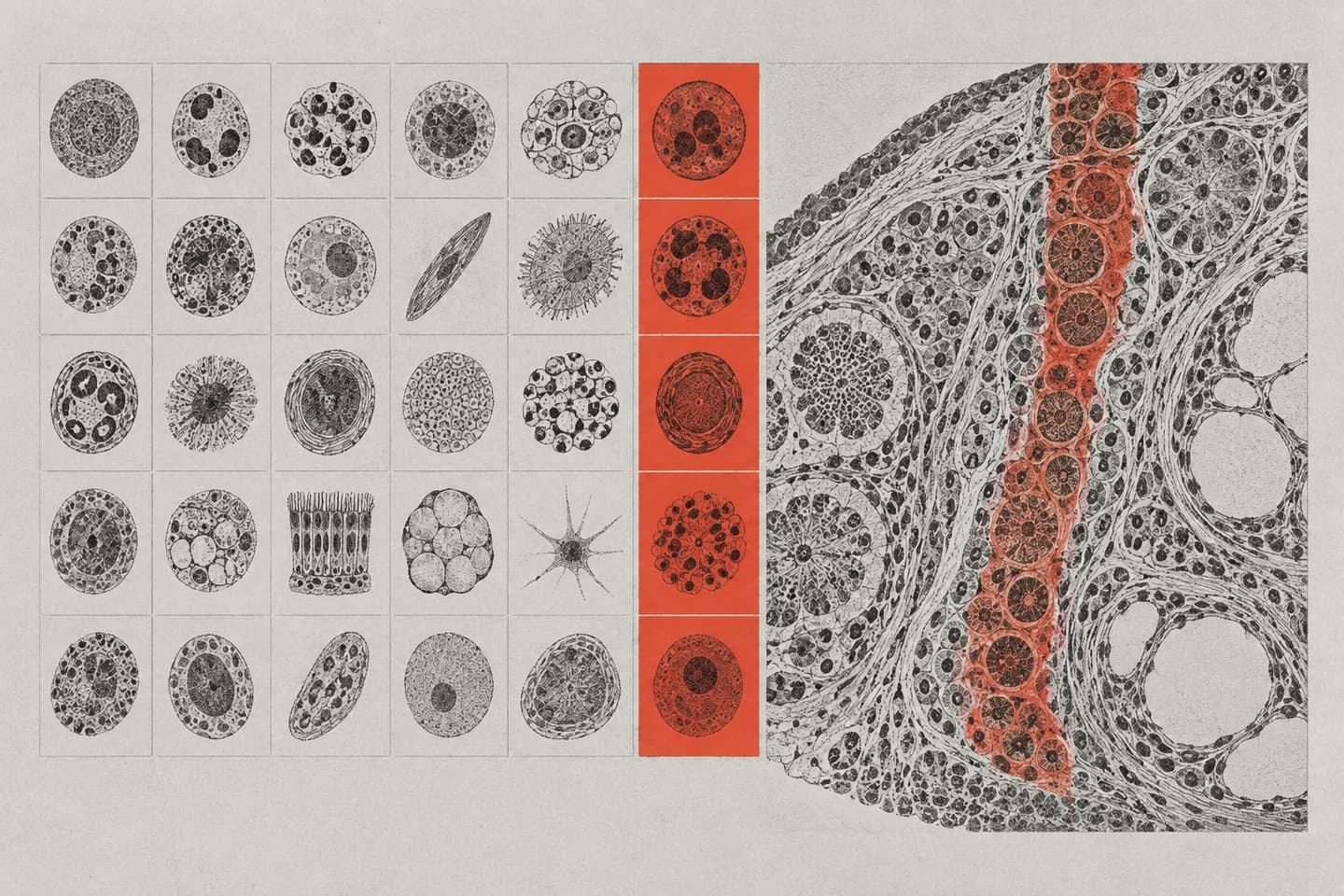
Make many measurements answer one clear question
Large datasets let researchers compare ageing across tissues, ages and populations. Their value grows when measurements can be connected to experimental conditions and health outcomes. Open data, shared annotations and repeatable analysis make a result available for independent scrutiny.
What to investigate
Combine gene activity, proteins, metabolites, images and clinical observations with their measurement context.
Check sampling bias, technical differences between batches and separation of training and validation cohorts.
Publish reusable datasets and analysis code, including results that weaken the original hypothesis.
Evidence to build on
Tabula Muris Senis profiled more than 350,000 cells from 23 mouse tissues and organs across age groups. The atlas helps distinguish changes within a cell type from shifts in the proportions of cell types. Those two processes can look similar in measurements averaged over an entire tissue.
What remains unresolved
A large number of cells can come from a small number of animals. Apparent precision at the cell level therefore needs checks at the level of independent organisms, and transfer to humans requires its own validation.
The next useful experiment
Choose an age-associated signal in an open atlas, reproduce it in a separate dataset and test whether changing the implicated process alters tissue function.
Proposed experiments →The wider strategy
The presentation links progress to cheaper measurements, automation and reusable biological data. This approach asks how those resources can produce reliable, testable knowledge.
The Death-Fighting Spectrum presentation ↗