05 / 08 · Research directions
Evolutionary biology of ageing
Study how selection, reproduction and investment in maintenance shape the diversity of lifespans.
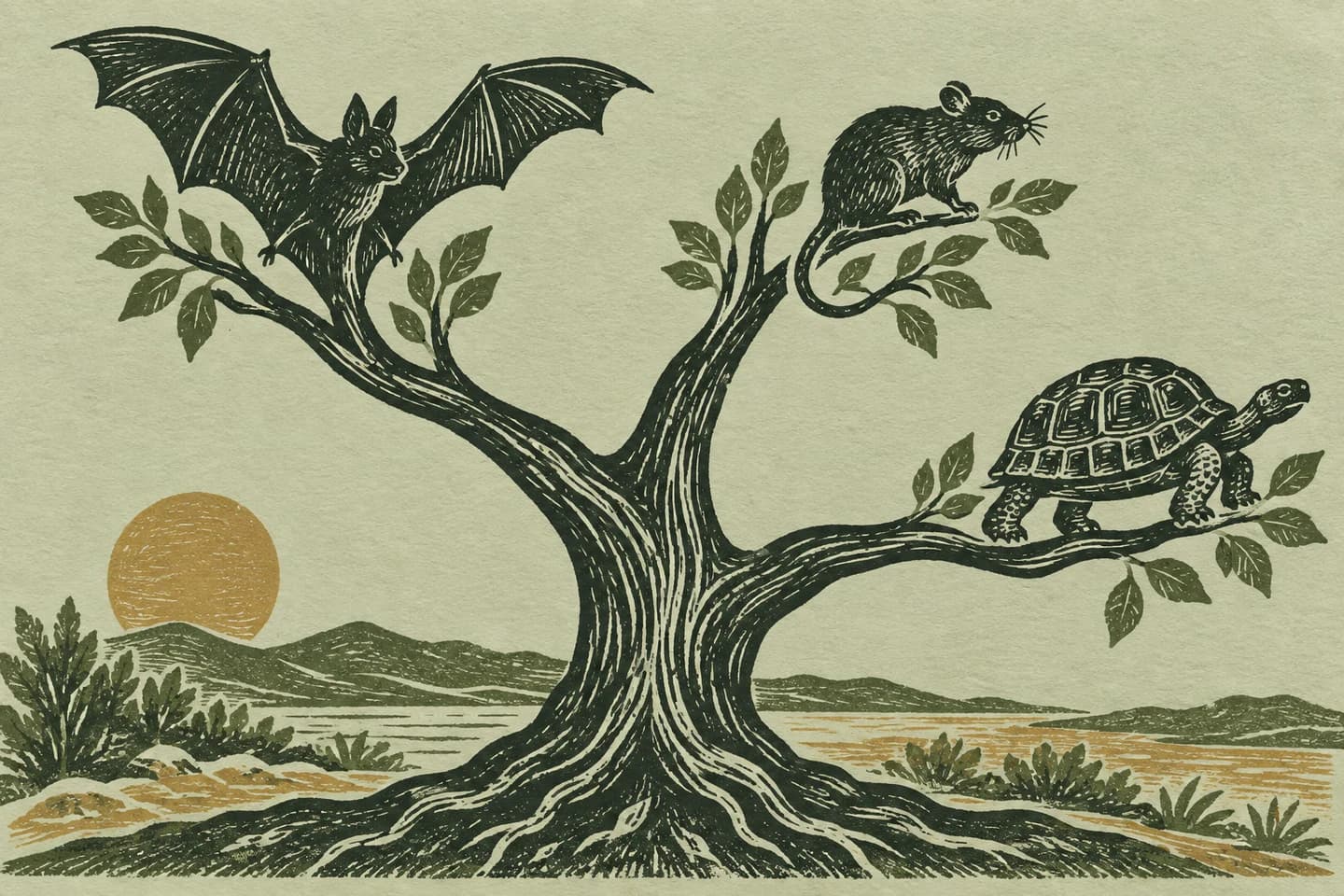
Explain how different life histories evolved
Evolutionary theories ask why natural selection has produced such different patterns of ageing. Mutation accumulation concerns variants whose harmful effects appear late. Antagonistic pleiotropy describes effects that help early in life and cost later. The disposable soma framework examines allocation to reproduction and maintenance.
What to investigate
Compare related species while accounting for ancestry, ecology and the age at reproduction.
Measure the early benefits and late costs of the same genetic or physiological change.
Test how protection from external hazards and different reproductive schedules alter selection on longevity.
Evidence to build on
Cagan and colleagues compared somatic mutations in intestinal crypts across 16 mammalian species. Annual mutation rates were strongly inversely related to species lifespan. The observation offers a comparative constraint for theories linking investment in genome maintenance with longevity.
What remains unresolved
A cross-species association leaves causality open. Evolutionary explanations address why a trait was shaped by selection; identifying a useful therapeutic target also requires a physiological mechanism and an intervention test.
The next useful experiment
Compare a maintenance mechanism in closely related species with different lifespans, then test the predicted early-life and late-life consequences of altering it.
Proposed experiments →The wider strategy
The presentation distinguishes evolutionary causes from cellular mechanisms and clinical interventions. Keeping these levels explicit makes their predictions easier to connect.
The Death-Fighting Spectrum presentation ↗