01 / 08 · Research directions
Paradoxes of ageing
Long-lived species and unexpected experimental results put our explanations of ageing to the test.
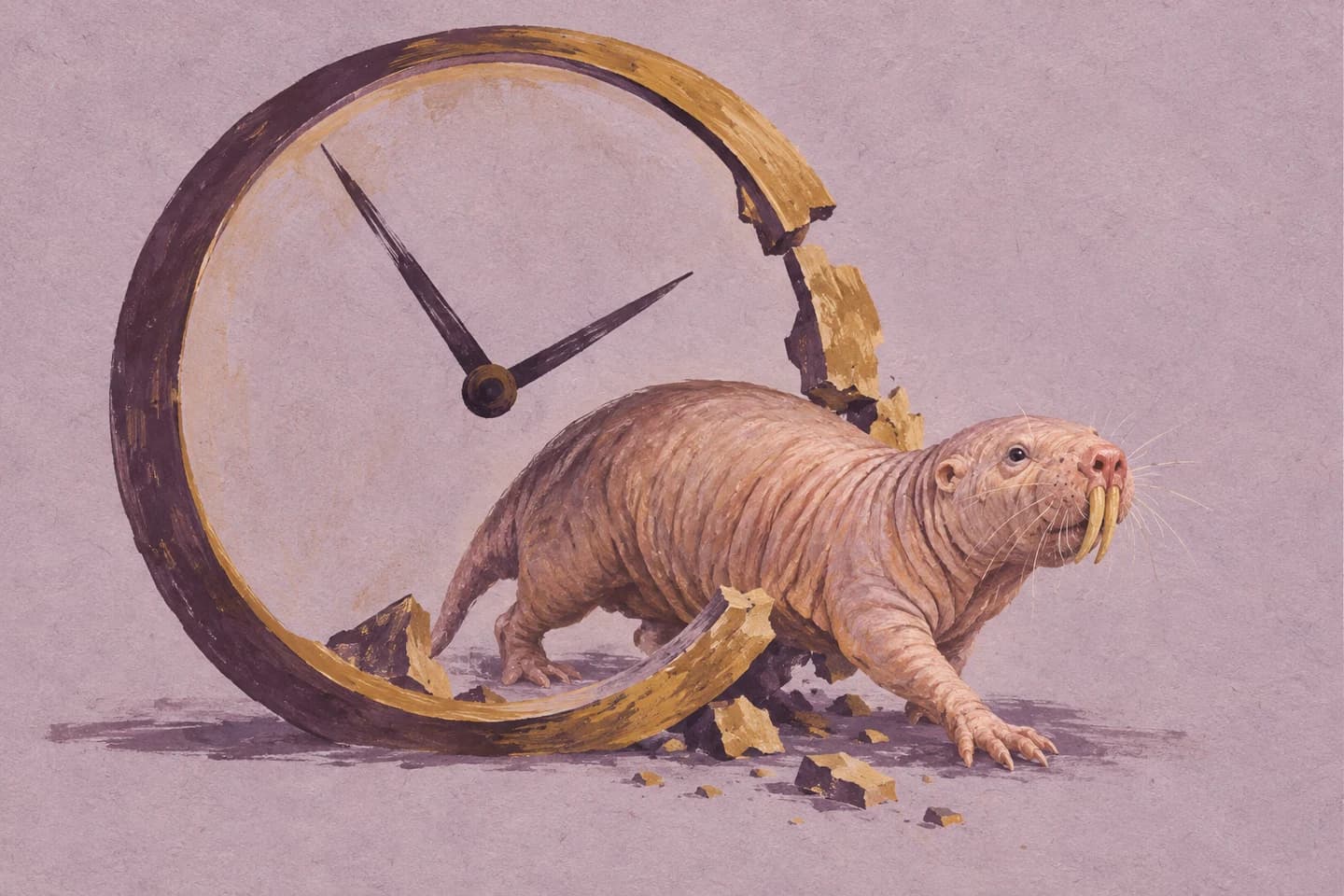
Exceptions that make a theory work harder
A useful theory must account for the diversity of ageing. Similar organisms can have very different lifespans, and a change that helps at one age can harm at another. Such contrasts help identify where an explanation is incomplete and which observation could distinguish it from its rivals.
What to investigate
Compare age-specific mortality, fertility and organ function across species and environments.
Separate a biological exception from differences in husbandry, sample size and how age was measured.
Translate each paradox into a test with a stated result that would support or weaken an explanation.
Evidence to build on
Ruby and colleagues analysed captive naked mole-rat records in 2018 and found no increase in mortality hazard with age over the observed range. The result challenges the expectation that mammalian mortality must follow the usual exponential rise. It concerns a measured demographic pattern in a particular population.
What remains unresolved
A flat mortality hazard over an observation period leaves open changes in individual tissues and the behaviour of mortality at later ages. The mechanism behind the pattern needs its own experiments.
The next useful experiment
Measure mortality and several tissue functions in the same long-lived species over time, and compare the results with a shorter-lived relative under documented conditions.
Proposed experiments →The wider strategy
The presentation separates theories from lists of age-related changes. Paradoxes supply demanding observations against which those theories can be compared.
The Death-Fighting Spectrum presentation ↗