02 / 08 · Research directions
Topology of age-related changes
Map how changes connect across cells, tissues and organs, and where those connections create vulnerability.
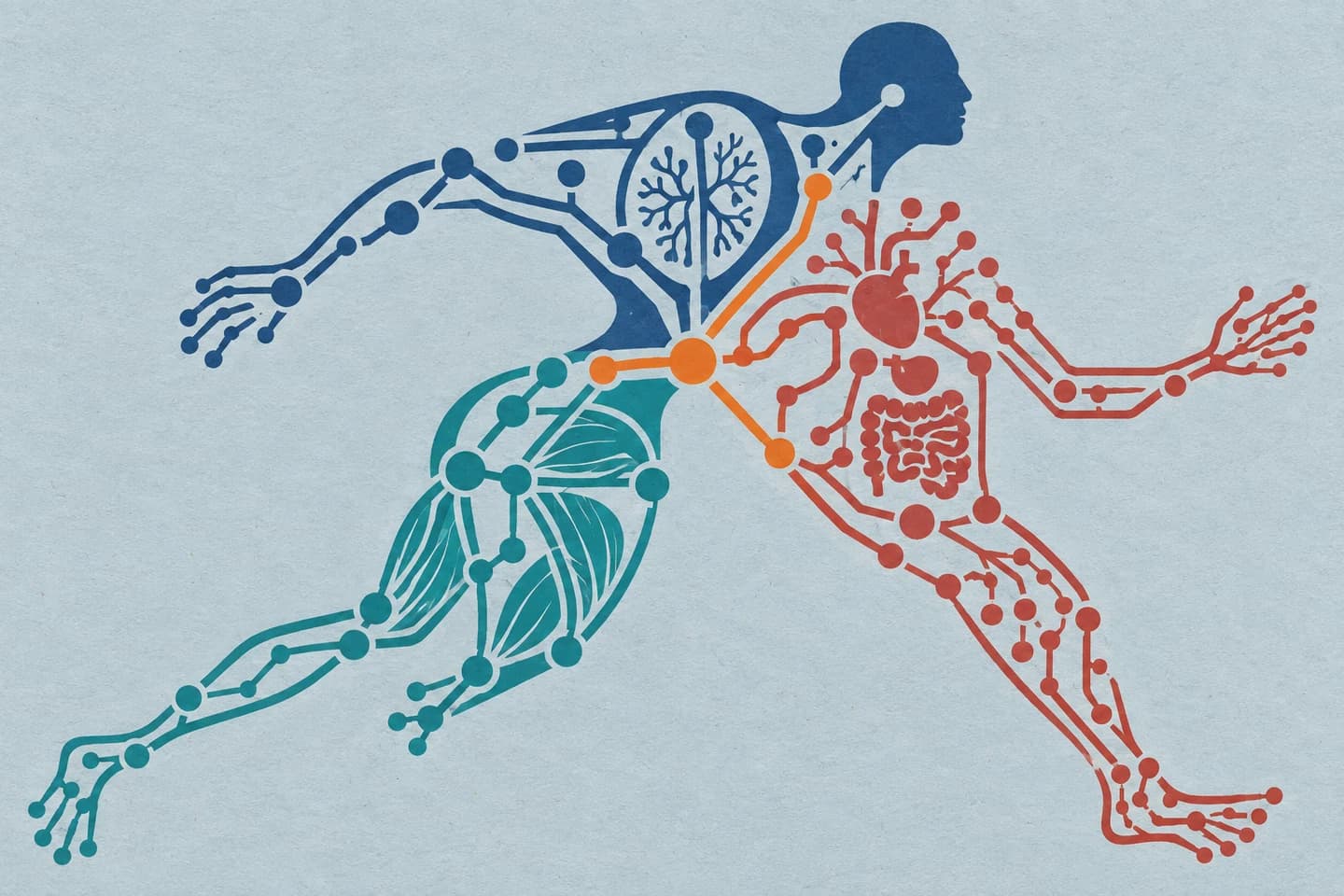
Ageing as a network of connected changes
Topology describes the organisation of connections. In ageing research, it asks which changes cluster together, which tissues communicate them and which links sustain the whole system. A map of these relationships can help distinguish a local defect from a process that affects several organs.
What to investigate
Build maps at several scales, from molecular interactions to cell neighbourhoods and communication between organs.
Follow the order of changes over time and identify candidate feedback loops and points of vulnerability.
Test whether a highly connected component drives dysfunction or merely responds to it.
Evidence to build on
Oh and colleagues used plasma proteins to estimate organ-specific ageing in people and linked these estimates to health and disease. This supports studying organs separately. Network medicine supplies methods for studying interactions; combining these perspectives is a research direction rather than a demonstrated causal map of ageing.
What remains unresolved
A correlation network depends on what was measured and when. Shared changes may have a common cause, and a statistical connection alone does not establish the direction of influence.
The next useful experiment
Track several organs repeatedly, perturb one candidate link in a model system and measure whether the predicted changes in other tissues follow.
Proposed experiments →The wider strategy
The presentation explicitly raises network topology in its section on blind spots. This approach develops that idea into a programme of measurements and causal tests.
The Death-Fighting Spectrum presentation ↗