Direction
Repairing damage
Some damaged cells stop dividing but remain in the tissue, sending signals that affect their neighbours. Removing harmful cells and waste is one way researchers try to restore the environment healthy cells need.
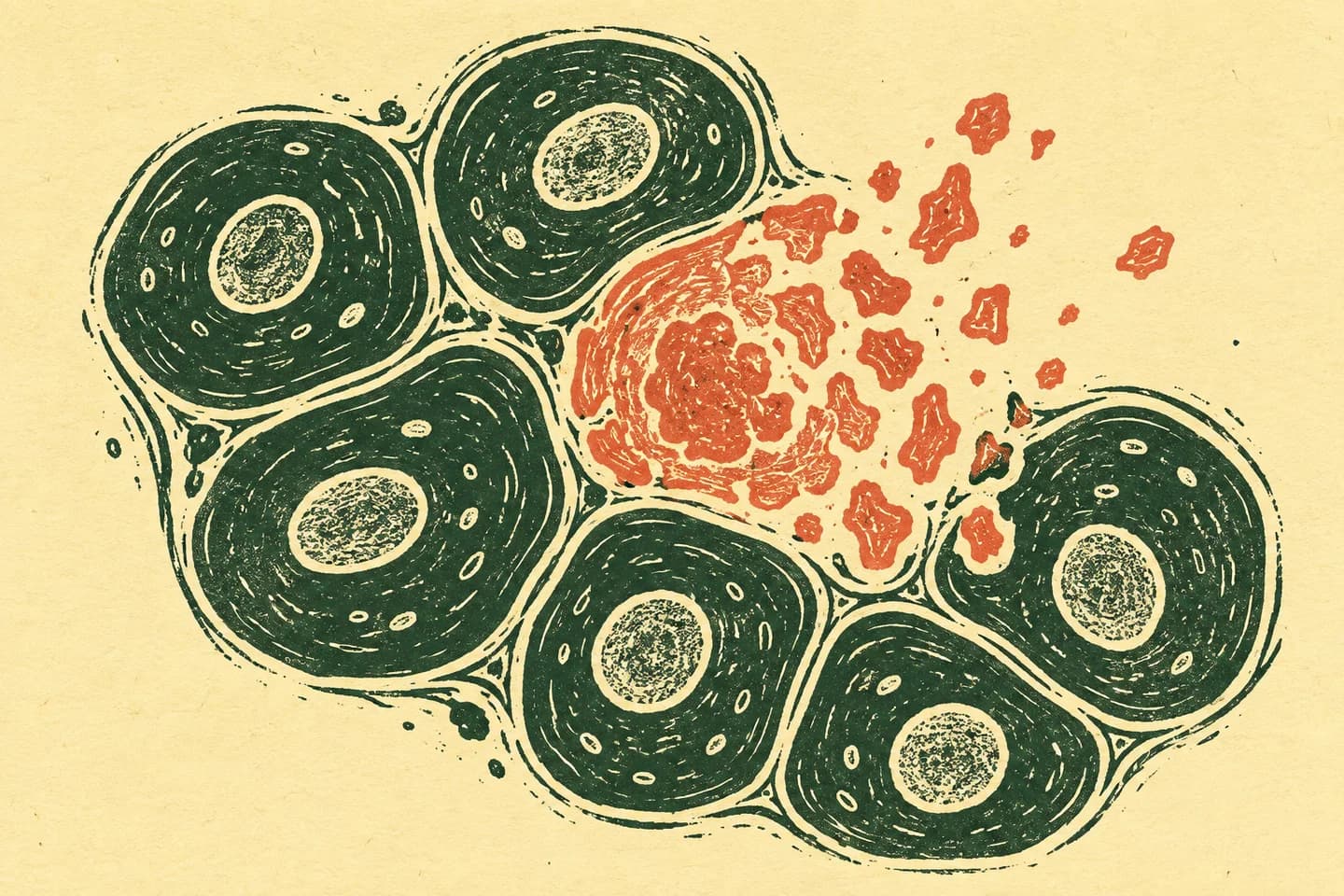
Can we remove harmful cells while keeping their useful roles?
Inside the researchMouse experiment
Baker and colleagues used a genetic system to remove p16-positive cells in mice. Starting in midlife, the intervention increased median lifespan and reduced deterioration in several organs.
What this leaves open. This was a controlled mouse experiment, not proof that a senolytic drug rejuvenates people. Senescent cells can also help with wound healing.
Read the paperNaturally occurring p16Ink4a-positive cells shorten healthy lifespanBaker et al. · Nature · 2016Companies
Companies in this direction
Ambition is what a company claims. Independent replication is what others have confirmed. Read the two columns together: the gap between them is where a promise runs ahead of a result.
| Company▲ | Ambition▲ | Independent replication▲ | Stage▲ | Headquarters▲ |
|---|---|---|---|---|
| Aptah Bio Aptah Bio develops oligo-based transcription modulation technology to restore RNA function and overcome cancer. | 8 | 2 | – | San Carlos, California, United States |
| Arda Therapeutics Arda develops targeted cell depletion therapies to treat chronic diseases by eliminating pathogenic cells. | 8 | 0 | series a | San Carlos, California, United States |
| Attralus Attralus develops pan-amyloid removal therapeutics designed to bind and remove toxic amyloid in systemic amyloidosis. | 8 | 4 | – | San Francisco, California, United States |
| Booster Therapeutics Booster Therapeutics develops small molecules that directly activate 20S proteasomes to restore protein quality control in complex diseases. | 8 | 3 | – | Germany |
| Capacity Bio Capacity Bio develops mitophagy modulators targeting mitochondrial biology for therapeutic applications. | 7 | 0 | seed | United States |
| Casma Therapeutics Casma Therapeutics develops cellular degradation approaches based on autophagy for drug discovery and development. | 7 | 4 | series c plus | Boston, Massachusetts, United States |
| Cleara Cleara Biotech develops peptide-based therapies to selectively eliminate cancer and chronic disease cells with impaired p53 signaling. | 8 | 2 | – | Netherlands |
| Cyclarity Therapeutics Cyclarity develops drugs to prevent age-related conditions by removing arterial plaque and clearing non-degradable cholesterol from arterial wall cells. | 8 | 3 | seed | – |
| Cyclo Therapeutics Develops medicines for rare and neurological disorders, led by Trappsol Cyclo for cholesterol transport diseases. | 7 | 4 | acquired | Gainesville, Florida, United States |
| Deciduous Therapeutics Develops novel medicines that activate endogenous immune mechanisms to eliminate senescent cells and treat age-related diseases. | 8 | 2 | – | 953 Indiana Street San Francisco, CA 94107 |
| Elastrin Therapeutics Elastrin Therapeutics develops targeted therapies to reverse arterial calcification and address cardiovascular and age-related conditions. | 8 | 2 | – | Greenville, South Carolina, United States |
| Elixirgen Therapeutics Develops therapies for rare diseases and aging-associated diseases using ZSCAN4 telomere technology and Bobcat mRNA. | 8 | 3 | – | Baltimore, Maryland, United States |
| Endogena Therapeutics Clinical-stage biotech developing first-in-class endogenous regenerative medicines to repair and regenerate tissues and organs. | 6 | 2 | – | Zurich, Switzerland |
| ETTA ETTA develops AI-guided longevity therapeutics targeting aging, including senescent cells. | 7 | 0 | – | United States |
| EVerZom EVerZom develops exosome-based therapeutics for digestive tissue healing and organ regeneration. | 6 | 3 | – | Paris, France |
| Intervene Immune Intervene Immune develops treatments for thymus regeneration and human longevity. | 8 | 2 | – | 1124 West Carson Street, MRL Building, 3rd Floor, Torrance, CA 90502 |
| IntraClear Biologics IntraClear Biologics develops damage-repair bioengineering therapies and ageing biomarkers targeting intracellular junk such as lipofuscin and 7-ketocholesterol. | 7 | 0 | – | Estonia |
| Juvena Therapeutics Juvena develops tissue restorative biologics for myopathies and metabolic diseases using an AI-enabled secreted protein platform. | 7 | 2 | series a | United States |
| Katairo GmbH Katairo develops Remofuscin for seriously disabling eye indications including Stargardt disease and dry age-related macular degeneration. | 7 | 3 | – | Tübingen, Germany |
| Legendary Pharmaceuticals Developing pharmaceutical and gene therapies to repair and reverse pathological changes of aging. | 8 | 0 | – | Gainesville, Florida, United States |
| Lento Bio Lento Bio develops small molecule therapeutics that repair molecular damage in the aging eye. | 8 | 1 | – | Syracuse, New York, United States |
| Matter Bio | 8 | 2 | – | – |
| Morphoceuticals Inc TechBio company building the first atlas of the bioelectrome to induce regeneration and treat disease. | 9 | 2 | – | Boston, Massachusetts, United States |
| Nexus Research Solutionts Nexus Research Solutions develops biomimetic longevity applications targeting cellular regeneration, ATP production, inflammation regulation, and neural preservation. | 6 | 0 | – | Dubai, UAE |
| Oisín Biotechnologies Oisín Biotechnologies develops redosable genetic medicines targeting the biology of aging using non-viral Fusogenix PLV delivery. | 8 | 2 | – | 701 Fifth Avenue Suite 4200 Seattle, WA 98104 |
| Regerna Therapeutics Regerna develops RNA-binding protein therapeutics to restore and regenerate functional muscle in aging, injury, and muscular dystrophy. | 8 | 3 | – | New York City, New York, United States |
| Rejuvenation Technologies Rejuvenation develops telomere extension therapies to rewind cellular aging mechanisms and treat diseases caused by short telomeres. | 8 | 2 | – | United States |
| ReneuBio ReneuBio develops small molecules to restore regenerative capacity in the aging brain by reactivating dormant neural stem cells. | 8 | 1 | – | San Diego, California, United States |
| Repair Biotechnologies Repair Biotechnologies develops a Cholesterol Degrading Platform to treat conditions caused by localized accumulations of excess cholesterol. | 8 | 1 | seed | 841 East Fayette St Syracuse, NY 13210 |
| RF Longevity RF Longevity aims to increase human longevity through bioengineering with transcranial radiofrequency waves. | 8 | 2 | – | Phoenix, Arizona, United States |
| Rockfish Bio Rockfish Bio develops senolytic therapies for age-related diseases and healthy aging. | 8 | 1 | – | Vienna, Austria |
| Rubedo Life Sciences Rubedo discovers and develops medicines targeting pathologic cells that drive aging and chronic diseases. | 8 | 3 | – | Sunnyvale, CA |
| Samsara Therapeutics Samsara Therapeutics develops autophagy-activating therapeutics for age-related neurodegenerative diseases. | 7 | 0 | series a | United States |
| TAZ Inc. TAZ develops anti-aging products, senolytic assays, epigenetic age testing, biomarkers, and drug discovery for age-related diseases. | 6 | 0 | – | 〒113-0033 東京都文京区本郷3-38-10 BIZComfort本郷38 |
| Telos Biotech Telos Biotech develops Telovance, a protein complex designed to lengthen telomeres during ex-vivo cell therapy manufacturing. | 7 | 2 | – | United States |
| Transposon Therapeutics Transposon Therapeutics develops transformational therapies for neurodegenerative and aging-related diseases. | 8 | 1 | – | San Diego, California, United States |
| Vandria Vandria develops first-in-class small molecules to restore mitochondrial function and reduce inflammation in age-related and chronic diseases. | 8 | 2 | series a | Switzerland |
| Vaxxinity (website removed all info intentionally*) Vaxxinity develops active immunotherapy medicines that harness the immune system to produce antibodies against disease. | 6 | 3 | – | Florida, United States; New York City, New York, United States |
| Vincere Biosciences Vincere makes new medicines to treat age-related diseases including Parkinson’s and kidney disease. | 7 | 3 | – | United States |
| Yap Therapeutics Medley Therapeutics develops regenerative genetic medicines and advanced biologics for chronic and life-threatening diseases. | 8 | 3 | – | United States |
People
People in this direction
- Aubrey de Greypopulariser · through Repair Biotechnologies
SENS Foundation founder and longevity advocacy pioneer.
- George Churchscientist · through Transposon Therapeutics
Led and founded major synthetic biology and genomics efforts with public work on aging reversal, gene therapy, and longevity biotechnology companies including Rejuvenate Bio.
- Marco Demariascientist · through Rubedo Life Sciences
Cellular-senescence researcher mapping its roles across aging and disease
- João Pedro de Magalhãesscientist · through IntraClear Biologics
Senescence.info founder and aging-database builder.
- Peter de Keizerscientist · through Cleara
Senescence researcher developing targeted senolytic therapies
- Steve Horvathscientist · through Intervene Immune
- Vera Gorbunovascientist · through Permanence Bio
Biologist discovering natural mechanisms of cancer resistance and longevity
- Matt Kaeberleinscientist · through Rejuveron Vascular Therapeutics AG (was RejuverVas)
- Laura Deminginvestor · through Deciduous Therapeutics
Founded The Longevity Fund as an early dedicated VC vehicle for aging and life-extension companies, helping make longevity biotech a fundable startup category.
- Eric Verdinscientist · through Deciduous Therapeutics
- Michael Levinscientist · through Morphoceuticals Inc
Regenerative biology and bioelectricity pioneer.
- David Gobelphilanthropist · through Oisín Biotechnologies
Co-founded and leads Methuselah Foundation, which funds prizes, grants, and ventures to extend healthy human lifespan and helped incubate SENS-related work.
- Kristen Fortneyentrepreneur · through Deciduous Therapeutics
- Jim Mellonentrepreneur · through Repair Biotechnologies
Co-founded Juvenescence and publicly framed longevity as an investable biotechnology thesis through the book Juvenescence and substantial company-building activity.
- James Peyerentrepreneur · through Deciduous Therapeutics
Biotech builder translating aging biology into a portfolio of medicines
- Christian Angermayerentrepreneur · through Rejuveron Vascular Therapeutics AG (was RejuverVas)
- Kelsey Moodyentrepreneur · through Lento Bio
Drug-development entrepreneur building an integrated longevity biotech platform
- Peter Diamandisentrepreneur · through Vaxxinity (website removed all info intentionally*)
- Phil Newmanpopulariser · through Endogena Therapeutics
Chronology
What happened, and when
- Grant
Transposon Therapeutics
$22M · Advanced Research Projects Agency for Health (ARPA-H)
- Series A
TAZ Inc.
- Series B
Juvena Therapeutics
$33.5M · Bison Ventures
- Grant
Booster Therapeutics
The Michael J. Fox Foundation for Parkinson's Research
- Series A
Vandria
$32M
- Seed round
Booster Therapeutics
$15M · Apollo Health Ventures, Novo Holdings
- Series A
Arda Therapeutics
$43M · Andreessen Horowitz (a16z Bio + Health)
- Seed round
Matter Bio
$7M
- Grant
Vaxxinity (website removed all info intentionally*)
- Series A
Vandria
$30.7M · ND Capital
- Venture round
Deciduous Therapeutics
LifeSpan Vision Ventures
- Venture round
Capacity Bio
$35M · RA Capital Management, Insight Partners
- Seed round
Morphoceuticals Inc
$8M · Prime Movers Lab
- Series C
Casma Therapeutics
$46M
- Series A
Juvena Therapeutics
$41M · Horizons Ventures, Mubadala Capital Ventures
- Seed round
Cleara
$2.5M · Apollo Health Ventures
- Seed round
Lento Bio
$680K · Ichor Life Sciences
- Venture round
Elastrin Therapeutics
$10M · Kizoo Technology Capital
- Series A
Endogena Therapeutics
$20M · Rejuveron Life Sciences AG
- Seed round
Oisín Biotechnologies
$5M · Althea Group, LLC
- SAFE
Oisín Biotechnologies
$3M
- Seed round
Repair Biotechnologies
$2.1M · Jim Mellon
- Pre-seed round
Repair Biotechnologies
Hypotheses
Hypotheses under test in this direction
Published by the Omega Point engine and tagged to this direction by a classifier; the gap each one attacks is named under it
- Misaligned fusion readiness may leave lasting losses in muscle recoveryOct 10, 2026In older human muscle after a mild lesion, mismatched readiness windows in precursors and recipient fibers could impair fusion and force recovery. Normal competence and fusion plus an ineffective selective timing correction would weaken this explanation in that setting.
- Disrupted interleukin-11 feedback may uncouple epithelial and stromal repairOct 10, 2026In older-human lung epithelial–stromal pairs, interleukin-11 signals may guide repair by reflecting a partner's state. Equivalent recovery with a state-independent schedule after accounting for receiver readiness, shared injury history and support would challenge the need for this guidance.
- Damaged-cell removal may seed mineral deposits on surfaces of cell remainsOct 10, 2026In older-human vascular smooth-muscle-cell cultures, remains from selective apoptotic removal could seed calcium-phosphate deposits under permissive chemistry. Unchanged total deposition after selective surface inactivation would challenge their proposed contribution
- Barrier repair, damaged-cell removal and reserve loading may improve function without slowing agingOct 10, 2026In a specified older-human population, the combination could improve deficits while later damage accumulation remains equivalent to contemporaneous care. A reproducible exposure-linked rate difference beyond an independently justified margin would reject equivalence for that damage channel and interval.
- Dominant repair-initiation signals may delay maturation during human lung repairOct 10, 2026In older-human alveolar repair cultures, cells may select the strongest effective pathway signal, delaying maturation while repair-initiation signaling dominates. Persistent response differences after a fixed pathway reset and equilibration would refute the proposed no-history rule
- Synchronized damaged-cell removal may induce lasting immune tolerance to later damaged cellsOct 10, 2026In older-human bronchial and immune-cell cultures from the same donor, synchronized removal could impair later recognition of damaged cells sharing the same antigens. Preserved surveillance after recovery would reject this link; faster endogenous accumulation requires separate demonstration
- Altered protein chemistry may block breakdown until chemical repair enables disposalOct 10, 2026In older-human donor cells, initially proposed skin fibroblasts, altered protein chemistry may prevent breakdown despite restored processing. Comparable breakdown after ordinary processing is restored would weaken this claim; chemical correction must demonstrably enable destruction of the same protein backbone
- Genome doubling in mature gut cells may repair surface defects and extend remaining lifeOct 6, 2026In old mice, briefly inducing genome doubling and enlargement in mature absorptive gut cells could extend remaining life while baseline gut renewal continues. The claim fails if benefit requires extra production of new cells or persists when genome doubling is selectively blocked
- Persistent muscle stromal cells may erase lifespan gains from fasting mimeticsOct 6, 2026The hypothesis proposes that fasting mimetics lose their lifespan benefit when blocked muscle recovery lets repair-supporting cells persist and drive scarring. Normal cell numbers and fates, together with no benefit from selectively limiting these cells, would argue against this mechanism.
- Repairing existing muscle proteins may preserve rapamycin’s lifespan benefit without new synthesisOct 5, 2026Increasing protein L-isoaspartyl methyltransferase (PCMT1) activity in muscle could preserve intermittent rapamycin’s lifespan benefit despite suppressed protein synthesis and no recovery of protein mass. Removing damage without restoring muscle function and survival would reject this mechanism.
- Restoring support flexibility may let intestinal progenitors complete repair and extend lifeOct 5, 2026In the old intestine, a brief, targeted small interfering RNA pulse against lysyl oxidase in fibroblasts around crypts could restore support flexibility and enable epithelial repair. A lifespan benefit that persists when the matrix is held stiff would reject the proposed mechanical requirement.
- Reserve cells may extend life by restoring intestinal crypts after renewal cells are lostOct 5, 2026Brief local R-spondin-1 and Wnt3a pulses may support Lgr5-positive stem cells and recruit initially Lgr5-negative, Dll1-positive secretory precursors to restore crypts and extend life. A survival benefit with reserve repair disabled, at matched average epithelial cell production, would reject this claim.
Forecasts