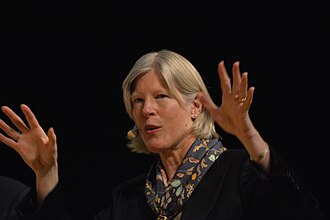
Cynthia Kenyon
Kenyon helped prove aging is not mystical wear-and-tear: a single daf-2 mutation doubled worm lifespan. That result made genetic control of longevity a serious field, not a fringe wish.
64 / 100scientistself-experimenterentrepreneurprofiles.ucsf.edu/cynthia.kenyon ↗Scoring AI engine · v0.4.0
Role
scientisthigh confidence
The evidence shows authored peer-reviewed aging papers, including the field-shaping daf-2/insulin-pathway work and later longevity papers. Her longevity impact runs through making aging genetically tractable, not through titles or affiliation.
Cynthia Kenyon — OpenAlex citation metrics ↗Inhibition of respiration extends C. elegans life span via r ↗The first long-lived mutants: discovery of the insulin/IGF-1 ↗Spontaneous age-related neurite branching in Caenorhabditis ↗
also: self-experimenter, entrepreneur, operator
Dimension breakdown
This score rates longevity commitment only. The role tags above — scientist, investor, and the rest — say what this person is; we don't score those separately.
Future vision
6.0/ 10
Kenyon has a clear and durable public scientific vision that aging is biologically plastic and potentially actionable for extending healthy human lifespan, grounded in her long-running genetics-of-aging work and translational framing. However, the evidence provided is stronger for scientific vision and research direction than for a highly specific public roadmap to ending aging, reversing decline, or achieving human lifespan extension on a defined path or timeline.
medium confidence
Scientific impact
9.0/ 10
Cynthia Kenyon has field-defining scientific impact in longevity biology. The primary citation-metrics evidence is strong: h-index 80, nearly 40,000 citations, and multiple highly cited aging/longevity papers, including the landmark 1993 C. elegans daf-2 mutant paper with 3,439 citations. The cited work directly shaped the genetic regulation of aging and insulin/IGF-1 longevity pathway agenda, which is central to modern aging biology. Lack of clinical trials limits translational impact but does not materially weaken the scientific-impact score.
high confidence
Capital deployed
3.0/ 10
There is credible but sparse evidence that Kenyon directed longevity-relevant research resources through NIH-funded projects and institution-building roles, including co-founding Elixir and later leading aging research at Calico. However, the evidence does not show personal capital deployed, disclosed funding amounts, recurring philanthropy, or independently quantified resource allocation, so the score should remain low.
low confidence
Strategic taste
9.0/ 10
Kenyon shows unusually strong strategic taste for longevity: she made an early, thesis-coherent bet that aging was genetically regulable, pursued it through C. elegans genetics, expanded into conserved insulin/IGF-1 and hormone signaling mechanisms, and later moved toward human gene perturbation, aging-cancer translation, institutional platform-building, and company formation. The evidence supports a field-defining strategic pattern, though some organizational and counterfactual details are thin.
high confidence
Field creation
4.0/ 10
The dimension applies, but the evidence for field creation is limited. Kenyon is credited with co-founding Elixir Pharmaceuticals, giving some organization-building signal, and she participated in a consensus workshop/publication that helped frame aging interventions for human translation. However, the provided evidence does not show that she created a durable program, funding path, protocol, or community infrastructure at field-defining scale.
medium confidence
Bravery and conviction
6.0/ 10
Kenyon has credible evidence of public conviction around aging/life-extension science: she pursued and published lifespan-extension genetics unusually early, later explicitly framed hormone research as relevant to life extension, and co-authored a public argument about readiness for human anti-aging interventions. However, the evidence does not show major personal downside, sustained criticism, financial sacrifice, or self-experimentation, so the score should be solid but not near the top of the scale.
medium confidence
Multiplier effect
8.0/ 10
Kenyon shows strong second-order leverage through exceptionally high citation impact around foundational aging-genetics work, indicating broad follow-on research activity and field legitimacy. The founding of Elixir Pharmaceuticals and later aging leadership at Calico further support translation and institution-building, though the evidence gives limited detail on capital attracted, programs built, or direct downstream outcomes.
medium confidence
Vision
Destination
Further characterization of these compounds may reveal new ways to extend healthy human lifespan.
Further characterization of these compounds may reveal new ways to extend healthy human lifespan.
Ponce d'elegans: genetic quest for the fountain of youth.
Experiments that hint of longer lives
The goal of aging research is to extend healthy, active life.
Kenyon's TED Talk: From Roundworms to Humans, in Pursuit of a Vibrant, Longer Life (11/28/2011)
Kenyon's TED Talk: From Roundworms to Humans, in Pursuit of a Vibrant, Longer Life (11/28/2011)
Kenyon's TED Talk: From Roundworms to Humans, in Pursuit of a Vibrant, Longer Life
Healthy animals with extreme longevity.
Healthy animals with extreme longevity.
Path
No canonical quotes yet.
Publicly endorses Aging biology controls lifespan and age-related disease susceptibility
Strategy
Kenyon's strategy centered on using C. elegans genetics to identify conserved mechanisms that regulate lifespan, then extending those mechanisms toward human genes, cancer, and neurodegeneration.
Kenyon's longevity strategy began with a high-conviction basic-science thesis: lifespan could be genetically regulated, shown by the 1993 finding that a single-gene mutation doubled C. elegans lifespan [S1]. Her grant portfolio then deepened that thesis through projects on genetic analysis of aging, DAF-12 hormone-receptor lifespan regulation, reproductive-system signals, and aging-linked neurodegeneration [S1]. The later move into human gene knockdowns and aging-cancer translational studies suggests a shift from mechanism discovery toward conserved pathways and disease-relevant translation [S1]. Her institutional base at UCSF and leadership of the Hillblom Center point to a strategy built around academic platform-building as well as individual projects [S1]. Co-founding Elixir Pharmaceuticals adds a company-formation channel for translating aging biology, though the available evidence does not specify its founding date or program details.
MixedHighC. Elegans Aging GeneticsLifespan RegulationHormone SignalingHuman Gene KnockdownsAging-Cancer LinksUCSFSan FranciscoCambridge UK
Notable bets
Portfolio
Investments
Donations
No public rows yet.
Organizations founded
Scientific output
h-index80
Citations-
Papers37
Trials0
Bravery and conviction
Belief evolution
Self-experimentation
Connections
Companies
Collaborators and lineage
Criticisms