Cues in the 50 tasks and how generated hypotheses match the articles
Analysis date: 27 October 2026. Corpus: the initial 2997 hypotheses from four generators across three modes. The repeat generation run of Claude Opus with a separate isolation check is excluded from this analysis.
What was tested
We tested the association between the content of the research question and the share of matches with the reference finding among the generated hypotheses. Under the primary matching criterion, at least two of the three judges from other companies gave the hypothesis a score of 3 or higher. Under the strict criterion, at least two judges gave a score of 4 or 5. These scores measure how well a hypothesis matches the article; alternative hypotheses with low scores may still prove true in other experiments.
This analysis evaluates the generation benchmark. Predictor forecasts and selection results were omitted from the calculations. A separate forecasting benchmark can validly use hypotheses of any origin, including manually written hypotheses and hypotheses generated with cues. Their origin defines the composition of the evaluated set; by itself, it does not invalidate the assessment of forecasting.
Question annotation
A question score of 0 means that the question states only the phenomenon to be explained. A question score of 1 means that it specifies a class of explanations, a source of perturbation, or a general process. A question score of 2 means that it already gives a substantial part of the causal link, a specific intervention with the direction of its effect, key molecular players, or a sufficiently narrow combination of conditions. The question score measures how strongly the search space is constrained. It does not establish a protocol violation: some details could represent valid background knowledge.
GPT-6 Astra with a high reasoning level annotated the tasks using the full questions, the background, and the reference findings. For borderline cases, adjacent plausible question scores were recorded in advance. The annotations and the analysis plan were saved in commit 82123e40 before being linked to the individual generation results in this analysis. Summary results and two previously discussed examples, AMPK and motor neuron death, were known before the annotation. A separate calculation was performed without those two tasks.
An alternative adjacent question score was recorded for 35 of the 50 questions. The robustness check replaces all of those question scores simultaneously. This check tests how sensitive the conclusion is to category boundaries; it does not measure agreement among independent experts.
Source files: annotations, tasks without generation results, freeze timestamp and checksums, full table of tasks and results.
Primary comparison for single-request generation
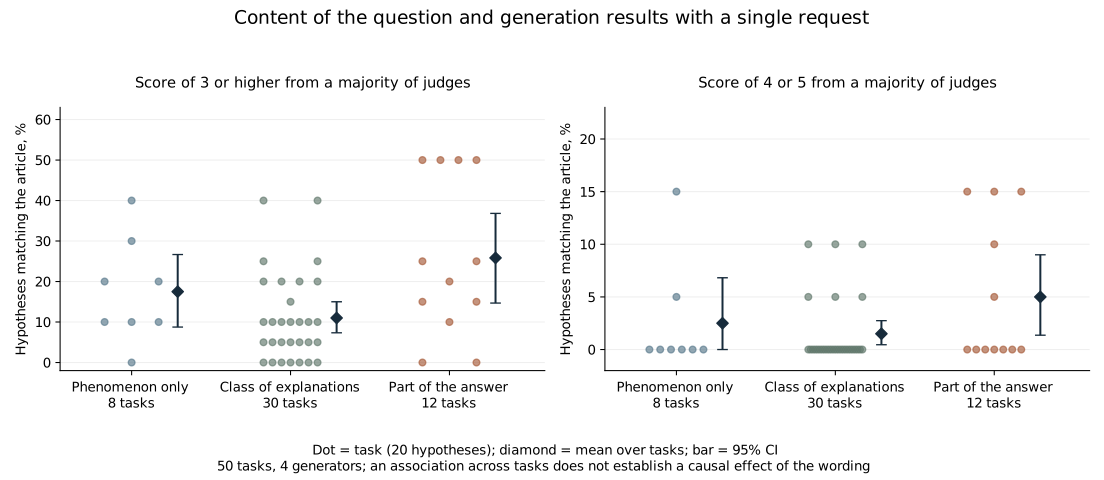
In each of the 50 tasks, four generators proposed five hypotheses each, yielding 1000 hypotheses in total. For each task, the four shares of matches among the generated hypotheses were averaged; the task is the unit of statistical analysis. Thus, the 1000 hypotheses were not treated as independent observations.
| Question content | Tasks | Score of 3 or higher from a majority of judges | 95% CI of share | Score of 4 or 5 from a majority of judges |
|---|---|---|---|---|
| 0. Only the phenomenon under study | 8 | 17.5% (28/160) | [8.8, 26.7] | 2.5% (4/160); CI [0.0, 6.8] |
| 1. A class of explanations is given | 30 | 11.0% (66/600) | [7.3, 15.0] | 1.5% (9/600); CI [0.5, 2.7] |
| 2. A substantial part of the answer is given | 12 | 25.8% (62/240) | [14.7, 36.8] | 5.0% (12/240); CI [1.4, 9.0] |
In the table, the confidence intervals (CIs) for the shares of matches are given in percent. Because every task has the same number of hypotheses in this mode, the share of matches among all hypotheses equals the mean across tasks.
| Criterion | Spearman correlation ρ | 95% CI | Permutation P | P with Holm correction for two criteria |
|---|---|---|---|---|
| Score of 3 or higher | 0.17 | [-0.15; 0.46] | 0.24318 | 0.43354 |
| Score of 4 or 5 | 0.17 | [-0.16; 0.48] | 0.21677 | 0.43354 |
Under the primary criterion, the difference between group 2 and groups 0 and 1 combined was 13.5 percentage points, 95% CI [2.1, 25.0]. In groups 0 and 1 combined, 94 of the 760 hypotheses (12.4%) matched the article. Under the strict criterion, the difference was 3.3 percentage points, 95% CI [-0.5; 7.4]. This is a pre-planned descriptive comparison, and its confidence interval is not adjusted for multiple comparisons.
The most explicit cues are associated with a higher share of matches among the generated hypotheses in this breakdown. However, there is no monotonic increase from group 0 to group 2: group 1 had a lower share of matches among its hypotheses than group 0. Consequently, the positive difference between group 2 and groups 0/1 is consistent with a weak overall rank correlation. These data do not support the claim “the stronger the cue, the better the generation” with sufficient certainty.
Other generation modes
| Mode | Criterion | ρ | 95% CI | Unadjusted P |
|---|---|---|---|---|
| A single request | Score of 3 or higher | 0.17 | [-0.15; 0.46] | 0.24318 |
| A single request | Score of 4 or 5 | 0.17 | [-0.16; 0.48] | 0.21677 |
| The multistep pipeline | Score of 3 or higher | 0.21 | [-0.08; 0.47] | 0.14240 |
| The multistep pipeline | Score of 4 or 5 | 0.33 | [-0.00; 0.61] | 0.01637 |
| Omega Point | Score of 3 or higher | -0.13 | [-0.40; 0.17] | 0.37079 |
| Omega Point | Score of 4 or 5 | -0.04 | [-0.34; 0.28] | 0.87072 |
| Mean across all 12 combinations of model and mode | Score of 3 or higher | 0.16 | [-0.14; 0.45] | 0.25344 |
| Mean across all 12 combinations of model and mode | Score of 4 or 5 | 0.25 | [-0.06; 0.54] | 0.07284 |
These comparisons are exploratory and use the same tasks. In the multistep pipeline, there is a noticeable positive association under the strict criterion, but it does not replicate in Omega Point. The reported P values are unadjusted across all exploratory checks. In the analysis of individual models and modes, no comparison reached P < 0.05 after correction for multiple comparisons (Holm) across the 24 tests. For two combinations, there were no matches under the strict criterion at all, leaving the correlation undefined; in calculating the correction, they were assigned P = 1.
Robustness of the primary result
| Single-request check | ρ for a score of 3 or higher | 95% CI | Unadjusted P |
|---|---|---|---|
| Pre-specified alternative question scores for borderline questions | -0.06 | [-0.34; 0.23] | 0.70266 |
| Joint score of the background and the question | 0.29 | [-0.06; 0.59] | 0.03993 |
| Excluding the AMPK and motor neuron death tasks, 48 tasks | 0.15 | [-0.17; 0.45] | 0.30267 |
| Excluding Claude Opus, 50 tasks | 0.15 | [-0.17; 0.44] | 0.30135 |
| Controlling for the length of the question and of the reference finding | 0.14 | [-0.20; 0.45] | undefined |
For the partial rank correlation, only the confidence interval was calculated; P was not calculated for that row. Length was measured in Unicode characters; the length of the reference finding includes the statement and its key elements.
When each individual task was left out in turn, the primary correlation remained within [0.12, 0.22]. Its sign therefore does not depend on any single task. Under the pre-recorded alternative annotation of borderline questions, however, the correlation is close to zero and reverses sign. This shift reflects substantial classification uncertainty rather than confirmation of no effect.
Scoring the question together with the background yields a stronger association. In this supplementary check, the permutation P is below 0.05, whereas the 95% confidence interval from resampling across tasks includes zero. The two methods quantify uncertainty differently, especially when individual categories contain few tasks and many values are tied. This exploratory result requires independent annotation and confirmation.
Examples useful for interpretation
R42810392, question score 2. Selective activation, cross-species lifespan extension, and changes in mammals are specified; the central causal scheme is already stated. Hidden elements: AMPK, compound 991, the specific species, and the mouse proteome. In single-request generation, 10 of 20 hypotheses met the primary criterion and 3 of 20 met the strict criterion.
R42601407, question score 2. The intervention and both expected effects from the reference finding are named directly. Hidden elements: Adiponectin, its receptors, and AdipoRon. In single-request generation, 0 of 20 hypotheses met the primary criterion and 0 of 20 met the strict criterion.
R42647635, question score 2. The causal hypothesis linking an increased mitochondrial DNA mutation burden to two outcomes in a large mammal is stated directly. Hidden elements: Defective POLG proofreading activity, pigs, and the editing method. In single-request generation, 10 of 20 hypotheses met the primary criterion and 3 of 20 met the strict criterion.
R42669067, question score 2. The question directly names two molecular players from the central reference finding. Hidden elements: The direction of regulation, Lamin B1, KAP1, H3K9me3, and cGAS-STING. In single-request generation, 10 of 20 hypotheses met the primary criterion and 0 of 20 met the strict criterion.
R42744804, question score 0. The outcome and the disease model are described; the mechanism of neuronal engulfment is absent. The background allows for interactions with surrounding cells. Hidden elements: Microglia, Axl, Mer, phosphatidylserine, and the engulfment of live neurons. In single-request generation, 4 of 20 hypotheses met the primary criterion and 1 of 20 met the strict criterion.
Limits of inference and the next experiment
The current data support a positive association for the group with the most explicit cues under the primary matching criterion. The overall correlation is weak, and the result is sensitive to how the category boundaries are drawn. The causal claim “these phrasings helped” remains untested: different tasks vary in difficulty, in how well the mechanism is known, in the specificity of the reference finding, and in how the judges respond. Comparing different tasks does not show what will happen if a cue is removed from the same task.
Testing the causal effect requires preparing two input versions for each task: the current version and a version in which cues to the reference finding are removed while sufficient background is retained. The same models should then independently generate an equal number of hypotheses under identical limits across several replicates, with a randomised run order. Judges should score the hypotheses blinded to the input version, and the primary comparison should be paired by task. A control generator that produces affirmative restatements of the question will additionally show what share of matches among the generated hypotheses can be achieved without adding substantive content to the question. These are tests of generation.
For the forecasting benchmark, the resulting set of hypotheses is evaluated separately. Forecasting performance can also be compared across different hypothesis sources if needed, though that represents a distinct research question.
Computation and reproducibility
The analysis used 99,999 permutations of question scores across whole tasks and 10,000 resamples of whole tasks with replacement. Two-sided P values were calculated from the absolute value of the correlation by adding one to both the numerator and the denominator. Confidence intervals represent the 2.5th and 97.5th percentiles, with ranks and ties recalculated within each resample. The global random seed is 20261027. The small sample size motivates using a permutation test rather than an asymptotic P value; see the Spearman documentation and the permutation test documentation.
In modes with varying numbers of retained hypotheses, the shares of matches among generated hypotheses were first calculated within each task, model, and mode, and then averaged with equal weight across cells. All 2997 binary outcomes were independently reconstructed from the raw judge scores after excluding the generator’s own company. We verified the numerators, denominators, task identifiers, tie-handling of ranks for equal shares, the exact permutation distribution on a small synthetic example, and the handling of constant variables. The primary Holm correction family comprises the two thresholds in single-request generation; a separate exploratory family comprises the 24 combinations of model, mode, and threshold. The supplementary robustness checks are not used as standalone confirmatory tests.
Numerical results for all comparisons: results.json. All calculations were performed without calling any models; the analysis code is packaged in an archive.
Annotation of each question
All 50 questions are listed below in their original English wording. The question score in each heading applies to the question alone. The full background, the reference finding, the key elements, and the results for each model and mode are available in the TSV table. The numerators in each entry refer to the 20 hypotheses produced by the four generators in single-request generation.
R42601407 with question score 2
Through what molecular mechanism does physical activity delay ovarian ageing and extend reproductive lifespan?
The intervention and both expected effects from the reference finding are named directly. Hidden elements: Adiponectin, its receptors, and AdipoRon.
Score of the question together with the background: 2. Alternative question score: 2. Primary criterion: 0/20. Strict criterion: 0/20.
R42642521 with question score 2
Can a specific age-depleted gut microbe and one of its metabolites causally suppress inflammaging and improve healthspan in old animals?
The question reproduces the scheme of a microorganism plus its metabolite and the expected effects, leaving only the specific players to be named. Hidden elements: Bifidobacterium pseudocatenulatum and 5-AVAB.
Score of the question together with the background: 2. Alternative question score: 1. Primary criterion: 0/20. Strict criterion: 0/20.
R42647635 with question score 2
Does experimentally increasing somatic mitochondrial DNA mutation burden cause premature ageing and shortened lifespan in a large mammal?
The causal hypothesis linking an increased mitochondrial DNA mutation burden to two outcomes in a large mammal is stated directly. Hidden elements: Defective POLG proofreading activity, pigs, and the editing method.
Score of the question together with the background: 2. Alternative question score: 2. Primary criterion: 10/20. Strict criterion: 3/20.
R42665751 with question score 2
How does age-associated mitochondrial dysfunction initiate and propagate inflammatory signaling that causes ovarian functional decline?
The causal sequence from mitochondrial dysfunction through the propagation of inflammatory signalling to ovarian dysfunction is already specified. Hidden elements: Mitochondrial DNA release, cGAS-cGAMP-STING, and gap junctions.
Score of the question together with the background: 2. Alternative question score: 1. Primary criterion: 5/20. Strict criterion: 2/20.
R42669067 with question score 2
How does SIRT1 regulate L1 retrotransposon activity, and does this regulation affect cellular senescence?
The question directly names two molecular players from the central reference finding. Hidden elements: The direction of regulation, Lamin B1, KAP1, H3K9me3, and cGAS-STING.
Score of the question together with the background: 2. Alternative question score: 2. Primary criterion: 10/20. Strict criterion: 0/20.
R42689491 with question score 2
Can in vivo correction of the HGPS-causing mutation rescue molecular, cellular, and structural defects in bone, and how does treatment timing affect efficacy?
Correction of the causal mutation and the expected rescue of bone defects are specified, and the importance of treatment timing is cued separately. Hidden elements: Adenine base editing, LMNA, and the advantage of early administration.
Score of the question together with the background: 2. Alternative question score: 2. Primary criterion: 10/20. Strict criterion: 3/20.
R42723144 with question score 2
Can naturally occurring inherited genetic variation alter the rate of ovarian ageing on equivalent heterogeneous nuclear backgrounds, and what cellular mechanism mediates this effect?
Matching the distribution of nuclear variants directs the search for the inherited cause outside the nuclear genome. Hidden elements: Mitochondrial haplotypes, TFAM import, and TOMM20.
Score of the question together with the background: 2. Alternative question score: 1. Primary criterion: 2/20. Strict criterion: 0/20.
R42786310 with question score 2
Can a commensal microorganism predicted from integrated human ageing profiles causally extend lifespan and healthspan and shift age-associated molecular and microbial states toward younger configurations?
The scheme for selecting the microorganism and the list of beneficial effects, including shifting molecular profiles toward a younger state, are already specified. Hidden elements: Neisseria flavescens, live versus inactivated bacteria, and differences between models.
Score of the question together with the background: 2. Alternative question score: 1. Primary criterion: 4/20. Strict criterion: 0/20.
R42806572 with question score 2
Can a dose-titratable immune engager safely eliminate senescent cells and alleviate age-related pathology across mice and non-human primates, and what measurement can guide its safe dosing?
The therapeutic construct, the mechanism of immune clearance of cells, dose titration, and translation of the effect from mice to primates are all specified. Hidden elements: GFD-CD3, uPAR, endothelial toxicity, and aminotransferases.
Score of the question together with the background: 2. Alternative question score: 2. Primary criterion: 5/20. Strict criterion: 1/20.
R42810392 with question score 2
Can direct pharmacological activation of a conserved metabolic target extend lifespan across evolutionarily diverse organisms and induce longevity-associated changes in mammals?
Selective activation, cross-species lifespan extension, and changes in mammals are specified; the central causal scheme is already stated. Hidden elements: AMPK, compound 991, the specific species, and the mouse proteome.
Score of the question together with the background: 2. Alternative question score: 2. Primary criterion: 10/20. Strict criterion: 3/20.
R42844664 with question score 2
Through what causal mechanism does time-restricted feeding protect against accelerated cardiovascular ageing?
The intervention and the direction of the effect are named directly, leaving the mediators to be identified. Hidden elements: Limosilactobacillus, acetate, GPR43, HDAC3, and NLRP3.
Score of the question together with the background: 2. Alternative question score: 2. Primary criterion: 3/20. Strict criterion: 0/20.
R42858183 with score 2
Can a defined intervention preserve lysosomal function and protein homeostasis during aging, thereby extending lifespan and maintaining organismal function, and through what mechanism?
The question specifies the sequence from lysosomal restoration through proteostasis to lifespan extension; the name of the intervention is hidden. Hidden elements: Rg3, phosphoinositides, TORC1-RSKS-1 and HLH-30.
Question score with the background: 2. Alternative question score: 1. Primary criterion: 3/20. Strict criterion: 0/20.
R42581103 with score 1
How does the aged systemic environment causally impair intestinal stem-cell metabolism and regenerative function?
The systemic source of the effect and impaired stem-cell metabolism are specified; the specific inflammatory signal is hidden. Hidden elements: TNF, TNFR1 and suppression of fatty acid oxidation.
Question score with the background: 1. Alternative question score: 2. Primary criterion: 5/20. Strict criterion: 1/20.
R42585340 with score 1
Which molecular mechanism enables mild cellular stress to preserve protein homeostasis during ageing and extend organismal lifespan?
Mild stress, proteostasis and lifespan extension are given; the type of stress and the protective programme are hidden. Hidden elements: Suppression of respiration, ELT-2 and the proteases CPR-5/CPR-8.
Question score with the background: 1. Alternative question score: 2. Primary criterion: 1/20. Strict criterion: 0/20.
R42605193 with score 1
Which circulating regulator causally promotes cellular senescence and organismal ageing, and through what intracellular signaling mechanism does it act?
The search is restricted to circulating regulators acting through intracellular signalling. Hidden elements: ANGPTL8, AKT2 and the AKT-mTOR-S6K sequence.
Question score with the background: 1. Alternative question score: 1. Primary criterion: 0/20. Strict criterion: 0/20.
R42608398 with score 1
Can a microbiota-derived factor directly cause the cellular dysfunction and progressive tissue remodeling characteristic of idiopathic pulmonary fibrosis, and if so, through what mechanism?
The microbial origin of the causal factor is given; the substance and cellular mechanism remain unknown. Hidden elements: Corisin and enhanced ubiquitin-proteasome degradation.
Question score with the background: 1. Alternative question score: 2. Primary criterion: 2/20. Strict criterion: 0/20.
R42642518 with score 1
Which circulating factors that accumulate with age actively induce ageing-related cellular phenotypes, and is their resulting biological burden reversible?
The accumulation of circulating factors, their causal action and the possibility of reversibility are given; the composition of the factors is hidden. Hidden elements: Metabolic parameters, tumour markers and dietary modification.
Question score with the background: 1. Alternative question score: 2. Primary criterion: 2/20. Strict criterion: 0/20.
R42663085 with score 1
Can an intrinsic molecular regulator be enhanced to reactivate quiescent hair follicles and restore hair regeneration, and through what mechanism?
Enhancement of an intrinsic regulator and follicle exit from quiescence are given; the type of regulator remains broad. Hidden elements: TPP1, telomere protection, telomerase and TELODIN.
Question score with the background: 1. Alternative question score: 0. Primary criterion: 0/20. Strict criterion: 0/20.
R42664348 with score 1
By what causal molecular mechanism does excess adiposity promote osteoarthritis progression, and can disrupting that mechanism reduce joint pathology?
The adipose-tissue source of the effect is specified; the mechanism of material transfer to chondrocytes is hidden. Hidden elements: Extracellular vesicles, mitochondrial DNA and cGAS-STING.
Question score with the background: 1. Alternative question score: 1. Primary criterion: 4/20. Strict criterion: 0/20.
R42698274 with score 1
What molecular mechanism exacerbates dihydrotestosterone-induced mitochondrial dysfunction, oxidative stress and senescence during androgenetic alopecia?
The hormonal stimulus and cellular defects that narrow the search are specified; the protein interaction is hidden. Hidden elements: SFRP2, FSTL1 and protein stabilisation.
Question score with the background: 1. Alternative question score: 0. Primary criterion: 0/20. Strict criterion: 0/20.
R42717261 with score 1
What mechanism induces pathogenic immune-cell senescence in ulcerative colitis, and does this senescence causally exacerbate the disease?
The question directs attention to immune-cell senescence as a cause of the disease. The background additionally names mitochondrial damage and the release of components into the cytosol. Hidden elements: NAD+, mitochondrial DNA, cGAS-STING and CD8+ T-cells.
Question score with the background: 2. Alternative question score: 0. Primary criterion: 8/20. Strict criterion: 2/20.
R42723546 with score 1
Can a cell-free regenerative treatment alleviate UV-induced skin photoaging, and which causal intracellular mechanism mediates its protective effects?
The class of cell-free interventions and the beneficial effect are named; the sequence of intracellular events is hidden. Hidden elements: Secretome, mitophagy, mitochondrial DNA and cGAS-STING.
Question score with the background: 1. Alternative question score: 2. Primary criterion: 5/20. Strict criterion: 2/20.
R42725837 with score 1
Does the transmembrane protein investigated in this study causally regulate cellular senescence and age-related tissue pathology, and through what signaling mechanism?
The protein class is specified, whereas its name and direction of action are omitted. Hidden elements: PTCHD4 and enhancement of AKT.
Question score with the background: 1. Alternative question score: 1. Primary criterion: 4/20. Strict criterion: 2/20.
R42736449 with score 1
Can an unannotated protein product that is altered in Alzheimer’s disease causally regulate cellular function relevant to disease pathology?
The search is restricted to an unannotated protein product; its locus, cells and function are hidden. Hidden elements: The MKKS microprotein and microglial mitochondrial respiration.
Question score with the background: 1. Alternative question score: 2. Primary criterion: 2/20. Strict criterion: 0/20.
R42748238 with score 1
What molecular mechanism causes age-related vascular deterioration to promote systemic senescence and shorten lifespan?
The direction from vascular deterioration to systemic senescence is given; the enzymatic chain and metabolite are hidden. Hidden elements: C/EBPβ, AEP, NAMPT cleavage and NAD+ deficiency.
Question score with the background: 1. Alternative question score: 2. Primary criterion: 2/20. Strict criterion: 0/20.
R42749700 with score 1
What molecular mechanism links disrupted chromatin regulation to cellular senescence in Hutchinson–Gilford progeria syndrome, and can targeting that mechanism ameliorate disease phenotypes and extend lifespan?
The search is directed towards chromatin regulation; the molecules and specific mode of regulation are hidden. Hidden elements: HMGA1, USP7, HP1β, ANGPTL2 and the UHP peptide.
Question score with the background: 1. Alternative question score: 1. Primary criterion: 1/20. Strict criterion: 0/20.
R42758848 with score 1
What developmentally established epigenetic mechanism preserves metabolic readiness for rapid immune activation, and how is it disrupted during ageing?
The epigenetic nature and metabolic function are given; the signalling factor and histone variant are hidden. Hidden elements: IL-7, GABPα, H2A.Z and oxidative phosphorylation genes.
Question score with the background: 1. Alternative question score: 2. Primary criterion: 2/20. Strict criterion: 0/20.
R42759510 with score 1
What molecular mechanism drives peripheral-to-brain signaling that promotes senescence, mitochondrial dysfunction, and cognitive vulnerability during female midlife?
The direction of signalling from the periphery to the brain and the set of outcomes are given; the source organ and carrier are hidden. Hidden elements: Spleen, RBMX, miR-10a-5p and γCaMKII.
Question score with the background: 1. Alternative question score: 2. Primary criterion: 0/20. Strict criterion: 0/20.
R42775695 with score 1
What causes defective mitochondrial quality-control flux in the aging heart, and how can restoring mitochondrial homeostasis reverse cardiac aging?
The search is restricted to mitochondrial quality control; the cause of impaired flux and the specific intervention are hidden. Hidden elements: HIF-3α, BNIP3 and mitochondrial transplantation.
Question score with the background: 1. Alternative question score: 2. Primary criterion: 2/20. Strict criterion: 0/20.
R42775698 with score 1
Can age-associated differences in the human gut microbial community causally reprogram intestinal barrier function, systemic metabolism, and mucosal gene expression, and what mediators contribute to these effects?
The source of the effect and three groups of outcomes are named; the direction of changes and the metabolites remain unknown. Hidden elements: Microbiota transplantation, Tyr-Phe, prostaglandin E3 and gene suppression.
Question score with the background: 1. Alternative question score: 2. Primary criterion: 2/20. Strict criterion: 0/20.
R42806003 with score 1
What intercellular mechanism causes placental senescence during maternal ageing, and can disrupting this mechanism restore placental and offspring health?
The intercellular nature of the cause is given; the cell types and the transmitted metabolic deficit are hidden. Hidden elements: Macrophages, IRF5, CD38 and NAD+ depletion in stromal cells.
Question score with the background: 1. Alternative question score: 0. Primary criterion: 4/20. Strict criterion: 1/20.
R42806945 with score 1
Which metabolic regulator causally mitigates ageing-related cognitive impairment, and through what molecular mechanism does it suppress cellular senescence and inflammation?
The metabolic class of the regulator and the direction of the effect are named; the identity of the regulator and the cellular mechanism are hidden. Hidden elements: Ghrelin, microglia and SHBG-JNK1-Beclin1.
Question score with the background: 1. Alternative question score: 2. Primary criterion: 0/20. Strict criterion: 0/20.
R42808804 with score 1
What causal mechanism links cochlear ageing to loss of blood-labyrinth barrier integrity and auditory dysfunction?
The search is directed towards damage to the cochlear vascular barrier; the specific cells and molecular causes are hidden. Hidden elements: Pericytes, IGF-1, SLC25A33 and TGF-β/Smad2.
Question score with the background: 1. Alternative question score: 0. Primary criterion: 1/20. Strict criterion: 0/20.
R42811065 with score 1
Which local mechanism connects stress-induced sympathetic activity to cellular senescence and impaired osteogenesis, and can it be modulated non-invasively?
The neural cause and intermediate cellular senescence are given; the local mediators and mode of intervention are hidden. Hidden elements: Neuropeptide Y, Y1R, semaphorin 3A and pulsed electromagnetic fields.
Question score with the background: 1. Alternative question score: 2. Primary criterion: 1/20. Strict criterion: 0/20.
R42821663 with score 1
Through what causal mechanism does hypertension accelerate osteoarthritis in joints predisposed by aging or mechanical injury?
The systemic effect and the susceptibility of injured joints are given; the circulating mediator is hidden. Hidden elements: Vasopressin, AVPR1A and NR4A3.
Question score with the background: 1. Alternative question score: 2. Primary criterion: 0/20. Strict criterion: 0/20.
R42822442 with score 1
How does nutrient scarcity in the solid-tumor microenvironment cause senescence and loss of persistence in adoptively transferred antitumor immune cells?
The search is restricted to nutrient scarcity as the cause of senescence in transferred immune cells. Hidden elements: Glucose, Th9, AMPK, ZAK-NIK and IL-9.
Question score with the background: 1. Alternative question score: 2. Primary criterion: 3/20. Strict criterion: 0/20.
R42826184 with score 1
What causal molecular mechanism remodels three-dimensional genome organization during ageing and thereby promotes age-associated inflammatory and activation-related transcription?
The class of changes in genome structure and the direction of the transcriptional effect are specified; the architectural protein and mode of remodelling are hidden. Hidden elements: SATB1, TAD boundaries and CTCF interactions.
Question score with the background: 1. Alternative question score: 2. Primary criterion: 1/20. Strict criterion: 0/20.
R42839094 with score 1
Does a conserved form of lipid remodeling actively constrain lifespan, and what molecular regulator controls it?
Lipid remodelling as a constraint on lifespan is given; the type of lipid change and the regulator are hidden. Hidden elements: Acyl-chain elongation and Plb1.
Question score with the background: 1. Alternative question score: 2. Primary criterion: 0/20. Strict criterion: 0/20.
R42841227 with score 1
Do age-related changes in gut microbial metabolism causally impair antiviral defense during influenza infection, and through what host mechanism can this deficit be counteracted?
The microbial metabolic origin of impaired antiviral defence is given; the metabolite and receptors are hidden. Hidden elements: Acetate, FFAR2/FFAR3 and histone H3 acetylation.
Question score with the background: 1. Alternative question score: 2. Primary criterion: 4/20. Strict criterion: 0/20.
R42841610 with score 1
What causal metabolic mechanism links cellular senescence to mitochondrial dysfunction and functional decline in ageing skeletal muscle, and can this mechanism be therapeutically reversed?
The search is restricted to a metabolic explanation of mitochondrial dysfunction; the metabolite and enzyme are hidden. Hidden elements: p38 MAPK, GLS1, urea and CB-839.
Question score with the background: 1. Alternative question score: 2. Primary criterion: 1/20. Strict criterion: 0/20.
R42842666 with score 1
How do the different cellular compartments of the vascular wall causally contribute to distinct features of Hutchinson-Gilford progeria vascular pathology?
The search is directed towards separating the causal functions of vascular-wall cells; the mapping of cell types to specific effects is hidden. Hidden elements: The roles of fibroblasts, smooth muscle cells and endothelial cells.
Question score with the background: 1. Alternative question score: 0. Primary criterion: 8/20. Strict criterion: 1/20.
R42853938 with score 1
What splicing-dependent mechanism enables resistance to CDK4/6 inhibition, and can disrupting it restore therapy-induced senescence?
Splicing and the class of therapy are given; the specific transcript and resistance mechanism are hidden. Hidden elements: SUV39H2 exon 2, H3K9me3 and p21.
Question score with the background: 1. Alternative question score: 2. Primary criterion: 1/20. Strict criterion: 0/20.
R42627902 with score 0
Which regulatory mechanism drives the age-associated shift away from erythroid differentiation and toward platelet-producing lineage programs?
The shift in cellular differentiation to be explained is described; the regulator and its mode of action remain unspecified. The background additionally directs attention to transcriptional regulation. Hidden elements: Pbx1 and suppression of Gata1.
Question score with the background: 1. Alternative question score: 1. Primary criterion: 2/20. Strict criterion: 0/20.
R42630044 with score 0
What mechanism limits the anabolic response of aged bone to mechanical loading, and can targeted stimulation restore this response?
The physiological response and its age-related decline are named; the request for targeted stimulation leaves the molecule and pathway unspecified. Hidden elements: Piezo1, connexin 43, PI3K-Akt and PGE2.
Question score with the background: 0. Alternative question score: 1. Primary criterion: 6/20. Strict criterion: 0/20.
R42639736 with score 0
What molecular mechanism links disrupted intracellular homeostasis to DNA damage and senescence?
Disrupted homeostasis denotes a broad problem; the question leaves calcium and any specific organelle unspecified. The background additionally mentions organelle interactions. Hidden elements: DHCR24, ENKUR and calcium overload.
Question score with the background: 1. Alternative question score: 0. Primary criterion: 2/20. Strict criterion: 0/20.
R42647119 with score 0
How does aging affect injury-induced neuronal reprogramming in the retina, and what mechanisms account for any age-related loss of regenerative capacity?
The tissue and the age-related change under study are given; the inflammatory mechanism and intervention are hidden. Hidden elements: The inflammatory state of Müller glia and dexamethasone.
Question score with the background: 0. Alternative question score: 1. Primary criterion: 8/20. Strict criterion: 3/20.
R42696595 with score 0
What genetic and molecular mechanism causes natural variation in seed longevity among rice varieties?
Genetic variation defines the phenomenon to be explained; lipids, RNA regulation and the specific gene are hidden. Hidden elements: SL6, fatty acids, ABA-VP1 and a 5′-UTR element.
Question score with the background: 0. Alternative question score: 1. Primary criterion: 0/20. Strict criterion: 0/20.
R42744804 with score 0
What disease-associated mechanism actively eliminates motor neurons and accelerates mortality in SOD1G93A mice?
The disease outcome and model are described; the mechanism of neuron engulfment is absent. The background allows for interaction with surrounding cells. Hidden elements: Microglia, Axl, Mer, phosphatidylserine, and engulfment of live neurons.
Question score with the background: 1. Alternative question score: 0. Primary criterion: 4/20. Strict criterion: 1/20.
R42805954 with score 0
What causal mechanism contributes to the age-related decline of thermogenic adipocytes in subcutaneous white adipose tissue?
The phenomenon to be explained is named; the neural pathway is present only in the background. Hidden elements: Microglia, ALKBH5, Ntf5, and sympathetic innervation.
Question score with the background: 1. Alternative question score: 0. Primary criterion: 2/20. Strict criterion: 0/20.
R42811497 with score 0
What molecular mechanism drives cellular senescence and fibrosis in localized scleroderma, and can pharmacological disruption of that mechanism alleviate the disease phenotype?
The question specifies the pathological outcomes and the general possibility of treatment; the molecular process is hidden. The background additionally mentions organelle homeostasis. Hidden elements: Parthenolide, Ero1L, and contacts between the endoplasmic reticulum and mitochondria.
Question score with the background: 1. Alternative question score: 0. Primary criterion: 4/20. Strict criterion: 0/20.